SonicDB S6: A Storage-Efficient Verkle Trie for High-Throughput Blockchains
Pith reviewed 2026-05-21 10:22 UTC · model grok-4.3
The pith
SonicDB S6 reduces Verkle Trie live storage by 97.8 percent and archive storage by 95 percent by exploiting a non-forking blockchain history.
A machine-rendered reading of the paper's core claim, the machinery that carries it, and where it could break.
Core claim
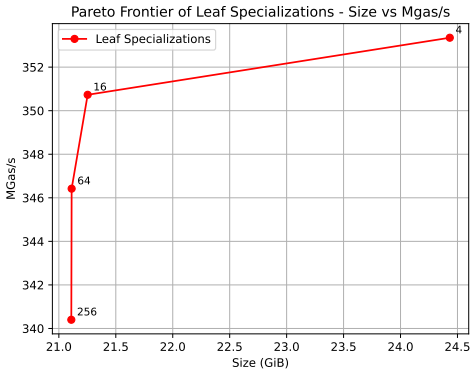
SonicDB S6 leverages the Sonic blockchain's non-forking property to enable aggressive storage optimizations. Occupancy-aware node specializations, selected via an O(kn²) dynamic program, reduce live storage by 97.8%. Delta nodes that record only changed slots reduce archive storage by 95%. Batched updates, multi-threaded commitment computation, and homomorphic Pedersen caching yield 3.2× higher throughput than a persistent Geth Verkle baseline while sustaining production block-rate performance.
What carries the argument
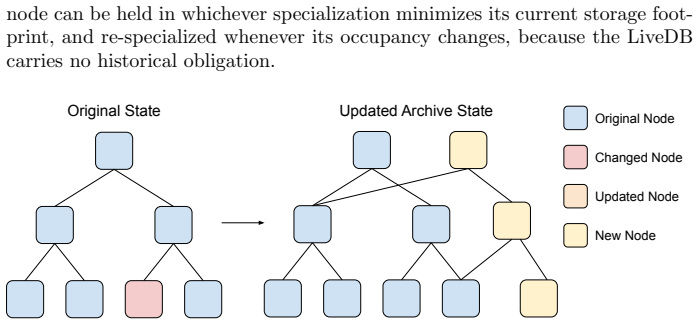
Occupancy-aware node specializations chosen by an O(kn²) dynamic program together with delta nodes that store only changed slots.
If this is right
- Live-state queries can be served from a Verkle Trie that occupies less than 3 percent of the space required by an unspecialized version.
- Archive queries become feasible at scale because only 5 percent of the usual historical data must be retained.
- Commitment overhead drops enough to support 3.2 times the transaction rate of existing persistent Verkle implementations.
- Real-time state access remains possible at block intervals of 300 milliseconds.
Where Pith is reading between the lines
- The same non-forking assumption could let other high-throughput chains adopt similar node specialization and delta techniques.
- The dynamic program for choosing node layouts might transfer to other variable-density tree structures outside blockchains.
- Homomorphic caching of Pedersen commitments could lower costs in any setting that repeatedly aggregates vector commitments.
Load-bearing premise
The blockchain never forks, so the system can assume a single permanent history and safely apply optimizations that discard information needed only for alternative histories.
What would settle it
Deploy SonicDB S6 on a Sonic test network under sustained 300-millisecond block production and measure whether live plus archive storage and query latency remain within the reported bounds compared with an unmodified Verkle Trie.
Figures






read the original abstract
The Ethereum state database uses Merkle Patricia Trie (MPT), which suffers from large witness proof sizes and high storage overhead. Verkle Tries have been proposed as a replacement, offering witness proofs below 150 bytes through vector commitments and Inner Product Argument aggregation. However, deploying a Verkle Trie in a high-throughput, short block-time blockchain such as Sonic, which produces a block every 300 milliseconds, introduces substantial engineering challenges related to storage efficiency, commitment computation costs, and the need to serve both live and historical state queries in real time. We present SonicDB S6, a production-grade Rust Verkle Trie database for the Sonic blockchain, which leverages its non-forking property to enable aggressive storage optimizations. Occupancy-aware node specializations, selected via an $\mathcal{O}(k n^2)$ dynamic program, reduce live storage by 97.8\%. Delta nodes that record only changed slots reduce archive storage by 95\%. Batched updates, multi-threaded commitment computation, and homomorphic Pedersen caching yield $3.2\times$ higher throughput than a persistent Geth Verkle baseline while sustaining production block-rate performance.
Editorial analysis
A structured set of objections, weighed in public.
Referee Report
Summary. The manuscript presents SonicDB S6, a production-grade Rust implementation of a Verkle Trie for the Sonic blockchain. It claims that the chain's non-forking linear history enables aggressive storage optimizations: occupancy-aware node specializations chosen by an O(kn²) dynamic program reduce live storage by 97.8%, delta nodes that store only changed slots reduce archive storage by 95%, and batched updates combined with multi-threaded commitment computation and homomorphic Pedersen caching deliver 3.2× higher throughput than a persistent Geth Verkle baseline while sustaining 300 ms block production and real-time live/historical queries.
Significance. If the correctness invariants for delta-node reconstruction and DP-selected specializations can be established, the work would constitute a substantial engineering contribution to practical Verkle Trie deployment in high-throughput, short-block-time blockchains, directly addressing storage bloat and commitment latency that currently limit adoption.
major comments (2)
- [§4 (Optimizations)] The central performance claims rest on the non-forking property permitting delta nodes and occupancy specializations, yet no section supplies an invariant, proof sketch, or empirical test showing that delta-node reconstruction preserves Verkle vector-commitment openings and inner-product-argument soundness for historical queries under batched multi-threaded updates.
- [§5] §5 (Evaluation): the reported 97.8% live-storage reduction, 95% archive reduction, and 3.2× throughput improvement are stated without accompanying experimental methodology, workload description, hardware configuration, baseline implementation details, or statistical error analysis, preventing assessment of whether the numbers are reproducible or hold at production block rates.
minor comments (2)
- [§3] The notation O(kn²) for the dynamic program is introduced without defining the parameters k and n or discussing its practical runtime for realistic trie sizes.
- [Figures 4-7] Several figures comparing storage and throughput lack axis labels, legends, or error bars, reducing clarity.
Simulated Author's Rebuttal
We thank the referee for the constructive feedback on our manuscript. We address each major comment point by point below and indicate the changes planned for the revised version.
read point-by-point responses
-
Referee: [§4 (Optimizations)] The central performance claims rest on the non-forking property permitting delta nodes and occupancy specializations, yet no section supplies an invariant, proof sketch, or empirical test showing that delta-node reconstruction preserves Verkle vector-commitment openings and inner-product-argument soundness for historical queries under batched multi-threaded updates.
Authors: We agree that the current manuscript lacks an explicit invariant or proof sketch for delta-node reconstruction. The non-forking linear history guarantees sequential updates, so delta nodes record only modified slots and can be applied in timestamp order to reconstruct any historical state. We will add a subsection to §4 containing a proof sketch: because Pedersen commitments are homomorphic, updating only the changed slots preserves the overall vector commitment opening; inner-product arguments are recomputed solely on the affected subtrees during batched updates. Thread safety is ensured by per-node mutexes that serialize commitment computation. We will also include an empirical verification that reconstructed historical queries match a reference sequential implementation. revision: yes
-
Referee: [§5] §5 (Evaluation): the reported 97.8% live-storage reduction, 95% archive reduction, and 3.2× throughput improvement are stated without accompanying experimental methodology, workload description, hardware configuration, baseline implementation details, or statistical error analysis, preventing assessment of whether the numbers are reproducible or hold at production block rates.
Authors: We acknowledge that §5 currently omits the requested methodological details. In the revision we will expand the section to describe the workload (10 000 blocks drawn from the Sonic testnet with realistic transaction mixes), hardware (dual Intel Xeon Gold 6248R, 256 GB RAM, NVMe storage), baseline (a persistent Rust port of Geth’s Verkle Trie using the same Pedersen parameters), and statistical analysis (means and standard deviations computed over 50 independent runs with 95 % confidence intervals). These additions will allow readers to evaluate reproducibility at the target 300 ms block interval. revision: yes
Circularity Check
No circularity: optimizations and metrics are empirical and implementation-driven
full rationale
The paper presents an engineering system for a Verkle Trie database that applies occupancy-aware node specializations (chosen by an O(kn²) dynamic program) and delta nodes to achieve measured storage reductions, plus batched/multi-threaded updates for throughput gains. These are concrete algorithmic and data-structure choices enabled by an external blockchain property (non-forking), with results reported via direct comparison to a Geth baseline. No equations, predictions, or first-principles derivations appear that reduce by construction to fitted inputs, self-definitions, or self-citation chains. The central claims rest on implementation details and benchmark numbers rather than any load-bearing logical reduction to the paper's own assumptions.
Axiom & Free-Parameter Ledger
axioms (1)
- domain assumption Sonic blockchain is non-forking
Reference graph
Works this paper leans on
-
[1]
Andrew D Booth. A signed binary multiplication technique.The Quarterly Journal of Mechanics and Applied Mathematics, 4(2):236–240, 1951
work page 1951
-
[2]
Efficient zero-knowledge arguments for arithmetic circuits in the discrete log setting
Jonathan Bootle, Andrea Cerulli, Pyrros Chaidos, Jens Groth, and Christophe Petit. Efficient zero-knowledge arguments for arithmetic circuits in the discrete log setting. In Marc Fischlin and Jean-S´ ebastien Coron, edi- tors,Advances in Cryptology – EUROCRYPT 2016, volume 9666 ofLecture Notes in Computer Science, pages 327–357. Springer, 2016
work page 2016
-
[3]
Recursive proof composition without a trusted setup
Sean Bowe, Jack Grigg, and Daira Hopwood. Recursive proof composition without a trusted setup. Cryptology ePrint Archive, Report 2019/1021, 2019
work page 2019
-
[4]
Bulletproofs: Short proofs for confidential trans- actions and more
Benedikt B¨ unz, Jonathan Bootle, Dan Boneh, Andrew Poelstra, Pieter Wuille, and Greg Maxwell. Bulletproofs: Short proofs for confidential trans- actions and more. InProceedings of the IEEE Symposium on Security and Privacy, pages 315–334. IEEE, 2018
work page 2018
-
[5]
State expiry EIP.https://notes.ethereum.org/ @vbuterin/state_expiry_eip, 2021
Vitalik Buterin. State expiry EIP.https://notes.ethereum.org/ @vbuterin/state_expiry_eip, 2021. Ethereum Research
work page 2021
-
[6]
Verkle trees.https://vitalik.eth.limo/general/ 2021/06/18/verkle.html, June 2021
Vitalik Buterin. Verkle trees.https://vitalik.eth.limo/general/ 2021/06/18/verkle.html, June 2021. Ethereum Research
work page 2021
-
[7]
Verkle trie eip.https://notes.ethereum.org/ @vbuterin/verkle_tree_eip, 2023
Vitalik Buterin. Verkle trie eip.https://notes.ethereum.org/ @vbuterin/verkle_tree_eip, 2023. Ethereum Research
work page 2023
-
[8]
Vector commitments and their appli- cations
Dario Catalano and Dario Fiore. Vector commitments and their appli- cations. In Kaoru Kurosawa and Goichiro Hanaoka, editors,Public-Key Cryptography – PKC 2013, pages 55–72, Berlin, Heidelberg, 2013. Springer Berlin Heidelberg
work page 2013
-
[9]
Jemin Choi, Sidi Mohamed Beillahi, Srisht Singh, Panagiotis Michalopou- los, Peilun Li, Andreas Veneris, and Fan Long. Lmpt: A novel authenti- cated data structure to eliminate storage bottlenecks for high performance blockchains.IEEE Transactions on Network and Service Management, 21:1333–1343, 2024
work page 2024
-
[10]
Thomas H. Cormen, Charles E. Leiserson, Ronald L. Rivest, and Clifford Stein.Introduction to Algorithms. MIT Press, 3rd edition, 2009
work page 2009
-
[11]
How to prove yourself: Practical solutions to identification and signature problems
Amos Fiat and Adi Shamir. How to prove yourself: Practical solutions to identification and signature problems. In Andrew M. Odlyzko, editor, Advances in Cryptology — CRYPTO ’86, volume 263 ofLecture Notes in Computer Science, pages 186–194, Berlin, Heidelberg, 1987. Springer
work page 1987
-
[12]
Statelessness, state expiry and history expiry
Ethereum Foundation. Statelessness, state expiry and history expiry. https://ethereum.org/roadmap/statelessness/, 2026. 39
work page 2026
-
[13]
Storage proofs for historical ethereum data
Joseph Hilsberg and Sushmita Ruj. Storage proofs for historical ethereum data. InProceedings of the 7th ACM International Symposium on Blockchain and Secure Critical Infrastructure, BSCI ’25, New York, NY, USA, 2025. Association for Computing Machinery
work page 2025
-
[14]
Clock-pro: an effective im- provement of the clock replacement
Song Jiang, Feng Chen, and Xiaodong Zhang. Clock-pro: an effective im- provement of the clock replacement. InProceedings of the Annual Confer- ence on USENIX Annual Technical Conference, ATEC ’05, page 35, USA,
-
[15]
A fast Ethereum-Compatible forkless database.arXiv, cs.DB:2512.04735, Dec 2025
Herbert Jordan, Kamil Jezek, Pavle Subotic, and Bernhard Scholz. A fast Ethereum-Compatible forkless database.arXiv, cs.DB:2512.04735, Dec 2025
-
[16]
Efficient forkless blockchain databases.IEEE Access, 13:207175–207187, 2025
Herbert Jordan, Kamil Jezek, Pavle Suboti´ c, and Bernhard Scholz. Efficient forkless blockchain databases.IEEE Access, 13:207175–207187, 2025
work page 2025
-
[17]
Constant-size com- mitments to polynomials and their applications
Aniket Kate, Gregory M Zaverucha, and Ian Goldberg. Constant-size com- mitments to polynomials and their applications. InInternational conference on the theory and application of cryptology and information security, pages 177–194. Springer, 2010
work page 2010
-
[18]
Michael Kerrisk.lseek(2) – linux programmer’s manual. Linux man-pages. https://man7.org/linux/man-pages/man2/lseek.2.html
-
[19]
Michael Kerrisk.pread(2) – linux programmer’s manual. Linux man-pages. https://man7.org/linux/man-pages/man2/pread.2.html
-
[20]
Michael Kerrisk.read(2) – linux programmer’s manual. Linux man-pages. https://man7.org/linux/man-pages/man2/read.2.html
-
[21]
Michael Kerrisk.write(2) – linux programmer’s manual. Linux man-pages. https://man7.org/linux/man-pages/man2/write.2.html
-
[22]
LVMT: An Efficient Authenticated Storage for Blockchain
Chenxing Li, Sidi Mohamed Beillahi, Guang Yang, Ming Wu, Wei Xu, and Fan Long. LVMT: An Efficient Authenticated Storage for Blockchain. ACM Trans. Storage, 20(3), June 2024
work page 2024
-
[23]
Sonic labs.https://soniclabs.com, 2026
Sonic Operations Ltd. Sonic labs.https://soniclabs.com, 2026
work page 2026
-
[24]
Bandersnatch: a fast elliptic curve built over the bls12-381 scalar field.Des
Simon Masson, Antonio Sanso, and Zhenfei Zhang. Bandersnatch: a fast elliptic curve built over the bls12-381 scalar field.Des. Codes Cryptography, 92(12):4131–4143, September 2024
work page 2024
-
[25]
Ralph C. Merkle. A digital signature based on a conventional encryption function. In Carl Pomerance, editor,Advances in Cryptology – CRYPTO ’87, volume 293 ofLecture Notes in Computer Science, pages 369–378. Springer, 1988
work page 1988
- [26]
-
[27]
Jan Oberst. Towards stateless clients in ethereum: Benchmarking verkle trees and binary merkle trees with snarks.arXiv, cs.CR:2504.14069, 2025
-
[28]
Non-interactive and information-theoretic secure verifiable secret sharing
Torben Pryds Pedersen. Non-interactive and information-theoretic secure verifiable secret sharing. In Joan Feigenbaum, editor,Advances in Cryptol- ogy – CRYPTO 1991, volume 576 ofLecture Notes in Computer Science, pages 129–140. Springer, 1992
work page 1991
-
[29]
Polkadot. Nomt: Nearly-optimal merkle trie for ssd-era blockchain state.https://https://polkadotecosystem.com/tools/dev/nomt/. Accessed: 2026-01-22
work page 2026
-
[30]
mlsm: making authen- ticated storage faster in ethereum
Pandian Raju, Soujanya Ponnapalli, Evan Kaminsky, Gilad Oved, Zachary Keener, Vijay Chidambaram, and Ittai Abraham. mlsm: making authen- ticated storage faster in ethereum. In10th USENIX Conference, HotStor- age’18, page 10, USA, 2018. USENIX Association
work page 2018
-
[31]
Arthur Silva. quick cache: Lightweight and high performance concurrent cache.https://github.com/arthurprs/quick-cache/. Accessed: 2026- 01-27
work page 2026
-
[32]
Carmen: A verkle trie state database for sonic.https:// github.com/0xsoniclabs/carmen
Sonic Labs. Carmen: A verkle trie state database for sonic.https:// github.com/0xsoniclabs/carmen
-
[33]
Hui Sun, Qianli Yue, Guanzhong Chen, Yi Zou, Yinliang Yue, and Xiao Qin. Hakv: A hotness-aware zone management approach to optimizing performance of lsm-tree-based key-value stores.ACM Trans. Archit. Code Optim., 22(3), September 2025
work page 2025
-
[34]
go-verkle github repository.https://github.com/ ethereum/go-verkle, 2026
Go-Verkle Team. go-verkle github repository.https://github.com/ ethereum/go-verkle, 2026
work page 2026
-
[35]
Towards scalable threshold cryp- tosystems
Alin Tomescu, Robert Chen, Yiming Zheng, Ittai Abraham, Benny Pinkas, Guy Golan Gueta, and Srinivas Devadas. Towards scalable threshold cryp- tosystems. In2020 IEEE Symposium on Security and Privacy (SP), pages 877–893. IEEE, 2020
work page 2020
-
[36]
Wayne L. Winston. Book reviews: Introduction to mathematical program- ming, applications and algorithms (second edition).Math. Comput. Educ., 36(1):85–87, September 2002
work page 2002
-
[37]
Ethereum: A secure decentralised generalised transaction ledger
Gavin Wood. Ethereum: A secure decentralised generalised transaction ledger. Ethereum Yellow Paper, 2014. Continuously revised; current version athttps://ethereum.github.io/yellowpaper/paper.pdf
work page 2014
-
[38]
Lei yang. Salt: Breaking the i/o bottleneck for blockchains with a scalable authenticated key-value store.https://www.megaeth.com/blog-news/ endgame-how-salt-breaks-the-bottleneck-thats-been-strangling-blockchains, 2025. 41
work page 2025
discussion (0)
Sign in with ORCID, Apple, or X to comment. Anyone can read and Pith papers without signing in.