The host galaxies and merger environments of short and long gamma-ray bursts producing kilonovae
Pith reviewed 2026-05-10 18:40 UTC · model grok-4.3
The pith
Five of nine kilonova-associated GRB hosts show tidal features from recent mergers with no morphological distinction between short and long GRB hosts, and single-Sersic fits can overestimate offsets in complex galaxies.
A machine-rendered reading of the paper's core claim, the machinery that carries it, and where it could break.
Core claim
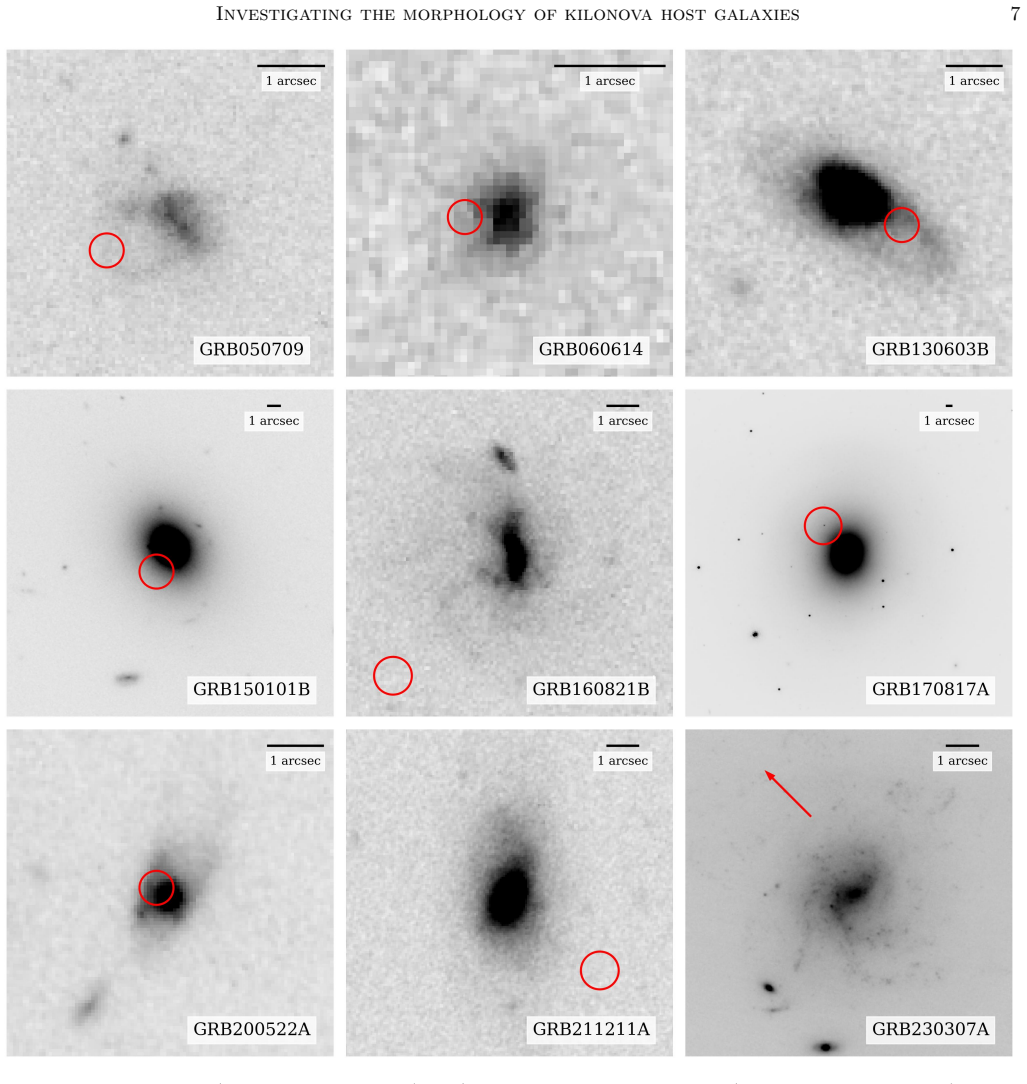
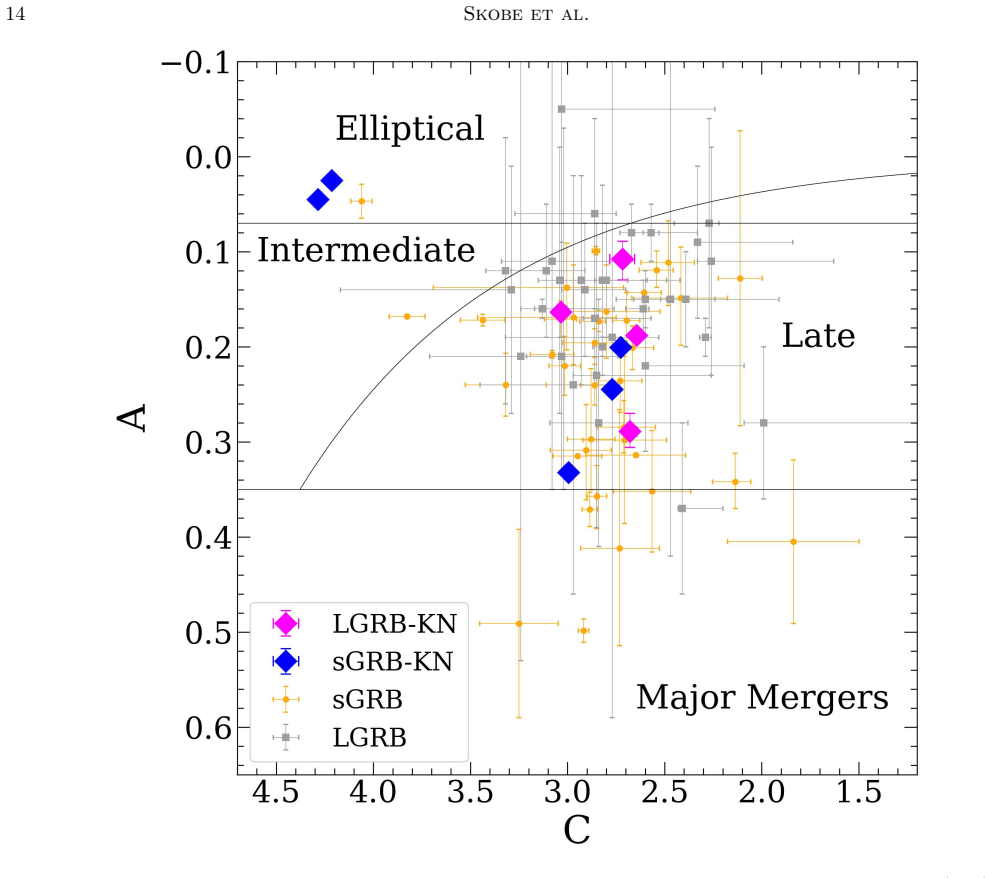
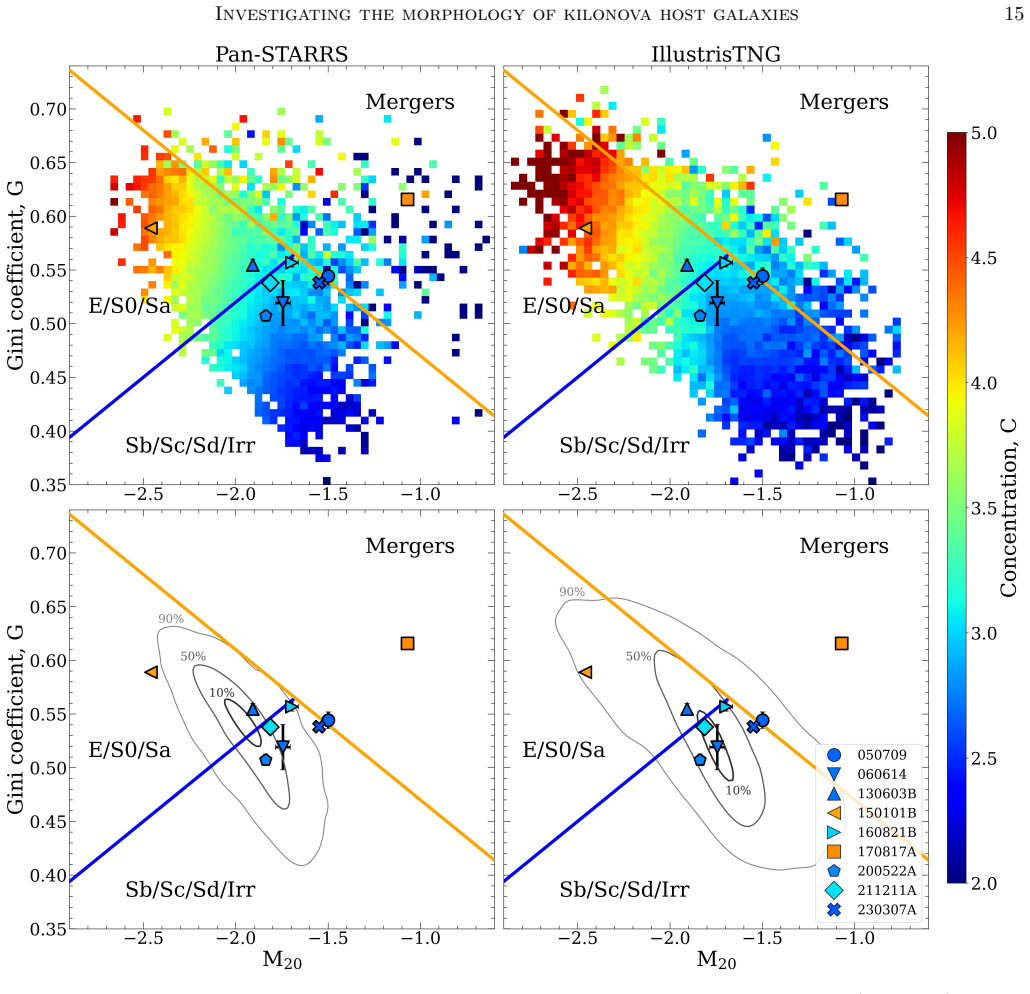
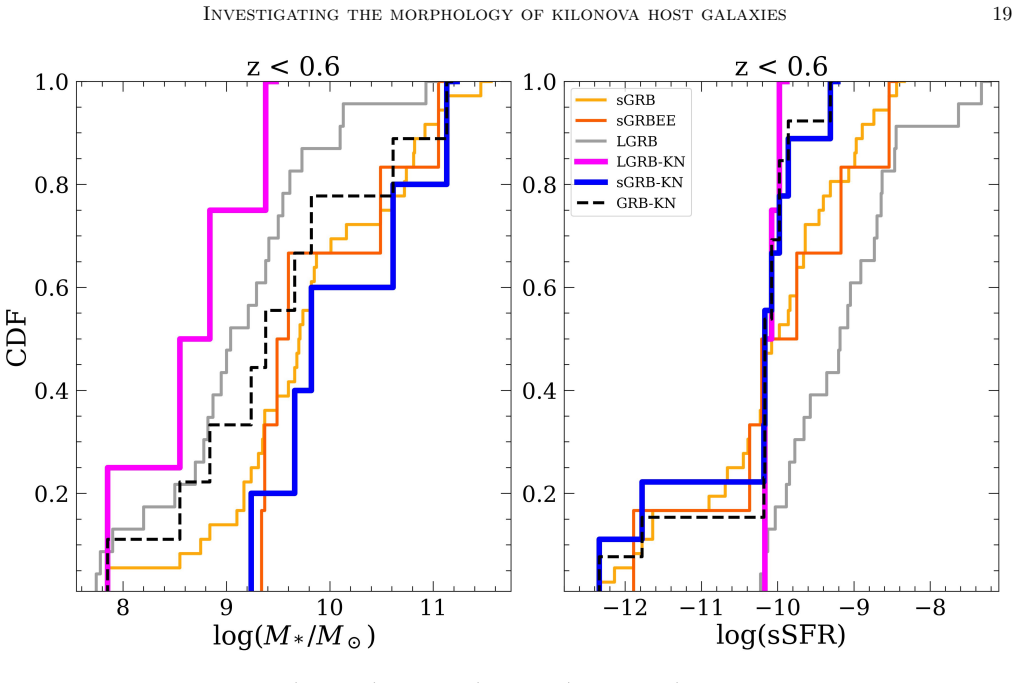
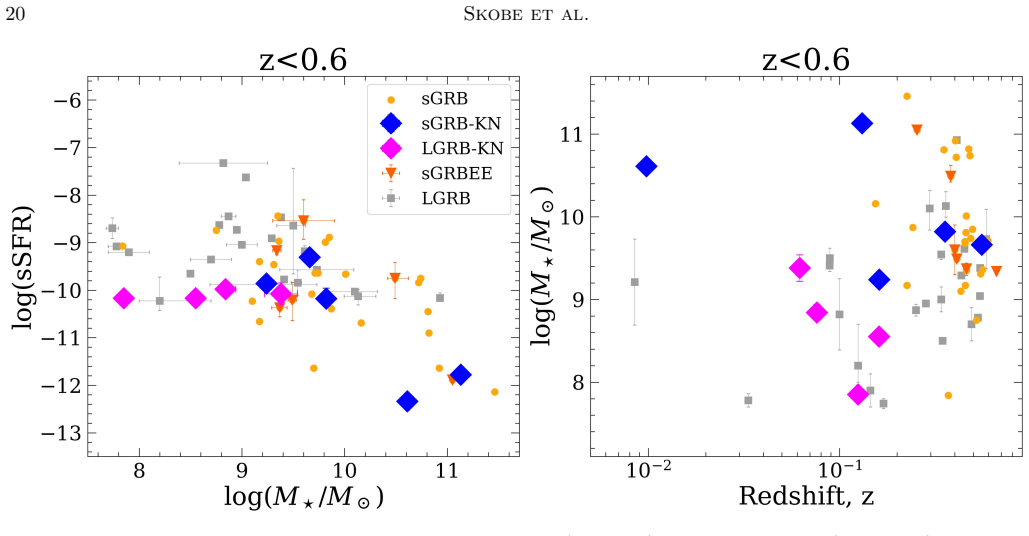
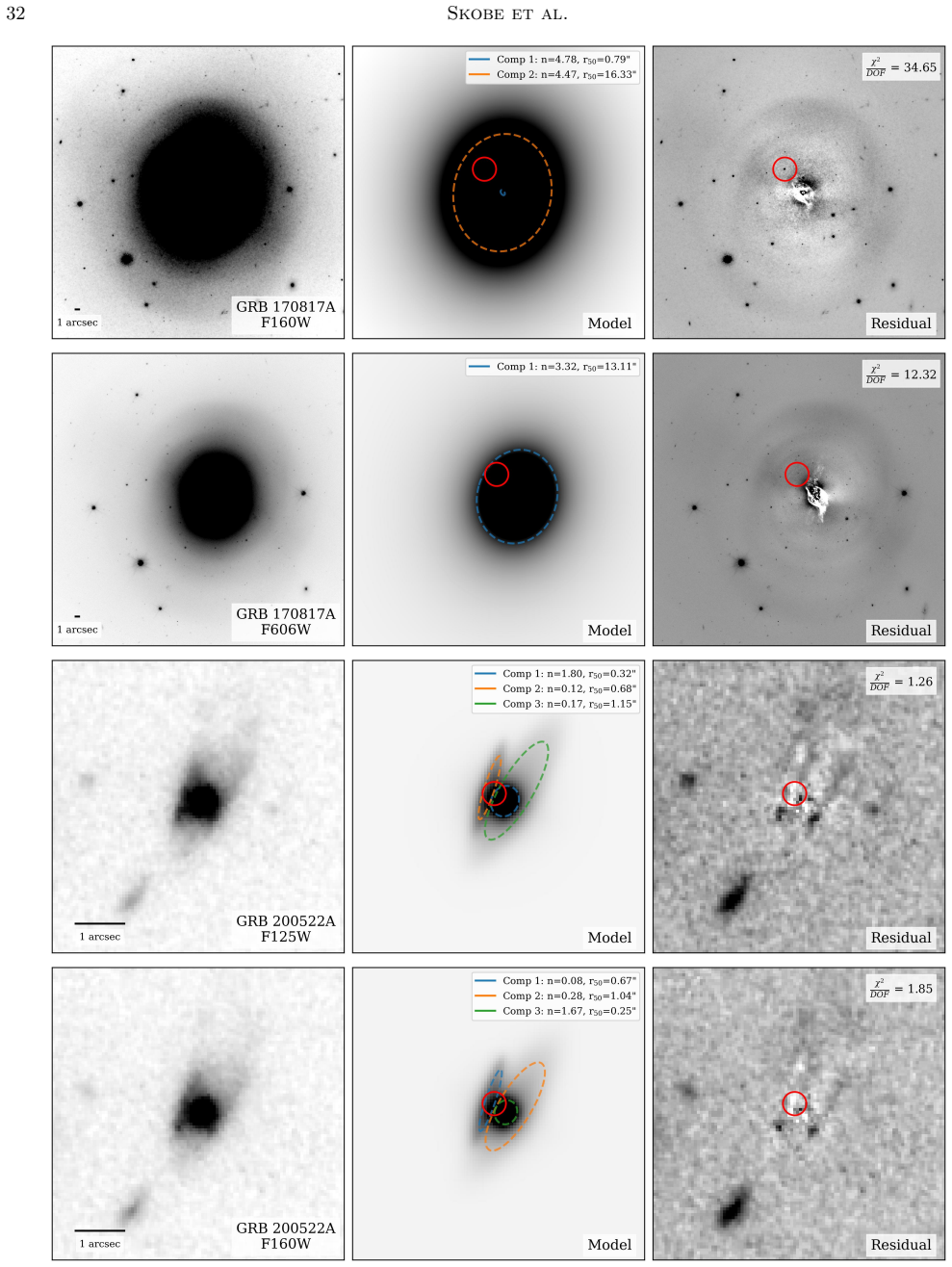
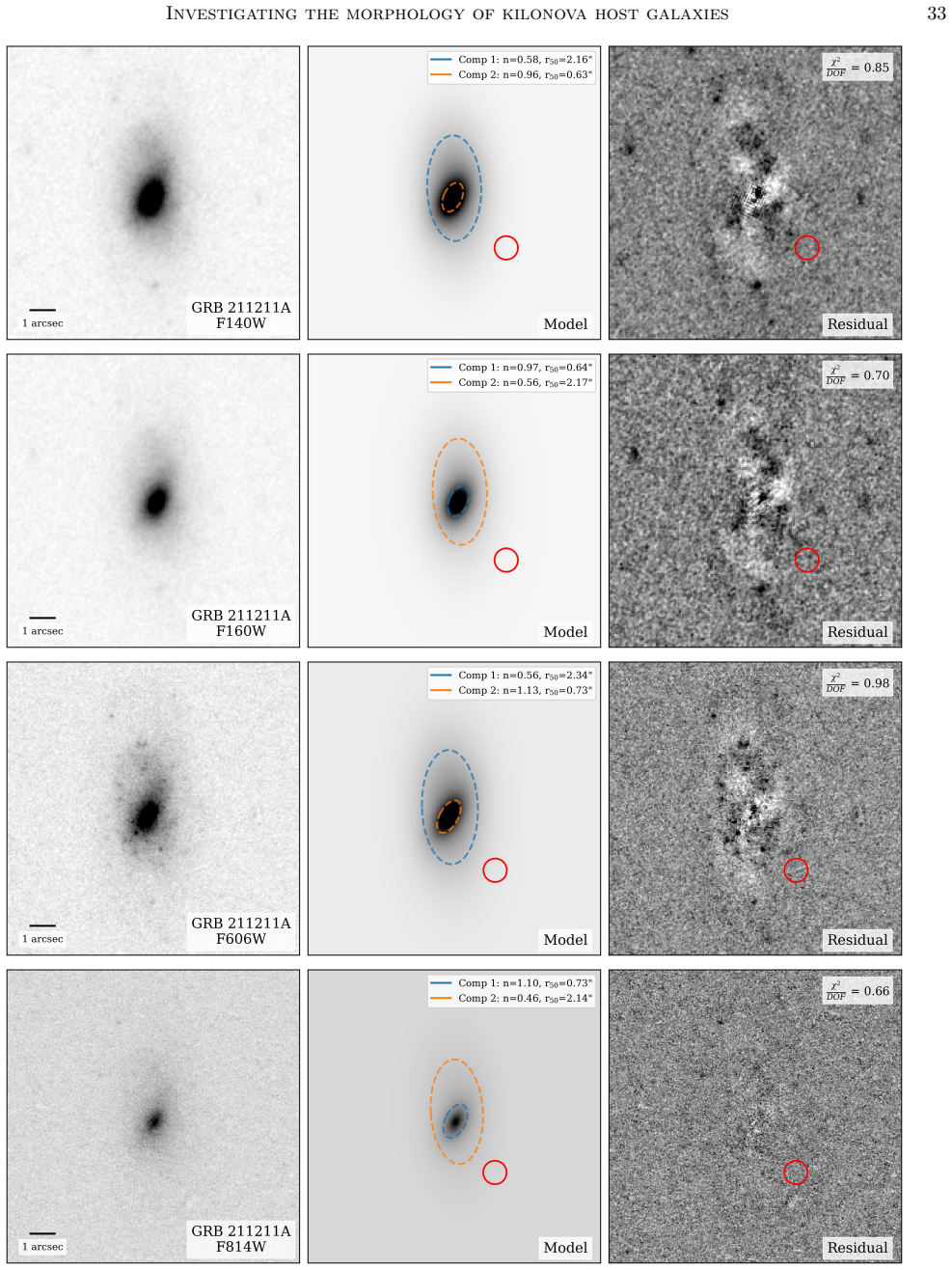
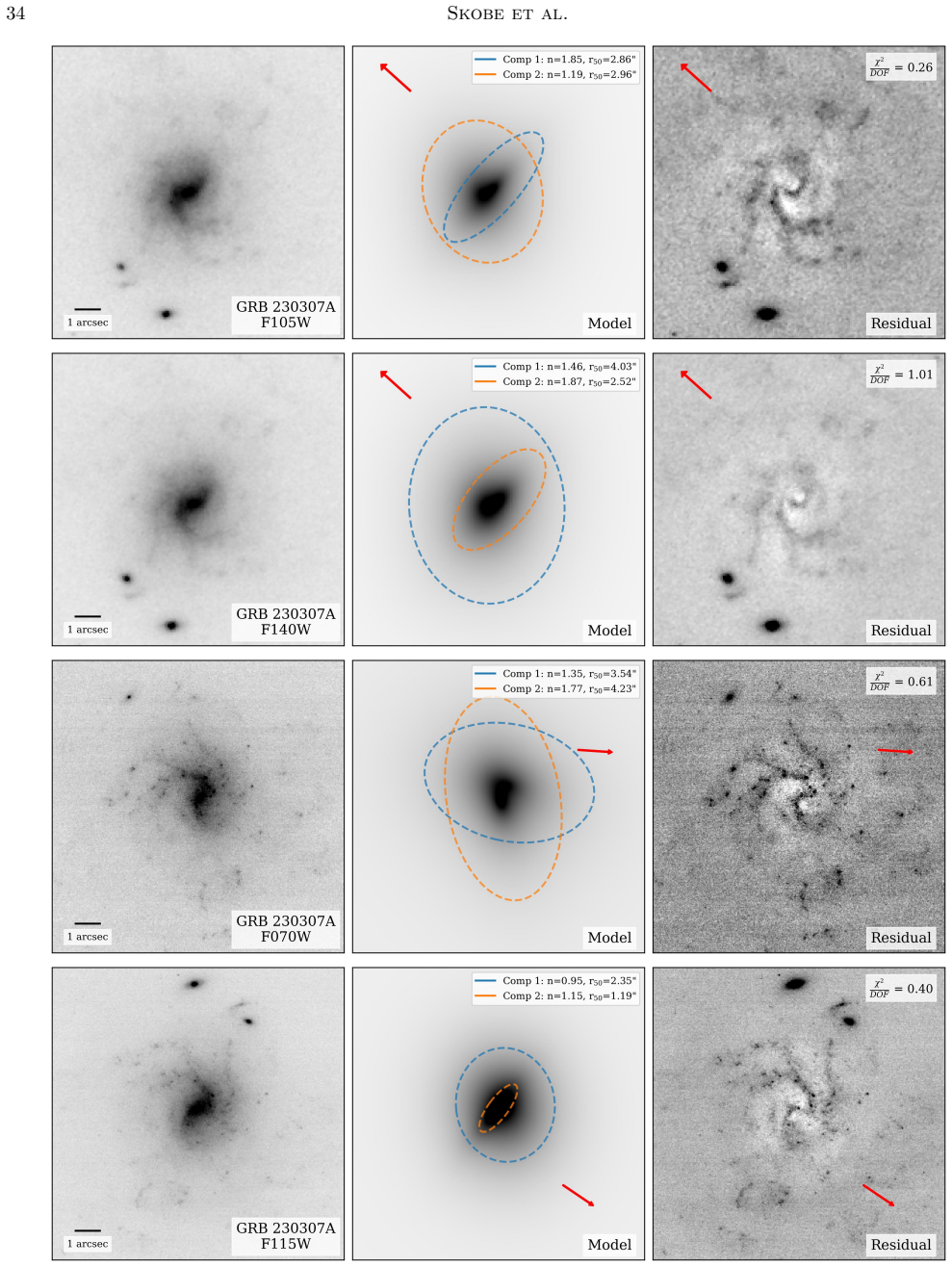
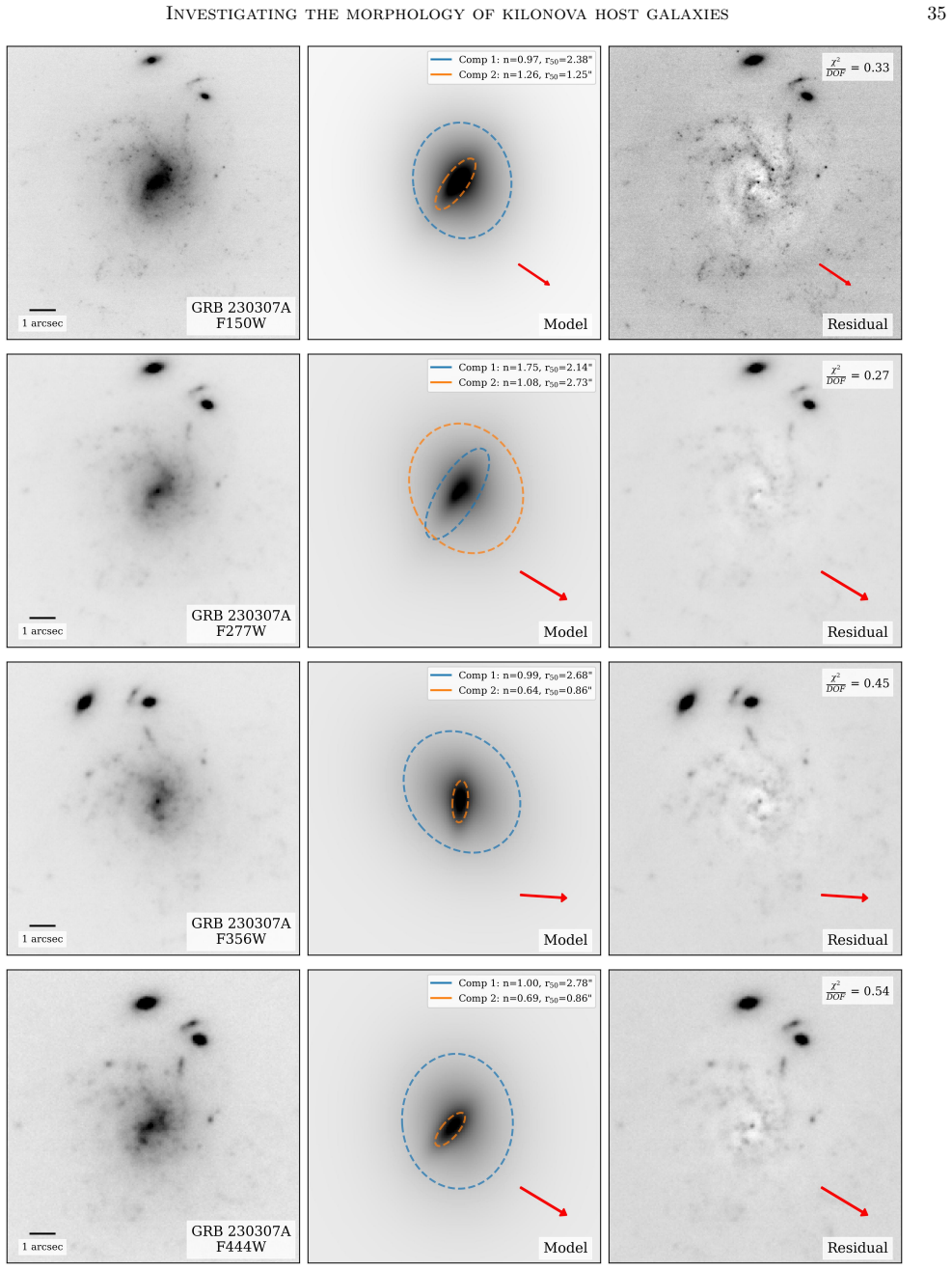
We find that five of the nine hosts display tidal features that show they have likely undergone recent mergers, suggesting that merger-driven, dynamical formation pathways may contribute in some systems. We find no clear morphological distinction between sGRB-KN and LGRB-KN hosts as both populations span a wide range of morphologies, including ellipticals, spirals, and interacting systems with tidal features.
Load-bearing premise
The kilonova candidates are genuine associations with the GRBs (especially the long ones) and that the tidal features directly indicate recent mergers relevant to the neutron star binary formation channels rather than unrelated galaxy evolution.
Figures
read the original abstract
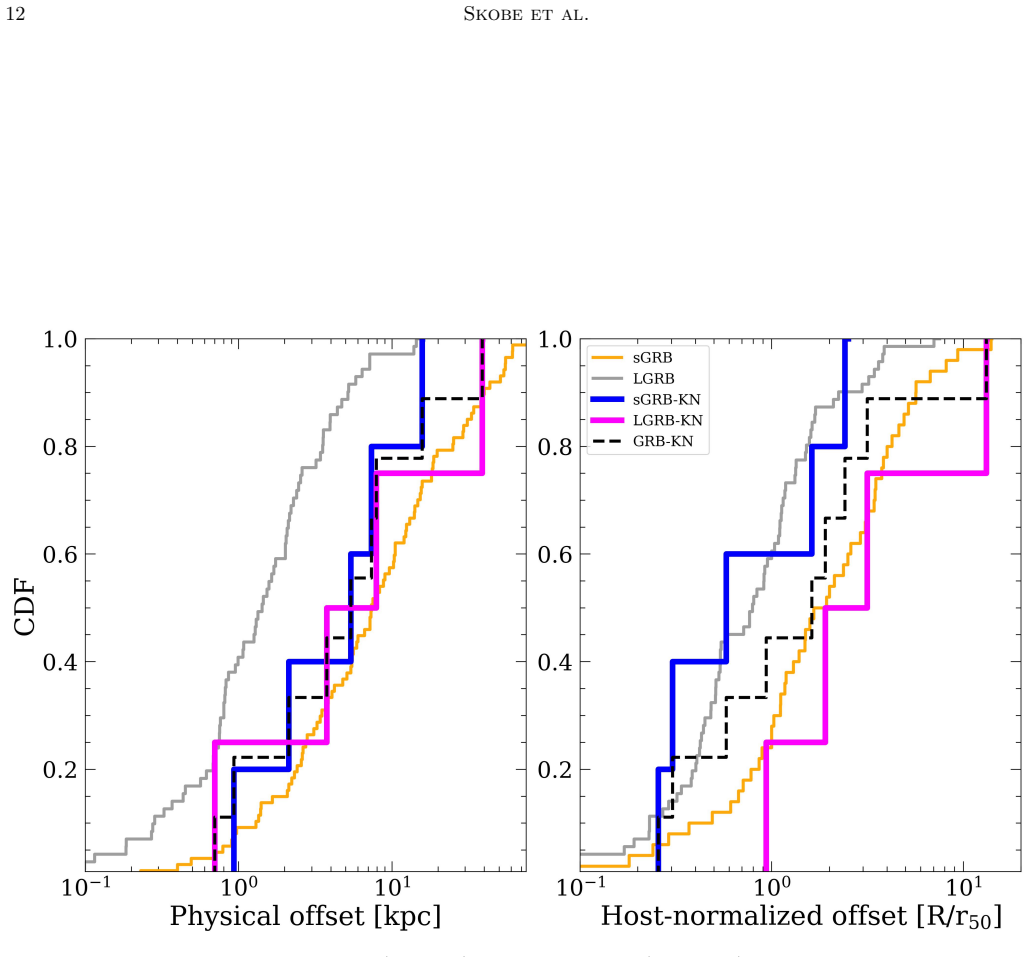
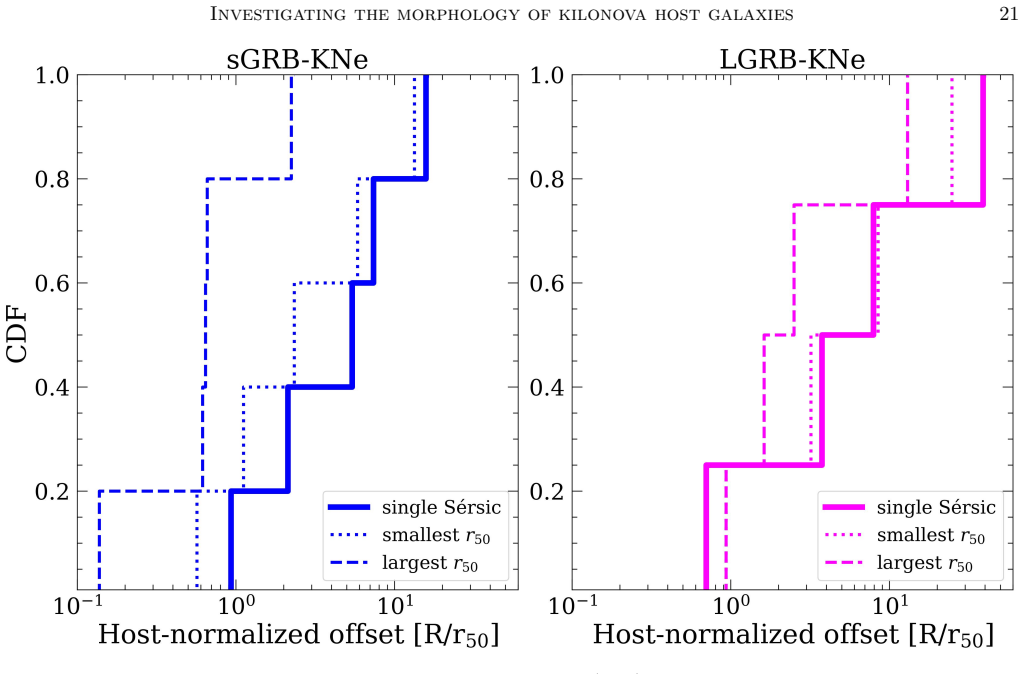
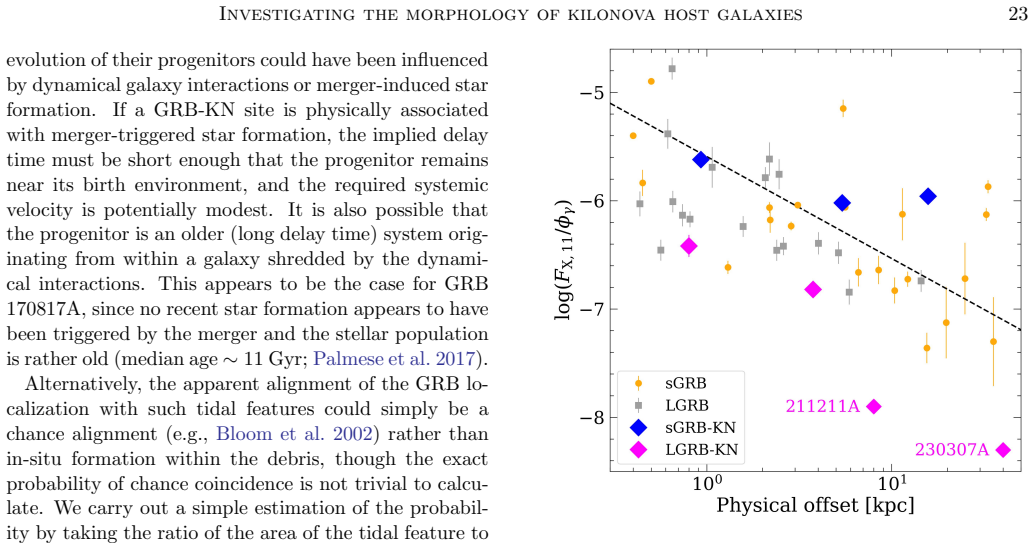
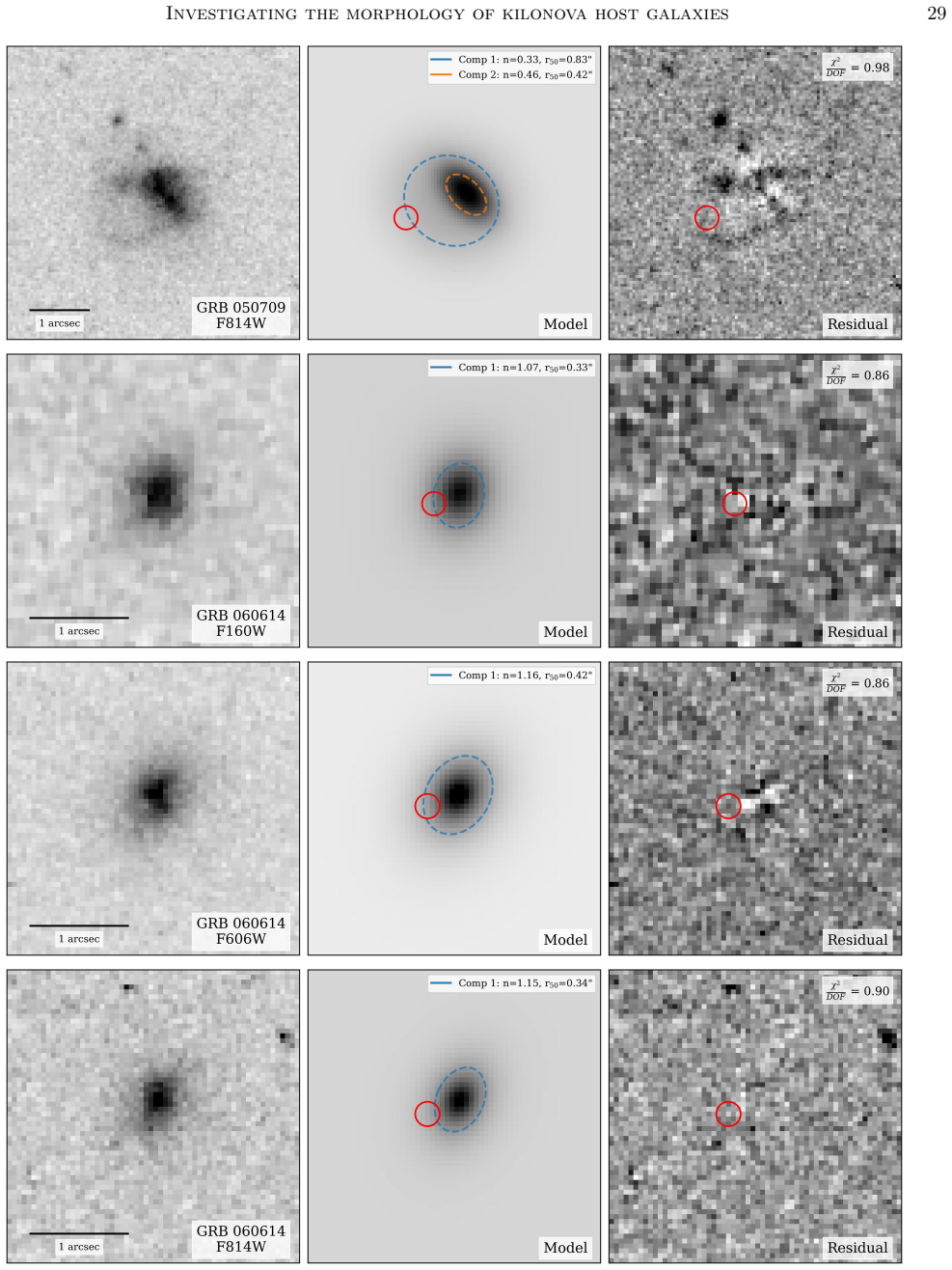
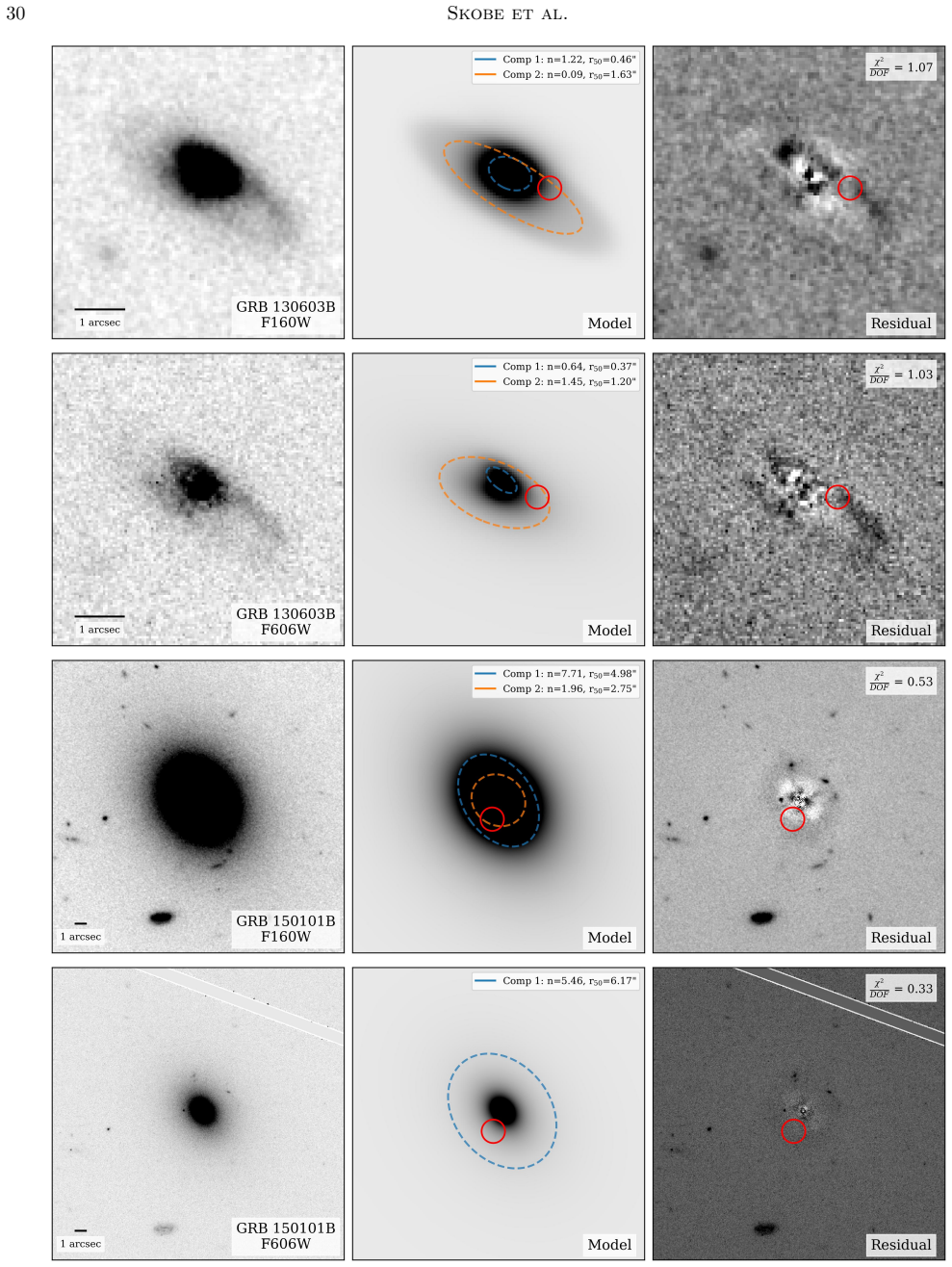
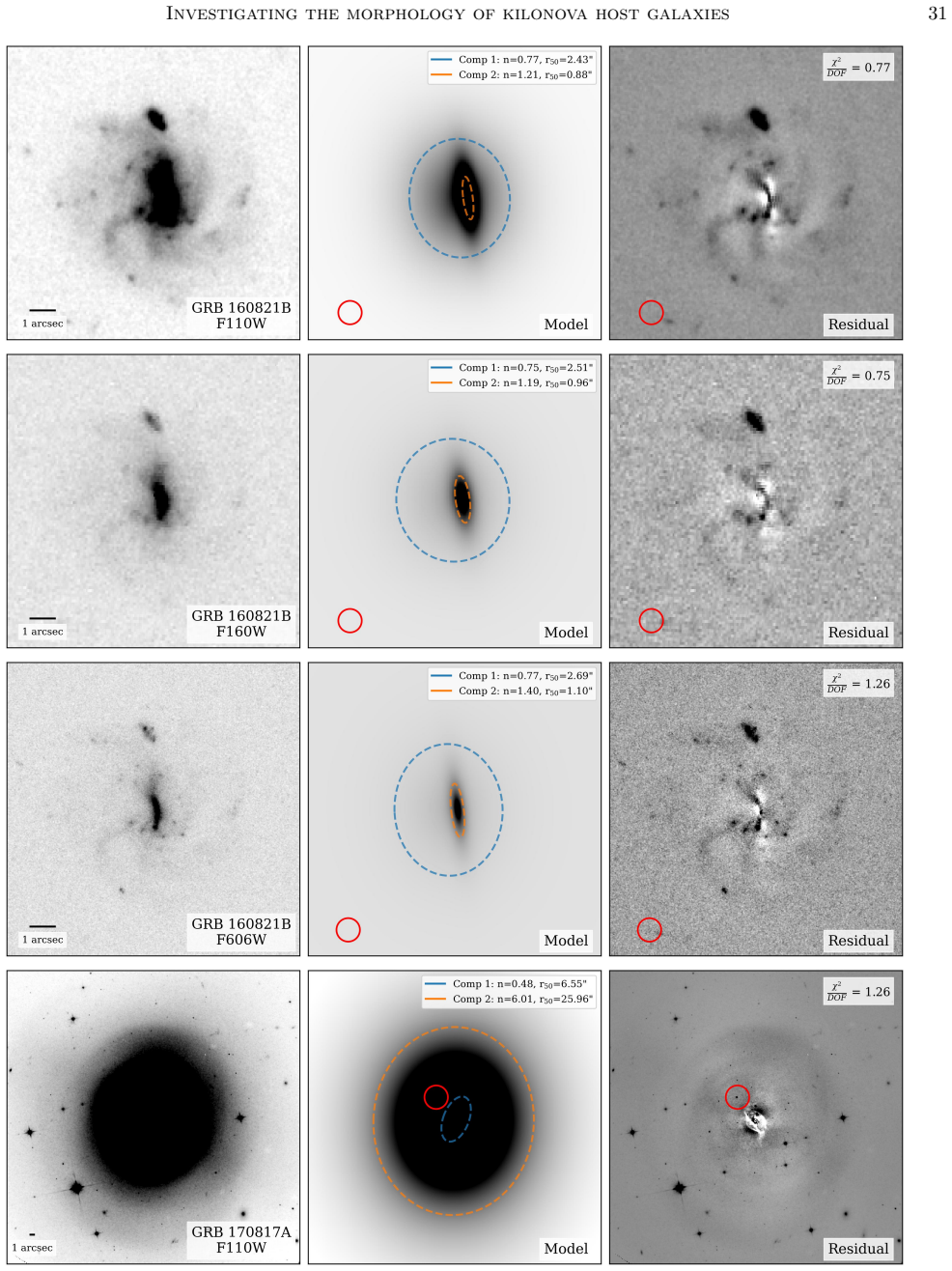
Gamma-ray bursts (GRBs) have traditionally been classified by their prompt emission duration and spectral hardness, with short GRBs (sGRB; $\lesssim2 \ \rm{s}$) originating from compact object mergers and long GRBs (LGRB; $\gtrsim2 \ \rm{s}$) from massive star core-collapse. Recent kilonova (KN) associations with long-duration GRBs have challenged this standard picture. We analyze the host galaxies of nine GRBs with associated kilonova candidates at $z<0.6$, including five sGRB-KNe and four LGRB-KNe. Using both parametric and non-parametric modeling of the host light distributions, we investigate the progenitor environments of these events and test whether their hosts show evidence for recent galaxy interactions that could favor dynamical formation channels or isolated pathways following merger-driven star formation episodes for neutron star binaries. We find that five of the nine hosts display tidal features that show they have likely undergone recent mergers, suggesting that merger-driven, dynamical formation pathways may contribute in some systems. We find no clear morphological distinction between sGRB-KN and LGRB-KN hosts as both populations span a wide range of morphologies, including ellipticals, spirals, and interacting systems with tidal features. Multi-S\'ersic modeling of the host light profiles further shows that host-normalized offsets inferred from single-S\'ersic fits can be overestimated when the transient is associated with a specific subcomponent of a complex host light profile. These results highlight the importance of decomposing host morphology into physically relevant components when interpreting GRB environments and galactocentric offsets.
Editorial analysis
A structured set of objections, weighed in public.
Referee Report
Summary. The paper analyzes the host galaxies of nine GRBs at z<0.6 with kilonova candidates (five short-duration and four long-duration) using both parametric multi-Sersic and non-parametric modeling of the light profiles. It reports that five of the nine hosts exhibit tidal features indicative of recent mergers, finds no clear morphological distinction between the sGRB-KN and LGRB-KN hosts (both spanning ellipticals, spirals, and interacting systems), and shows that single-Sersic fits can overestimate host-normalized offsets when the transient is tied to a subcomponent of a complex host.
Significance. If the kilonova associations hold, the results provide direct observational support for merger-driven dynamical formation channels contributing to some neutron-star binary systems and caution against overinterpreting offsets in morphologically complex hosts. The work supplies concrete, model-based measurements on a small sample with no circular derivations, highlighting the value of decomposing host light profiles into physically motivated components for GRB environment studies.
major comments (2)
- [Introduction and §2] Sample definition (Introduction and §2): The claims of no clear morphological distinction between sGRB-KN and LGRB-KN hosts and the inference that tidal features trace dynamical NS-binary formation pathways rest on the four LGRB-KN candidates being genuine NS-merger events. The manuscript does not re-evaluate or quantify the robustness of these associations (despite the canonical core-collapse link for LGRBs), so even one or two misclassifications would shrink the LGRB-KN subsample and undermine both results.
- [§4] Tidal-feature identification (§4, results on non-parametric modeling): The statement that five hosts 'display tidal features that show they have likely undergone recent mergers' requires explicit criteria for classifying features as merger-induced rather than unrelated asymmetries; without this, the link to dynamical formation channels remains qualitative.
minor comments (3)
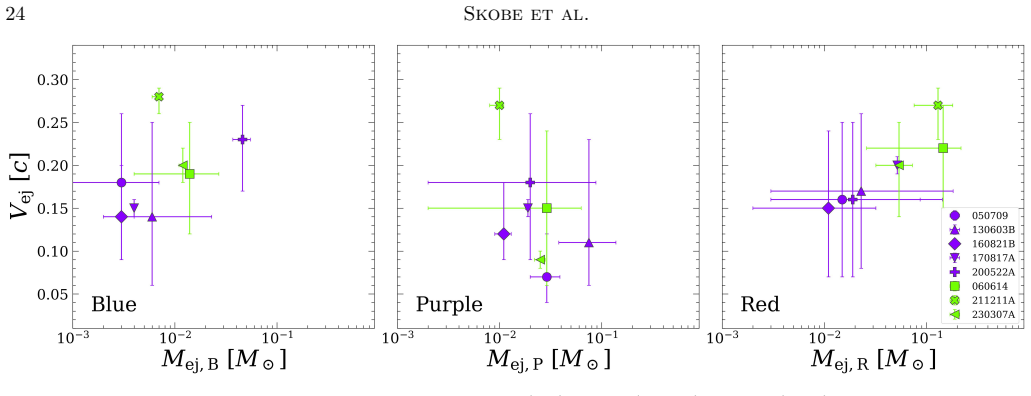
- [Figures] Figure captions (e.g., Fig. 1 and Fig. 3): Add explicit labels distinguishing sGRB-KN from LGRB-KN hosts and clarify which panels show single- versus multi-Sersic residuals.
- [§3.2] §3.2: The range of Sersic indices and effective radii for the multi-component fits should be tabulated for reproducibility.
- [Abstract and §5] Abstract and §5: The phrase 'merger-driven, dynamical formation pathways may contribute in some systems' should be tied more directly to the specific hosts showing tidal features.
Simulated Author's Rebuttal
We thank the referee for their constructive comments, which have helped us improve the clarity and rigor of the manuscript. We address each major comment below and have revised the paper where appropriate.
read point-by-point responses
-
Referee: [Introduction and §2] Sample definition (Introduction and §2): The claims of no clear morphological distinction between sGRB-KN and LGRB-KN hosts and the inference that tidal features trace dynamical NS-binary formation pathways rest on the four LGRB-KN candidates being genuine NS-merger events. The manuscript does not re-evaluate or quantify the robustness of these associations (despite the canonical core-collapse link for LGRBs), so even one or two misclassifications would shrink the LGRB-KN subsample and undermine both results.
Authors: We agree that the strength of our conclusions on morphological similarities and merger signatures depends on the reliability of the kilonova associations. Our study is a host-galaxy analysis that takes the associations as reported in the literature; we do not re-analyze the prompt emission, afterglow, or light-curve properties of the transients themselves. In the revised manuscript we have added a dedicated paragraph in the Introduction that summarizes existing assessments of association probabilities from the literature, explicitly notes the small sample size, and states that even one misclassification would affect the LGRB-KN subsample. This provides necessary context without expanding the scope beyond host morphology. revision: partial
-
Referee: [§4] Tidal-feature identification (§4, results on non-parametric modeling): The statement that five hosts 'display tidal features that show they have likely undergone recent mergers' requires explicit criteria for classifying features as merger-induced rather than unrelated asymmetries; without this, the link to dynamical formation channels remains qualitative.
Authors: We accept this criticism. The original text was insufficiently precise. In the revised §4 we now provide explicit classification criteria: visual identification of asymmetric low-surface-brightness extensions, tidal tails, shells, or bridges to companions, supported by quantitative non-parametric residuals exceeding 3σ above the smooth model and cross-checked against hydrodynamic merger simulations. We have also tempered the language to state that these features are consistent with recent mergers rather than definitively proving dynamical formation channels. revision: yes
- Re-evaluation or quantitative robustness assessment of the kilonova associations for the long GRB candidates, as this would require new analysis of the transient data outside the scope of the present host-galaxy study.
Circularity Check
No significant circularity in observational host-galaxy analysis
full rationale
The paper reports direct measurements of host morphologies for nine GRB events selected by prior kilonova associations. It applies standard parametric (Sérsic) and non-parametric modeling to imaging data, identifies tidal features by visual and quantitative inspection, and compares morphological distributions between sGRB-KN and LGRB-KN subsamples. No equations, fitted parameters, or uniqueness theorems are introduced whose outputs are then relabeled as independent predictions. No self-citation chain supplies a load-bearing premise that is itself unverified within the present work. The central results (prevalence of tidal features, lack of morphological distinction, offset bias from single-component fits) are empirical outcomes of the applied methods rather than tautological restatements of the input sample definition. The robustness of the KN associations themselves is an external assumption, not a circular step internal to the derivation.
Axiom & Free-Parameter Ledger
free parameters (1)
- Number and parameters of Sersic components
axioms (2)
- domain assumption Tidal features reliably indicate recent galaxy mergers
- domain assumption Kilonova candidates are correctly associated with the GRBs
Forward citations
Cited by 1 Pith paper
-
The Lazuli Space Observatory: Opportunities for time-domain and multi-messenger astronomy
Lazuli is proposed as a space observatory combining flagship sensitivity with response times one to two orders of magnitude faster than current large facilities to enable new time-domain and multi-messenger science.
Reference graph
Works this paper leans on
-
[1]
Anderson, J. 2016, Empirical Models for the WFC3/IR PSF, Instrument Science Report WFC3 2016-12, 42 pages Andreoni, I., Ackley, K., Cooke, J., et al. 2017, PASA, 34, e069, doi: 10.1017/pasa.2017.65 Arcavi, I., Hosseinzadeh, G., Howell, D. A., et al. 2017, Nature, 551, 64, doi: 10.1038/nature24291 Astropy Collaboration, Robitaille, T. P., Tollerud, E. J., ...
-
[2]
https://arxiv.org/abs/1808.05287 Bloom, J. S., Kulkarni, S. R., & Djorgovski, S. G. 2002, AJ, 123, 1111, doi: 10.1086/338893 Bloom, J. S., Sigurdsson, S., & Pols, O. R. 1999, MNRAS, 305, 763, doi: 10.1046/j.1365-8711.1999.02437.x Bom, C. R., Rodrigues, D. C., Cortesi, A., et al. 2025, arXiv e-prints, arXiv:2512.09036, doi: 10.48550/arXiv.2512.09036 Bradle...
-
[3]
N., Paschalidis, V., & Shapiro, S
https://arxiv.org/abs/astro-ph/9809280 Ruiz, M., Lang, R. N., Paschalidis, V., & Shapiro, S. L. 2016, ApJL, 824, L6, doi: 10.3847/2041-8205/824/1/L6 Salvaterra, R., Devecchi, B., Colpi, M., & D’Avanzo, P. 2010, MNRAS, 406, 1248, doi: 10.1111/j.1365-2966.2010.16752.x Sari, R., Piran, T., & Narayan, R. 1998, ApJL, 497, L17, doi: 10.1086/311269 Savaglio, S.,...
discussion (0)
Sign in with ORCID, Apple, or X to comment. Anyone can read and Pith papers without signing in.