Model-Agnostic Energy Throughput Control for Range and Lifetime Extension of Electric Vehicles via Cell-Level Inverters
Pith reviewed 2026-05-10 18:02 UTC · model grok-4.3
The pith
Cell-level inverters let EVs route energy to healthier battery cells, extending pack lifetime by 7 to 38 percent in simulations.
A machine-rendered reading of the paper's core claim, the machinery that carries it, and where it could break.
Core claim
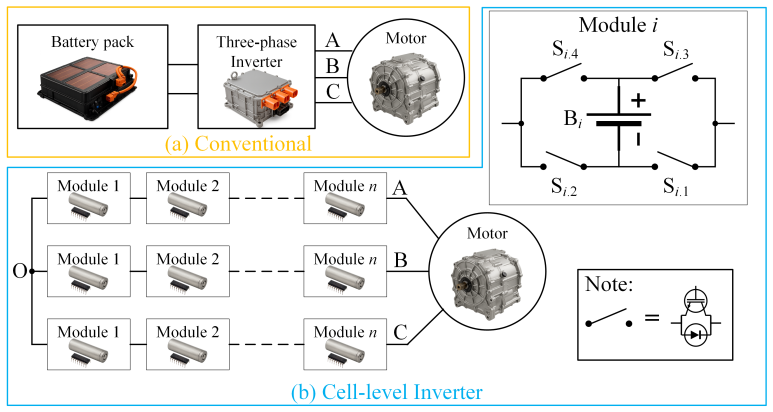
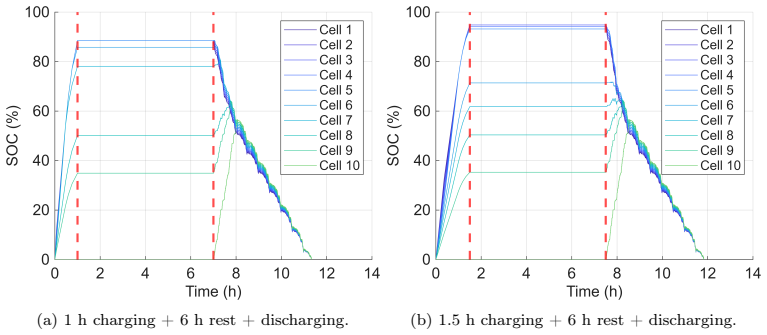
By performing power conversion at the individual cell with an H-bridge inverter topology, the authors enable independent control of each cell's energy throughput. Their model-agnostic controller then routes more energy through healthier cells: it allows state-of-charge divergence during charging to promote state-of-health equalization and rebalances state-of-charge during discharge to maximize usable pack capacity under per-cell limits. When tested on lithium-manganese-oxide and lithium-iron-phosphate aging models with a Tesla Model 3 charge-discharge profile across fourteen parameter settings, the strategy produces a 7-38 percent lifetime gain relative to a conventional state-of-charge-only
What carries the argument
The H-bridge cell-level inverter topology that supplies independent power conversion for each cell, paired with an energy-throughput controller that preferentially directs cycles to higher state-of-health cells.
If this is right
- Battery packs can reach longer total energy throughput without requiring new cell chemistries or hardware redesign beyond the inverter topology.
- The same control logic produces gains on both lithium-manganese-oxide and lithium-iron-phosphate cells and across varied driving profiles.
- Usable driving range remains intact because weaker cells are protected from over-use while stronger cells carry more of the load.
- Routine daily charging sessions become an active means of slowing pack degradation with little extra computation.
Where Pith is reading between the lines
- Pack designers could accept greater variation among individual cells at purchase, potentially lowering manufacturing cost.
- The approach could be deployed as a software update on vehicles already equipped with cell-level inverters rather than requiring entirely new hardware.
- Real-time monitoring of cell health could further refine the routing decisions beyond the open-loop strategy tested here.
Load-bearing premise
Cell-level H-bridge inverters can be manufactured at scale with acceptable efficiency, cost, and heat management, and the two aging models used accurately predict real battery degradation under the tested conditions.
What would settle it
A multi-year test on physical battery packs equipped with cell-level inverters that applies the proposed controller and measures whether actual lifetime extension falls outside the simulated 7-38 percent range compared with standard balancing.
Figures



read the original abstract
A conventional electric vehicle (EV) powertrain relies on a centralized high-voltage DC-AC inverter, thereby limiting cell-level control and potentially reducing overall driving range and battery lifetime. This paper studies an H-bridge-based cell-level inverter topology that performs power conversion at the cell level, enabling independent control of individual cells and expanding the design space for battery management. Leveraging these additional degrees of freedom, we propose a model-agnostic energy-throughput control strategy that extends EV range while improving battery-pack lifetime. Because usable energy (and thus driving range) and lifetime are governed by the cells with the lowest state-of-charge (SOC) and state-of-health (SOH), respectively, the proposed controller preferentially routes energy throughput to healthier cells. Specifically, during charging, it permits cell SOCs to diverge to promote SOH equalization; during discharging, it rebalances SOC to maximize usable capacity under per-cell constraints. The proposed SOC-SOH-aware control strategy is evaluated on two aging models representing lithium manganese oxide and lithium iron phosphate chemistries, using a Tesla Model 3 charge-discharge profile across 14 different parameter settings. Simulations show a 7-38% improvement in lifetime relative to a conventional SOC-only balancing baseline. More broadly, the results suggest a software-defined pathway to extend EV pack life through routine charging, with minimal reliance on specific degradation models or discharge profiles.
Editorial analysis
A structured set of objections, weighed in public.
Referee Report
Summary. The paper proposes an H-bridge-based cell-level inverter topology for EVs enabling independent per-cell power conversion and control. It introduces a model-agnostic SOC-SOH energy-throughput strategy that permits SOC divergence during charging to equalize SOH across cells and rebalances SOC during discharge to maximize usable capacity under per-cell limits. Simulations on empirical LMO and LFP aging models driven by a Tesla Model 3 charge-discharge profile across 14 parameter settings report 7-38% lifetime gains relative to a conventional SOC-only balancing baseline.
Significance. If the reported lifetime gains prove robust, the work demonstrates a software-defined control pathway to improve pack utilization and longevity with limited dependence on specific degradation models, which could inform distributed-inverter BMS architectures for EVs.
major comments (3)
- [Evaluation section] Evaluation section: the central 7-38% lifetime improvement is obtained from simulations, yet no error bars, variance across the 14 parameter settings, or sensitivity analysis is reported; this weakens confidence in the quantitative claim and its dependence on the chosen aging models and baseline.
- [Aging models and simulation setup] Aging models and simulation setup: the strategy's benefit relies on the aging models correctly capturing reduced degradation when SOC trajectories are deliberately diverged during charging; the manuscript does not provide evidence that the LMO and LFP models were validated or identified under such SOC-divergent, per-cell current conditions rather than balanced-SOC or constant-current data.
- [Baseline comparison] Baseline comparison: the SOC-only balancing baseline is not described in sufficient detail for the cell-level H-bridge topology (e.g., how per-cell voltage or current limits are enforced in the baseline versus the proposed controller), making it unclear whether the reported gains arise from the SOC-SOH logic or from differences in how the topology is utilized.
minor comments (1)
- [Abstract] The abstract states results across '14 different parameter settings' without enumerating the parameters or their ranges, which would clarify the breadth of the evaluation.
Simulated Author's Rebuttal
We thank the referee for the constructive and detailed review of our manuscript. We have carefully addressed each major comment below and revised the paper where appropriate to improve clarity and robustness.
read point-by-point responses
-
Referee: [Evaluation section] Evaluation section: the central 7-38% lifetime improvement is obtained from simulations, yet no error bars, variance across the 14 parameter settings, or sensitivity analysis is reported; this weakens confidence in the quantitative claim and its dependence on the chosen aging models and baseline.
Authors: We agree that reporting variance and sensitivity would strengthen the quantitative claims. Although the 14 parameter settings were selected to span relevant operating conditions, explicit error bars and sensitivity results were not included in the original submission. In the revised manuscript we have added error bars (mean and standard deviation of lifetime improvement across the 14 settings) and a new sensitivity analysis subsection examining the effects of the SOH-equalization threshold and rebalancing rate on the reported gains. revision: yes
-
Referee: [Aging models and simulation setup] Aging models and simulation setup: the strategy's benefit relies on the aging models correctly capturing reduced degradation when SOC trajectories are deliberately diverged during charging; the manuscript does not provide evidence that the LMO and LFP models were validated or identified under such SOC-divergent, per-cell current conditions rather than balanced-SOC or constant-current data.
Authors: The LMO and LFP models are empirical models taken from the literature and incorporate SOC-dependent degradation terms. Direct validation data under per-cell SOC-divergent charging conditions are not available in the source studies. We have revised the manuscript to state the model origins explicitly, to discuss the extrapolation assumptions, and to note the associated uncertainty as a limitation of the present evaluation. revision: partial
-
Referee: [Baseline comparison] Baseline comparison: the SOC-only balancing baseline is not described in sufficient detail for the cell-level H-bridge topology (e.g., how per-cell voltage or current limits are enforced in the baseline versus the proposed controller), making it unclear whether the reported gains arise from the SOC-SOH logic or from differences in how the topology is utilized.
Authors: We acknowledge that the baseline description lacked sufficient implementation detail. The SOC-only baseline applies conventional balancing at every time step using the same H-bridge topology and identical per-cell voltage/current limits as the proposed controller. In the revised manuscript we have expanded the baseline description, added a comparison table of control actions, and clarified that the performance difference is attributable to the SOC-SOH logic rather than topology utilization. revision: yes
Circularity Check
No circularity: model-agnostic controller evaluated on independent aging models
full rationale
The paper derives a SOC-SOH control policy that permits SOC divergence during charge and rebalancing during discharge, then evaluates it via forward simulation on two separate empirical aging models (LMO and LFP) under a fixed Tesla Model 3 drive cycle. The 7-38 % lifetime delta is obtained by direct comparison against an SOC-only baseline; no equation, fitted parameter, or self-citation reduces this delta to the controller inputs by construction. The aging models are treated as external oracles, and the control law itself is stated without reference to the specific degradation equations. The derivation chain is therefore self-contained against external benchmarks.
Axiom & Free-Parameter Ledger
axioms (1)
- domain assumption Standard LMO and LFP aging models accurately represent cell degradation under the Tesla Model 3 charge-discharge profile
Lean theorems connected to this paper
-
IndisputableMonolith/Cost/FunctionalEquation.leanwashburn_uniqueness_aczel unclear?
unclearRelation between the paper passage and the cited Recognition theorem.
min ∑ w_{i,j} Q_{i,j} with w_{i,j} = (1 + κ I_avg,j) / (SOH_i - SOH_EOL)^2 (Eq. 9-10); Strategy 1 remaining-capacity-gain balancing; Theorem 1 on sorted ΔQ vs duty-cycle fractions
-
IndisputableMonolith/Foundation/AbsoluteFloorClosure.leanreality_from_one_distinction unclear?
unclearRelation between the paper passage and the cited Recognition theorem.
LSPWM level-shifted PWM, cell-level H-bridge inverter, SOC/SOH definitions (Eq. 1-4)
What do these tags mean?
- matches
- The paper's claim is directly supported by a theorem in the formal canon.
- supports
- The theorem supports part of the paper's argument, but the paper may add assumptions or extra steps.
- extends
- The paper goes beyond the formal theorem; the theorem is a base layer rather than the whole result.
- uses
- The paper appears to rely on the theorem as machinery.
- contradicts
- The paper's claim conflicts with a theorem or certificate in the canon.
- unclear
- Pith found a possible connection, but the passage is too broad, indirect, or ambiguous to say the theorem truly supports the claim.
Reference graph
Works this paper leans on
-
[1]
Climate TRACE, Climate TRACE explore: United states (usa) emissions by sector (co2e, 100-year gwp), year 2025,https: //climatetrace.org/explore#admin=United%20States%20(USA): 255:USA:country&gas=co2e&year=2025&timeframe=100§or= &asset=, accessed 2026-02-25 (2026)
work page 2025
-
[2]
K. Wagh, P. Dhatrak, A review on powertrain subsystems and charging technology in battery electric vehicles: Current and future trends, Pro- ceedings of the Institution of Mechanical Engineers, Part D: Journal of Automobile Engineering 236 (4) (2022) 479–496
work page 2022
-
[3]
D.-D. Tran, M. Vafaeipour, M. El Baghdadi, R. Barrero, J. Van Mierlo, O. Hegazy, Thorough state-of-the-art analysis of electric and hybrid ve- hicle powertrains: Topologies and integrated energy management strate- gies, Renewable and Sustainable Energy Reviews 119 (2020) 109596. 32
work page 2020
-
[4]
P. Vishnuram, S. P, V. K, M. Bajaj, T. Khurshaid, A. Nauman, S. Kamel, A comprehensive review on ev power converter topologies charger types infrastructure and communication techniques, Frontiers in Energy Research 11 (2023) 1103093
work page 2023
-
[5]
Z. Du, B. Ozpineci, L. M. Tolbert, J. N. Chiasson, Dc–ac cascaded h- bridge multilevel boost inverter with no inductors for electric/hybrid electric vehicle applications, IEEE Transactions on Industry Applica- tions 45 (3) (2009) 963–970
work page 2009
-
[6]
S. Chowdhury, E. Gurpinar, B. Ozpineci, High-energy density capaci- tors for electric vehicle traction inverters, in: 2020 IEEE Transportation Electrification Conference & Expo (ITEC), IEEE, 2020, pp. 644–650
work page 2020
- [7]
-
[8]
K. Kandasamy, M. Vilathgamuwa, K. J. Tseng, Inter-module state-of- charge balancing and fault-tolerant operation of cascaded h-bridge con- verter using multi-dimensional modulation for electric vehicle applica- tion, IET Power Electronics 8 (10) (2015) 1912–1919
work page 2015
-
[9]
T. Wu, F. Ji, L. Liao, C. Chang, Voltage-soc balancing control scheme for series-connected lithium-ion battery packs, Journal of Energy Stor- age 25 (2019) 100895
work page 2019
- [10]
- [11]
- [12]
- [13]
-
[14]
T. Baumhöfer, M. Brühl, S. Rothgang, D. U. Sauer, Production caused variation in capacity aging trend and correlation to initial cell perfor- mance, Journal of Power Sources 247 (2014) 332–338
work page 2014
-
[15]
S. J. Harris, D. J. Harris, C. Li, Failure statistics for commercial lithium ion batteries: A study of 24 pouch cells, Journal of Power Sources 342 (2017) 589–597
work page 2017
-
[16]
J. Lin, X. Liu, S. Li, C. Zhang, S. Yang, A review on recent progress, challenges and perspective of battery thermal management system, In- ternational Journal of Heat and Mass Transfer 167 (2021) 120834
work page 2021
-
[17]
L. He, Z. Yang, Y. Gu, C. Liu, T. He, K. G. Shin, Soh-aware reconfigu- ration in battery packs, IEEE Transactions on Smart Grid 9 (4) (2016) 3727–3735
work page 2016
-
[18]
M. M. U. Rehman, F. Zhang, M. Evzelman, R. Zane, K. Smith, D. Mak- simovic, Advanced cell-level control for extending electric vehicle battery pack lifetime, in: 2016 IEEE Energy Conversion Congress and Exposi- tion (ECCE), IEEE, 2016, pp. 1–8
work page 2016
- [19]
-
[21]
E. Martinez-Laserna, I. Gandiaga, E. Sarasketa-Zabala, J. Badeda, D.- I. Stroe, M. Swierczynski, A. Goikoetxea, Battery second life: Hype, hope or reality? a critical review of the state of the art, Renewable and Sustainable Energy Reviews 93 (2018) 701–718
work page 2018
- [22]
-
[23]
L. Canals Casals, M. Rodríguez, C. Corchero, R. E. Carrillo, Evaluation of the end-of-life of electric vehicle batteries according to the state-of- health, World Electric Vehicle Journal 10 (4) (2019) 63
work page 2019
-
[24]
M.Etxandi-Santolaya, L.C.Casals, T.Montes, C.Corchero, Areelectric vehicle batteries being underused? a review of current practices and sources of circularity, Journal of environmental management 338 (2023) 117814
work page 2023
-
[25]
Revision 2 (1 1996).doi:10.2172/214312
USABC electric vehicle Battery Test Procedures Manual. Revision 2 (1 1996).doi:10.2172/214312. URLhttps://www.osti.gov/biblio/214312
-
[26]
J. P. Christophersen, Battery Test Manual For Electric Vehicles, Revi- sion 3 (6 2015).doi:10.2172/1186745. URLhttps://www.osti.gov/biblio/1186745
-
[27]
CaliforniaAirResourcesBoard, Section1962.8-WarrantyRequirements for Zero-Emission and Batteries in Plug-in Hybrid Electric 2026 and Subsequent Model Year Passenger Cars and Light-Duty Trucks (3 2024)
work page 2026
- [28]
- [29]
- [30]
-
[31]
California Air Resources Board, Section 1962.5 - Data Standardization Requirements for 2026 and Subsequent Model Year Light-Duty Zero Emission Vehicles and Plug-in Hybrid Electric Vehicles (3 2024)
work page 1962
-
[32]
M. B. Latran, A. Teke, Investigation of multilevel multifunctional grid connected inverter topologies and control strategies used in photovoltaic systems, Renewable and Sustainable Energy Reviews 42 (2015) 361–376. 35
work page 2015
-
[33]
S. Ray, N. Gupta, R. A. Gupta, A comprehensive review on cascaded h-bridge inverter-based large-scale grid-connected photovoltaic, IETE Technical review 34 (5) (2017) 463–477
work page 2017
-
[34]
K. Zhou, D. Wang, Relationship between space-vector modulation and three-phase carrier-based pwm: a comprehensive analysis [three-phase inverters], IEEE transactions on industrial electronics 49 (1) (2002) 186– 196
work page 2002
- [35]
- [36]
-
[37]
P. K. Roy, M. Shahjalal, T. Shams, A. Fly, S. Stoyanov, M. Ahsan, J. Haider, A critical review on battery aging and state estimation technologies of lithium-ion batteries: prospects and issues, Electronics 12 (19) (2023) 4105
work page 2023
-
[38]
A. Vasylyev, A. Vannoni, A. Sorce, Optimal dispatch of li-ion battery energy storage, reviewing and considering cycling and calendar ageing models, Applied Thermal Engineering (2025) 125597
work page 2025
-
[39]
K. K. Duru, C. Karra, P. Venkatachalam, S. A. Betha, A. A. Madhavan, S. Kalluri, Critical insights into fast charging techniques for lithium-ion batteries in electric vehicles, IEEE Transactions on Device and Materials Reliability 21 (1) (2021) 137–152
work page 2021
-
[40]
L. Lam, P. Bauer, E. Kelder, A practical circuit-based model for li-ion battery cells in electric vehicle applications, in: 2011 IEEE 33rd Interna- tionalTelecommunicationsEnergyConference(INTELEC),IEEE,2011, pp. 1–9
work page 2011
- [41]
- [42]
-
[43]
B. Xu, A. Oudalov, A. Ulbig, G. Andersson, D. S. Kirschen, Modeling of lithium-ion battery degradation for cell life assessment, IEEE Trans- actions on Smart Grid 9 (2) (2016) 1131–1140
work page 2016
-
[44]
P. M. Attia, A. Bills, F. B. Planella, P. Dechent, G. Dos Reis, M. Dubarry, P. Gasper, R. Gilchrist, S. Greenbank, D. Howey, et al., “knees” in lithium-ion battery aging trajectories, Journal of The Elec- trochemical Society 169 (6) (2022) 060517. 37
work page 2022
discussion (0)
Sign in with ORCID, Apple, or X to comment. Anyone can read and Pith papers without signing in.