Multi-dimensional, time-dependent approximate NLTE unified model atmospheres with winds for hot, massive stars
Pith reviewed 2026-05-10 17:42 UTC · model grok-4.3
The pith
Approximate NLTE treatment in massive star wind simulations separates gas and radiation temperatures through localized shock heating.
A machine-rendered reading of the paper's core claim, the machinery that carries it, and where it could break.
Core claim
The central claim is that an approximate NLTE formalism evaluating energy and Planck mean opacities via Sobolev escape probabilities and thermalization parameters from a line database of about four million lines causes radiation and gas temperatures to diverge in the wind. Gas is heated at shock fronts created by velocity dispersion, but strong radiative cooling keeps the heating localized. The outcome is a multi-component wind structure in density, velocity, and now also temperature, with direct consequences for interpreting O-type star spectra.
What carries the argument
approximate NLTE opacity calculation that incorporates scattering through Sobolev escape probabilities and effective thermalization parameters evaluated in an accelerating medium
If this is right
- The wind now carries temperature variations in addition to density and velocity fluctuations.
- These temperature structures will alter the formation of observed spectral lines from O-type stars.
- Unified model atmospheres can incorporate NLTE effects in the outflow while remaining multi-dimensional and time-dependent.
- Localized shock heating remains confined rather than raising the overall wind temperature.
Where Pith is reading between the lines
- Mass-loss rates inferred from observations may need adjustment once temperature-dependent line formation is included.
- Similar NLTE opacity treatments could be tested in other velocity-gradient flows such as supernova ejecta or accretion disks.
- The localization of hot gas may influence X-ray emission or other high-energy diagnostics produced at shocks.
Load-bearing premise
The approximate NLTE formalism using Sobolev escape probabilities and effective thermalization parameters from the line database accurately captures the true heating and cooling rates throughout the accelerating wind.
What would settle it
High-resolution spectra of O-type stars that lack line-profile signatures of localized hot gas pockets, or that instead show uniform gas temperatures matching the radiation field across the wind acceleration zone.
Figures


read the original abstract
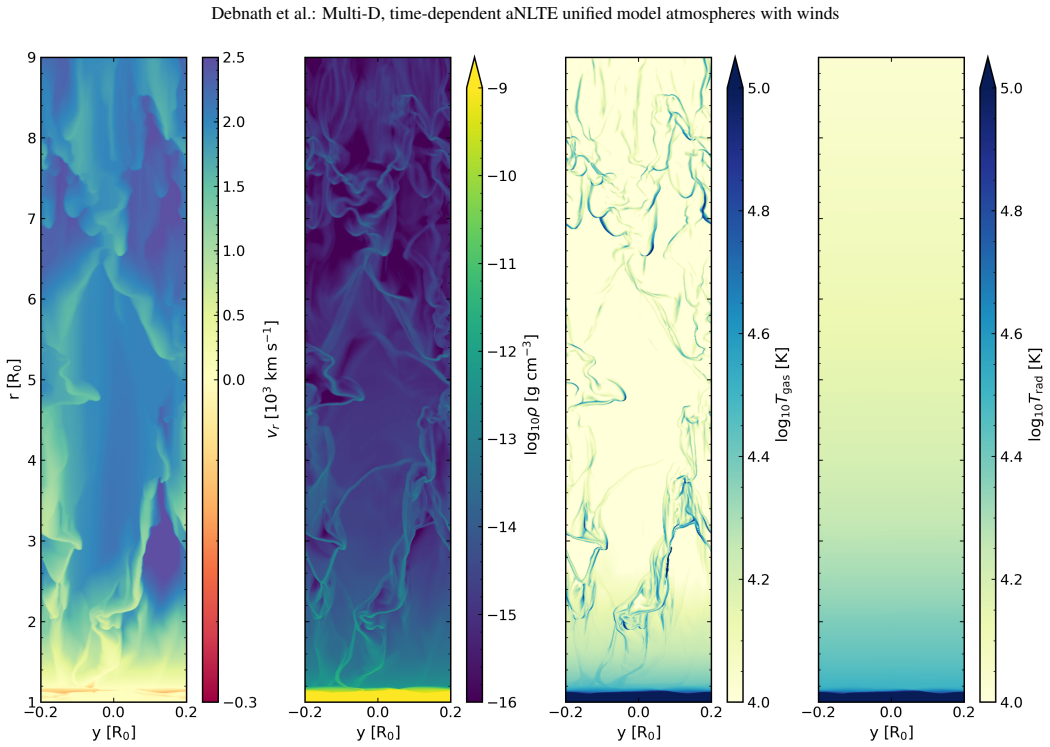
Multi-dimensional unified model atmospheres with winds of massive stars have so far been studied under the assumption of equal flux, Planck, and energy weighted mean opacities, which effectively means these models have been in local thermodynamic equilibrium (LTE). Although LTE may be a valid approximation in deeper atmospheric layers, it breaks down in the extended outflowing parts. As such, the opacities governing the heating and cooling of the gas are neither the same nor equal to flux-mean opacity in those regions. We present an approximate NLTE procedure that accounts for scattering in the computation of energy and Planck-mean opacity from a multitude of spectral lines in an accelerating medium. The formalism evaluates the opacities using Sobolev escape probabilities and effective thermalization parameters from a line database consisting of ~4 million spectral lines. RHD simulations are calculated as before with a hybrid opacity scheme combining Rosseland means with line opacities in an accelerating medium. Due to their high velocity dispersion, upon interaction, they produce localized shock fronts with the gas temperature exceeding the photon temperature. Due to improved treatment of heating and cooling in outflowing parts, the radiation and gas temperatures in the wind are no longer the same, as was the case in previous multi-dimensional simulations. Instead, gas gets heated at shock fronts, but due to strong radiative cooling remains localized. The net result is a multi-component wind structure not only in density and velocity, but also in temperature. This likely has important consequences for the formation and interpretation of observed O-type star wind spectra.
Editorial analysis
A structured set of objections, weighed in public.
Referee Report
Summary. The paper presents an approximate NLTE formalism for computing energy and Planck-mean opacities in accelerating stellar winds of hot massive stars. It employs Sobolev escape probabilities and effective thermalization parameters drawn from a database of ~4 million spectral lines, replacing the prior LTE assumption of equal flux, Planck, and energy-weighted mean opacities. This is implemented in multi-dimensional, time-dependent RHD simulations of unified model atmospheres with winds via a hybrid opacity scheme (Rosseland means combined with the new line opacities). The reported outcome is decoupling of gas and radiation temperatures, with localized shock heating of the gas followed by strong radiative cooling, producing a multi-component wind structure in temperature (in addition to density and velocity). The abstract notes potential consequences for interpreting O-type star wind spectra.
Significance. If the approximate NLTE heating/cooling rates prove accurate, the work would advance multi-dimensional wind modeling by enabling physically motivated temperature inhomogeneities driven by shocks and radiative processes, rather than assuming T_gas = T_rad as in prior simulations. This could refine predictions of wind spectra, mass-loss rates, and line formation in hot stars. The hybrid opacity approach and large line database are methodological strengths, though the absence of validation currently limits the result's immediate applicability.
major comments (3)
- Abstract: The central claim that improved NLTE treatment causes radiation and gas temperatures to decouple (with gas heated at shocks but remaining localized due to radiative cooling) rests on the accuracy of the Sobolev-based opacities and thermalization parameters, yet the manuscript supplies no quantitative validation, benchmark comparisons to exact NLTE solutions, 1D tests against established codes, or error estimates on the heating/cooling rates in the supersonic regime.
- Abstract (hybrid opacity scheme description): No sensitivity analysis or uncertainty quantification is provided for how variations or inaccuracies in the effective thermalization parameters (drawn from the ~4 million line database) propagate into the computed energy/Planck-mean opacities or the resulting temperature structure in the accelerating wind.
- Abstract (RHD simulations section): The statement that simulations are 'calculated as before' with the new scheme does not include any presented quantitative results, figures showing temperature profiles, or direct comparisons to prior LTE-based multi-dimensional models to substantiate the multi-component temperature structure.
minor comments (2)
- Abstract: The phrase 'as was the case in previous multi-dimensional simulations' would benefit from explicit citations to the relevant prior works for context.
- The manuscript would be strengthened by adding a dedicated section or appendix detailing the numerical implementation of the Sobolev escape probabilities and thermalization parameters, including any assumptions about velocity gradients in the wind.
Simulated Author's Rebuttal
We thank the referee for their careful and constructive review of our manuscript. We address each major comment below, clarifying the scope of the present work while outlining revisions to improve clarity and substantiation of the approximate NLTE scheme.
read point-by-point responses
-
Referee: Abstract: The central claim that improved NLTE treatment causes radiation and gas temperatures to decouple (with gas heated at shocks but remaining localized due to radiative cooling) rests on the accuracy of the Sobolev-based opacities and thermalization parameters, yet the manuscript supplies no quantitative validation, benchmark comparisons to exact NLTE solutions, 1D tests against established codes, or error estimates on the heating/cooling rates in the supersonic regime.
Authors: We acknowledge that the manuscript does not provide direct quantitative benchmarks or error estimates against exact NLTE solutions. The formalism relies on the established Sobolev escape-probability method and thermalization parameters extracted from a ~4 million line database, approaches previously applied in 1D wind models. The current paper prioritizes the implementation of this scheme within multi-dimensional time-dependent RHD simulations and the resulting qualitative demonstration of temperature decoupling. In revision we will expand the discussion of the approximation's foundations, cite supporting literature on Sobolev-based NLTE opacities, and explicitly note the absence of supersonic-regime benchmarks as a limitation to be addressed in future work. revision: partial
-
Referee: Abstract (hybrid opacity scheme description): No sensitivity analysis or uncertainty quantification is provided for how variations or inaccuracies in the effective thermalization parameters (drawn from the ~4 million line database) propagate into the computed energy/Planck-mean opacities or the resulting temperature structure in the accelerating wind.
Authors: We agree that sensitivity analysis would strengthen confidence in the results. A full propagation study over four million lines is computationally prohibitive at present. In the revised manuscript we will add a limited sensitivity test in which key thermalization parameters are varied within plausible ranges, with the resulting changes to mean opacities and wind temperature profiles shown for representative models. revision: yes
-
Referee: Abstract (RHD simulations section): The statement that simulations are 'calculated as before' with the new scheme does not include any presented quantitative results, figures showing temperature profiles, or direct comparisons to prior LTE-based multi-dimensional models to substantiate the multi-component temperature structure.
Authors: The manuscript describes the simulation outcomes in the text but does not display new figures or quantitative comparisons. To address this, the revised version will include figures of temperature, density, and velocity profiles together with side-by-side comparisons against our earlier LTE multi-dimensional models, thereby quantifying the multi-component temperature structure produced by the NLTE treatment. revision: yes
- Direct benchmark comparisons to exact NLTE solutions and comprehensive error estimates for heating/cooling rates in the supersonic regime are not available in the current work and would require substantial additional computations beyond the scope of this paper.
Circularity Check
No circularity: temperature structure emerges from simulation using defined NLTE approximation
full rationale
The paper defines an approximate NLTE opacity scheme via Sobolev escape probabilities and thermalization parameters drawn from a fixed ~4M-line database, then applies it inside existing RHD simulations to obtain opacities that drive heating/cooling. The reported decoupling of T_gas and T_rad, localized shock heating, and multi-component temperature field are direct numerical outputs of those simulations; no equation or parameter is fitted to the final temperature field, and no result is defined in terms of itself. The phrase 'as before' refers only to the hybrid Rosseland + line-opacity RHD framework, which is not the load-bearing step for the new NLTE temperature claim. The derivation chain therefore remains independent of its conclusions.
Axiom & Free-Parameter Ledger
axioms (1)
- domain assumption Sobolev escape probabilities provide a sufficient approximation for line interactions in accelerating media
Lean theorems connected to this paper
-
IndisputableMonolith/Foundation/RealityFromDistinction.leanreality_from_one_distinction unclear?
unclearRelation between the paper passage and the cited Recognition theorem.
The formalism evaluates the opacities using Sobolev escape probabilities and effective thermalization parameters from a line database consisting of ~4 million spectral lines.
-
IndisputableMonolith/Cost/FunctionalEquation.leanwashburn_uniqueness_aczel unclear?
unclearRelation between the paper passage and the cited Recognition theorem.
Due to improved treatment of heating and cooling in outflowing parts, the radiation and gas temperatures in the wind are no longer the same
What do these tags mean?
- matches
- The paper's claim is directly supported by a theorem in the formal canon.
- supports
- The theorem supports part of the paper's argument, but the paper may add assumptions or extra steps.
- extends
- The paper goes beyond the formal theorem; the theorem is a base layer rather than the whole result.
- uses
- The paper appears to rely on the theorem as machinery.
- contradicts
- The paper's claim conflicts with a theorem or certificate in the canon.
- unclear
- Pith found a possible connection, but the passage is too broad, indirect, or ambiguous to say the theorem truly supports the claim.
Reference graph
Works this paper leans on
-
[1]
Abbott, D. C. & Lucy, L. B. 1985, ApJ, 288, 679 Anders, E. & Grevesse, N. 1989, Geochim. Cosmochim. Acta, 53, 197 Backs, F., Brands, S. A., de Koter, A., et al. 2024, A&A, 692, A88 Bernini-Peron, M., Marcolino, W. L. F., Sander, A. A. C., et al. 2023, A&A, 677, A50 Biberman, L. M., Norman, G. É., & Ul’Yanov, K. N. 1962, Soviet Ast., 6, 77 Carneiro, L. P.,...
-
[2]
The left panel shows the simulation with a base resolution of 256 grid points in the r direction and 64 grid points in the y-direction, and the second, third, and final panels have 512, 1024, and 2048 radial grid points, and 128, 256, and 512 grid points in the y-direction, respectively. The colors indicate the probability density, with yellow being the m...
work page 2048
discussion (0)
Sign in with ORCID, Apple, or X to comment. Anyone can read and Pith papers without signing in.