Central Limit Theorem for Random Partial Sphere Coverings in High Dimensions
Pith reviewed 2026-05-10 18:16 UTC · model grok-4.3
The pith
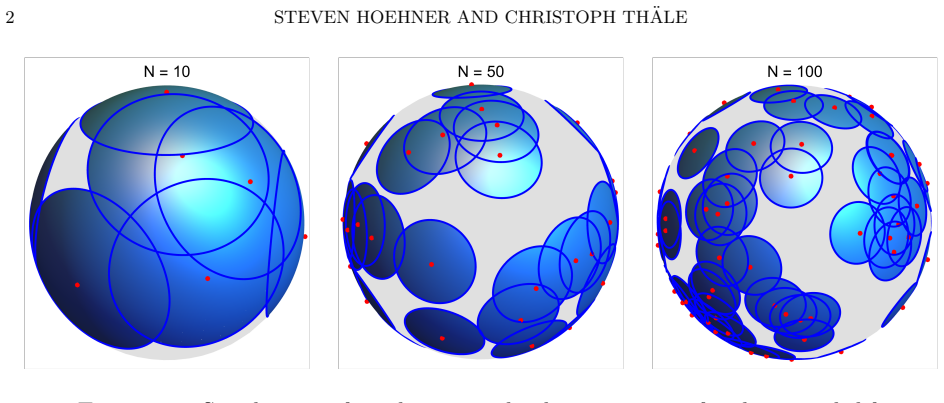
The uncovered volume after placing N random spherical caps each of area fraction 1/N obeys a central limit theorem with Gaussian fluctuations and explicit Kolmogorov rate.
A machine-rendered reading of the paper's core claim, the machinery that carries it, and where it could break.
Core claim
We establish a Central Limit Theorem for the volume of the resulting random partial covering, showing that its fluctuations are asymptotically Gaussian. Moreover, we obtain a quantitative bound on the rate of convergence in the Kolmogorov distance. Our results hold both in fixed dimension and in a high-dimensional regime where the dimension grows at most logarithmically with N.
What carries the argument
The uncovered surface volume after N independent uniform random spherical caps of relative area 1/N; this random variable satisfies the CLT through uniform control of its moments and characteristic function.
If this is right
- The fluctuations of the uncovered volume around its mean become Gaussian for large N.
- Convergence to the normal holds in Kolmogorov distance with an explicit rate that is uniform across the stated dimension regimes.
- The same CLT applies when dimension is fixed and when dimension grows at most logarithmically with N.
- The model functions as a continuous geometric analogue of the classical balls-into-bins problem.
Where Pith is reading between the lines
- The quantitative Kolmogorov bound supplies explicit error estimates that could be used in applications requiring approximate coverage probabilities.
- Similar moment and characteristic-function arguments might extend the CLT to related geometric objects such as random caps on other manifolds.
- The logarithmic growth restriction on dimension suggests a possible transition in the limit law once dimension grows faster than log N.
Load-bearing premise
The N caps are placed independently and uniformly at random with each exactly covering surface fraction 1/N, and the uncovered volume is a measurable random variable whose moments and characteristic function remain controllable uniformly in the allowed dimension regimes.
What would settle it
Generate many independent realizations of the uncovered volume for N equal to several thousand and d equal to 5, then compute the empirical Kolmogorov distance to the fitted normal and check whether it stays below the paper's explicit bound.
Figures
read the original abstract
We study a random partial covering model on the $(d-1)$-dimensional unit sphere, where $N$ spherical caps are placed independently and uniformly at random, each covering a surface fraction of $1/N$. This model provides a continuous geometric analogue of the classical balls-into-bins problem. We establish a Central Limit Theorem for the volume of the resulting random partial covering, showing that its fluctuations are asymptotically Gaussian. Moreover, we obtain a quantitative bound on the rate of convergence in the Kolmogorov distance. Our results hold both in fixed dimension and in a high-dimensional regime where the dimension grows at most logarithmically with $N$.
Editorial analysis
A structured set of objections, weighed in public.
Referee Report
Summary. The manuscript studies a random partial covering model on the (d-1)-sphere in which N spherical caps are placed independently and uniformly at random, each having surface measure exactly 1/N. It establishes a central limit theorem asserting that the volume of the resulting (random) partial covering is asymptotically normal after centering and scaling, together with an explicit quantitative bound on the Kolmogorov distance to the limiting Gaussian. The CLT and rate are claimed to hold both for fixed dimension d and in the regime where d grows at most logarithmically with N.
Significance. If the technical arguments are correct, the result supplies a geometrically natural continuous analogue of the classical balls-and-bins occupancy problem, with the covered volume playing the role of the number of occupied bins. The quantitative Kolmogorov bound and the allowance for slowly growing dimension (d = O(log N)) are useful features for applications in geometric probability and high-dimensional statistics. The paper thereby extends existing CLTs for coverage processes to a setting that is both continuous and high-dimensional.
major comments (2)
- [Main theorem / Section 2] The abstract and introduction state that the results hold when d grows at most logarithmically with N, but the precise dependence of the Kolmogorov rate on d is not displayed in the main theorem statement (presumably Theorem 1.1 or 2.1). Without an explicit d-dependent bound it is difficult to verify that the high-dimensional regime is genuinely covered by the same argument used for fixed d.
- [Proof of the CLT (Section 4 or 5)] The moment calculations or characteristic-function estimates that control the variance and the Berry-Esseen-type bound must remain uniform in the high-dimensional regime; the manuscript should explicitly indicate where the logarithmic growth of d is used to absorb the dimension-dependent factors arising from the surface measure or the spherical geometry.
minor comments (3)
- [Abstract] The phrase 'volume of the resulting random partial covering' in the abstract is slightly ambiguous; it should be clarified whether the random variable under study is the measure of the union (covered volume) or its complement (uncovered volume).
- [Introduction / Model definition] Notation for the spherical caps and the surface measure should be introduced once and used consistently; in particular, the normalization 'each covering a surface fraction of 1/N' should be tied to an explicit formula for the cap radius.
- [Section 1] A short remark on the measurability of the covered-volume functional (which is needed to justify the application of the CLT) would be helpful for readers.
Simulated Author's Rebuttal
We thank the referee for the positive evaluation and the helpful comments on clarifying the high-dimensional regime. We address the two major comments below and will revise the manuscript accordingly to improve readability.
read point-by-point responses
-
Referee: [Main theorem / Section 2] The abstract and introduction state that the results hold when d grows at most logarithmically with N, but the precise dependence of the Kolmogorov rate on d is not displayed in the main theorem statement (presumably Theorem 1.1 or 2.1). Without an explicit d-dependent bound it is difficult to verify that the high-dimensional regime is genuinely covered by the same argument used for fixed d.
Authors: We agree that an explicit display of the d-dependence in the Kolmogorov bound would make the range of validity more transparent. In the revised manuscript we will update the statement of the main theorem (Theorem 1.1) to include the full form of the bound, which is of order O((log N)/sqrt(N)) times a factor polynomial in d (arising from the spherical measure estimates). Under the hypothesis d = O(log N) this quantity tends to zero, confirming that the same argument covers both the fixed-d and slowly growing-d regimes. revision: yes
-
Referee: [Proof of the CLT (Section 4 or 5)] The moment calculations or characteristic-function estimates that control the variance and the Berry-Esseen-type bound must remain uniform in the high-dimensional regime; the manuscript should explicitly indicate where the logarithmic growth of d is used to absorb the dimension-dependent factors arising from the surface measure or the spherical geometry.
Authors: We will add targeted remarks in Sections 4 and 5 to highlight the precise steps where the assumption d = O(log N) is used. These occur in the control of the variance of the coverage indicators (via the surface-area formulas on the sphere) and in the remainder terms of the characteristic-function expansion, where dimension-dependent constants are absorbed by the logarithmic growth condition to preserve uniformity of the Berry-Esseen bound. revision: yes
Circularity Check
No significant circularity detected
full rationale
The derivation establishes a CLT for the random partial covering volume via direct probabilistic arguments (moment bounds, characteristic function control, and quantitative Kolmogorov distance estimates) that apply uniformly in both fixed-d and d = O(log N) regimes. These steps rest on the model's independent uniform cap placements and measurability of the volume functional, without any reduction of the target CLT to a fitted parameter, self-defined quantity, or load-bearing self-citation. The high-dimensional extension uses explicit uniform estimates that do not presuppose the Gaussian limit, rendering the chain self-contained against external probabilistic benchmarks.
Axiom & Free-Parameter Ledger
axioms (2)
- standard math Existence of a probability space on which N independent uniform random spherical caps can be defined, each with exact surface measure 1/N.
- domain assumption The uncovered volume is a measurable random variable whose distribution admits control via characteristic functions or Stein's method in the stated regimes.
Lean theorems connected to this paper
-
IndisputableMonolith/Foundation/AlexanderDuality.leanalexander_duality_circle_linking contradicts?
contradictsCONTRADICTS: the theorem conflicts with this paper passage, or marks a claim that would need revision before publication.
We establish a Central Limit Theorem for the volume of the resulting random partial covering... d(N) ≤ α log N
-
IndisputableMonolith/Cost/FunctionalEquation.leanwashburn_uniqueness_aczel unclear?
unclearRelation between the paper passage and the cited Recognition theorem.
f(x1,...,xN) := σ(∪ CN(xi)) ... Δ1f(Z) = σ(CN(Z1)∖U) − σ(CN(X′1)∖U)
What do these tags mean?
- matches
- The paper's claim is directly supported by a theorem in the formal canon.
- supports
- The theorem supports part of the paper's argument, but the paper may add assumptions or extra steps.
- extends
- The paper goes beyond the formal theorem; the theorem is a base layer rather than the whole result.
- uses
- The paper appears to rely on the theorem as machinery.
- contradicts
- The paper's claim conflicts with a theorem or certificate in the canon.
- unclear
- Pith found a possible connection, but the passage is too broad, indirect, or ambiguous to say the theorem truly supports the claim.
Reference graph
Works this paper leans on
-
[1]
P. Erd˝ os, L. Few, and C. A. Rogers. The amount of overlapping in partial coverings of space by equal spheres.Mathematika, 11(2):171–184, 1964
work page 1964
-
[2]
S. Hoehner and G. Kur. A Concentration Inequality for Random Polytopes, Dirichlet–Voronoi Tiling Numbers and the Geometric Balls and Bins Problem.Discrete & Computational Geometry, 65(3):730–763, 2021
work page 2021
-
[3]
S. Hoehner and G. Kur. On the Optimality of Random Partial Sphere Coverings in High Dimensions. arXiv:2501.10607, 2025
-
[4]
Z. Kabluchko, D. A. Steigenberger, and C. Th¨ ale.Random Simplices, volume 2383 ofLecture Notes in Mathematics. Springer, 2026
work page 2026
-
[5]
Q.-M. Shao and Z.-S. Zhang. Berry–Esseen bounds for functionals of independent random variables.Sto- chastic Processes and their Applications, 183, 2025. Department of Mathematics & Computer Science, Longwood University, 201 High St., F armville, Virginia 23901, USA E-mail address:hoehnersd@longwood.edu F aculty of Mathematics, Ruhr University Bochum, 448...
work page 2025
discussion (0)
Sign in with ORCID, Apple, or X to comment. Anyone can read and Pith papers without signing in.