Fixed-Effects Models for Causal Inference in Longitudinal Cluster Randomized and Quasi-Experimental Trials
Pith reviewed 2026-05-10 18:25 UTC · model grok-4.3
The pith
Fixed-effects models with correctly specified treatment effects yield consistent estimators for marginal treatment effects in longitudinal cluster trials even if other model components are misspecified.
A machine-rendered reading of the paper's core claim, the machinery that carries it, and where it could break.
Core claim
Linear and log-link fixed-effects models with correctly specified treatment effect structures yield consistent and asymptotically normal estimators for nonparametrically defined treatment effect estimands in longitudinal CRTs, even under arbitrary misspecification of other model components. The constant treatment effect estimator targets the period-average treatment effect for the overlap population, and fixed-effects models can maintain consistency by adjusting for cluster-level and individual-level time-invariant confounding in longitudinal CQTs.
What carries the argument
M-estimation framework applied to linear and log-link fixed-effects models, which targets marginal estimands and provides robustness outside the treatment effect structure.
If this is right
- Some CRT designs achieve model-robustness without correct specification of the treatment effect structure.
- Fixed-effects models can adjust for both cluster-level and individual-level time-invariant confounding in longitudinal CQTs.
- Fixed-effects models serve as a robust and potentially preferable alternative to mixed-effects models for longitudinal CT analysis.
Where Pith is reading between the lines
- Practitioners may find fixed-effects models simpler to implement and interpret than mixed-effects models in large longitudinal datasets.
- The overlap population estimand suggests results apply most directly to units with complete period coverage across treatment conditions.
- Similar M-estimation robustness arguments could be tested for other link functions or outcome types beyond linear and log-link.
Load-bearing premise
The treatment effect structure must be correctly specified in the fixed-effects model.
What would settle it
A simulation study or re-analysis of longitudinal cluster trial data where the treatment effect structure is deliberately misspecified while other components are correct, checking whether the estimator becomes inconsistent or biased.
Figures


read the original abstract
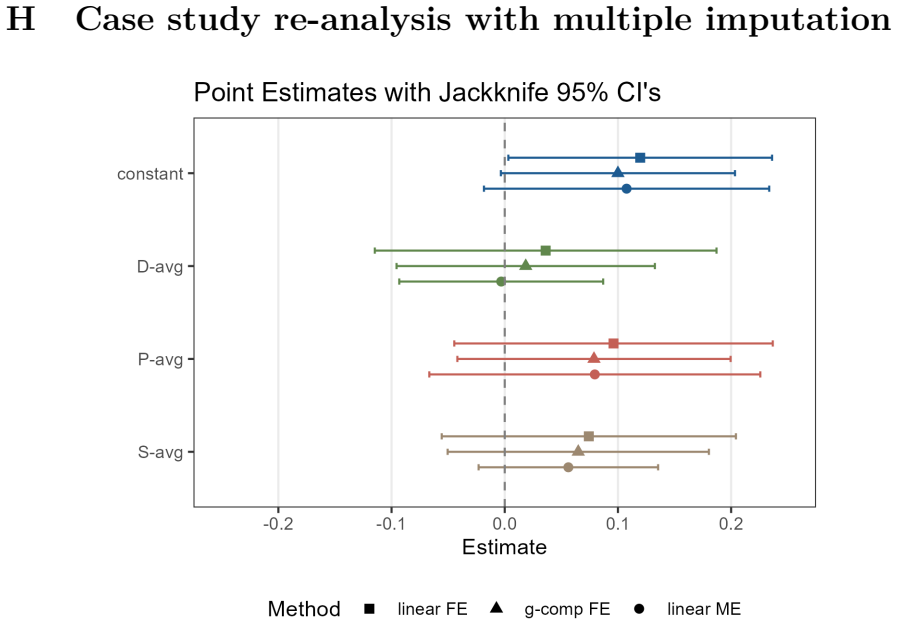
This article investigates the model-robustness of fixed-effects models for analyzing a broad class of longitudinal cluster trials (CTs) such as stepped-wedge, parallel-with-baseline and crossover designs, encompassing both randomized (CRTs) and quasi-experimental (CQTs) designs. We clarify a longstanding misconception in biostatistics, demonstrating that fixed-effects models, traditionally perceived as targeting only finite-sample conditional estimands, can effectively target super-population marginal estimands through an M-estimation framework. We comprehensively prove that linear and log-link fixed-effects models with correctly specified treatment effect structures can broadly yield consistent and asymptotically normal estimators for nonparametrically defined treatment effect estimands in longitudinal CRTs, even under arbitrary misspecification of other model components. We identify that the constant treatment effect estimator generally targets the period-average treatment effect for the overlap population (P-ATO); accordingly, some CRT designs don't even require correct specification of the treatment effect structure for model-robustness. We further characterize conditions where fixed-effects models can maintain consistency by adjusting for both cluster-level and individual-level time-invariant confounding in longitudinal CQTs. Altogether, supported by simulation and a case study re-analysis, we establish fixed-effects models as a robust and potentially preferable alternative to mixed-effects models for longitudinal CT analysis.
Editorial analysis
A structured set of objections, weighed in public.
Referee Report
Summary. The paper claims to resolve a misconception in biostatistics by showing that fixed-effects models in longitudinal cluster trials can target super-population marginal treatment effect estimands using an M-estimation approach. It provides comprehensive proofs that linear and log-link fixed-effects models, when the treatment effect structure is correctly specified, produce consistent and asymptotically normal estimators for nonparametric estimands despite misspecification of other components. The constant treatment effect is shown to target the period-average treatment effect for the overlap population (P-ATO). The work also addresses conditions for consistency in quasi-experimental designs with confounding and is backed by simulations and a case study re-analysis.
Significance. If the central claims hold, this manuscript makes a substantial contribution to causal inference methods for cluster randomized and quasi-experimental trials. It provides a theoretically grounded alternative to mixed-effects models that is robust to misspecification. The explicit identification of the P-ATO target and the conditions for model-robustness are valuable for practitioners. The inclusion of proofs, simulation studies, and a real-world case study adds credibility and practical utility to the findings.
minor comments (3)
- Consider defining 'P-ATO' at its first mention for readers unfamiliar with the term.
- The discussion of the longstanding misconception could benefit from citing specific prior works that hold the view being challenged.
- The re-analysis results would be more informative if compared directly to mixed-effects model estimates in a table.
Simulated Author's Rebuttal
We thank the referee for their positive summary, recognition of the manuscript's contributions to causal inference methods for longitudinal cluster trials, and recommendation of minor revision. No specific major comments were provided in the report.
Circularity Check
No significant circularity; derivation self-contained via external M-estimation
full rationale
The paper establishes consistency of linear and log-link fixed-effects models for nonparametric marginal treatment effect estimands in longitudinal CRTs/CQTs by invoking the standard M-estimation framework, with the key condition of correct treatment-effect structure specification made explicit. No load-bearing step reduces a claimed prediction to a fitted parameter by construction, nor does any derivation rely on self-citation chains or imported uniqueness theorems. The argument is supported by stated proofs, simulations, and a case study re-analysis, rendering it independent of the target results and externally falsifiable.
Axiom & Free-Parameter Ledger
axioms (2)
- domain assumption Correct specification of the treatment effect structure
- standard math Standard regularity conditions for M-estimation and asymptotic normality
Reference graph
Works this paper leans on
-
[1]
Cameron, A. C. and Trivedi, P. K. (2005).Microeconometrics: Methods and Applications. Cambridge University Press. Google-Books-ID: TdlKAgAAQBAJ
work page 2005
-
[2]
Chen, X. and Li, F. (2025). Model-assisted analysis of covariance estimators for stepped wedge cluster randomized experiments.Scandinavian Journal of Statistics, 52(1):416–446. _eprint: https://onlinelibrary.wiley.com/doi/pdf/10.1111/sjos.12755
-
[3]
Gardiner, J. C., Luo, Z., and Roman, L. A. (2009). Fixed effects, random effects and GEE: What are the differences?Statistics in Medicine, 28(2):221–239. _eprint: https://onlinelibrary.wiley.com/doi/pdf/10.1002/sim.3478
-
[4]
Hausman, J. A. (1978). Specification Tests in Econometrics.Econometrica, 46(6):1251–1271. Publisher: [Wiley, Econometric Society]
work page 1978
-
[5]
Kiefer, N. M. (1980). Estimation of fixed effect models for time series of cross-sections with arbitrary intertemporal covariance.Journal of Econometrics, 14(2):195–202
work page 1980
-
[6]
Lee, K. M. and Cheung, Y. B. (2024). The fixed-effects model for robust analysis of stepped-wedge cluster trials with a small number of clusters and continuous outcomes: a simulation study.Trials, 25(1):718
work page 2024
-
[7]
Lee, K. M., Turner, E. L., and Kenny, A. (2025). Analysis of Stepped-Wedge Cluster Randomized Trials When Treatment Effects Vary by Exposure Time or Calendar Time.Statistics in Medicine, 44(20-22):e70256. _eprint: https://onlinelibrary.wiley.com/doi/pdf/10.1002/sim.70256
-
[8]
P., Hemming, K., Taljaard, M., Melnick, E
Li, F., Hughes, J. P., Hemming, K., Taljaard, M., Melnick, E. R., and Heagerty, P. J. (2021). Mixed-effects models for the design and analysis of stepped wedge cluster randomized trials: An overview.Statistical Methods in Medical Research, 30(2):612–639. Publisher: SAGE Publications Ltd
work page 2021
- [9]
-
[10]
Li, F., Morgan, K. L., and Zaslavsky, A. M. (2018). Balancing Covariates via Propensity Score Weighting. Journal of the American Statistical Association, 113(521):390–400. Publisher: Taylor & Francis
work page 2018
-
[11]
Liang, K.-Y. and Zeger, S. L. (1986). Longitudinal data analysis using generalized linear models.Biometrika, 73(1):13–22. 121
work page 1986
-
[12]
Neyman, J. and Scott, E. L. (1948). Consistent Estimates Based on Partially Consistent Observations. Econometrica, 16(1):1
work page 1948
-
[13]
Ross, R. K., Zivich, P. N., Stringer, J. S. A., and Cole, S. R. (2024). M-estimation for common epidemiological measures: introduction and applied examples.International Journal of Epidemiology, 53(2):dyae030
work page 2024
-
[14]
G., Liu, C., Huang, W., Liu, A., Zhang, Y., Smith, M
Hudgens, M. G., Liu, C., Huang, W., Liu, A., Zhang, Y., Smith, M. K., Mitchell, K. M., Ong, J. J., Fu, H., Vickerman, P., Yang, L., Wang, C., Zheng, H., Yang, B., and Tucker, J. D. (2018). Crowdsourcing to expand HIV testing among men who have sex with men in China: A closed cohort stepped wedge cluster randomized controlled trial.PLOS Medicine, 15(8):e1002645
work page 2018
-
[15]
Tsiatis, A. A. (2006).Semiparametric Theory and Missing Data. Springer Series in Statistics. Springer New
work page 2006
-
[16]
York, New York, NY. van der Vaart, A. W. (1998).Asymptotic statistics. Cambridge series in statistical and probabilistic mathematics. Cambridge University Press, Cambridge, UK ; New York, NY, USA
work page 1998
-
[17]
Wang, B., Wang, X., and Li, F. (2024). How to achieve model-robust inference in stepped wedge trials with model-based methods?Biometrics, 80(4):ujae123
work page 2024
-
[18]
Wooldridge, J. M. (2010).Econometric Analysis of Cross Section and Panel Data. MIT Press, Cambridge, Mass., 2. ed edition. OCLC: 705585553. 122
work page 2010
discussion (0)
Sign in with ORCID, Apple, or X to comment. Anyone can read and Pith papers without signing in.