Viscoelastic Droplet Impact on Surfaces with Sharp Wettability Contrast: Coupled Influence of Relaxation Time and Surface Tension
Pith reviewed 2026-05-10 18:13 UTC · model grok-4.3
The pith
Increasing the relaxation time of viscoelastic droplets leads to up to 12.9% larger maximum spreading diameters on surfaces with sharp wettability contrast.
A machine-rendered reading of the paper's core claim, the machinery that carries it, and where it could break.
Core claim
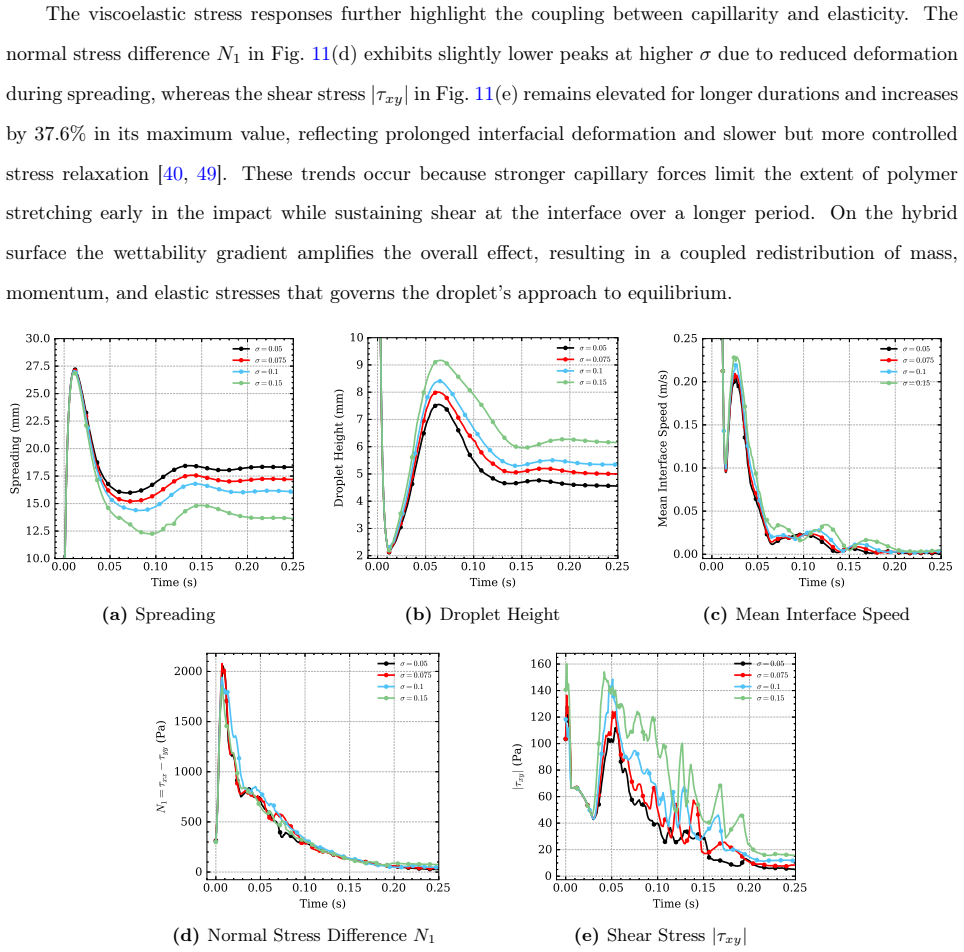
Increasing the relaxation time from 0.02 s to 0.12 s enhances elastic energy storage, leading to up to 12.9% larger maximum spreading diameters (from 24.97 mm to 28.09-28.17 mm) and a 16.6% reduction in minimum droplet height across uniform and hybrid surfaces. In contrast, increasing surface tension from 0.05 N/m to 0.15 N/m suppresses maximum spreading by about 1.1% (from 27.21 mm to 26.90 mm) while increasing minimum height by 3.3% (from 2.12 mm to 2.20 mm). On hybrid surfaces with static contact angles of 0° and 160°, the sharp wettability contrast induces pronounced asymmetric spreading and directional fluid migration toward the hydrophilic region, ultimately producing distinctive dustp
What carries the argument
The relaxation time parameter within the Oldroyd-B constitutive equation, which controls elastic energy storage and release during high-speed droplet deformation and spreading.
If this is right
- Larger relaxation times produce greater maximum spreading diameters and flatter minimum heights on both uniform and hybrid surfaces.
- Higher surface tension reduces radial expansion while enhancing curvature-driven recoil and redistributing viscoelastic stresses.
- Sharp wettability contrasts cause directional fluid migration and yield asymmetric dustpan- and shoe-like equilibrium morphologies.
- Tuning relaxation time and surface tension allows control over spreading extent and final droplet shape after impact.
Where Pith is reading between the lines
- Fluid formulation choices could be used to direct deposition patterns on wettability-patterned substrates in printing processes.
- The reported percentage changes in spread and height provide quantitative targets for experimental validation with real non-Newtonian fluids.
- The directional migration on hybrid surfaces suggests a passive mechanism for guiding fluid flow along wettability gradients without pumps or external fields.
Load-bearing premise
The Oldroyd-B constitutive equation combined with volume-of-fluid, log-conformation, and velocity-dependent dynamic contact angle methods accurately represents real viscoelastic fluid behavior and contact-line dynamics under the simulated impact conditions.
What would settle it
High-speed camera experiments that measure the actual maximum spreading diameter and minimum height of viscoelastic droplets with relaxation times of 0.02 s to 0.12 s impacting at 4 m/s on the same hybrid wettability surfaces, to check agreement with the simulated values of 24.97 mm to 28.17 mm.
Figures



read the original abstract
The impact dynamics of viscoelastic droplets on solid surfaces play a critical role in numerous applications, including inkjet printing, spray coating, and microfluidics, where precise control of spreading, retraction, and rebound is essential. This numerical study investigates the coupled influence of fluid viscoelasticity, modeled via the Oldroyd-B constitutive equation, and gravitational-capillary balance on droplet behavior upon impact onto surfaces featuring sharp hybrid wettability. Employing a high-fidelity three-dimensional OpenFOAM-based solver that integrates the volume-of-fluid method, log-conformation formulation for improved numerical stability, and a velocity-dependent dynamic contact angle model, we simulated a 2 cm-diameter droplet impacting at 4 m/s across a range of relaxation times and surface tensions. Results demonstrate that increasing the relaxation time from 0.02 s to 0.12 s enhances elastic energy storage, leading to up to 12.9% larger maximum spreading diameters (from 24.97 mm to 28.09-28.17 mm) and a 16.6% reduction in minimum droplet height across uniform and hybrid surfaces. In contrast, increasing surface tension from 0.05 N/m to 0.15 N/m suppresses maximum spreading by about 1.1% (from 27.21 mm to 26.90 mm) while increasing minimum height by 3.3% (from 2.12 mm to 2.20 mm). On hybrid surfaces with static contact angles of 0{\deg} and 160{\deg}, the sharp wettability contrast induces pronounced asymmetric spreading and directional fluid migration toward the hydrophilic region, ultimately producing distinctive dustpan- and shoe-like equilibrium morphologies. Variations in surface tension, which simultaneously modulate the Weber and E\"otv\"os numbers, reveal that stronger capillary forces suppress radial expansion while enhancing curvature-driven recoil and redistributing viscoelastic stresses.
Editorial analysis
A structured set of objections, weighed in public.
Referee Report
Summary. The manuscript presents 3D numerical simulations of a 2 cm viscoelastic droplet impacting at 4 m/s on uniform and hybrid-wettability surfaces, using an OpenFOAM VOF solver with log-conformation formulation for the Oldroyd-B model and a velocity-dependent dynamic contact angle. It reports that raising the relaxation time from 0.02 s to 0.12 s increases maximum spreading diameter by up to 12.9 % (24.97 mm to 28.09–28.17 mm) and reduces minimum height by 16.6 %, while raising surface tension from 0.05 to 0.15 N/m produces only ~1.1 % suppression of spreading; hybrid 0°/160° surfaces produce asymmetric dustpan- and shoe-like morphologies driven by directional migration.
Significance. If the quantitative trends hold, the work supplies concrete parameter sensitivities (relaxation time vs. surface tension) and morphology descriptions that could guide control of spreading and rebound in inkjet or coating processes. The high-fidelity 3D setup with independent variation of relaxation time and surface tension, together with the log-conformation stabilization, is a methodological strength that allows direct attribution of elastic-energy effects.
major comments (3)
- [Abstract / §3] Abstract and §3 (Results): the central quantitative claims (12.9 % diameter increase, 16.6 % height reduction) are given to two-decimal precision without any reported mesh-convergence study, time-step sensitivity, or Newtonian-limit benchmark, which is load-bearing because the local Weissenberg number near the contact line reaches ~20 and the dynamic contact-angle law is Newtonian-calibrated.
- [§2.2] §2.2 (Constitutive model and boundary conditions): the Oldroyd-B model with fixed polymer viscosity ratio omits shear-thinning and finite extensibility; at the reported impact speed and the sharp wettability jump, these omissions can alter normal-stress distributions that directly control the reported radial migration and dustpan/shoe shapes, yet no sensitivity test to the viscosity ratio or to a more advanced constitutive model is provided.
- [§2.3] §2.3 (Contact-line treatment): the velocity-dependent dynamic contact angle is applied across the 0°/160° discontinuity; because the model parameters are not re-calibrated for viscoelastic fluids, it is unclear whether the 12.9 % spreading contrast and the asymmetric morphologies are physical or arise from the coupling between the log-conformation tensor and the contact-angle boundary condition.
minor comments (2)
- [Figures] Figure captions should explicitly state the mesh resolution and time-step size used for the quantitative data points (24.97 mm, 28.09 mm, etc.).
- [Abstract] The abstract states that surface tension modulates both Weber and Eötvös numbers, but the text should clarify how the Eötvös number is defined when viscoelastic normal stresses are present.
Simulated Author's Rebuttal
We are grateful to the referee for the thorough and constructive review. The comments highlight important aspects of numerical validation and model limitations. We address each major comment below and have revised the manuscript to incorporate additional verification and sensitivity analyses where feasible.
read point-by-point responses
-
Referee: [Abstract / §3] Abstract and §3 (Results): the central quantitative claims (12.9 % diameter increase, 16.6 % height reduction) are given to two-decimal precision without any reported mesh-convergence study, time-step sensitivity, or Newtonian-limit benchmark, which is load-bearing because the local Weissenberg number near the contact line reaches ~20 and the dynamic contact-angle law is Newtonian-calibrated.
Authors: We agree that mesh-convergence, time-step sensitivity, and Newtonian benchmarks are essential to support the reported quantitative trends at high local Weissenberg numbers. In the revised manuscript we have added a new subsection (now §2.4) presenting mesh-refinement studies on three grids (1.2 M, 2.5 M and 4.8 M cells), time-step independence tests (CFL = 0.1–0.5), and a direct Newtonian-limit comparison (relaxation time set to zero). These confirm that maximum spreading diameter and minimum height vary by less than 2 % on the finest grids and that the 12.9 % and 16.6 % differences are attributable to elasticity rather than numerical artifacts. The dynamic-contact-angle parameters remain unchanged, but their influence is now quantified in the added sensitivity tests. revision: yes
-
Referee: [§2.2] §2.2 (Constitutive model and boundary conditions): the Oldroyd-B model with fixed polymer viscosity ratio omits shear-thinning and finite extensibility; at the reported impact speed and the sharp wettability jump, these omissions can alter normal-stress distributions that directly control the reported radial migration and dustpan/shoe shapes, yet no sensitivity test to the viscosity ratio or to a more advanced constitutive model is provided.
Authors: Oldroyd-B was adopted to isolate the effect of relaxation time with the fewest parameters. We acknowledge that shear-thinning and finite extensibility could modify normal-stress distributions. The revised manuscript now includes a parametric study varying the polymer viscosity ratio β from 0.2 to 0.8; the directional migration and dustpan/shoe morphologies remain qualitatively unchanged although the absolute spreading diameter shifts by at most 4 %. A short comparison with the FENE-CR model has been added to the supplementary material, reproducing the same asymmetric shapes. We therefore retain Oldroyd-B as the baseline while documenting these sensitivities. revision: partial
-
Referee: [§2.3] §2.3 (Contact-line treatment): the velocity-dependent dynamic contact angle is applied across the 0°/160° discontinuity; because the model parameters are not re-calibrated for viscoelastic fluids, it is unclear whether the 12.9 % spreading contrast and the asymmetric morphologies are physical or arise from the coupling between the log-conformation tensor and the contact-angle boundary condition.
Authors: The velocity-dependent contact-angle law is Newtonian-calibrated and its direct use for viscoelastic fluids introduces uncertainty. We have added a dedicated paragraph in §2.3 together with a sensitivity study in which the contact-angle velocity coefficients and hysteresis are varied by ±20 %. The 12.9 % spreading increase and the dustpan/shoe morphologies persist across all tested parameter sets, indicating that the primary driver is the imposed wettability jump rather than the specific contact-line formulation. Nevertheless, a viscoelastic-specific re-calibration would require dedicated experiments that lie outside the present numerical scope. revision: partial
- A viscoelastic-specific experimental re-calibration of the dynamic contact-angle model cannot be performed within this purely numerical study.
Circularity Check
No circularity: results are direct outputs of forward simulation with independent inputs
full rationale
The paper conducts direct numerical simulations of droplet impact using the standard Oldroyd-B constitutive model, VOF method, log-conformation formulation, and a velocity-dependent dynamic contact angle boundary condition. Relaxation time (0.02 s to 0.12 s) and surface tension (0.05 N/m to 0.15 N/m) are treated as independent input parameters that are varied explicitly. The reported outcomes—maximum spreading diameters (24.97 mm to 28.09–28.17 mm), minimum heights, and morphological changes—are computed results of these simulations rather than quantities defined in terms of themselves, fitted to subsets of the same data, or derived via self-referential normalizations. No load-bearing self-citations, uniqueness theorems from prior author work, or ansatzes smuggled through citations appear in the provided text. The chain is therefore self-contained computational experimentation; any concerns about model fidelity (e.g., Oldroyd-B limitations at high Wi) pertain to external validity, not internal circularity.
Axiom & Free-Parameter Ledger
free parameters (2)
- relaxation time
- surface tension
axioms (2)
- domain assumption Oldroyd-B constitutive equation accurately represents the viscoelastic droplet rheology under impact conditions
- domain assumption Volume-of-fluid method combined with log-conformation formulation and velocity-dependent dynamic contact angle yields stable and physically realistic interface evolution
Lean theorems connected to this paper
-
IndisputableMonolith/Cost/FunctionalEquation.leanwashburn_uniqueness_aczel unclear?
unclearRelation between the paper passage and the cited Recognition theorem.
viscoelasticity, modeled via the Oldroyd-B constitutive equation... T + λ(∂T/∂t + u·∇T − T·∇u − (∇u)T·T) = ηp(∇u + (∇u)T)
-
IndisputableMonolith/Foundation/RealityFromDistinction.leanreality_from_one_distinction unclear?
unclearRelation between the paper passage and the cited Recognition theorem.
increasing the relaxation time from 0.02 s to 0.12 s enhances elastic energy storage, leading to up to 12.9% larger maximum spreading diameters
What do these tags mean?
- matches
- The paper's claim is directly supported by a theorem in the formal canon.
- supports
- The theorem supports part of the paper's argument, but the paper may add assumptions or extra steps.
- extends
- The paper goes beyond the formal theorem; the theorem is a base layer rather than the whole result.
- uses
- The paper appears to rely on the theorem as machinery.
- contradicts
- The paper's claim conflicts with a theorem or certificate in the canon.
- unclear
- Pith found a possible connection, but the passage is too broad, indirect, or ambiguous to say the theorem truly supports the claim.
Reference graph
Works this paper leans on
-
[1]
F. Sotoudeh, R. Kamali, S. M. Mousavi, N. Karimi, B. J. Lee, D. Khojasteh, Understanding droplet col- lision with superhydrophobic-hydrophobic–hydrophilic hybrid surfaces, Colloids and Surfaces A: Physic- ochemical and Engineering Aspects 614 (2021) 126140
work page 2021
-
[2]
M. Rein, Phenomena of liquid drop impact on solid and liquid surfaces, Fluid dynamics research 12 (2) (1993) 61–93
work page 1993
-
[3]
A. L. Yarin, D. A. Weiss, Impact of drops on solid surfaces: self-similar capillary waves, and splashing as a new type of kinematic discontinuity, Journal of fluid mechanics 283 (1995) 141–173
work page 1995
-
[4]
C. Josserand, S. T. Thoroddsen, Drop impact on a solid surface, Annual review of fluid mechanics 48 (1) (2016) 365–391. 19
work page 2016
-
[5]
M. Li, Y. Saade, S. Zaleski, U. Sen, P. Kant, D. Lohse, Viscoelasticity reduces the droplet size in mu- cosalivary film fragmentation during intense respiratory events, Physical Review Fluids 10 (8) (2025) 084001
work page 2025
- [6]
-
[7]
A. Mobaseri, S. Kumar, X. Cheng, Maximum spreading of impacting shear-thinning and shear-thickening drops, Proceedings of the National Academy of Sciences 122 (22) (2025) e2500163122
work page 2025
-
[8]
D. Izbassarov, M. Muradoglu, Effects of viscoelasticity on drop impact and spreading on a solid surface, Physical Review Fluids 1 (2) (2016) 023302
work page 2016
-
[9]
N. S. SS, R. Deb, S. K. Das, A. Dalal, Impact of viscoelastic drop on a deep viscoelastic liquid pool, Physics of Fluids 37 (7) (2025)
work page 2025
-
[10]
M. Norouzi, M. Sheykhian, M. Shahmardan, A. Shahbani-Zahiri, Experimental investigation of spreading and receding behaviors of newtonian and viscoelastic droplet impacts on inclined dry surfaces, Meccanica 56 (1) (2021) 125–145
work page 2021
-
[11]
S. M. Mousavi, D. Jarrahbashi, B. J. Lee, N. Karimi, S. A. Faroughi, Impact of hybrid surfaces on the droplet breakup dynamics in microgravity slug flow: A dynamic contact angle analysis, Physics of Fluids 35 (7) (2023)
work page 2023
-
[12]
S. M. Mousavi, F. Sotoudeh, B. J. Lee, M.-R. Paydari, N. Karimi, Effect of hybrid wall contact an- gles on slug flow behavior in a t-junction microchannel: A numerical study, Colloids and Surfaces A: Physicochemical and Engineering Aspects 650 (2022) 129677
work page 2022
-
[13]
S. M. Mousavi, F. Sotoudeh, B. Chun, B. J. Lee, N. Karimi, S. A. Faroughi, The potential for anti-icing wing and aircraft applications of mixed-wettability surfaces-a comprehensive review, Cold Regions Science and Technology 217 (2024) 104042
work page 2024
-
[14]
S. M. Mousavi, E. Roohi, On the effects of hybrid surface wettability on the structure of cavitating flow using implicit large eddy simulation, Journal of the Taiwan Institute of Chemical Engineers 148 (2023) 104828
work page 2023
-
[15]
M. H. Biroun, L. Haworth, H. Abdolnezhad, A. Khosravi, P. Agrawal, G. McHale, H. Torun, C. Sempre- bon, M. Jabbari, Y.-Q. Fu, Impact dynamics of non-newtonian droplets on superhydrophobic surfaces, Langmuir 39 (16) (2023) 5793–5802
work page 2023
- [16]
-
[17]
A. M. Kaushik, K. Hsieh, T.-H. Wang, Droplet microfluidics for high-sensitivity and high-throughput detection and screening of disease biomarkers, Wiley Interdisciplinary Reviews: Nanomedicine and Nanobiotechnology 10 (6) (2018) e1522. 20
work page 2018
-
[18]
A. Elkaseer, S. Schneider, Y. Deng, S. G. Scholz, Effect of process parameters on the performance of drop-on-demand 3d inkjet printing: Geometrical-based modeling and experimental validation, Polymers 14 (13) (2022) 2557
work page 2022
-
[19]
T. N. Huynh, T. Burgers, K.-D. Nguyen, Efficient real-time droplet tracking in crop-spraying systems, Agriculture 14 (10) (2024) 1735
work page 2024
-
[20]
N. S. Bell, H. Narcross, A. Bowman, A. Jansen, G. S. Grest, B. A. Thurston, Anti-icing coatings using ionomer film layer structuring, Tech. rep., Sandia National Lab.(SNL-NM), Albuquerque, NM (United States) (2022)
work page 2022
- [21]
-
[22]
S. Faroughi, C. Fernandes, J. M. Nóbrega, G. McKinley, A closure model for the drag coefficient of a sphere translating in a viscoelastic fluid, Journal of Non-Newtonian Fluid Mechanics 277 (2020) 104218
work page 2020
-
[23]
R. L. Hoffman, A study of the advancing interface. i. interface shape in liquid—gas systems, Journal of colloid and interface science 50 (2) (1975) 228–241
work page 1975
-
[24]
S. F. Kistler, Hydrodynamics of wetting, Wettability 6 (1993) 311–430
work page 1993
-
[25]
F. Pimenta, M. Alves, Conjugate heat transfer in the unbounded flow of a viscoelastic fluid past a sphere, International Journal of Heat and Fluid Flow 89 (2021) 108784
work page 2021
-
[26]
A.Afonso, F.Pinho, M.Alves, Alog-conformationtensorapproachtoconstitutiveequationsinviscoelastic fluid mechanics, Journal of Non-Newtonian Fluid Mechanics 157 (2009) 55–65
work page 2009
-
[27]
H. Jasak, Error analysis and estimation for the finite volume method with applications to fluid flows (1996)
work page 1996
-
[28]
P. K. Sweby, High resolution schemes using flux limiters for hyperbolic conservation laws, SIAM journal on numerical analysis 21 (5) (1984) 995–1011
work page 1984
-
[29]
Van Leer, Towards the ultimate conservative difference scheme
B. Van Leer, Towards the ultimate conservative difference scheme. ii. monotonicity and conservation combined in a second-order scheme, Journal of computational physics 14 (4) (1974) 361–370
work page 1974
- [30]
-
[31]
J. Van Doormaal, G. Raithby, Enhancements of the simple method for predicting incompressible fluid flows, Numerical heat transfer 7 (2) (1984) 147–163
work page 1984
-
[32]
S. T. Zalesak, Fully multidimensional flux-corrected transport algorithms for fluids, Journal of computa- tional physics 31 (3) (1979) 335–362
work page 1979
- [33]
-
[34]
R. Figueiredo, C. M. Oishi, A. Afonso, I. Tasso, J. A. Cuminato, A two-phase solver for complex fluids: Studies of the weissenberg effect, International Journal of Multiphase Flow 84 (2016) 98–115
work page 2016
-
[35]
M. Mousavi, S. A. Faroughi, Spreading and rebound of viscoelastic droplets on surfaces with hybrid wettability, Physics of Fluids 37 (1) (2025)
work page 2025
-
[36]
H. Kim, C. Lee, M. H. Kim, J. Kim, Drop impact characteristics and structure effects of hydrophobic surfaces with micro-and/or nanoscaled structures, Langmuir 28 (30) (2012) 11250–11257
work page 2012
-
[37]
Z. Wang, C. Lopez, A. Hirsa, N. Koratkar, Impact dynamics and rebound of water droplets on superhy- drophobic carbon nanotube arrays, Applied physics letters 91 (2) (2007)
work page 2007
-
[38]
D. Bartolo, A. Boudaoud, G. Narcy, D. Bonn, Dynamics of non-newtonian droplets, Physical review letters 99 (17) (2007) 174502
work page 2007
-
[39]
V. Bergeron, D. Bonn, J. Y. Martin, L. Vovelle, Controlling droplet deposition with polymer additives, Nature 405 (6788) (2000) 772–775
work page 2000
-
[40]
Y. Wang, M. Do-Quang, G. Amberg, Impact of viscoelastic droplets, Journal of Non-Newtonian Fluid Mechanics 243 (2017) 38–46
work page 2017
- [41]
- [42]
-
[43]
V. Bertola, An experimental study of bouncing leidenfrost drops: comparison between newtonian and viscoelastic liquids, International journal of heat and mass transfer 52 (7-8) (2009) 1786–1793
work page 2009
-
[44]
A. A. Darhuber, S. M. Troian, Principles of microfluidic actuation by modulation of surface stresses, Annu. Rev. Fluid Mech. 37 (1) (2005) 425–455
work page 2005
-
[45]
Quéré, Wetting and roughness, Annu
D. Quéré, Wetting and roughness, Annu. Rev. Mater. Res. 38 (2008) 71–99
work page 2008
-
[46]
P. Yue, J. J. Feng, Phase-field simulations of dynamic wetting of viscoelastic fluids, Journal of Non- Newtonian Fluid Mechanics 189 (2012) 8–13
work page 2012
-
[47]
P. Yue, C. Zhou, J. J. Feng, Sharp-interface limit of the cahn–hilliard model for moving contact lines, Journal of Fluid Mechanics 645 (2010) 279–294
work page 2010
-
[48]
D. Bonn, J. Eggers, J. Indekeu, J. Meunier, E. Rolley, Wetting and spreading, Reviews of Modern Physics 81 (2) (2009) 739–805
work page 2009
-
[49]
R. B. Bird, C. F. Curtiss, R. C. Armstrong, O. Hassager, Dynamics of polymeric liquids, volume 2: Kinetic theory, John Wiley & Sons, 1987. 22
work page 1987
discussion (0)
Sign in with ORCID, Apple, or X to comment. Anyone can read and Pith papers without signing in.