Incentivising green video streaming through a 2-tier subscription model with carbon-aware rewards
Pith reviewed 2026-05-10 17:56 UTC · model grok-4.3
The pith
A two-tier subscription model with carbon rewards lets video providers reduce emissions by lowering quality on a controlled share of streams.
A machine-rendered reading of the paper's core claim, the machinery that carries it, and where it could break.
Core claim
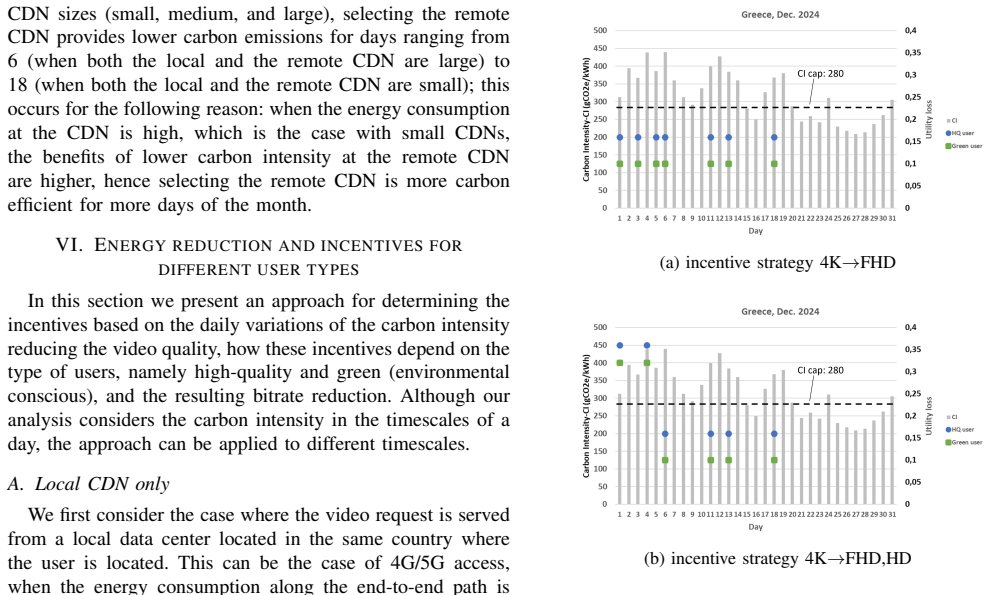
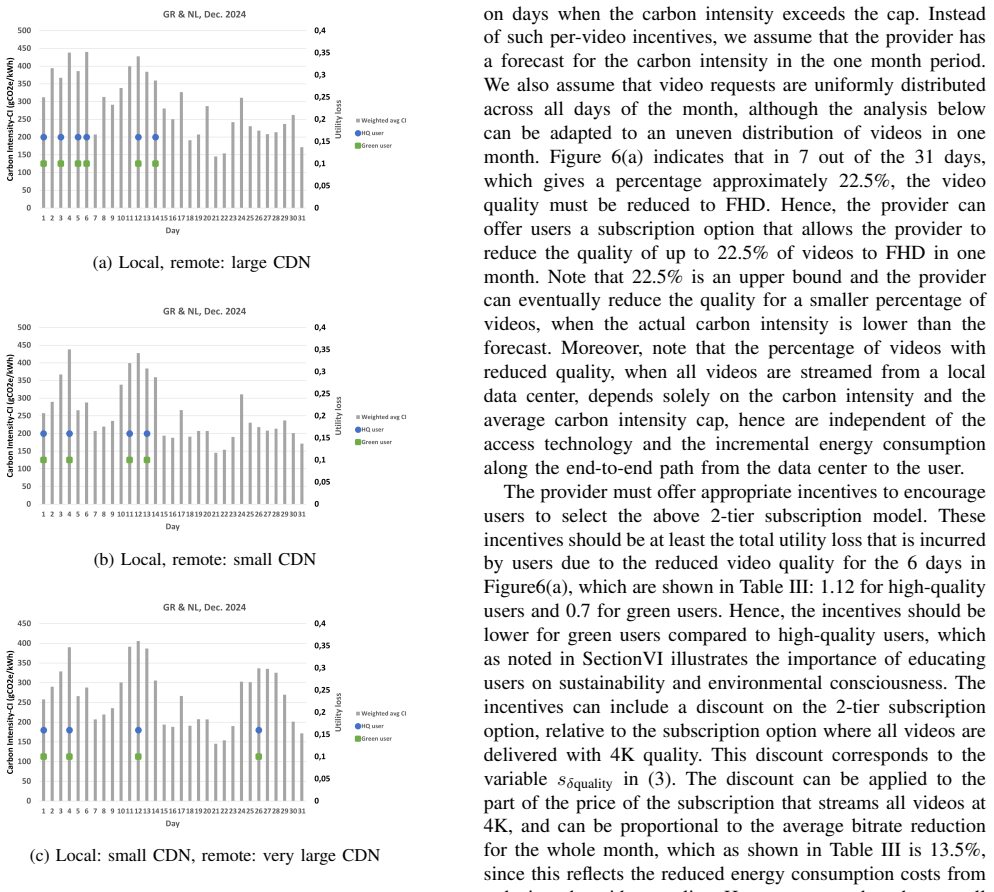
The incentives for lower-quality streaming depend on the energy consumption of video segments, the carbon intensity of the delivery path, and whether users are quality-sensitive or environmentally conscious. A practical two-tier subscription provides a discount plus carbon rewards and allows providers to reduce quality for up to a maximum percentage of videos within a time window. When video comes from a local data center, that maximum percentage depends solely on carbon intensity and the average intensity cap, while incentives also reflect users' environmental consciousness. When video can come from either a local or remote data center with different intensities, the maximum percentage and
What carries the argument
Two-tier subscription model with discount and carbon rewards, which sets a maximum percentage of videos that can be streamed at reduced quality based on carbon intensity, energy consumption, and user type.
If this is right
- Providers can set the reduced-quality tier one resolution level below maximum user satisfaction to balance incentives and satisfaction.
- For local-only delivery the maximum share of lower-quality videos is fixed by carbon intensity and the average cap alone.
- For local-versus-remote delivery both the share and incentive levels also depend on relative carbon intensity, energy use, and extra network costs.
- Incentives scale with users' measured level of environmental consciousness.
Where Pith is reading between the lines
- The same structure could be adapted to other bandwidth-intensive services such as cloud gaming or live events.
- Over time, repeated exposure to lower-quality streams might shift user expectations downward even for non-green users.
- Accurate real-time carbon-intensity signals from data centers and networks become a necessary infrastructure for the model to work at scale.
Load-bearing premise
Users will actually respond to the modeled incentives by accepting lower quality in exchange for rewards, and carbon intensity plus energy use can be measured accurately enough to set the maximum percentage.
What would settle it
A controlled user study or field trial that measures the actual fraction of green users who switch to the reduced-quality tier when offered the modeled rewards and discounts.
Figures
read the original abstract
We investigate incentives for reducing the carbon emissions of video streaming that depend on the energy consumption of segments in the end-to-end video delivery path, the carbon intensity, and the user type, i.e., quality-sensitive and green or environmentally conscious users. The incentives can be offered through a practical 2-tier subscription model with a discount and carbon rewards, which gives providers the flexibility to reduce the quality for up to a maximum percentage of videos within a time period, such as one month. The key features of our approach are i) it is preferable to offer subscriptions where the reduced-quality tier is set one resolution level below the resolution required for maximum user satisfaction; ii) when a video is streamed from a local data center, the maximum percentage of videos streamed at a lower quality depends solely on the carbon intensity and the average intensity cap, whereas the incentives also depend on the users' level of environmental consciousness; iii) when a video can be streamed from a local or a remote data center with different carbon intensities, the maximum percentage of videos streamed at lower quality and the incentives depend on the relative carbon intensity and energy consumption at the data centers, and the additional network energy costs from the remote data center.
Editorial analysis
A structured set of objections, weighed in public.
Referee Report
Summary. The manuscript proposes a 2-tier subscription model for video streaming services that incentivizes reduced carbon emissions via discounts and carbon rewards. Users are segmented into quality-sensitive and environmentally conscious types; providers can reduce quality for up to a maximum percentage of streams per period. The central claims are that the reduced-quality tier should be set one resolution level below the level required for maximum user satisfaction, that the maximum allowable percentage of lower-quality streams when using a local data center depends only on carbon intensity and an average intensity cap (while incentives also depend on environmental consciousness), and that both the percentage and incentives depend on relative carbon intensities, energy consumption, and extra network costs when local and remote data centers are available.
Significance. If the modeling assumptions hold and the closed-form expressions are robust, the work supplies a practical, analytically tractable mechanism for carbon-aware incentives in a high-volume traffic class. The explicit dependence on data-center location and relative intensities, together with the parameter-light expressions for the maximum reduced-quality fraction, would be a concrete contribution to green networking. The absence of any empirical calibration of the user utility function or robustness checks, however, limits the immediate applicability and the strength of the optimality claims.
major comments (3)
- [§3] §3 (User utility model): The optimality of setting the reduced-quality tier one resolution below maximum satisfaction (claim i) and the closed-form expressions for the maximum percentage (claims ii–iii) are derived by maximizing provider revenue subject to a deterministic linear utility function that equates environmental consciousness directly to willingness to accept quality reduction. No sensitivity analysis or alternative functional forms are examined, so the load-bearing claims inherit any misspecification in this utility model.
- [§4] §4 (Local data-center case): The statement that the maximum percentage of lower-quality streams depends solely on carbon intensity and the average intensity cap follows from the optimization constraints, but the derivation assumes perfect, error-free knowledge of carbon intensity at subscription time. No propagation of measurement uncertainty or temporal variability is shown, which directly affects the claimed parameter-free character of the percentage.
- [§5] §5 (Local vs. remote data-center case): The inclusion of additional network energy costs for remote streaming is correctly identified as a distinguishing factor, yet the manuscript provides no procedure or data source for estimating these costs in an operational setting. Because the incentive levels and maximum percentage depend on this term, the practical utility of claim iii cannot be assessed without it.
minor comments (3)
- [Abstract] The abstract lists the three key features but does not indicate that they are obtained from an explicit optimization; a single sentence clarifying the modeling approach would improve readability.
- [§2] Notation for carbon intensity, energy per segment, and the environmental-consciousness parameter is introduced piecemeal; a consolidated table of symbols at the beginning of the model section would reduce cross-referencing.
- [§6] Figure captions for the numerical illustrations do not state the exact parameter values used for carbon intensity and user-type fractions, making reproduction difficult.
Simulated Author's Rebuttal
We thank the referee for the constructive feedback on our manuscript. We address each major comment below, indicating planned revisions where appropriate while defending the analytical contributions of the work.
read point-by-point responses
-
Referee: [§3] §3 (User utility model): The optimality of setting the reduced-quality tier one resolution below maximum satisfaction (claim i) and the closed-form expressions for the maximum percentage (claims ii–iii) are derived by maximizing provider revenue subject to a deterministic linear utility function that equates environmental consciousness directly to willingness to accept quality reduction. No sensitivity analysis or alternative functional forms are examined, so the load-bearing claims inherit any misspecification in this utility model.
Authors: The deterministic linear utility model was deliberately chosen to derive closed-form expressions that explicitly reveal the dependence of optimal parameters on carbon intensity, energy consumption, and user environmental awareness—the central analytical contribution. This functional form is standard in incentive mechanism design because it yields tractable solutions without sacrificing the ability to obtain the stated claims. We agree that sensitivity analysis would be beneficial and will add a dedicated discussion paragraph in the revised manuscript examining the robustness of the optimality results under the linear assumption, while noting alternative forms as future work. revision: partial
-
Referee: [§4] §4 (Local data-center case): The statement that the maximum percentage of lower-quality streams depends solely on carbon intensity and the average intensity cap follows from the optimization constraints, but the derivation assumes perfect, error-free knowledge of carbon intensity at subscription time. No propagation of measurement uncertainty or temporal variability is shown, which directly affects the claimed parameter-free character of the percentage.
Authors: The model is formulated for subscription design where providers use forecasted or average carbon intensity values available at the planning stage, consistent with real-time data sources used in practice. The parameter-free character of the maximum percentage holds under this information structure and isolates the effect of the intensity cap. We acknowledge that measurement error and variability are relevant in deployment; the revised manuscript will include an explicit statement of this modeling assumption together with a brief remark on how stochastic extensions could be pursued. revision: partial
-
Referee: [§5] §5 (Local vs. remote data-center case): The inclusion of additional network energy costs for remote streaming is correctly identified as a distinguishing factor, yet the manuscript provides no procedure or data source for estimating these costs in an operational setting. Because the incentive levels and maximum percentage depend on this term, the practical utility of claim iii cannot be assessed without it.
Authors: We will revise §5 to include a short estimation procedure referencing established models for network energy consumption (e.g., power models based on data volume and distance from the literature on CDN and core-network energy use). Operators can obtain the additional cost term from internal monitoring or public datasets such as those provided by the IEA or Green Web Foundation. This addition will make the dependence in claim iii directly usable. revision: yes
Circularity Check
No significant circularity detected; derivations rest on external assumptions rather than self-referential reduction.
full rationale
The abstract and provided excerpts state closed-form dependencies for maximum reduced-quality percentages on carbon intensity, energy consumption, and environmental consciousness parameters. No quoted equations or sections exhibit self-definitional loops, fitted inputs renamed as predictions, or load-bearing self-citations that collapse the central claims back to the inputs by construction. The utility model and optimization steps are presented as given inputs to the analysis, not derived from the target results themselves. This is the normal case of a model-based paper whose predictions inherit modeling assumptions but do not circularly presuppose their own outputs.
Axiom & Free-Parameter Ledger
free parameters (2)
- maximum percentage of lower-quality videos
- discount and carbon reward levels
axioms (2)
- domain assumption Users can be partitioned into quality-sensitive and green/environmentally conscious types whose responses to incentives are predictable and stable.
- domain assumption Carbon intensity and end-to-end energy consumption of local and remote data centers can be accurately quantified and compared.
Lean theorems connected to this paper
-
IndisputableMonolith/Cost/FunctionalEquation.leanwashburn_uniqueness_aczel unclear?
unclearRelation between the paper passage and the cited Recognition theorem.
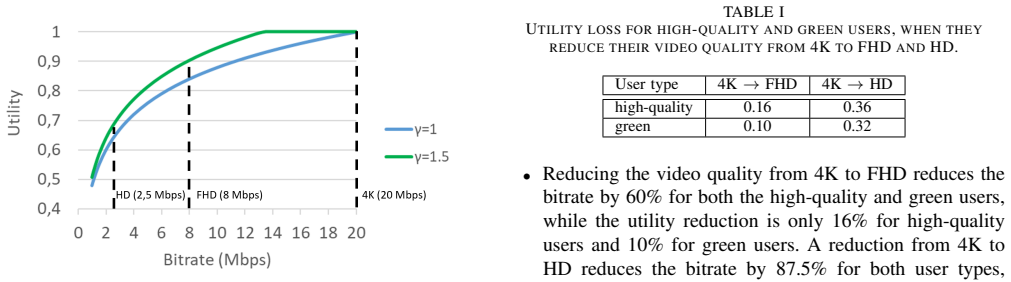
We consider a user utility for video streaming based on the Mean Opinion Score (MOS) formulation in [4]: MOS_γ(x) = 4 / (log(x'_max) - log(x_min)) * log(x) + ... with greenness factor γ > 1
-
IndisputableMonolith/Foundation/AlphaCoordinateFixation.leanJ_uniquely_calibrated_via_higher_derivative unclear?
unclearRelation between the paper passage and the cited Recognition theorem.
the maximum percentage of videos streamed at a lower quality depends solely on the carbon intensity and the average intensity cap
What do these tags mean?
- matches
- The paper's claim is directly supported by a theorem in the formal canon.
- supports
- The theorem supports part of the paper's argument, but the paper may add assumptions or extra steps.
- extends
- The paper goes beyond the formal theorem; the theorem is a base layer rather than the whole result.
- uses
- The paper appears to rely on the theorem as machinery.
- contradicts
- The paper's claim conflicts with a theorem or certificate in the canon.
- unclear
- Pith found a possible connection, but the passage is too broad, indirect, or ambiguous to say the theorem truly supports the claim.
Reference graph
Works this paper leans on
-
[1]
R. Madlener, S. Sheykhha, W. Briglauer, “The electricity- and CO2- saving potentials offered by regulation of European video-streaming services,” Energy Policy, vol. 161, 112716, 2022
work page 2022
-
[2]
P. Suski, J. Pohl, V . Frick, “All you can stream: Investigating the role of user behavior for greenhouse gas intensity of video streaming,” inProc. of the 7th International Conference on ICT for Sustainability (ICT4S), 2020
work page 2020
-
[3]
B. T. Seger, J. Burkhardt, F. Straub, S. Scherz, G. Nieding, “Reducing the Individual Carbon Impact of Video Streaming: A Seven-Week Intervention Using Information, Goal Setting, and Feedback,” Journal of Consumer Policy, vol. 46, pp. 137-153, February 2023
work page 2023
-
[4]
A Greener Experience: Trade-Offs between QoE and CO2 Emissions in Today’s and 6G Networks,
T. Hoßfeld, M. Varela, L. Skorin-Kapov, P. E. Heegaard, “A Greener Experience: Trade-Offs between QoE and CO2 Emissions in Today’s and 6G Networks,” IEEE Communications Magazine, vol. 61, no. 9, pp. 178-184, September 2023
work page 2023
-
[5]
An Analysis of the Trade-off between Sustainability and Quality of Experience for Video Streaming
G. Bing ¨ol, S. Porcu, A. Floris, L. Atzori, “An Analysis of the Trade-off between Sustainability and Quality of Experience for Video Streaming”, inProc. of IEEE International Conference on Communications Work- shops (ICC Workshops), 2023
work page 2023
-
[6]
Sustainability vs. Quality of Experience: Striking the Right Balance for Video Streaming,
G. Bing ¨ol, “Sustainability vs. Quality of Experience: Striking the Right Balance for Video Streaming,” ACM SIG Multimedia Records, vol. 15, issue 2, 2024
work page 2024
-
[7]
The carbon footprint of streaming video: fact-checking the headlines,
G. Kamiya, “The carbon footprint of streaming video: fact-checking the headlines,” International Energy Agency (IEA), 10 December 2020. Retrieved 26 November, 2025
work page 2020
-
[8]
J. Malmodin, “The power consumption of mobile and fixed network data services-The case of streaming video and downloading large files,” inInternational Congress Electronics Goes Green, 2020
work page 2020
-
[9]
Evaluation and projection of 4G and 5G RAN energy footprints: the case of Belgium for 2020–2025,
L. Golard, J. Louveaux, D. Bol, “Evaluation and projection of 4G and 5G RAN energy footprints: the case of Belgium for 2020–2025,” Annals of Telecommunications, vol. 78, pp. 313–327, 2023
work page 2020
-
[10]
Assessing V oD pressure on network power consumption
G. Guennebaud, A. Bugeau, A. Dudouit, “Assessing V oD pressure on network power consumption”, inProc. of IEEE International Conference on ICT for Sustainability (ICT4S), 2023
work page 2023
-
[11]
D. Mytton, D. Lund ´en, J. Malmodin, “Network energy use not directly proportional to data volume: The power model approach for more reliable network energy consumption calculations”, Journal of Industrial Ecology, vol. 28, issue 4, pp. 966-980, 2024
work page 2024
-
[12]
2024 United States Data Center Energy Usage Re- port
A. Shehabi et al, “2024 United States Data Center Energy Usage Re- port”, Energy Analysis and Environmental Impacts Division, Lawrence Berkeley National Laboratory, LBNL-2001637, December 2024
work page 2024
-
[13]
H. Viswanathan, S. Wesemann, J. Du, H. Holma, ”Energy efficiency in next-generation mobile networks”, Nokia Bell Labs white paper, February 2025
work page 2025
- [14]
-
[15]
Carbon-Intelligent Content Scheduling in CDNs
S. El-Zahr, W. Nathan, N. Zilberman, “Carbon-Intelligent Content Scheduling in CDNs”, inProc. of ANRW ’25: Proceedings of the 2025 Applied Networking Research Workshop, 2025
work page 2025
-
[16]
Carbon-Aware Online Control of Geo-Distributed Cloud Services
Z. Zhou et al., “Carbon-Aware Online Control of Geo-Distributed Cloud Services”, IEEE Transactions on Parallel and Distributed Systems, vol. 27, no. 9, pp. 2506-2519, 2016
work page 2016
-
[17]
Energy Efficiency in 3GPP technologies
A. Sultan, “Energy Efficiency in 3GPP technologies”, 3GPP, https://www.3gpp.org/technologies/deep-dive/ee-article, July 08, 2024. Last Updated April 08, 2025
work page 2024
-
[18]
Path Energy Traffic Ratio API (PETRA)
A. Rodriguez-Natal, L. M. Contreras, M. Palmero, J. Lindblad, A. Gallego Sanchez, “Path Energy Traffic Ratio API (PETRA)”, IETF draft- petra-green-api-02, 20 October, 2025. 10
work page 2025
discussion (0)
Sign in with ORCID, Apple, or X to comment. Anyone can read and Pith papers without signing in.