Recent Neutrino Oscillation and Cross-Section Results from the T2K Experiment
Pith reviewed 2026-05-10 17:12 UTC · model grok-4.3
The pith
T2K's latest results use gadolinium-loaded detector data and new cross-section measurements to advance the search for neutrino charge-parity violation.
A machine-rendered reading of the paper's core claim, the machinery that carries it, and where it could break.
Core claim
Recent T2K results incorporate the first gadolinium-loaded far detector data for oscillation measurements while adding world-first cross-section results on rare channels, showing that high-statistics near-detector interaction data directly improves the precision and reliability of the far-detector search for leptonic charge-parity violation.
What carries the argument
The near detector complex, which supplies high-statistics neutrino-nucleus cross-section measurements across different targets to constrain the interaction models used in the far-detector oscillation fit.
Load-bearing premise
Near-detector cross-section measurements constrain the neutrino-nucleus interaction models used in the far-detector oscillation fit without leaving significant biases from unmeasured channels or nuclear effects.
What would settle it
A persistent discrepancy in far-detector event rates or energy spectra that remains after fitting both oscillation parameters and near-detector constraints, pointing to incomplete modeling of neutrino interactions.
Figures
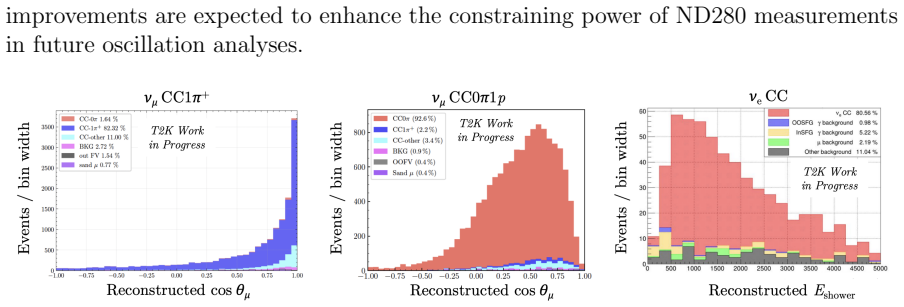
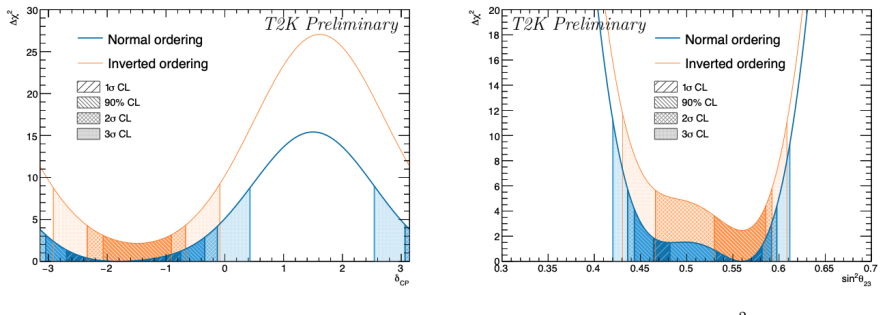
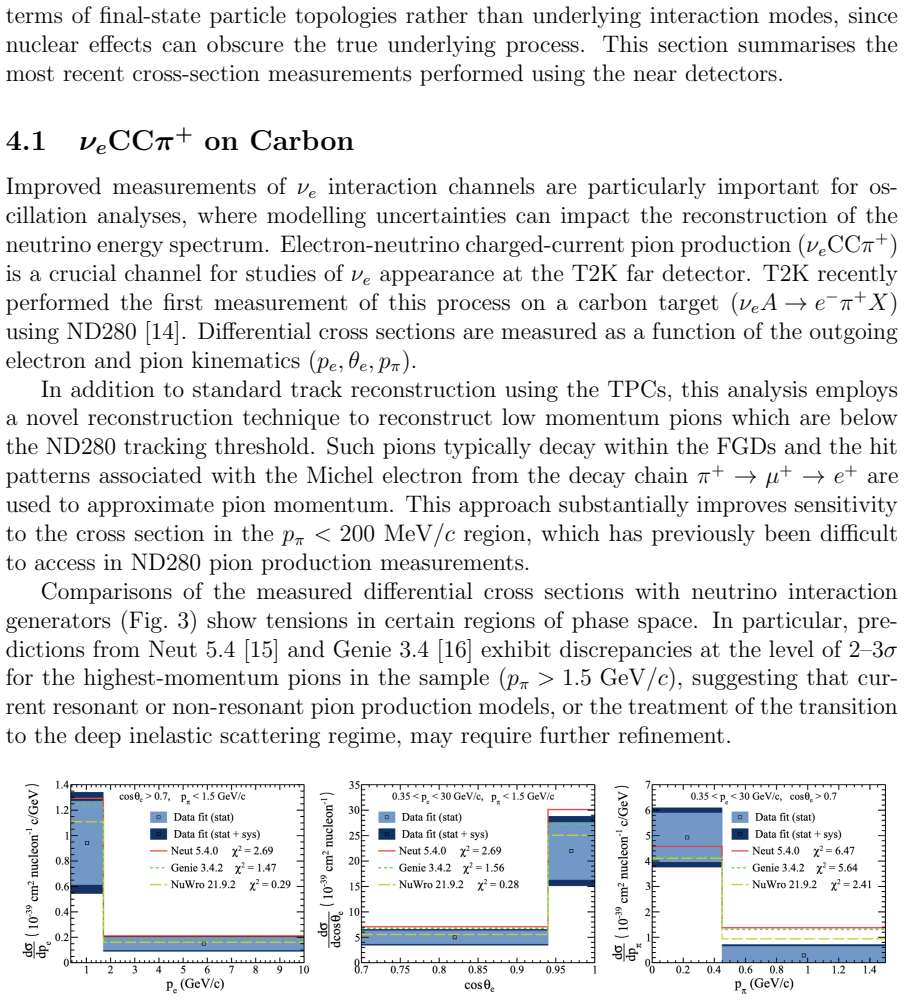
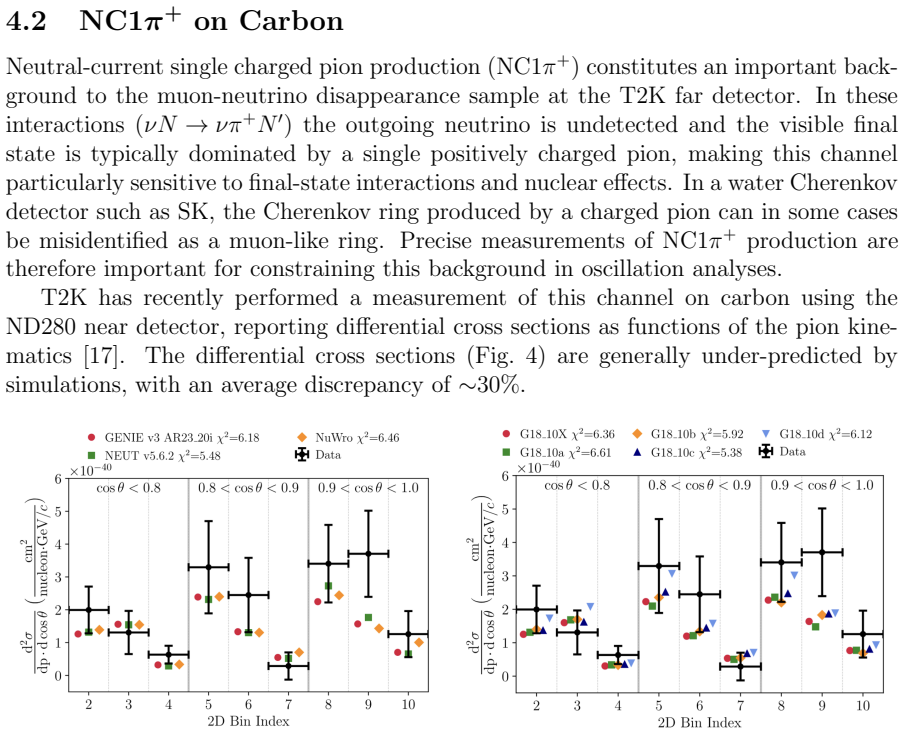
read the original abstract
The T2K long-baseline neutrino oscillation experiment in Japan continues to lead the search for leptonic charge-parity violation while providing precision measurements of mixing and mass splitting parameters. Central to this programme is the mitigation of systematic uncertainties through the near detector complex, which provides high-statistics neutrino-nucleus interaction cross-section measurements across various targets. This contribution presents the latest T2K oscillation results, incorporating the first data with a gadolinium-loaded far detector, and highlights several recent cross-section measurements, including several world-first measurements of rare interaction channels. Together, these results demonstrate the vital synergy between interaction modelling and oscillation analysis in the search for charge-parity violation in the T2K-II era.
Editorial analysis
A structured set of objections, weighed in public.
Referee Report
Summary. The manuscript summarizes recent T2K results on neutrino oscillations, incorporating the first data from a gadolinium-loaded far detector, alongside new cross-section measurements on multiple targets that include several world-first observations of rare interaction channels. It positions these as demonstrating the synergy between interaction modeling from the near detector and oscillation analyses for improved CP-violation searches in the T2K-II era.
Significance. If the presented results hold after detailed scrutiny, they provide timely updates to T2K's oscillation parameters and cross-section database, with the Gd-loaded data marking progress toward higher-statistics analyses. The rare-channel measurements add value by constraining previously unmeasured neutrino-nucleus processes, supporting the broader goal of reducing systematics in long-baseline experiments.
major comments (1)
- The central claim of synergy between ND cross-section measurements and FD oscillation fits (including the new Gd-loaded sample) is load-bearing for the paper's narrative, yet the oscillation results section provides no explicit propagation of the latest ND constraints into the FD systematic error budget, no updated covariance matrices, and no bias tests for residual nuclear effects or target differences in the Gd-tagged events. Without these, it is not possible to verify that unmeasured kinematic regions or 2p2h/FSI modeling uncertainties have been adequately controlled.
minor comments (2)
- The abstract contains no numerical results, central values, or uncertainty ranges for either the oscillation parameters or cross sections, reducing its utility as a standalone summary.
- Figure captions and axis labels in the cross-section results section should explicitly state the target nuclei and kinematic ranges covered by the new measurements to allow direct comparison with prior T2K and external data.
Simulated Author's Rebuttal
We thank the referee for their careful and constructive review of our manuscript. We address the major comment below, providing an honest assessment of the current content and indicating revisions that will be incorporated to strengthen the presentation of the synergy between near- and far-detector results.
read point-by-point responses
-
Referee: The central claim of synergy between ND cross-section measurements and FD oscillation fits (including the new Gd-loaded sample) is load-bearing for the paper's narrative, yet the oscillation results section provides no explicit propagation of the latest ND constraints into the FD systematic error budget, no updated covariance matrices, and no bias tests for residual nuclear effects or target differences in the Gd-tagged events. Without these, it is not possible to verify that unmeasured kinematic regions or 2p2h/FSI modeling uncertainties have been adequately controlled.
Authors: We agree that explicit documentation of how the latest ND constraints propagate into the FD systematic error budget would strengthen the narrative, particularly for the new Gd-loaded sample. The current oscillation results section relies on the established analysis framework from prior T2K publications, in which ND cross-section measurements on multiple targets have already been used to constrain interaction models (including 2p2h and FSI effects) and to construct the covariance matrices applied to the FD fits. The Gd-loaded data primarily improves neutron tagging efficiency for better energy reconstruction and does not introduce new target materials or kinematic regions beyond those already constrained by ND data. However, we acknowledge that this manuscript does not contain a dedicated paragraph or figure explicitly showing the updated error budget, the most recent covariance matrices, or bias tests specific to residual nuclear effects in the Gd-tagged events. To address this, we will add a concise subsection (or expanded paragraph) in the oscillation results section that (i) references the relevant ND publications and their covariance matrices, (ii) states how these constraints are propagated to the FD analysis, and (iii) notes that dedicated bias studies for the Gd sample are part of ongoing work and will appear in future dedicated papers. These textual additions will make the synergy more transparent without requiring new numerical analyses or altering the reported results. revision: partial
Circularity Check
No circularity: experimental results presentation with no derivation chain
full rationale
The document is a conference contribution reporting measured oscillation results (including first Gd-loaded far-detector data) and cross-section measurements from T2K. No equations, first-principles derivations, fitted parameters renamed as predictions, or uniqueness theorems are presented. The asserted synergy between near-detector constraints and far-detector analysis is a qualitative statement about the experimental program rather than a mathematical reduction of outputs to inputs by construction. The paper is therefore self-contained as a report of direct measurements against external data.
Axiom & Free-Parameter Ledger
Reference graph
Works this paper leans on
- [1]
-
[2]
Y. Fukuda et al. (Super-Kamiokande Collaboration). The Super-Kamiokande de- tector.Nucl. Instrum. Meth. A, 501:418–462, 2003
work page 2003
-
[3]
O’Keeffe, on behalf of the T2K Collaboration
H. O’Keeffe, on behalf of the T2K Collaboration. Status and plans for T2K neutrino oscillation analyses. Contribution to NuFact 2025, Liverpool, September 2025. indico.cern.ch/event/1528564/contributions/6619084/
-
[4]
L. Kneale. Supernova spotting in Super-Kamiokande Gd. InProspects in Neutrino Physics, 2024
work page 2024
-
[5]
P. A. Amaudruz et al. The T2K Fine-Grained Detectors.Nucl. Instrum. Meth. A, 696:1–31, 2012
work page 2012
-
[6]
N. Abgrall et al. Time Projection Chambers for the T2K Near Detectors.Nucl. Instrum. Meth. A, 637:25–46, 2011
work page 2011
-
[7]
M. Antonova et al. (Baby MIND Collaboration). Baby MIND: A Magnetized Seg- mented Neutrino Detector for the WAGASCI Experiment.JINST, 12(07):C07028, 2017
work page 2017
- [8]
- [9]
-
[10]
Giganti, on behalf of the T2K Collaboration
C. Giganti, on behalf of the T2K Collaboration. T2K Experiment Sta- tus and Plans. Presented at the XXXI International Conference on Neu- trino Physics and Astrophysics (Neutrino 2024), Milan, Italy, June 2024. agenda.infn.it/event/37867/contributions/233954/
work page 2024
-
[11]
A. Habig et al. (NOvA Collaboration). The NOvA Experiment.Nucl. Phys. B Proc. Suppl., 229-232:460–460, 2012
work page 2012
- [12]
-
[13]
M. A. Acero et al. (T2K and NOvA Collaborations). Joint neutrino oscillation analysis from the T2K and NOvA experiments.Nature, 646:818–824, 2025
work page 2025
- [14]
-
[15]
Y. Hayato and L. Pickering. The NEUT neutrino interaction simulation program library.Eur. Phys. J. ST, 230(24):4469–4481, 2021
work page 2021
-
[16]
J. Tena-Vidal et al. Neutrino-nucleon cross-section model tuning in GENIE v3. Phys. Rev. D, 104(7):072009, 2021
work page 2021
- [17]
- [18]
-
[19]
Zhao, on behalf of the T2K Collaboration
X. Zhao, on behalf of the T2K Collaboration. Latest CC0πCross-Section Mea- surements from T2K. Presentation at NuInt 2025, Mainz, Germany, October 2025. indico.fnal.gov/event/64969/contributions/317924/
work page 2025
-
[20]
X. G. Lu, L. Pickering, S. Dolan, G. Barr, D. Coplowe, Y. Uchida, D. Wark, M. O. Wascko, A. Weber, and T. Yuan. Measurement of nuclear effects in neutrino inter- actions with minimal dependence on neutrino energy.Phys. Rev. C, 94(1):015503, 2016
work page 2016
-
[21]
X. G. Lu and J. T. Sobczyk. Identification of nuclear effects in neutrino and an- tineutrino interactions on nuclei using generalized final-state correlations.Phys. Rev. C, 99(5):055504, 2019. 9
work page 2019
-
[22]
A. P. Furmanski and J. T. Sobczyk. Neutrino energy reconstruction from one muon and one proton events.Phys. Rev. C, 95(6):065501, 2017. 10
work page 2017
discussion (0)
Sign in with ORCID, Apple, or X to comment. Anyone can read and Pith papers without signing in.