Colloquium: Radio astronomy with the Arecibo 305-m telescope: In contemporaneous context
Pith reviewed 2026-05-10 16:46 UTC · model grok-4.3
The pith
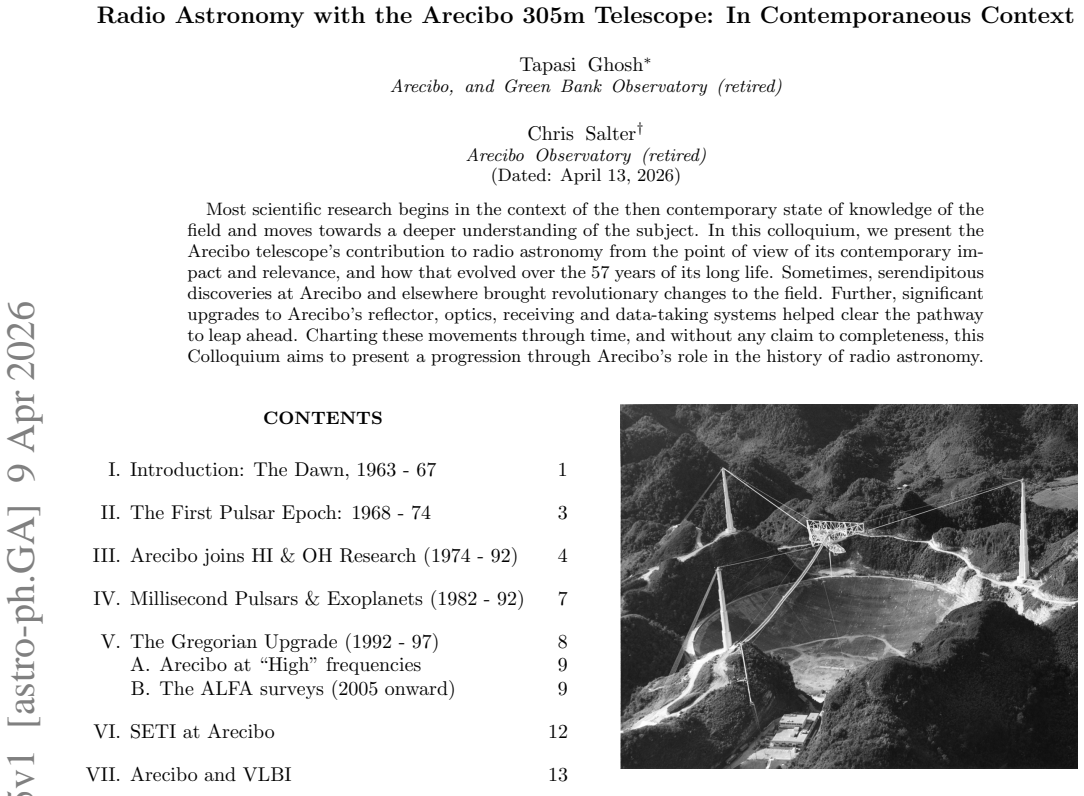
The Arecibo 305-m telescope advanced radio astronomy through 57 years of upgrades and serendipitous discoveries viewed in their contemporary context.
A machine-rendered reading of the paper's core claim, the machinery that carries it, and where it could break.
Core claim
The Arecibo telescope contributed to radio astronomy by enabling key observations and undergoing successive upgrades that cleared pathways for advances, with these developments charted according to their contemporary state of knowledge and impact rather than retrospective judgment.
What carries the argument
The progression through time of the telescope's role, organized around serendipitous discoveries and upgrades to its physical and electronic systems.
If this is right
- Upgrades to reflector, optics, receivers, and data systems enabled successive leaps in observational reach.
- Serendipitous discoveries at Arecibo and elsewhere produced revolutionary changes in radio astronomy.
- Viewing contributions through their contemporary context reveals how relevance evolved across multiple eras.
- The telescope's long operational life allowed it to participate in and shape ongoing advances in the field.
Where Pith is reading between the lines
- Similar contemporaneous framing could clarify the historical role of other single-dish telescopes with long service lives.
- The emphasis on upgrades suggests that future large radio facilities should incorporate modular design for repeated improvements.
- The role of chance observations implies that survey strategies at new instruments should retain flexibility for unexpected signals.
Load-bearing premise
The selected events, discoveries, and upgrades accurately capture the telescope's contemporary impact and relevance without significant omission or retrospective bias.
What would settle it
A documented major radio astronomy breakthrough or system upgrade at Arecibo during the 57-year period that is absent from the colloquium and demonstrably central to the field's development at the time it occurred.
Figures




read the original abstract
Most scientific research begins in the context of the then-contemporary state of knowledge of the field and moves toward a deeper understanding of the subject. This colloquium presents the Arecibo telescope$^{'}$s contribution to radio astronomy from the point of view of its contemporary impact and relevance and how that evolved over the 57 years of its long life. Sometimes, serendipitous discoveries at Arecibo and elsewhere brought revolutionary changes to the field. Further, significant upgrades to the reflector, optics, receiving, and data-taking systems helped clear a pathway for a leap ahead. Charting these movements through time and without any claim to completeness, this Colloquium presents a progression through Arecibo telescope$^{'}$s role in the history of radio astronomy.
Editorial analysis
A structured set of objections, weighed in public.
Referee Report
Summary. The manuscript is an invited colloquium presenting a chronological narrative of the Arecibo 305-m telescope's contributions to radio astronomy, framed through the lens of its contemporary impact and relevance over 57 years of operation. It highlights serendipitous discoveries and key upgrades to the reflector, optics, receivers, and data systems that advanced the field, while explicitly disclaiming any claim to completeness.
Significance. If the factual recounting holds, the paper supplies a useful historical perspective on the evolution of radio astronomy via one of its most iconic instruments. By organizing events around contemporaneous context rather than retrospective judgment, it illustrates the interplay between instrumental capability and scientific progress. The modest framing (no completeness claim, no quantitative predictions or derivations) is a strength that aligns the scope with what a narrative can reliably deliver.
Simulated Author's Rebuttal
We thank the referee for the positive assessment of the manuscript and the recommendation to accept. The review accurately captures the scope and intent of this invited colloquium as a chronological narrative of the Arecibo telescope's contributions framed in contemporaneous context, without any claim to completeness.
Circularity Check
No significant circularity: historical narrative without derivations or predictions
full rationale
The paper is an invited colloquium that explicitly frames its content as one possible progression through Arecibo's role in radio astronomy history, with the statement 'without any claim to completeness.' It contains no equations, no quantitative predictions, no fitted parameters, and no load-bearing self-citations or uniqueness theorems. The central claim reduces only to presenting a selected historical narrative, which is satisfied by construction once the text is written but does not involve any self-definitional loops, fitted inputs renamed as predictions, or ansatzes smuggled via citation. This is a self-contained historical account with no derivation chain to inspect for circularity.
Axiom & Free-Parameter Ledger
Reference graph
Works this paper leans on
-
[1]
Arecibo Ionospheric Observatory
W. E. Gordon, “Arecibo Ionospheric Observatory”, Sci- ence146, 26 (1964)
work page 1964
-
[2]
Schmidt, 3C 273 : A Star-Like Object with Large Red-Shift, Nature197, 1040 (1963)
M. Schmidt, 3C 273 : A Star-Like Object with Large Red-Shift, Nature197, 1040 (1963)
work page 1963
-
[3]
R. C. Jennison and M. K. Das Gupta, Fine Structure of the Extra-terrestrial Radio Source Cygnus I, Nature 172, 996 (1953)
work page 1953
-
[4]
D. O. Edge, J. R. Shakeshaft, W. B. McAdam, J. E. Baldwin, and S. Archer, A survey of radio sources at a frequency of 159 Mc/s., Memoirs of the Royal Astro- nomical Society68, 37 (1959)
work page 1959
-
[5]
J. D. H. Pilkington and J. F. Scott, A survey of radio sources between declinations 20°and 40°, Memoirs of the Royal Astronomical Society69, 183 (1965)
work page 1965
-
[6]
J. F. R. Gower, P. F. Scott, and D. Wills, A survey of radio sources in the declination ranges – 07°to 20°and 40°to 80°, Memoirs of the Royal Astronomical Society 71, 49 (1967)
work page 1967
-
[7]
B. Y. Mills, O. B. Slee, and E. R. Hill, A Catalogue of Radio Sources between Declinations +10°and -20°, Australian Journal of Physics11, 360 (1958)
work page 1958
-
[8]
K. I. Kellermann, The Spectra of Non-Thermal Radio Sources., ApJ140, 969 (1964)
work page 1964
-
[9]
A. A. Penzias and R. W. Wilson, A Measurement of Excess Antenna Temperature at 4080 Mc/s., ApJ142, 419 (1965)
work page 1965
-
[10]
H. Bondi and T. Gold, The Steady-State Theory of the Expanding Universe, MNRAS108, 252 (1948)
work page 1948
-
[11]
D. Altschuler and C. Salter, The Arecibo Observatory: Fifty Astronomical Years, Physics Today66, 43 (2013)
work page 2013
-
[12]
G. H. Pettengill, Arecibo Observatory, Arecibo, Puerto Rico. Report 1969-1970., inBulletin of the American Astronomical Society, Vol. 3 (1971) pp. 30–34
work page 1969
-
[13]
Hazard, Lunar Occultation of a Radio Source, Nature 191, 58 (1961)
C. Hazard, Lunar Occultation of a Radio Source, Nature 191, 58 (1961)
work page 1961
-
[14]
C. Hazard, The method of lunar occultations and its application to a survey of the radio sources 3C 212, MN- RAS124, 343 (1962)
work page 1962
-
[15]
P. A. G. Scheuer, On the Use of Lunar Occultations for Investigating the Angular Structure of Radio Sources, Australian Journal of Physics15, 333 (1962)
work page 1962
- [16]
- [17]
- [18]
-
[19]
K. R. Lang, J. Sutton, C. Hazard, and S. Gulkis, Ad- ditional Occultation Studies of Weak Radio Sources at Arecibo Observatory: lIST 4, ApJ160, 17 (1970)
work page 1970
- [20]
-
[21]
M. H. Cohen, E. J. Gundermann, and D. E. Harris, Radio Sources Studied by Interplanetary Scintillations., AJ71, 158 (1966)
work page 1966
-
[22]
M. H. Cohen, E. J. Gundermann, H. E. Hardebeck, D. E. Harris, and L. E. Sharp, Interplanetary scintil- lations. II. Observations, AJ71, 850 (1966)
work page 1966
-
[23]
M. H. Cohen, E. J. Gundermann, H. E. Hardebeck, D. E. Harris, E. E. Salpeter, and L. E. Sharp, Radio Sources: Angular Size from Scintillation Studies, Sci- ence153, 745 (1966)
work page 1966
-
[24]
M. H. Cohen, E. J. Gundermann, H. E. Hardebeck, and L. E. Sharp, Interplanetary Scintillations. II Observa- tions, ApJ147, 449 (1967)
work page 1967
-
[25]
M. H. Cohen and E. J. Gundermann, Angular Diameter of 3c 279 from Interplanetary Scintillations, ApJ Letters 148, L49 (1967)
work page 1967
-
[26]
M. H. Cohen, E. J. Gundermann, and D. E. Harris, New Limits on the Diameters of Radio Sources, ApJ150, 767 (1967). 19
work page 1967
-
[27]
D. E. Harris and E. J. Gundermann, Interplanetary Scintillations. V. A Survey of the Northern Ecliptic, The Astronomical Journal Supplement73, 17 (1968)
work page 1968
-
[28]
M. H. Cohen, E. J. Gundermann, D. E. Harris, and G. Zeissig, Structure of Scintillating Radio Sources., The Astronomical Journal Supplement73, 171 (1968)
work page 1968
-
[29]
M. H. Cohen and E. J. Gundermann, Interplanetary Scintillations. IV. Observations Near the Sun, ApJ155, 645 (1969)
work page 1969
-
[30]
Terzian, Observations of Planetary Nebulae at Radio Wavelengths., AJ71, 182 (1966)
Y. Terzian, Observations of Planetary Nebulae at Radio Wavelengths., AJ71, 182 (1966)
work page 1966
-
[31]
Y. Terzian and A. Parrish, Observations of the Orion Nebula at Low Radio Frequencies, Astrophysical Letters 5, 261 (1970)
work page 1970
- [32]
-
[33]
W. J. Cocke, M. J. Disney, and D. J. Taylor, Discovery of Optical Signals from Pulsar NP 0532, Nature221, 525 (1969)
work page 1969
-
[34]
J. W. Cooley and J. W. Tukey, An algorithm for the machine calculation of complex Fourier series, Math. Comput.19(90), 297 (1965)
work page 1965
-
[35]
H. D. Craft, R. V. E. Lovelace, and J. M. Sutton, New pulsar., IAU Circ.2100, 1 (1968)
work page 1968
-
[36]
F. D. Drake and H. D. Craft, Jr., Pulse Structure of Four Pulsars, Science160, 758 (1968)
work page 1968
-
[37]
H. D. Craft and J. M. Comella, Frequency Dependent Pulse Widths for CP 1133, Nature220, 676 (1968)
work page 1968
-
[38]
J. M. Rankin, J. M. Comella, H. D. Craft, Jr., D. W. Richards, D. B. Campbell, and C. C. Counselman, III, Radio Pulse Shapes, Flux Densities, and Dispersion of Pulsar NP 0532, ApJ162, 707 (1970)
work page 1970
-
[39]
D. C. Backer, Peculiar Pulse Burst in PSR 1237 + 25, Nature228, 1297 (1970)
work page 1970
-
[40]
C. C. Counselman, III and J. M. Rankin, Multipath Delay Distortion of Radio Pulses from NP 0532, ApJ 166, 513 (1971)
work page 1971
-
[41]
K. Davidson and Y. Terzian, Galactic HII and the Dispersion Measures of the Pulsars, Nature221, 729 (1969)
work page 1969
-
[42]
K. Davidson and Y. Terzian, Dispersion Measures of Pulsars, AJ74, 849 (1969)
work page 1969
-
[43]
H. D. Craft, Jr.,Radio Observations of the Pulse Pro- files and Dispersion Measures of Twelve Pulsars., Ph.D. thesis, Cornell University, New York (1970)
work page 1970
-
[44]
D. B. Campbell and C. Heiles, Pulsar NP 0532: Average Polarization and Daily Variability at 430 MHz, Nature 225, 527 (1970)
work page 1970
-
[45]
C. Heiles and D. B. Campbell, Pulsar NP 0532: Prop- erties and Systematic Polarization of Individual Strong Pulses at 430 MHz, Nature226, 529 (1970)
work page 1970
-
[46]
K. R. Lang, Interstellar Scintillations of Pulsar Radia- tion, Science166, 1401 (1969)
work page 1969
-
[47]
K. R. Lang, Size and Motion of the Interstellar Scin- tillation Pattern from Observations of CP 1133, Nature 225, 528 (1970)
work page 1970
-
[48]
K. R. Lang, Interstellar Scintillation of Pulsar Radia- tion, ApJ164, 249 (1971)
work page 1971
-
[49]
D. W. Richards, G. H. Pettengill, C. C. Counselman, III, and J. M. Rankin, Quasi-Sinusoidal Oscillation in Arrival Times of Pulses from NP 0532, ApJ Letters160, L1 (1970)
work page 1970
-
[50]
J. M. Rankin, C. C. Counselman, III, and D. W. Richards, Crab Nebula Pulsar Radio Pulse Arrival Times at Arecibo Observatory, AJ76, 686 (1971)
work page 1971
-
[51]
J. M. Rankin, C. C. Counselman, III, and D. W. Richards, Erratum: Crab Nebula Pulsar Radio Pulse Arrival Times at Arecibo Observatory, AJ76, 1154 (1971)
work page 1971
-
[52]
R. V. E. Lovelace, J. M. Sutton, and H. D. Craft, Pulsar NP 0532 Near Crab Nebula, IAU Circ.2113, 1 (1968)
work page 1968
-
[53]
Gold, Rotating Neutron Stars as the Origin of the Pulsating Radio Sources, Nature218, 731 (1968)
T. Gold, Rotating Neutron Stars as the Origin of the Pulsating Radio Sources, Nature218, 731 (1968)
work page 1968
-
[54]
Drake, Radio Observations of the Crab Nebula Pul- sar, inThe Crab Nebula, Vol
F. Drake, Radio Observations of the Crab Nebula Pul- sar, inThe Crab Nebula, Vol. 46, edited by R. D. Davies and F. Graham-Smith (1971) p. 73
work page 1971
-
[55]
A. E. Vaughan and M. I. Large, Pulsar observations at Molonglo, PASA1, 220 (1969)
work page 1969
-
[56]
M. L. Large and A. E. Vaughan, A search of the galac- tic plane for high dispersion pulsars, MNRAS151, 277 (1971)
work page 1971
-
[57]
A. E. Vaughan and M. I. Large, Discovery of three pul- sars, MNRAS156, 27P (1972)
work page 1972
-
[58]
A. G. Lyne and B. J. Rickett, Radio Observations of Five Pulsars, Nature219, 1339 (1968)
work page 1968
-
[59]
J. G. Davies and M. I. Large, A single-pulse search for pulsars, MNRAS149, 301 (1970)
work page 1970
-
[60]
J. G. Davies, M. I. Large, and A. C. Pickwick, Five New Pulsars, Nature227, 1123 (1970)
work page 1970
-
[61]
R. A. Hulse and J. H. Taylor, A High-Sensitivity Pulsar Survey, ApJ Letters191, L59 (1974)
work page 1974
-
[62]
J. H. Taylor, R. A. Hulse, B. Margon, A. David- sen, K. Mason, P. Sanford, W. Liller, P. L. Bernacca, F. Ciatti, R. S. John, V. H. Regener, C. Papaliolios, C. Pennypacker, C. Canizares, J. McClintock, B. Jones, D. Graham, and R. Wielebinski, Binary pulsar., IAU Circ.2704, 1 (1974)
work page 1974
-
[63]
J. M. Weisberg, D. J. Nice, and J. H. Taylor, Tim- ing Measurements of the Relativistic Binary Pulsar PSR B1913+16, ApJ722, 1030 (2010), arXiv:1011.0718 [astro-ph.GA]
work page Pith review arXiv 2010
-
[64]
J. M. Dickey, E. E. Salpeter, and Y. Terzian, Galactic neutral hydrogen emission-absorption observations from Arecibo., ApJ Suppl.36, 77 (1978)
work page 1978
-
[65]
S. R. Kulkarni, K. C. Turner, C. Heiles, and J. M. Dickey, The Arecibo-Los Canos spectral line interfer- ometer., ApJ Suppl.57, 631 (1985)
work page 1985
-
[66]
W. B. Burton, The Large-Scale Distribution of Neu- tral Hydrogen in the Galaxy, inGalactic and Extra- Galactic Radio Astronomy, edited by G. L. Verschuur, K. I. Kellermann, and V. van Brunt (Springer-Verlag,
-
[67]
G. L. Verschuur, Interstellar Neutral Hydrogen and Its Small-Scale Structure, inGalactic and Extra-Galactic Radio Astronomy, edited by G. L. Verschuur, K. I. Kellermann, and V. van Brunt (Springer-Verlag, 1974) p. 27
work page 1974
-
[68]
H. C. van de Hulst, C. A. Muller, and J. H. Oort, The spiral structure of the outer part of the Galactic Sys- tem derived from the hydrogen emission at 21 cm wave- length, Bulletin of the Astronimical Institutes of the Netherlands12, 117 (1954)
work page 1954
-
[69]
G. Westerhout, The distribution of atomic hydrogen in the outer parts of the Galactic System, Bulletin of the Astronimical Institutes of the Netherlands13, 201 (1957). 20
work page 1957
-
[70]
J. H. Oort, Neutral Hydrogen in Galaxies, Ricerche As- tronomiche5, 25 (1958)
work page 1958
-
[71]
F. J. Kerr, The Large-Scale Distribution of Hydrogen in the Galaxy, Annu. Rev. Astron. Astrophys.7, 39 (1969)
work page 1969
-
[72]
J. P. Hagen, A. E. Lilley, and E. F. McClain, Absorption of 21-CM Radiation by Interstellar Hydrogen., ApJ122, 361 (1955)
work page 1955
-
[73]
Heiles, H I shells and supershells, ApJ229, 533 (1979)
C. Heiles, H I shells and supershells, ApJ229, 533 (1979)
work page 1979
-
[74]
G. B. Field, D. W. Goldsmith, and H. J. Habing, Cosmic-Ray Heating of the Interstellar Gas, ApJ Letters 155, L149 (1969)
work page 1969
-
[75]
C. F. McKee and J. P. Ostriker, A theory of the inter- stellar medium: three components regulated by super- nova explosions in an inhomogeneous substrate., ApJ 218, 148 (1977)
work page 1977
-
[76]
V. Radhakrishnan, J. D. Murray, P. Lockhart, and R. P. J. Whittle, The Parkes Survey of 21-centimeter Absorption in Discrete-Source Spectra. II. Galactic 21- centimeter Observations in the Direction of 35 Extra- galactic Sources, ApJ Suppl.24, 15 (1972)
work page 1972
-
[77]
J. Crovisier, I. Kazes, and D. Aubry, Neutral hydrogen 21-cm galactic spectra observed at Arecibo towards 45 extragalactic radio sources, Astron. Astrophys. Suppli- ment41, 229 (1980)
work page 1980
-
[78]
J. Crovisier, Statistical Properties of Interstellar Neutral Hydrogen from 21-CM Absorption Surveys, A&A94, 162 (1981)
work page 1981
-
[79]
N. H. Dieter, W. J. Welch, and J. D. Romney, A very small interstellar neutral hydrogen cloud observed with VLBI techniques., ApJ Letters206, L113 (1976)
work page 1976
-
[80]
P. J. Diamond, W. M. Goss, J. D. Romney, R. S. Booth, P. M. W. Kalberla, and U. Mebold, The Structure of the Interstellar Medium at the 25 AU Scale, ApJ347, 302 (1989)
work page 1989
discussion (0)
Sign in with ORCID, Apple, or X to comment. Anyone can read and Pith papers without signing in.