Matrix Representations for Scale Functions of Spectrally Negative L\'evy Processes with Rational Jumps
Pith reviewed 2026-05-10 17:53 UTC · model grok-4.3
The pith
Spectrally negative Lévy processes with matrix-exponential jumps admit explicit scale function representations through rational arrival process embeddings.
A machine-rendered reading of the paper's core claim, the machinery that carries it, and where it could break.
Core claim
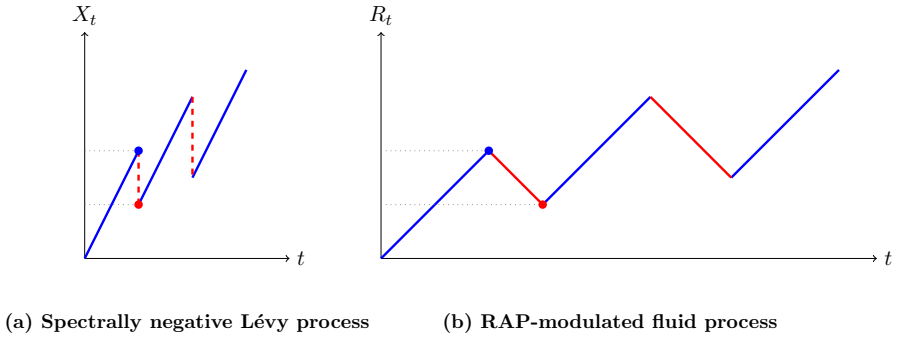
By embedding the spectrally negative Lévy process into a stochastic fluid process modulated by a rational arrival process, the q-scale function receives an explicit matrix representation constructed via iterative schemes that generalize the phase-type formulas.
What carries the argument
The embedding of the Lévy process into a stochastic fluid process modulated by a rational arrival process, which converts the scale-function problem into matrix-analytic iteration.
If this is right
- The scale function admits an explicit matrix representation for all matrix-exponential jump distributions.
- Iterative schemes compute the scale function without requiring the phase-type restriction.
- Exit probabilities and first-passage times inherit the same matrix form for this larger class of processes.
- The representation reduces exactly to the earlier phase-type formula when the jumps are phase-type.
Where Pith is reading between the lines
- The same embedding technique may produce matrix formulas for other fluctuation quantities such as resolvents or occupation measures.
- Rational arrival process representations could link Lévy fluctuation theory to broader classes of Markov-modulated models used in queueing and risk analysis.
- Numerical stability of the iterative schemes can be checked by comparing outputs against known closed-form scale functions for exponential or hyperexponential jumps.
Load-bearing premise
The scale-function identity for the original Lévy process remains unchanged after the embedding into the rational arrival process modulated fluid process.
What would settle it
For a concrete spectrally negative Lévy process whose jumps have a known matrix-exponential distribution, compute the Laplace transform of the formula produced by the iterative scheme and check whether it equals one divided by the Laplace exponent minus q.
Figures


read the original abstract
For a spectrally negative L\'evy process with Laplace transform $\psi$, the $q$-scale function is characterized as the function whose Laplace transform is $(\psi(\cdot)-q)^{-1}$. It has applications in fluctuation theory, for example, exit problems and first hitting probabilities. It is also used in areas like ruin theory, risk theory, continuous state branching processes and optimal control. In this paper, we extend the scale function representation of Ivanovs (2021) from spectrally negative L\'evy processes with phase-type jumps to the general case of matrix-exponential jumps. The extension is non-trivial because the probabilistic arguments employed by Ivanovs rely on an embedding to a Markov-modulated Brownian motion, a framework that does not accommodate the algebraic generality of matrix-exponential distributions. We overcome this limitation by embedding the L\'evy process into a stochastic fluid process modulated by a rational arrival process (RAP), a class of continuous-valued Markov processes driven by orbit processes. This approach yields iterative schemes related to those of Ivanovs (2021) to provide a simple and explicit formula for the scale function. Our method gives the same fixed point when restricted to the phase-type case, and demonstrates the utility of orbit representations in analytical problems beyond the phase-type setting.
Editorial analysis
A structured set of objections, weighed in public.
Referee Report
Summary. The manuscript extends the matrix representation of q-scale functions for spectrally negative Lévy processes from the phase-type jump case (Ivanovs 2021) to the more general matrix-exponential jump case. The extension is achieved by embedding the Lévy process into a stochastic fluid process modulated by a rational arrival process (RAP), leading to iterative schemes that provide an explicit formula for the scale function. The method is shown to recover the phase-type case as a fixed point.
Significance. If the central construction holds, the result offers a practical way to obtain explicit representations for scale functions beyond phase-type distributions, which are important in fluctuation theory, ruin theory, and related fields. The approach highlights the utility of RAP and orbit representations for analytical problems, generalizing previous probabilistic embeddings.
major comments (1)
- The claim that the scale function obtained from the RAP-modulated fluid process, when restricted to the original Lévy process, satisfies the defining Laplace transform identity (ψ(·) - q)^{-1} lacks independent verification for general matrix-exponential jumps. While the reduction to the phase-type case (where it becomes a Markov-modulated Brownian motion) is noted, no separate analytic confirmation or numerical test is provided that the embedding commutes with the resolvent operator outside this subclass. This is central to the extension and requires additional justification.
Simulated Author's Rebuttal
We thank the referee for the positive assessment of our manuscript and the detailed feedback on the central construction. We address the major comment below.
read point-by-point responses
-
Referee: The claim that the scale function obtained from the RAP-modulated fluid process, when restricted to the original Lévy process, satisfies the defining Laplace transform identity (ψ(·) - q)^{-1} lacks independent verification for general matrix-exponential jumps. While the reduction to the phase-type case (where it becomes a Markov-modulated Brownian motion) is noted, no separate analytic confirmation or numerical test is provided that the embedding commutes with the resolvent operator outside this subclass. This is central to the extension and requires additional justification.
Authors: We agree that an explicit independent verification of the Laplace transform identity for general matrix-exponential jumps would strengthen the central claim. In the revised manuscript we will add a dedicated subsection deriving the identity directly from the RAP embedding. The argument proceeds by showing that the resolvent of the fluid process, when projected onto the original Lévy process via the orbit map, coincides with (ψ(s) - q)^{-1}; this uses the fact that the RAP modulation preserves the infinitesimal generator on the relevant subspace and the exit-time distributions for the spectrally negative process. The derivation does not rely on the phase-type reduction. We will also include a numerical check for a concrete matrix-exponential distribution that is not phase-type, comparing the explicit formula against numerical inversion of the Laplace transform. revision: yes
Circularity Check
No circularity: derivation proceeds from Laplace-transform definition via independent embedding construction
full rationale
The paper starts from the standard Laplace-transform characterization of the q-scale function as the inverse of (ψ(·) − q) and constructs an explicit matrix representation by embedding the spectrally negative Lévy process into a RAP-modulated fluid process. This embedding is introduced as a new technical device that extends the phase-type case of Ivanovs (2021) without any fitted parameters, self-referential equations, or load-bearing self-citations; the resulting iterative schemes are derived directly from the fluid-process resolvent and reduce to the known phase-type formulas when restricted to that subclass. Because the central claim is obtained by algebraic manipulation of the embedding rather than by re-expressing the target scale function in terms of itself, the derivation chain remains self-contained and externally verifiable against the defining Laplace identity.
Axiom & Free-Parameter Ledger
axioms (2)
- standard math The Laplace exponent ψ of a spectrally negative Lévy process admits the representation that allows the scale function to be recovered from the inverse of (ψ(·)−q).
- domain assumption A rational arrival process (RAP) can be used to modulate a stochastic fluid process whose exit probabilities coincide with those of the original Lévy process.
Reference graph
Works this paper leans on
-
[1]
Russian and A merican put options under exponential phase-type L \'e vy models
S ren Asmussen, Florin Avram, and Martijn R Pistorius. Russian and A merican put options under exponential phase-type L \'e vy models. Stochastic Processes and their Applications , 109(1):79--111, 2004
work page 2004
-
[2]
Renewal theory and queueing algorithms for matrix-exponential distributions
S ren Asmussen and Mogens Bladt. Renewal theory and queueing algorithms for matrix-exponential distributions. Lecture notes in pure and applied mathematics , pages 313--342, 1996
work page 1996
-
[3]
Point processes with finite-dimensional conditional probabilities
S ren Asmussen and Mogens Bladt. Point processes with finite-dimensional conditional probabilities. Stochastic Processes and their Applications , 82(1):127--142, 1999
work page 1999
-
[4]
S ren Asmussen and Mogens Bladt. From PH / MAP to ME / RAP . Queueing Systems , 100(3):173--175, 2022
work page 2022
-
[5]
Dini derivatives and regularity for exchangeable increment processes
Osvaldo Angtuncio Hern\' a ndez and Ger\' o nimo Uribe Bravo. Dini derivatives and regularity for exchangeable increment processes. Trans. Amer. Math. Soc. Ser. B , 7:24--45, 2020
work page 2020
- [6]
- [7]
-
[8]
L \'e vy processes, phase-type distributions, and martingales
S ren Asmussen. L \'e vy processes, phase-type distributions, and martingales. Stochastic Models , 30(4):443--468, 2014
work page 2014
-
[9]
An extension of P itman's theorem for spectrally positive L \'evy processes
Jean Bertoin. An extension of P itman's theorem for spectrally positive L \'evy processes. Ann. Probab. , 20(3):1464--1483, 1992
work page 1992
-
[10]
L \'e vy processes , volume 121 of Cambridge Tracts in Mathematics
Jean Bertoin. L \'e vy processes , volume 121 of Cambridge Tracts in Mathematics . Cambridge University Press, Cambridge, 1996
work page 1996
-
[11]
N. H. Bingham. Continuous branching processes and spectral positivity. Stochastic Process. Appl. , 4(3):217--242, 1976
work page 1976
-
[12]
Quasi-birth-and-death processes with rational arrival process components
Nigel G Bean and Bo Friis Nielsen. Quasi-birth-and-death processes with rational arrival process components. Stochastic Models , 26(3):309--334, 2010
work page 2010
-
[13]
Matrix-Exponential Distributions in Applied Probability
Mogens Bladt and Bo Friis Nielsen. Matrix-Exponential Distributions in Applied Probability . Springer, 2017
work page 2017
-
[14]
Nigel G. Bean, Giang T. Nguyen, Bo F. Nielsen, and Oscar Peralta. RAP -modulated fluid processes: First passages and the stationary distribution. Stochastic Processes and their Applications , 149:308--340, 2022
work page 2022
-
[15]
Algorithms for return probabilities for stochastic fluid flows
Nigel G Bean, Ma gorzata M O'Reilly, and Peter G Taylor. Algorithms for return probabilities for stochastic fluid flows. Stochastic Models , 21(1):149--184, 2005
work page 2005
-
[16]
Minimal representations for matrix-exponential distributions
Peter Buchholz and Mikl \'o s Telek. Minimal representations for matrix-exponential distributions. Queueing Systems , 73:395--427, 2013
work page 2013
-
[17]
L. Chaumont and R. A. Doney. On L \'evy processes conditioned to stay positive. Electron. J. Probab. , 10:no. 28, 948--961, 2005
work page 2005
-
[18]
David R. Cox. A use of complex probabilities in the theory of stochastic processes. Proceedings of the Cambridge Philosophical Society , 51:313--319, 1955
work page 1955
-
[19]
Two-sided reflection of M arkov-modulated B rownian motion
B D'Auria, J Ivanovs, O Kella, and M Mandjes. Two-sided reflection of M arkov-modulated B rownian motion. Stochastic Models , 28(2):316--332, 2012
work page 2012
-
[20]
Phase-type fitting of scale functions for spectrally negative L \'e vy processes
Masahiko Egami and Kazutoshi Yamazaki. Phase-type fitting of scale functions for spectrally negative L \'e vy processes. Journal of Computational and Applied Mathematics , 264:1--22, 2014
work page 2014
-
[21]
An introduction to probability theory and its applications
William Feller. An introduction to probability theory and its applications. V ol. II . Second edition. John Wiley & Sons Inc., New York, 1971
work page 1971
-
[22]
Hans U. Gerber and Elias S. W. Shiu. On the time value of ruin. N. Am. Actuar. J. , 2(1):48--78, 1998. With discussion and a reply by the authors
work page 1998
-
[23]
Numerical inverse L aplace transformation using concentrated matrix exponential distributions
G \'a bor Horv \'a th, Ill \'e s Horv \'a th, Salah Al-Deen Almousa, and Mikl \'o s Telek. Numerical inverse L aplace transformation using concentrated matrix exponential distributions. Performance Evaluation , 137:102067, 2020
work page 2020
-
[24]
High order concentrated matrix-exponential distributions
G \'a bor Horv \'a th, Ill \'e s Horv \'a th, and Mikl \'o s Telek. High order concentrated matrix-exponential distributions. Stochastic Models , 36(2):176--192, 2020
work page 2020
-
[25]
Concentrated matrix exponential distributions
Ill \'e s Horv \'a th, Orsolya S \'a f \'a r, Mikl \'o s Telek, and Bence Z \'a mb \'o . Concentrated matrix exponential distributions. In European Workshop on Performance Engineering , pages 18--31. Springer, 2016
work page 2016
-
[26]
Occupation densities in solving exit problems for M arkov additive processes and their reflections
Jevgenijs Ivanovs and Zbigniew Palmowski. Occupation densities in solving exit problems for M arkov additive processes and their reflections. Stochastic Process. Appl. , 122(9):3342--3360, 2012
work page 2012
-
[27]
Markov-modulated B rownian motion with two reflecting barriers
Jevgenijs Ivanovs. Markov-modulated B rownian motion with two reflecting barriers. Journal of Applied Probability , 47(4):1034--1047, 2010
work page 2010
-
[28]
On scale functions for L \'e vy processes with negative phase-type jumps
Jevgenijs Ivanovs. On scale functions for L \'e vy processes with negative phase-type jumps. Queueing Systems , 99:1--28, 2021
work page 2021
-
[29]
Alexey Kuznetsov, Andreas E. Kyprianou, and Victor Rivero. The theory of scale functions for spectrally negative L \'evy processes. In L\'evy Matters II , volume 2061 of Lecture Notes in Mathematics . Springer, 2013
work page 2061
- [30]
-
[31]
W iener- H opf factorization for L \'e vy processes having positive jumps with rational transforms
Alan L Lewis and Ernesto Mordecki. W iener- H opf factorization for L \'e vy processes having positive jumps with rational transforms. Journal of Applied Probability , 45(1):118--134, 2008
work page 2008
-
[32]
P. W. Millar. Zero-one laws and the minimum of a M arkov process. Trans. Amer. Math. Soc. , 226:365--391, 1977
work page 1977
-
[33]
Concentrated matrix exponential distributions with real eigenvalues
Andr \'a s M \'e sz \'a ros and Mikl \'o s Telek. Concentrated matrix exponential distributions with real eigenvalues. Probability in the Engineering and Informational Sciences , 36(4):1171--1187, 2022
work page 2022
-
[34]
A versatile M arkovian point process
Marcel F Neuts. A versatile M arkovian point process. Journal of Applied Probability , 16(4):764--779, 1979
work page 1979
-
[35]
Marcel F. Neuts. Matrix-Geometric Solutions in Stochastic Models: An Algorithmic Approach . Johns Hopkins University Press, 1981
work page 1981
-
[36]
Giang T. Nguyen and Oscar Peralta. Rate of strong convergence to M arkov-modulated B rownian motion. Journal of Applied Probability , 59(1):1--16, 2022
work page 2022
-
[37]
Characterization of phase-type distributions
Colm Art O'Cinneide. Characterization of phase-type distributions. Stochastic Models , 6(1):1--57, 1990
work page 1990
-
[38]
A M arkov jump process associated with the matrix-exponential distribution
Oscar Peralta. A M arkov jump process associated with the matrix-exponential distribution. Journal of Applied Probability , 60(1):1--13, 2023
work page 2023
-
[39]
Rational arrival processes with strictly positive densities need not be M arkovian
Oscar Peralta. Rational arrival processes with strictly positive densities need not be M arkovian. arXiv preprint arXiv:2603.28047 , 2026
- [40]
-
[41]
On maxima and ladder processes for a dense class of L \'e vy process
Martijn Pistorius. On maxima and ladder processes for a dense class of L \'e vy process. Journal of Applied Probability , 43(1):208--220, 2006
work page 2006
-
[42]
B. A. Rogozin. The local behavior of processes with independent increments. Teor. Verojatnost. i Primenen. , 13:507--512, 1968
work page 1968
-
[43]
L. C. G. Rogers. The two-sided exit problem for spectrally positive L \'evy processes. Adv. in Appl. Probab. , 22(2):486--487, 1990
work page 1990
-
[44]
Mikl \'o s Telek. The two-matrix problem. Queueing Systems , 100(3):265--267, 2022
work page 2022
discussion (0)
Sign in with ORCID, Apple, or X to comment. Anyone can read and Pith papers without signing in.