Living Off the Grid: Continuous Range-Angle Super-Resolution for Near-Field XL-MIMO
Pith reviewed 2026-05-10 15:54 UTC · model grok-4.3
The pith
Reparameterizing distance as inverse range enables gridless continuous super-resolution of range-angle pairs from compressed hybrid measurements in near-field XL-MIMO.
A machine-rendered reading of the paper's core claim, the machinery that carries it, and where it could break.
Core claim
By reparameterizing distance through inverse range, the near-field spherical-wave manifold acquires a compact spectral structure. A panelized weighted fitting strategy converts the Fresnel terms into a stable transform-domain representation that keeps the hybrid measurement model linear. Each continuous range-angle pair is thereby embedded as a structured rank-one atom, and recovery is posed as two-dimensional atomic norm minimization whose solution is certified by a dual polynomial over the transformed domain.
What carries the argument
The inverse-range atomic norm, formed after panelized weighted fitting maps Fresnel terms to a transform domain where each continuous range-angle pair appears as a structured rank-one atom and the hybrid measurement model stays linear.
If this is right
- Exact support recovery of continuous range-angle parameters occurs in the noiseless setting with only few compressed hybrid measurements.
- The method supplies a gridless foundation for near-field channel estimation and sensing in hybrid XL-MIMO and integrated sensing-communication systems.
- Path localization is certified by a dual polynomial constructed over the transformed domain.
- Discretization mismatch, coherence, and resolution loss from gridded range-angle formulations are avoided.
Where Pith is reading between the lines
- The same inverse-range lifting might be adapted to produce efficient solvers for real-time parameter tracking in time-varying channels.
- Analogous reparameterizations could address spherical-wave estimation tasks in radar or acoustic arrays where range and angle must be recovered jointly.
- In noisy regimes the atomic-norm formulation could incorporate explicit regularization terms whose performance is testable against conventional near-field estimators.
Load-bearing premise
Reparameterizing distance through inverse range must reveal a compact spectral structure for the near-field spherical-wave manifold that permits Fresnel terms to be converted stably into a transform-domain representation while keeping the measurement model linear under hybrid combining.
What would settle it
Numerical recovery of the exact continuous range and angle values for multiple paths from a small number of noiseless compressed hybrid measurements, or failure of the dual polynomial to certify the support when the inverse-range structure is violated.
Figures

read the original abstract
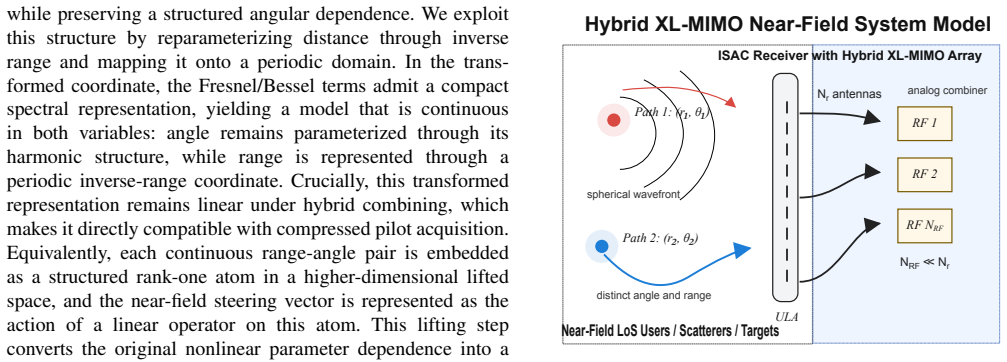
Near-field extremely large multiple input multiple output (XL-MIMO) breaks the assumptions that make classical super-resolution effective: the receiver acquires only a limited set of compressed pilot observations, while each propagation path is jointly determined by angle and distance under a spherical-wave model. This invalidates the far-field Vandermonde structure exploited by conventional methods, and many existing near-field formulations remain only gridless by discretizing range and angle and thus inheriting mismatch, coherence, and resolution loss. This paper develops a continuous 2D super-resolution framework for hybrid near-field measurements that avoids range and angle gridding. The key idea is to reparameterize distance through inverse range, which reveals a compact spectral structure for the near-field spherical-wave manifold. Building on this observation, we introduce a panelized weighted fitting strategy that converts the range-dependent Fresnel terms into a stable transform-domain representation, resulting in a lifted mode, in which each continuous range-angle pair is embedded as a structured rank-one atom and the measurement model remains linear under hybrid combining. Recovery is then posed as a 2D atomic norm minimization, with path localization certified through a dual polynomial over the transformed domain. Numerical experiments show exact support recovery in the noiseless setting using only few compressed hybrid measurements. These results establish the proposed inverse-range atomic norm viewpoint as a new gridless foundation for near-field sensing and channel estimation in hybrid XL-MIMO and integrated sensing and communication systems.
Editorial analysis
A structured set of objections, weighed in public.
Referee Report
Summary. The paper develops a gridless 2D super-resolution framework for near-field XL-MIMO channel estimation and sensing under hybrid compressed measurements. It reparameterizes range via inverse distance to expose a compact spectral structure in the spherical-wave manifold, introduces a panelized weighted fitting strategy to linearize the Fresnel terms, embeds continuous range-angle pairs as structured rank-one atoms in a lifted domain, and recovers the support via 2D atomic-norm minimization certified by a dual polynomial. Numerical experiments are reported to achieve exact noiseless support recovery from few hybrid measurements.
Significance. If the derivations and recovery guarantees hold, the inverse-range atomic-norm formulation supplies a new continuous-domain foundation for near-field XL-MIMO and ISAC that avoids grid mismatch and coherence issues of discretized approaches. The panelized linearization and dual-polynomial certification are technically interesting extensions of atomic-norm tools to spherical-wave manifolds.
major comments (2)
- [§4.2] §4.2, the lifted-mode construction: the claim that the panelized weighted fitting keeps the measurement model exactly linear under arbitrary hybrid combining is not accompanied by an explicit derivation showing that the weighting matrices commute with the hybrid combiner; without this step the atomic-norm program may become non-convex in the hybrid case.
- [§5] §5, Theorem 1 (noiseless exact recovery): the dual-polynomial certification argument relies on the inverse-range reparameterization producing a Vandermonde-like structure, yet the Fresnel-phase remainder term is only bounded rather than shown to vanish identically; a concrete counter-example or tightness analysis is needed to confirm that the bound does not degrade the exact-recovery radius.
minor comments (2)
- [Abstract / Fig. 3] The abstract states 'exact support recovery' but does not specify the number of paths, SNR, or compression ratio used in the experiments; these parameters should be stated explicitly in the caption of the corresponding figure.
- [§3.1] Notation for the panelized weights is introduced without a clear table summarizing their dependence on the Fresnel parameter; a small table would improve readability.
Simulated Author's Rebuttal
We thank the referee for the detailed and constructive comments. We address each major comment below and will revise the manuscript accordingly to strengthen the presentation and proofs.
read point-by-point responses
-
Referee: [§4.2] §4.2, the lifted-mode construction: the claim that the panelized weighted fitting keeps the measurement model exactly linear under arbitrary hybrid combining is not accompanied by an explicit derivation showing that the weighting matrices commute with the hybrid combiner; without this step the atomic-norm program may become non-convex in the hybrid case.
Authors: We thank the referee for highlighting this point. The panelized weighting is constructed in the inverse-range domain after the hybrid combiner has been applied; because the combiner is a fixed linear operator independent of the continuous range-angle parameters, the weighting matrices commute with it. This preserves exact linearity of the measurement model and convexity of the atomic-norm program. We will insert the missing explicit derivation (including the commutation step) into the revised §4.2. revision: yes
-
Referee: [§5] §5, Theorem 1 (noiseless exact recovery): the dual-polynomial certification argument relies on the inverse-range reparameterization producing a Vandermonde-like structure, yet the Fresnel-phase remainder term is only bounded rather than shown to vanish identically; a concrete counter-example or tightness analysis is needed to confirm that the bound does not degrade the exact-recovery radius.
Authors: The inverse-range reparameterization converts the dominant spherical-wave term into a Vandermonde structure while the Fresnel remainder appears as a controlled perturbation whose magnitude is bounded by the panelized fitting. In the noiseless setting the dual polynomial is designed so that this bounded perturbation does not violate the strict inequality required for exact support certification inside the derived radius. We will add both a tightness analysis of the bound and a concrete numerical counter-example (showing the recovery radius remains intact) to the revised proof of Theorem 1. revision: yes
Circularity Check
No significant circularity identified
full rationale
The paper's core derivation reparameterizes distance via inverse range to expose spectral structure in the spherical-wave manifold, then introduces a panelized weighted fitting to linearize Fresnel terms into a lifted rank-one atomic representation for 2D atomic-norm minimization and dual-polynomial certification. These steps are presented as novel modeling choices that convert the hybrid near-field measurement model into a form amenable to existing atomic-norm recovery guarantees. No equation or claim reduces by construction to a fitted parameter renamed as a prediction, nor does any load-bearing premise collapse to a self-citation whose validity is assumed rather than independently verified. The noiseless exact-support recovery result is therefore an output of the proposed framework rather than a tautology of its inputs.
Axiom & Free-Parameter Ledger
free parameters (1)
- panelized weights
axioms (2)
- domain assumption Spherical-wave propagation model governs near-field paths
- domain assumption Hybrid combining preserves linearity of the measurement model
invented entities (1)
-
structured rank-one atom embedding continuous range-angle pair
no independent evidence
Reference graph
Works this paper leans on
-
[1]
Compressed sensing off the grid,
G. Tang, B. N. Bhaskar, P. Shah, and B. Recht, “Compressed sensing off the grid,”IEEE Transactions on Information Theory, vol. 59, no. 11, pp. 7465–7490, 2013
work page 2013
-
[2]
Towards a mathematical theory of super-resolution,
E. J. Cand `es and C. Fernandez-Granda, “Towards a mathematical theory of super-resolution,”Communications on Pure and Applied Mathemat- ics, vol. 67, no. 6, pp. 906–956, 2014
work page 2014
-
[3]
When near becomes far: From rayleigh to optimal near-field and far-field boundaries,
S. Daei, G. Fodor, and M. Skoglund, “When near becomes far: From rayleigh to optimal near-field and far-field boundaries,”IEEE GLOBE- COM, 2025
work page 2025
-
[4]
Near-field isac in 6g: Addressing phase nonlinearity via lifted super- resolution,
S. Daei, A. Zamani, S. Chatterjee, M. Skoglund, and G. Fodor, “Near-field isac in 6g: Addressing phase nonlinearity via lifted super- resolution,” inICASSP 2025-2025 IEEE International Conference on Acoustics, Speech and Signal Processing (ICASSP). IEEE, 2025, pp. 1–5
work page 2025
-
[5]
Near-field communications: A comprehensive survey,
Y . Liu, C. Ouyang, Z. Wang, J. Xu, X. Mu, and A. L. Swindlehurst, “Near-field communications: A comprehensive survey,”IEEE Commu- nications Surveys & Tutorials, 2024
work page 2024
-
[6]
When near becomes far: From rayleigh to optimal near-field and far-field boundaries,
S. Daei, G. Fodor, and M. Skoglund, “When near becomes far: From rayleigh to optimal near-field and far-field boundaries,” inGLOBECOM 2025 - 2025 IEEE Global Communications Conference, 2025, pp. 3586– 3592
work page 2025
-
[7]
Channel estimation and hybrid precoding for millimeter wave cellular systems,
A. Alkhateeb, O. E. Ayach, G. Leus, and R. W. H. Jr., “Channel estimation and hybrid precoding for millimeter wave cellular systems,” IEEE Journal of Selected Topics in Signal Processing, vol. 8, no. 5, pp. 831–846, 2014
work page 2014
-
[8]
Channel estimation for extremely large-scale MIMO: Far-field or near-field?
M. Cui and L. Dai, “Channel estimation for extremely large-scale MIMO: Far-field or near-field?”IEEE Transactions on Communications, vol. 70, no. 4, pp. 2663–2677, 2022
work page 2022
-
[9]
X. Zhang, Z. Wang, H. Zhang, and L. Yang, “Near-field channel estimation for extremely large-scale array communications: A model- based deep learning approach,”IEEE Communications Letters, vol. 27, no. 4, pp. 1155–1159, 2023
work page 2023
-
[10]
Near-field integrated sensing and communications,
Z. Wang, X. Mu, and Y . Liu, “Near-field integrated sensing and communications,”IEEE Communications Letters, vol. 27, no. 8, pp. 2048–2052, 2023
work page 2048
-
[11]
Sensitivity to basis mismatch in compressed sensing,
Y . Chi, L. L. Scharf, A. Pezeshki, and A. R. Calderbank, “Sensitivity to basis mismatch in compressed sensing,”IEEE Transactions on Signal Processing, vol. 59, no. 5, pp. 2182–2195, 2011
work page 2011
-
[12]
Convexity meets curvature: Lifted near-field super-resolution,
S. Daei, G. Fodor, and M. Skoglund, “Convexity meets curvature: Lifted near-field super-resolution,”arXiv preprint arXiv:2602.14063, 2026
-
[13]
F. Xi and D. Yang, “Near-field channel estimation and joint angle-range recovery in xl-mimo systems: A gridless super-resolution approach,” arXiv preprint arXiv:2511.23187, 2025
-
[14]
The con- vex geometry of linear inverse problems,
V . Chandrasekaran, B. Recht, P. A. Parrilo, and A. S. Willsky, “The con- vex geometry of linear inverse problems,”Foundations of Computational mathematics, vol. 12, no. 6, pp. 805–849, 2012
work page 2012
-
[15]
Blind two-dimensional super- resolution in multiple-input single-output linear systems,
S. Sayyari, S. Daei, and F. Haddadi, “Blind two-dimensional super- resolution in multiple-input single-output linear systems,”IEEE Signal Processing Letters, vol. 28, pp. 583–587, 2020
work page 2020
-
[16]
Two-dimensional super-resolution via convex relaxation,
I. Valiulahi, S. Daei, F. Haddadi, and F. Parvaresh, “Two-dimensional super-resolution via convex relaxation,”IEEE Transactions on Signal Processing, vol. 67, no. 13, pp. 3372–3382, 2019
work page 2019
-
[17]
Off-the-grid recovery of time and frequency shifts with multiple measurement vectors,
M. Safari, S. Daei, and F. Haddadi, “Off-the-grid recovery of time and frequency shifts with multiple measurement vectors,”Signal Processing, vol. 183, p. 108016, 2021
work page 2021
-
[18]
Demixing sines and spikes using multiple measurement vectors,
H. Maskan, S. Daei, and M. H. Kahaei, “Demixing sines and spikes using multiple measurement vectors,”Signal Processing, vol. 203, p. 108786, 2023
work page 2023
-
[19]
Timely and painless breakups: Off-the-grid blind message recovery and users’ demixing,
S. Daei, S. Razavikia, M. Skoglund, G. Fodor, and C. Fischione, “Timely and painless breakups: Off-the-grid blind message recovery and users’ demixing,”IEEE Transactions on Information Theory, 2025
work page 2025
-
[20]
Dumitrescu,Positive Trigonometric Polynomials and Signal Process- ing Applications
B. Dumitrescu,Positive Trigonometric Polynomials and Signal Process- ing Applications. Springer, 2017
work page 2017
-
[21]
Super-resolution of point sources via convex programming,
C. Fernandez-Granda, “Super-resolution of point sources via convex programming,”Information and Inference: A Journal of the IMA, vol. 5, no. 3, pp. 251–303, 2016
work page 2016
discussion (0)
Sign in with ORCID, Apple, or X to comment. Anyone can read and Pith papers without signing in.