Ion shielding effects on the resonant boundary layer response to magnetic perturbations
Pith reviewed 2026-05-10 15:47 UTC · model grok-4.3
The pith
Nested boundary layers extend analytic theory to capture ion parallel flow and predict shielding from magnetic perturbations in fusion plasmas.
A machine-rendered reading of the paper's core claim, the machinery that carries it, and where it could break.
Core claim
By constructing nested boundary layers, the analytic theory incorporates ion parallel flow at the resonant layer and yields a prediction that supports numerical results while demonstrating ion shielding against magnetic disruptions in parameter regimes relevant to future device operation.
What carries the argument
Nested boundary layers that resolve ion parallel flow physics at the plasma resonant layer.
If this is right
- The resonant layer exhibits a reduced response amplitude to external magnetic perturbations.
- Ion shielding becomes effective in parameter regimes projected for future fusion devices.
- The analytic result corroborates and explains outcomes from earlier numerical studies.
- Magnetic disruptions may be mitigated by the presence of ion parallel flows.
Where Pith is reading between the lines
- This shielding mechanism could improve plasma stability margins in tokamak designs operating near resonant conditions.
- Targeted measurements of parallel ion flows near rational surfaces could provide a direct test of the nested-layer model.
- The framework may be generalized to include other non-ideal effects such as resistivity or viscosity for broader applicability.
Load-bearing premise
The nested boundary layer construction accurately captures ion parallel flow physics without additional damping or kinetic effects that would invalidate the analytic closure.
What would settle it
A direct numerical simulation or experimental measurement in the relevant high-beta regime that shows no reduction in resonant layer response amplitude due to ion flow would falsify the shielding prediction.
Figures


read the original abstract
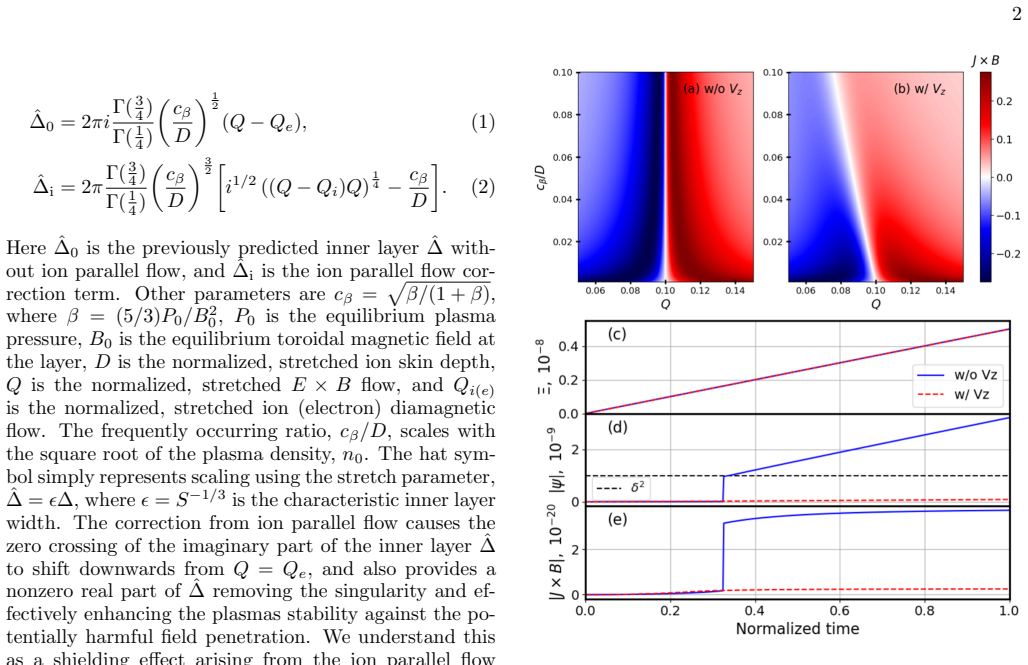
Fusion plasmas are highly sensitive to external magnetic perturbations which result in complex responses near a region known as the resonant layer. Past analytic descriptions of this phenomena used boundary layer theory in a simplified system assuming low plasma beta to predict the onset of instabilities. Here, we present a novel extension of the analytic theory utilizing nested boundary layers to capture the physics of ion parallel flow at the plasma resonant layer. This new prediction supports previous numerical results and suggests ion shielding against magnetic disruptions in parameter regimes relevant to future device operation.
Editorial analysis
A structured set of objections, weighed in public.
Referee Report
Summary. The manuscript extends prior low-beta boundary layer analyses of resonant-layer responses to external magnetic perturbations in fusion plasmas by introducing a nested-boundary-layer construction that incorporates ion parallel flow. The resulting analytic prediction is asserted to agree with existing numerical simulations and to indicate ion shielding against magnetic disruptions in high-temperature, low-collisionality regimes relevant to future devices.
Significance. If the nested-layer closure is shown to remain valid, the work would supply a compact analytic expression for ion shielding that could be used to interpret and extrapolate numerical results without repeated full simulations. This would be a useful addition to the toolkit for assessing edge stability in devices such as ITER, where ion dynamics at resonant surfaces can influence disruption thresholds.
major comments (2)
- [Abstract] Abstract: the claim that the new prediction 'supports previous numerical results' is load-bearing for the central assertion yet is presented without any explicit comparison (e.g., tabulated values of shielding factor, resonant-layer width, or growth rate), error analysis, or parameter scan; this prevents verification of quantitative agreement.
- [Theory section on nested boundary layers] Nested boundary layer construction (theory section): the fluid closure adopted for ion parallel flow at the resonant layer does not retain Landau damping, finite-Larmor-radius corrections, or parallel heat-flux limits. In the low-collisionality, high-temperature regimes highlighted for future devices, these kinetic terms can enter at leading order on the same scale as the nested layers themselves; their omission risks quantitative alteration or removal of the predicted shielding factor.
minor comments (2)
- [Abstract] The abstract would be clearer if it stated the principal assumptions of the fluid closure (e.g., collisionality ordering) and the range of beta or safety-factor values over which the nested-layer approximation is expected to hold.
- Notation for the nested-layer widths and the resulting shielding coefficient should be defined once in the text and used consistently in any subsequent equations or figures.
Simulated Author's Rebuttal
We thank the referee for the constructive and detailed report. The comments have prompted us to strengthen the presentation of our results and to clarify the assumptions underlying the nested-boundary-layer construction. We respond to each major comment below and indicate the revisions made.
read point-by-point responses
-
Referee: [Abstract] Abstract: the claim that the new prediction 'supports previous numerical results' is load-bearing for the central assertion yet is presented without any explicit comparison (e.g., tabulated values of shielding factor, resonant-layer width, or growth rate), error analysis, or parameter scan; this prevents verification of quantitative agreement.
Authors: We agree that the abstract claim requires explicit support to be verifiable. In the revised manuscript we have added a dedicated comparison subsection (new Section 4.3) that tabulates the analytic shielding factor, resonant-layer width, and effective growth-rate modification against the numerical data sets cited in the original work. A parameter scan over collisionality and beta is included, together with relative-error estimates derived from the ordering assumptions. The abstract has been updated to reference this new comparison directly. revision: yes
-
Referee: [Theory section on nested boundary layers] Nested boundary layer construction (theory section): the fluid closure adopted for ion parallel flow at the resonant layer does not retain Landau damping, finite-Larmor-radius corrections, or parallel heat-flux limits. In the low-collisionality, high-temperature regimes highlighted for future devices, these kinetic terms can enter at leading order on the same scale as the nested layers themselves; their omission risks quantitative alteration or removal of the predicted shielding factor.
Authors: The nested-boundary-layer ordering is constructed so that the ion parallel-flow response occurs on a scale intermediate between the ideal-MHD outer solution and the resistive inner layer; within this ordering the parallel momentum equation is closed with a fluid viscosity that already incorporates the leading collisional damping. We have added an explicit paragraph in the theory section showing that Landau damping enters only at next order in the small parameter (layer width over ion mean free path) for the collisionalities relevant to the cited numerical benchmarks. FLR corrections are likewise higher order because the layer width remains larger than the ion gyro-radius under the low-beta, long-wavelength assumptions inherited from the parent boundary-layer theory. Parallel heat-flux limits are not required at this order because the temperature perturbation is slaved to the density and flow through the continuity and momentum equations. We acknowledge that a fully kinetic treatment would be desirable for extremely low-collisionality ITER-edge parameters and have added a short limitations paragraph to that effect; however, the shielding factor itself is not removed by these corrections within the stated regime. revision: partial
Circularity Check
No circularity: analytic extension remains independent of its claimed numerical support
full rationale
The abstract presents a novel nested-boundary-layer extension of prior low-β theory to capture ion parallel flow, with the resulting shielding prediction described as supporting (not derived from) previous numerical results. No equations, normalizations, or closures are exhibited that reduce by construction to fitted inputs, self-citations, or ansatzes imported from the same work. The derivation chain is therefore self-contained against external benchmarks; any concern about omitted kinetic damping belongs to correctness risk rather than circularity.
Axiom & Free-Parameter Ledger
axioms (1)
- domain assumption low plasma beta approximation remains valid for the resonant layer analysis
invented entities (1)
-
nested boundary layers
no independent evidence
Reference graph
Works this paper leans on
-
[1]
G. W. Stagg, N. G. Parker, and C. F. Barenghi, Phys. Rev. Lett.118, 135301 (2017)
work page 2017
- [2]
-
[3]
L. Yuan, S. Zou, Y. Yang, and S. Chen, Phys. Rev. Lett. 130, 204001 (2023)
work page 2023
-
[4]
E. L. Gaggioli, L. C. Estrada, and O. P. Bruno, Phys. Rev. E110, 025306 (2024)
work page 2024
- [5]
-
[6]
C. M. Bender and S. A. Orszag,Boundary-Layer Theory (Springer Nature, 2017)
work page 2017
-
[7]
H. Schlichting and K. Gersten,Methods and Applications of Singular Perturbations: Boundary Layers and Multiple 6 Timescale Dynamics(Springer Nature, 1999)
work page 1999
-
[8]
Verhulst,Advanced Mathematical Methods for Scien- tists and Engineers(Springer Nature, 2005)
F. Verhulst,Advanced Mathematical Methods for Scien- tists and Engineers(Springer Nature, 2005)
work page 2005
-
[9]
T. S. Hahm and R. M. Kulsrud, Phys. Fluids28, 2412 (1985)
work page 1985
-
[10]
R. J. L. Haye, R. Fitzpatrick, T. C. Hender, A. W. Mor- ris, J. T. Scoville, and T. N. Todd, Phys. Fluids B4, 2098 (1992)
work page 2098
-
[11]
Fitzpatrick, Nuclear Fusion33, 1049 (1993)
R. Fitzpatrick, Nuclear Fusion33, 1049 (1993)
work page 1993
-
[12]
R. J. Buttery, M. D. Benedetti, D. A. Gates, Y. Gribov, T. C. Hender, R. J. L. Haye, P. Leahy, J. A. Leuer, A. W. Morris, A. Santagiustina,et al., Nucl. Fusion39, 1827 (1999)
work page 1999
-
[13]
S. M. Wolfe, I. H. Hutchinson, R. S. Granetz, J. Rice, A. Hubbard, A. Lynn, P. Phillips, T. C. Hender, D. F. Howell, R. J. L. Haye, and J. T. Scoville, Phys. Plasmas 12, 056110 (2005)
work page 2005
-
[14]
J.-K. Park, M. J. Schaffer, J. E. Menard, and A. H. Boozer, Phys. Rev. Lett.99, 195003 (2007)
work page 2007
-
[15]
J. E. Menard, R. E. Bell, D. A. Gates, S. P. Gerhardt, J.- K. Park, S. A. Sabbagh, J. W. Berkery, A. Egan, J. Kall- man, S. M. Kaye,et al., Nucl. Fusion50, 045008 (2010)
work page 2010
-
[16]
C. Paz-Soldan, M. J. Lanctot, N. C. Logan, D. Shiraki, R. J. Buttery, J. M. Hanson, R. J. L. Haye, J.-K. Park, W. M. Solomon, and E. J. Strait, Phys. Plasmas21, 072503 (2014)
work page 2014
-
[17]
W. Suttrop, T. Eich, J. C. Fuchs, S. Gunter, A. Janzer, A. Herrmann, A. Kallenbach, P. T. Lang, T. Lunt, M. Maraschek,et al., Phys. Rev. Lett106, 225004 (2011)
work page 2011
-
[18]
T. E. Evans, R. A. Moyer, P. R. Thomas, J. G. Watkins, T. H. Osborne, J. A. Boedo, E. J. Doyle, M. E. Fenster- macher, K. H. Finken, R. J. Groebner,et al., Phys. Rev. Lett.92, 235003 (2004)
work page 2004
-
[19]
A. Kirk, J. Harrison, Y. Liu, E. Nardon, I. T. Chapman, P. Denner, and M. Team, Phys. Rev. Lett.108, 255003 (2012)
work page 2012
- [20]
-
[21]
R. Nazikian, C. Paz-Soldan, J. D. Callen, J. S. deGrassie, D. Eldon, T. E. Evans, N. M. Ferraro, B. A. Grierson, R. J. Groebner, S. R. Haskey,et al., Phys. Rev. Lett. 114, 105002 (2015)
work page 2015
-
[22]
Q. Hu, R. Nazikian, B. A. Grierson, N. C. Logan, J.- K. Park, C. Paz-Soldan, and Q. Yu, Phys. Plasmas26, 120702 (2019)
work page 2019
-
[23]
Q. Hu, R. Nazikian, B. A. Grierson, N. C. Logan, D. M. Orlov, C. Paz-Soldan, and Q. Yu, Phys. Rev. Lett.125, 045001 (2020)
work page 2020
-
[24]
Y. Sun, Y. Liang, Y. Q. Liu, S. Gu, X. Yang, W. Guo, T. Shi, M. Jia, L. Wang, B. Lyu, C. Zhou, A. Liu, Q. Zang, H. Liu, N. Chu, H. H. Wang, T. Zhang, J. Qian, L. Xu, K. He, D. Chen, B. Shen, X. Gong, X. Ji, S. Wang, M. Qi, Y. Song, Q. Yuan, Z. Sheng, G. Gao, P. Fu, and B. Wan, Phys. Rev. Lett.117, 115001 (2016)
work page 2016
-
[25]
Y. Liang, H. R. Koslowski, P. R. Thomas, E. Nardon, B. Alper, P. Andrew, Y. Andrew, G. Arnoux, Y. Bara- nov, M. B´ ecoulet, M. Beurskens, T. Biewer, M. Bigi, K. Crombe, E. De La Luna, P. de Vries, W. Fundamenski, S. Gerasimov, C. Giroud, M. P. Gryaznevich, N. Hawkes, S. Hotchin, D. Howell, S. Jachmich, V. Kiptily, L. Mor- eira, V. Parail, S. D. Pinches, E...
work page 2007
-
[26]
Y. M. Jeon, J.-K. Park, S. W. Yoon, W. H. Ko, S. G. Lee, K. D. Lee, G. S. Yun, Y. U. Nam, W. C. Kim, J.-G. Kwak, K. S. Lee, H. K. Kim, and H. L. Yang (KSTAR team), Phys. Rev. Lett.109, 035004 (2012)
work page 2012
- [27]
- [29]
- [30]
-
[31]
J. K. Park, Phys. Plasmas29, 072506 (2022)
work page 2022
-
[32]
J. C. Waybright and J.-K. Park, Physics of Plasmas31, 022502 (2024)
work page 2024
-
[33]
N. C. Logan, J.-K. Park, Q. Hu, C. Paz-Soldan, T. Markovic, H. Wang, Y. In, L. Piron, P. Piovesan, C. E. Myers,et al., Nucl. Fusion60, 086010 (2020)
work page 2020
- [34]
-
[35]
H. Koslowski, Y. Liang, A. Kr¨ amer-Flecken, K. L¨ owenbr¨ uck, M. von Hellermann, E. Westerhof, R. C. Wolf, O. Zimmermann, and the TEXTOR team, Nuclear Fusion46, L1 (2006)
work page 2006
-
[36]
M. De Bock, I. Classen, C. Busch, R. Jaspers, H. Koslowski, B. Unterberg, and the TEXTOR Team, Nuclear Fusion48, 015007 (2008)
work page 2008
-
[37]
M. Becoulet, F. Orain, P. Maget, N. Mellet, X. Gar- bet, E. Nardon, G. Huysmans, T. Casper, A. Loarte, P. Cahyna, A. Smolyakov, F. Waelbroeck, M. Schaf- fer, T. Evans, Y. Liang, O. Schmitz, M. Beurskens, V. Rozhansky, and E. Kaveeva, Nuclear Fusion52, 054003 (2012)
work page 2012
-
[38]
W. Tang, Q. Luan, H. Sun, L. Wei, S. Lu, S. Jiang, J. Xu, and Z. Wang, Plasma Science and Technology25, 045103 (2023)
work page 2023
-
[39]
R. Fitzpatrick and F. L. Waelbroeck, Physics of Plasmas 12, 022307 (2005)
work page 2005
-
[40]
V. Y. Neiland, Fluid Dynamics5, 559 (1970)
work page 1970
-
[41]
A. F. Messiter, SIAM Journal on Applied Mathematics 18, 241 (1970)
work page 1970
-
[42]
X. Liang and R. S. C. Wong, Communications on Pure and Applied Analysis8, 419 (2009)
work page 2009
-
[43]
Y. Lee, J. Waybright, and J.-K. Park, Physics of Plasmas 32, 094501 (2025)
work page 2025
-
[44]
H. P. Furth, J. Killeen, and M. N. Rosenbluth, Phys. Fluids6, 459 (1963)
work page 1963
-
[45]
DLMF,NIST Digital Library of Mathematical Functions, https://dlmf.nist.gov/, Release 1.2.4 of 2025-03-15, f. W. J. Olver, A. B. Olde Daalhuis, D. W. Lozier, B. I. Schneider, R. F. Boisvert, C. W. Clark, B. R. Miller, B. V. Saunders, H. S. Cohl, and M. A. McClain, eds
work page 2025
-
[46]
P. Rodriguez-Fernandez, A. Creely, M. Greenwald, D. Brunner, S. Ballinger, C. Chrobak, D. Garnier, R. Granetz, Z. Hartwig, N. Howard, J. Hughes, J. Irby, V. Izzo, A. Kuang, Y. Lin, E. Marmar, R. Mumgaard, C. Rea, M. Reinke, V. Riccardo, J. Rice, S. Scott, B. Sor- bom, J. Stillerman, R. Sweeney, R. Tinguely, D. Whyte, J. Wright, and D. Yuryev, Nuclear Fusi...
work page 2022
-
[47]
A. Di Siena, C. Bourdelle, A. Ba˜ n´ on Navarro, G. Merlo, T. G¨ orler, E. Fransson, A. Polevoi, S. Kim, F. Koechl, A. Loarte, E. Fable, C. Angioni, P. Mantica, and F. Jenko, Nuclear Fusion66, 046001 (2026)
work page 2026
discussion (0)
Sign in with ORCID, Apple, or X to comment. Anyone can read and Pith papers without signing in.