pith. machine review for the scientific record. sign in

arxiv: 2604.10287 · v1 · submitted 2026-04-11 · 🌌 astro-ph.GA · astro-ph.HE

Recognition: unknown

Full-polarization millimeter wavelength variability of Sagittarius A* during the 2018 EHT campaign

Ezequiel Albentosa-Ruiz , Jasmin E. Washington , Nicola Marchili , Iv\'an Mart\'i-Vidal , Ciriaco Goddi , Maciek Wielgus , Alejandro Mus , Angelo Ricarte
show 267 more authors
Daniel P. Marrone Le\'on D. S. Salas Yuhei Iwata Douglas F. Carlos Alexandra J. Tetarenko Kotaro Moriyama Vedant Dhruv Kazunori Akiyama Antxon Alberdi Walter Alef Juan Carlos Algaba Richard Anantua Keiichi Asada Rebecca Azulay Uwe Bach Anne-Kathrin Baczko David Ball Mislav Balokovi\'c Bidisha Bandyopadhyay John Barrett Michi Baub\"ock Bradford A. Benson Dan Bintley Lindy Blackburn Raymond Blundell Katherine L. Bouman Geoffrey C. Bower Michael Bremer Roger Brissenden Silke Britzen Avery E. Broderick Dominique Broguiere Thomas Bronzwaer Sandra Bustamante John E. Carlstrom Andrew Chael Chi-kwan Chan Dominic O. Chang Koushik Chatterjee Shami Chatterjee Ming-Tang Chen Yongjun Chen Xiaopeng Cheng Pierre Christian Ilje Cho Nicholas S. Conroy John E. Conway Thomas M. Crawford Geoffrey B. Crew Alejandro Cruz-Osorio Yuzhu Cui Brandon Curd Rohan Dahale Jordy Davelaar Mariafelicia De Laurentis Roger Deane Jessica Dempsey Gregory Desvignes Jason Dexter Indu K. Dihingia Sheperd S. Doeleman Sergio A. Dzib Ralph P. Eatough Razieh Emami Heino Falcke Joseph Farah Vincent L. Fish Edward Fomalont H. Alyson Ford Marianna Foschi Antonio Fuentes Raquel Fraga-Encinas William T. Freeman Per Friberg Christian M. Fromm Peter Galison Charles F. Gammie Roberto Garc\'ia Olivier Gentaz Gertie Geertsema Boris Georgiev Roman Gold Jos\'e L. G\'omez Arturo I. G\'omez-Ruiz Minfeng Gu Mark Gurwell Kazuhiro Hada Daryl Haggard Ronald Hesper Dirk Heumann Luis C. Ho Paul Ho Mareki Honma Chih-Wei L. Huang Lei Huang David H. Hughes Shiro Ikeda C. M. Violette Impellizzeri Makoto Inoue Sara Issaoun David J. James Buell T. Jannuzi Michael Janssen Britton Jeter Wu Jiang Alejandra Jim\'enez-Rosales Michael D. Johnson Adam C. Jones Svetlana Jorstad Abhishek V. Joshi Taehyun Jung Ramesh Karuppusamy Tomohisa Kawashima Garrett K. Keating Mark Kettenis Dong-Jin Kim Jae-Young Kim Jongsoo Kim Junhan Kim Motoki Kino Jun Yi Koay Prashant Kocherlakota Yutaro Kofuji Patrick M. Koch Shoko Koyama Carsten Kramer Joana A. Kramer Michael Kramer Thomas P. Krichbaum Cheng-Yu Kuo Noemi La Bella Sang-Sung Lee Aviad Levis Zhiyuan Li Rocco Lico Greg Lindahl Michael Lindqvist Mikhail Lisakov Jun Liu Kuo Liu Elisabetta Liuzzo Wen-Ping Lo Andrei P. Lobanov Laurent Loinard Colin J. Lonsdale Amy E. Lowitz Ru-Sen Lu Jirong Mao Sera Markoff Alan P. Marscher Satoki Matsushita Lynn D. Matthews Lia Medeiros Karl M. Menten Izumi Mizuno Yosuke Mizuno Joshua Montgomery James M. Moran Monika Moscibrodzka Wanga Mulaudzi Hendrik M\"uller Cornelia M\"uller Gibwa Musoke Ioannis Myserlis Hiroshi Nagai Neil M. Nagar Dhanya G. Nair Masanori Nakamura Gopal Narayanan Iniyan Natarajan Antonios Nathanail Santiago Navarro Fuentes Joey Neilsen Chunchong Ni Michael A. Nowak Junghwan Oh Hiroki Okino H\'ector Ra\'ul Olivares S\'anchez Tomoaki Oyama Feryal \"Ozel Daniel C. M. Palumbo Georgios Filippos Paraschos Jongho Park Harriet Parsons Nimesh Patel Ue-Li Pen Dominic W. Pesce Vincent Pi\'etu Aleksandar PopStefanija Oliver Porth Ben Prather Giacomo Principe Dimitrios Psaltis Hung-Yi Pu Venkatessh Ramakrishnan Ramprasad Rao Mark G. Rawlings Luciano Rezzolla Bart Ripperda Jan R\"oder Freek Roelofs Cristina Romero-Ca\~nizales Eduardo Ros Arash Roshanineshat Helge Rottmann Alan L. Roy Ignacio Ruiz Chet Ruszczyk Kazi L. J. Rygl Salvador S\'anchez David S\'anchez-Arg\"uelles Miguel S\'anchez-Portal Mahito Sasada Kaushik Satapathy Saurabh Tuomas Savolainen F. Peter Schloerb Jonathan Schonfeld Karl-Friedrich Schuster Lijing Shao Zhiqiang Shen Sasikumar Silpa Des Small Bong Won Sohn Jason SooHoo Kamal Souccar Joshua S. Stanway He Sun Fumie Tazaki Paul Tiede Remo P. J. Tilanus Michael Titus Kenji Toma Pablo Torne Teresa Toscano Efthalia Traianou Tyler Trent Sascha Trippe Matthew Turk Ilse van Bemmel Huib Jan van Langevelde Daniel R. van Rossum Jesse Vos Jan Wagner Derek Ward-Thompson John Wardle Jonathan Weintroub Robert Wharton Kaj Wiik Gunther Witzel Michael F. Wondrak George N. Wong Qingwen Wu Nitika Yadlapalli Paul Yamaguchi Aristomenis Yfantis Doosoo Yoon Andr\'e Young Ziri Younsi Wei Yu Feng Yuan Ye-Fei Yuan Ai-Ling Zeng J. Anton Zensus Shuo Zhang Guang-Yao Zhao Shan-Shan Zhao
Authors on Pith no claims yet

Pith reviewed 2026-05-10 15:23 UTC · model grok-4.3

classification 🌌 astro-ph.GA astro-ph.HE
keywords Sagittarius A*millimeter variabilitypolarizationX-ray flaressynchrotron emissionaccretion flowsred noise
0
0 comments X

The pith

Near-simultaneous X-ray and millimeter peaks in Sagittarius A* point to continuous energy injection in optically thin plasma.

A machine-rendered reading of the paper's core claim, the machinery that carries it, and where it could break.

The paper uses high-cadence ALMA full-polarization data at millimeter wavelengths from the 2018 Event Horizon Telescope campaign to track Sagittarius A* variability. Total intensity varies little, below 10 percent, while linear and circular polarization fluctuate at 30 and 50 percent. Time-series analysis shows red-noise behavior with power spectral densities from -2 to -3 in all Stokes parameters. On April 24 an X-ray flare observed by Chandra lines up with a millimeter peak without the usual cooling delay, accompanied by stronger variability and coherent polarization loops. This timing favors ongoing energy supply to an optically thin emitting region over standard transient synchrotron models that predict lags from particle cooling.

Core claim

The near-simultaneous X-ray and millimeter peaks on April 24, together with enhanced variability and stable polarization timescales, indicate that the flare emission arises from continuous energy injection within an optically thin region rather than from a transient synchrotron event subject to cooling delays.

What carries the argument

Inter-band delay measurements in polarized intensity light curves combined with direct timing comparison to the simultaneous X-ray flare.

If this is right

  • Accretion flow models must include steady energy replenishment to reproduce flare simultaneity across wavelengths.
  • Polarization arises from a spatially coherent structure separate from the more variable total-intensity region.
  • Power spectra with indices between -2 and -3 describe the variability in all Stokes parameters on intra-day scales.
  • Stable polarized-intensity timescales constrain the emitting region's size or magnetic coherence.

Where Pith is reading between the lines

These are editorial extensions of the paper, not claims the author makes directly.

  • Similar timing tests in other black-hole systems could reveal whether continuous injection is a general feature of near-horizon plasma.
  • Multi-wavelength monitoring at higher cadence might isolate whether magnetic reconnection supplies the ongoing energy.
  • If the pattern holds, flare models for Sgr A* would shift emphasis from single injection events to sustained energization processes.

Load-bearing premise

The X-ray flare and millimeter peak must be produced by the same plasma parcel so that their timing can distinguish cooling delays from continuous injection.

What would settle it

A repeat high-cadence campaign that measures a clear multi-minute lag between X-ray and millimeter peaks matching expected synchrotron cooling times in several flares would restore the standard transient model.

Figures

Figures reproduced from arXiv: 2604.10287 by Abhishek V. Joshi, Adam C. Jones, Ai-Ling Zeng, Alan L. Roy, Alan P. Marscher, Alejandra Jim\'enez-Rosales, Alejandro Cruz-Osorio, Alejandro Mus, Aleksandar PopStefanija, Alexandra J. Tetarenko, Amy E. Lowitz, Andrei P. Lobanov, Andrew Chael, Andr\'e Young, Angelo Ricarte, Anne-Kathrin Baczko, Antonio Fuentes, Antonios Nathanail, Antxon Alberdi, Arash Roshanineshat, Aristomenis Yfantis, Arturo I. G\'omez-Ruiz, Avery E. Broderick, Aviad Levis, Bart Ripperda, Ben Prather, Bidisha Bandyopadhyay, Bong Won Sohn, Boris Georgiev, Bradford A. Benson, Brandon Curd, Britton Jeter, Buell T. Jannuzi, Carsten Kramer, Charles F. Gammie, Cheng-Yu Kuo, Chet Ruszczyk, Chih-Wei L. Huang, Chi-kwan Chan, Christian M. Fromm, Chunchong Ni, Ciriaco Goddi, C. M. Violette Impellizzeri, Colin J. Lonsdale, Cornelia M\"uller, Cristina Romero-Ca\~nizales, Dan Bintley, Daniel C. M. Palumbo, Daniel P. Marrone, Daniel R. van Rossum, Daryl Haggard, David Ball, David H. Hughes, David J. James, David S\'anchez-Arg\"uelles, Derek Ward-Thompson, Des Small, Dhanya G. Nair, Dimitrios Psaltis, Dirk Heumann, Dominic O. Chang, Dominic W. Pesce, Dominique Broguiere, Dong-Jin Kim, Doosoo Yoon, Douglas F. Carlos, Eduardo Ros, Edward Fomalont, Efthalia Traianou, Elisabetta Liuzzo, Ezequiel Albentosa-Ruiz, Feng Yuan, Feryal \"Ozel, F. Peter Schloerb, Freek Roelofs, Fumie Tazaki, Garrett K. Keating, Geoffrey B. Crew, Geoffrey C. Bower, George N. Wong, Georgios Filippos Paraschos, Gertie Geertsema, Giacomo Principe, Gibwa Musoke, Gopal Narayanan, Greg Lindahl, Gregory Desvignes, Guang-Yao Zhao, Gunther Witzel, H. Alyson Ford, Harriet Parsons, H\'ector Ra\'ul Olivares S\'anchez, Heino Falcke, Helge Rottmann, Hendrik M\"uller, He Sun, Hiroki Okino, Hiroshi Nagai, Huib Jan van Langevelde, Hung-Yi Pu, Ignacio Ruiz, Ilje Cho, Ilse van Bemmel, Indu K. Dihingia, Iniyan Natarajan, Ioannis Myserlis, Iv\'an Mart\'i-Vidal, Izumi Mizuno, Jae-Young Kim, James M. Moran, Jan R\"oder, J. Anton Zensus, Jan Wagner, Jasmin E. Washington, Jason Dexter, Jason SooHoo, Jesse Vos, Jessica Dempsey, Jirong Mao, Joana A. Kramer, Joey Neilsen, John Barrett, John E. Carlstrom, John E. Conway, John Wardle, Jonathan Schonfeld, Jonathan Weintroub, Jongho Park, Jongsoo Kim, Jordy Davelaar, Jos\'e L. G\'omez, Joseph Farah, Joshua Montgomery, Joshua S. Stanway, Juan Carlos Algaba, Junghwan Oh, Junhan Kim, Jun Liu, Jun Yi Koay, Kaj Wiik, Kamal Souccar, Karl-Friedrich Schuster, Karl M. Menten, Katherine L. Bouman, Kaushik Satapathy, Kazi L. J. Rygl, Kazuhiro Hada, Kazunori Akiyama, Keiichi Asada, Kenji Toma, Kotaro Moriyama, Koushik Chatterjee, Kuo Liu, Laurent Loinard, Lei Huang, Le\'on D. S. Salas, Lia Medeiros, Lijing Shao, Lindy Blackburn, Luciano Rezzolla, Luis C. Ho, Lynn D. Matthews, Maciek Wielgus, Mahito Sasada, Makoto Inoue, Mareki Honma, Mariafelicia De Laurentis, Marianna Foschi, Mark G. Rawlings, Mark Gurwell, Mark Kettenis, Masanori Nakamura, Matthew Turk, Michael A. Nowak, Michael Bremer, Michael D. Johnson, Michael F. Wondrak, Michael Janssen, Michael Kramer, Michael Lindqvist, Michael Titus, Michi Baub\"ock, Miguel S\'anchez-Portal, Mikhail Lisakov, Minfeng Gu, Ming-Tang Chen, Mislav Balokovi\'c, Monika Moscibrodzka, Motoki Kino, Neil M. Nagar, Nicholas S. Conroy, Nicola Marchili, Nimesh Patel, Nitika Yadlapalli, Noemi La Bella, Oliver Porth, Olivier Gentaz, Pablo Torne, Patrick M. Koch, Paul Ho, Paul Tiede, Paul Yamaguchi, Per Friberg, Peter Galison, Pierre Christian, Prashant Kocherlakota, Qingwen Wu, Ralph P. Eatough, Ramesh Karuppusamy, Ramprasad Rao, Raquel Fraga-Encinas, Raymond Blundell, Razieh Emami, Rebecca Azulay, Remo P. J. Tilanus, Richard Anantua, Roberto Garc\'ia, Robert Wharton, Rocco Lico, Roger Brissenden, Roger Deane, Rohan Dahale, Roman Gold, Ronald Hesper, Ru-Sen Lu, Salvador S\'anchez, Sandra Bustamante, Sang-Sung Lee, Santiago Navarro Fuentes, Sara Issaoun, Sascha Trippe, Sasikumar Silpa, Satoki Matsushita, Saurabh, Sera Markoff, Sergio A. Dzib, Shami Chatterjee, Shan-Shan Zhao, Sheperd S. Doeleman, Shiro Ikeda, Shoko Koyama, Shuo Zhang, Silke Britzen, Svetlana Jorstad, Taehyun Jung, Teresa Toscano, Thomas Bronzwaer, Thomas M. Crawford, Thomas P. Krichbaum, Tomoaki Oyama, Tomohisa Kawashima, Tuomas Savolainen, Tyler Trent, Ue-Li Pen, Uwe Bach, Vedant Dhruv, Venkatessh Ramakrishnan, Vincent L. Fish, Vincent Pi\'etu, Walter Alef, Wanga Mulaudzi, Wei Yu, Wen-Ping Lo, William T. Freeman, Wu Jiang, Xiaopeng Cheng, Ye-Fei Yuan, Yongjun Chen, Yosuke Mizuno, Yuhei Iwata, Yutaro Kofuji, Yuzhu Cui, Zhiqiang Shen, Zhiyuan Li, Ziri Younsi.

Figure 1
Figure 1. Figure 1: Stokes I CLEAN image of Sgr A∗ and the minispiral from visi￾bilities at 213.1 GHz, produced after the QA2 calibration for April 21. The assumption of constant flux density in the QA2 calibra￾tion results in a core with constant brightness, shifting all vari￾ability to the minispiral. To derive the light curves of Sgr A∗ (i.e., the compact core), we implemented an algorithm to enhance the QA2 gain calibrati… view at source ↗
Figure 2
Figure 2. Figure 2: April 22 total flux density of Sgr A∗ and the minispiral at 213.1 GHz, before (red and blue crosses) and after (purple and black dots) correcting for variability transfer. The flux density uncertainty, es￾timated from the covariance matrix, is approximately 0.1% and is there￾fore not visible. A complementary calibration method for the time-variable source Sgr A∗ is presented in Appendix C, where the manual… view at source ↗
Figure 3
Figure 3. Figure 3: Sgr A∗ ALMA light curves of Stokes I, the polarized intensity, the EVPA, and Stokes V (from top to bottom) for the four spectral bands, for all four days (from left to right, April 21, 22, 24, and 25). Stokes V light curves are tentative, as the detected levels fall below ALMA’s guaranteed CP accuracy. The gray-shaded band on April 24 marks the time range of the Chandra X-ray flare. short timescale variabi… view at source ↗
Figure 4
Figure 4. Figure 4: Sgr A∗ ALMA light curves of the fractional polarization for the four spectral bands, the depolarization measure, the rotation measure, and the spectral index (from top to bottom) for all four days (from left to right, April 21, 22, 24, and 25). The gray-shaded band on April 24 marks the time range of the Chandra X-ray flare. For circular polarization, we observe daily averages ranging from -0.41% to -1.0% … view at source ↗
Figure 5
Figure 5. Figure 5: Historical 230 GHz amplitude measurements of Sgr A∗ from 2005 to 2019 in [PITH_FULL_IMAGE:figures/full_fig_p007_5.png] view at source ↗
Figure 6
Figure 6. Figure 6: Modulation index measured across various observations as a function of observational duration. Each data point from the 2018 ALMA dataset at B3 (227 GHz) is represented by hexagons, while other data points, as well as the fitted damped random walk (DRW) curve with shaded confidence intervals are derived from Wielgus et al. (2022a). we first computed the LNDCF between SPWs. Strongly cor￾related signals betw… view at source ↗
Figure 8
Figure 8. Figure 8: LNDCF between SPWs B1-B2 (black dots), B1-B4 (red squares), and B3-B4 (blue diamonds), for total flux density (left) and polarized intensity (right), for April 24. −2 0 2 ∆t (min) 0.800 0.825 0.850 0.875 0.900 0.925 0.950 0.975 1.000 LNDCF B1-B4 −2 0 2 ∆t (min) Stokes I P April 21 April 22 April 24 April 25 [PITH_FULL_IMAGE:figures/full_fig_p008_8.png] view at source ↗
Figure 10
Figure 10. Figure 10: SF plots of the Sgr A∗ 213.1 GHz light curves for total intensity (left) and polarized intensity (right), for April 21, 22, 24 and 25, and all combined (black dots, blue squares, red diamonds, magenta triangles, and cyan crosses, respectively). In [PITH_FULL_IMAGE:figures/full_fig_p008_10.png] view at source ↗
Figure 11
Figure 11. Figure 11: PSD slope index (top) and timescales (bottom) estimated from the SF of the total intensity (left) and polarized intensity (right) 2017 and 2018 light curves, for the spectral bands B1 (blue dots) and B4 (or￾ange squares). A second characteristic PSD and timescale, derived from the Stokes I SF, are marked with a cross (x). PSD values are computed from the SF slope as αPS D = −(1 + αS F) (blue dots and oran… view at source ↗
Figure 12
Figure 12. Figure 12: Sgr A∗ ALMA polarimetric loops observed in April 2018, for the spectral band B4, for all four days. The colors of the data points represent the time evolution of the Q − U behavior. affected by an overall offset due to the RM. It may, however, be sensitive to the variable internal Faraday effects in Sgr A∗ (Wielgus et al. 2024). Systematic error bars were computed by surveying over spline fitting paramete… view at source ↗
Figure 7
Figure 7. Figure 7: The variability does not increase significantly on 2018 [PITH_FULL_IMAGE:figures/full_fig_p011_7.png] view at source ↗
Figure 13
Figure 13. Figure 13: Chandra counts (top) and Sgr A∗ total intensity ALMA light curves (bottom) for the flares observed in 2017 and 2018 during the EHT campaigns. The gray-shaded band marks the time range of the high-energy flare, with indicated maximum. 5.3. Comparison with GRMHD variability In EHTC et al. (2022c) the variability of Sgr A∗ , constrained by ALMA observations (Wielgus et al. 2022a), was com￾pared to prediction… view at source ↗
Figure 14
Figure 14. Figure 14: Moreover, including radiative synchrotron cooling of [PITH_FULL_IMAGE:figures/full_fig_p011_14.png] view at source ↗
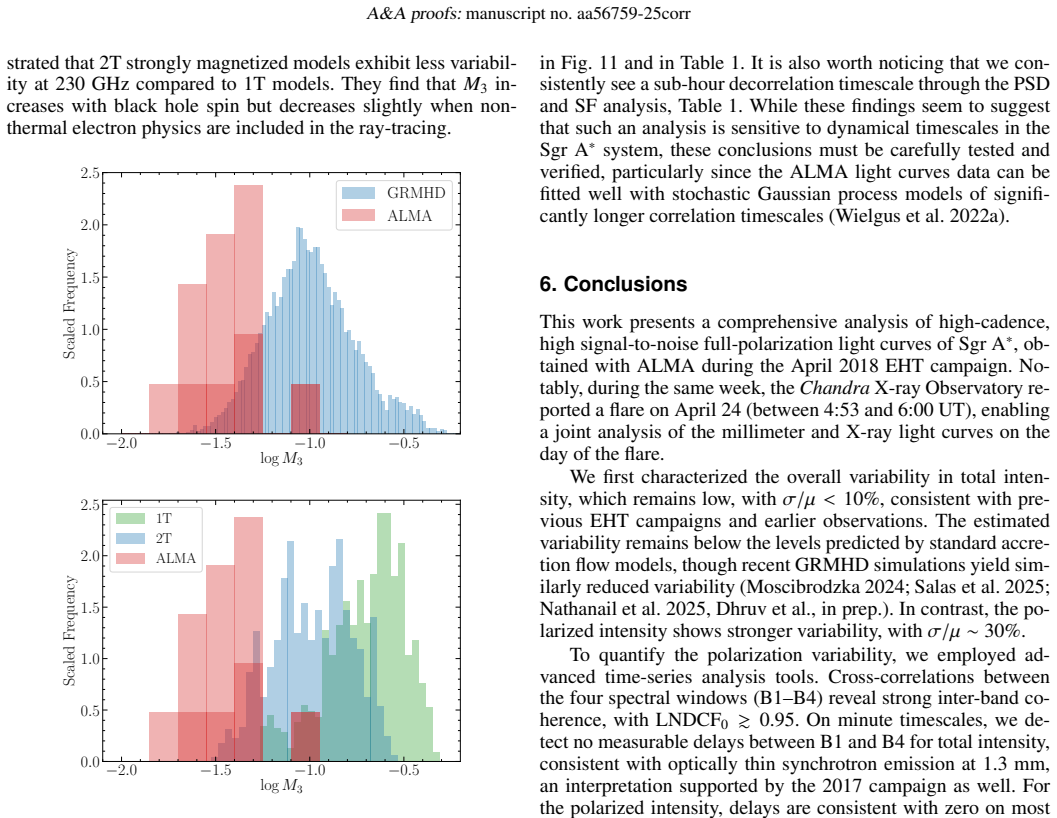
Figure 14
Figure 14. Figure 14: Distribution of M3 in ALMA observations taken during the 2017 and 2018 EHT campaigns, compared to the distributions from different GRMHD models. The top panel shows the comparison with the EHT library of GRMHD models, while the bottom panel shows the comparison with the 1T and 2T GRMHD models from Salas et al. (2025). The dark red part of the observational histogram represents the 2017 ALMA data from Wiel… view at source ↗
read the original abstract

Sagittarius A* (Srg A*), the supermassive black hole at the center of the Milky Way, provides a unique laboratory to study accretion dynamics and plasma processes near the event horizon. We investigated the variability and polarization properties of Srg A* using ALMA observations during the 2018 Event Horizon Telescope campaign. We analyzed high-cadence full-polarization light curves from ALMA at millimeter wavelengths, performed time-series analysis, and investigated the temporal behavior during an X-ray flare observed by Chandra on 2018 April 24. The variability characteristics are compared with expectations from standard accretion flow models. We find low variability in total intensity ($\sigma/\mu < 10\%$), but significantly higher variability in linear and circular polarization (~ 30% and ~ 50%, respectively). A time-series analysis reveals red-noise variability, with power spectral densities between -2 and -3 across all Stokes parameters. Polarized intensity shows stable intra-day timescales, while total intensity exhibits more variable timescales, suggesting distinct emission regions, with polarization likely arising from a coherent structure. On April 24, a statistically significant inter-band delay in polarized intensity coincides with a near-simultaneous X-ray and millimeter peak that deviates from the typical delayed flare scenario. This event also features enhanced millimeter variability and coherent polarization loop evolution. The observed simultaneity challenges standard models of transient synchrotron emission with cooling delays, favoring instead a scenario of continuous energy injection in an optically thin region. Our results offer new constraints on the physical mechanisms driving variability in Srg A*, and provide key observational input for refining theoretical models of accretion and plasma behavior in the vicinity of supermassive black holes.

Editorial analysis

A structured set of objections, weighed in public.

Desk editor's note, referee report, simulated authors' rebuttal, and a circularity audit. Tearing a paper down is the easy half of reading it; the pith above is the substance, this is the friction.

Referee Report

1 major / 2 minor

Summary. The manuscript presents an analysis of full-polarization millimeter-wavelength light curves of Sagittarius A* obtained with ALMA during the 2018 EHT campaign. Key findings include low fractional variability in total intensity (<10%), higher variability in linear (~30%) and circular (~50%) polarization, red-noise power spectral densities with indices between -2 and -3, and distinct variability timescales between total and polarized intensity. A notable event on 2018 April 24 is highlighted, featuring near-simultaneous X-ray and millimeter peaks along with a statistically significant inter-band delay in polarized intensity, which the authors interpret as evidence favoring continuous energy injection over standard cooling-delay models in transient synchrotron emission.

Significance. If the reported simultaneity and its interpretation are robust, the paper would provide significant new constraints on the physical processes governing variability and emission in the accretion flow around Sgr A*. It contributes observational evidence that can help discriminate between competing models of plasma heating and synchrotron radiation near the event horizon. The full-polarization approach and multi-wavelength comparison are particularly valuable strengths.

major comments (1)
  1. [Abstract (discussion of April 24 event)] The assertion of a 'statistically significant inter-band delay in polarized intensity' coinciding with the X-ray and millimeter peaks is central to the claim that this event deviates from typical delayed-flare behavior and supports continuous energy injection. However, no cross-correlation coefficient, significance level, or test against the red-noise background (PSD slopes -2 to -3) is provided. This omission makes it difficult to evaluate whether the observed simultaneity is statistically meaningful or consistent with chance alignment of independent processes.
minor comments (2)
  1. [Abstract] The acronym 'Srg A*' appears to be a typographical error and should be corrected to 'Sgr A*'.
  2. [Abstract] The abstract would benefit from a brief mention of the number of epochs, frequency bands, and any data quality cuts applied to the ALMA observations to allow better assessment of the reported variability levels.

Simulated Author's Rebuttal

1 responses · 0 unresolved

We thank the referee for their careful and constructive review of our manuscript. We address the single major comment below and will revise the paper accordingly to strengthen the statistical support for our claims.

read point-by-point responses
  1. Referee: [Abstract (discussion of April 24 event)] The assertion of a 'statistically significant inter-band delay in polarized intensity' coinciding with the X-ray and millimeter peaks is central to the claim that this event deviates from typical delayed-flare behavior and supports continuous energy injection. However, no cross-correlation coefficient, significance level, or test against the red-noise background (PSD slopes -2 to -3) is provided. This omission makes it difficult to evaluate whether the observed simultaneity is statistically meaningful or consistent with chance alignment of independent processes.

    Authors: We agree with the referee that the manuscript would benefit from explicit quantitative details on the cross-correlation analysis to substantiate the claim of statistical significance. While the abstract and main text describe the near-simultaneous X-ray/mm peaks and the inter-band delay in polarized intensity, along with its interpretation favoring continuous energy injection, the specific cross-correlation coefficient, lag value, and formal significance test against red-noise realizations were not reported. In the revised manuscript we will add this information, including the peak cross-correlation coefficient, the measured lag, and the results of Monte Carlo simulations that generate surrogate light curves matching the observed PSD slopes (-2 to -3) to establish the significance level. This addition will allow readers to directly assess the robustness of the simultaneity against the red-noise background. revision: yes

Circularity Check

0 steps flagged

No significant circularity; claims rest on direct observational timing and variability metrics

full rationale

The paper reports ALMA light-curve statistics (variability amplitudes, PSD slopes between -2 and -3, intra-day timescales) and a timing coincidence between an X-ray flare and millimeter peak. These quantities are extracted from the data themselves and compared against pre-existing standard synchrotron models; no equation or parameter is fitted inside the paper and then re-labeled as a 'prediction' of the same data. No self-citation chain is invoked to justify uniqueness or an ansatz, and the central claim (simultaneity favoring continuous injection) is presented as an empirical challenge rather than a derived identity. The analysis is therefore self-contained against external benchmarks.

Axiom & Free-Parameter Ledger

0 free parameters · 0 axioms · 0 invented entities

This is an observational study whose claims rest on empirical ALMA light-curve measurements and standard comparisons to existing accretion models; no new free parameters, axioms, or invented entities are introduced.

pith-pipeline@v0.9.0 · 7032 in / 1270 out tokens · 34642 ms · 2026-05-10T15:23:17.957277+00:00 · methodology

discussion (0)

Sign in with ORCID, Apple, or X to comment. Anyone can read and Pith papers without signing in.

Reference graph

Works this paper leans on

9 extracted references · 2 canonical work pages

  1. [1]

    E. Pancini

    Albentosa-Ruiz, E. & Marchili, N. 2024, PASP, 136, 114502 Aschenbach, B., Grosso, N., Porquet, D., & Predehl, P. 2004, A&A, 417, 71 Balick, B. & Brown, R. L. 1974, ApJ, 194, 265 Blackburn, L., Chan, C.-k., Crew, G. B., et al. 2019, ApJ, 882, 23 Bower, G. C., Broderick, A., Dexter, J., et al. 2018, ApJ, 868, 101 Bower, G. C., Falcke, H., Wright, M. C., & B...

  2. [2]

    The visibility amplitude light curves confirm that, unlike Sgr A∗, the other AGN targets exhibit stable flux densities throughout each night of observation

    We display both the sum and difference of the parallel-hand correlations (XXandYY) and the cross-hand cor- relations (XYandY X), which correspond to the Stokes I, Q, U, and V light curves, respectively, according to the Radio Interfer- ometer Measurement Equation formalism (Smirnov 2011). The visibility amplitude light curves confirm that, unlike Sgr A∗, ...

  3. [3]

    On April 21, the LNDCF is slightly lower, around 0.6±0.1. The reduced correlation on April 21 and 25 is likely due to the lower elevation of Sgr A ∗ during ALMA observations coinciding with SMA coverage, leading to lower observed flux densities and increased noise in the light curves. Given this overall consistency, also in agreement with the findings of ...

  4. [4]

    In this appendix we examine in greater detail the behavior of the SF and describe the methodol- ogy employed to estimate PSD slopes and variability timescales

    Appendix F: Details of the structure function analysis Section 4.2 presents the main results of the SF analysis of the Sgr A∗ 2018 ALMA light curves. In this appendix we examine in greater detail the behavior of the SF and describe the methodol- ogy employed to estimate PSD slopes and variability timescales. In Fig. 10 the SF of total intensity for April ...

  5. [5]

    This process involved binning the data using a window approximately two times the observational cadence and fitting a spline to the re- sulting light curve

    were computed after denoising the light curve. This process involved binning the data using a window approximately two times the observational cadence and fitting a spline to the re- sulting light curve. This effectively reduced noise while preserv- ing the main features of the signal, mitigating noise that could af- fect the SF slope estimates for the to...

  6. [6]

    Fig. F .1.Sample of SF fitted to retrieve the slope (blue line, with an area corresponding to the 3σlevel), the plateau level (orange line) and the timescales (red point, marking the intersection of the slope and the plateau). Left: SF of the April 21 Stokes I denoised light curve. Right: SF of the April 22 Stokes I light curve; we note two distinct slope...

  7. [7]

    Appendix H: Polarization properties and accretion rate of Sgr A ∗ The RM andm ′ observables provide insight into the structure of the Faraday depth across the source (e.g., Sokoloffet al. 1998). In Table H.1, we present the polarized observables averaged for each day. For the total flux density, polarized intensity, EVPA and Stokes V , we report the daily...

  8. [8]

    using the time-series analysis techniques introduced in this work. The lack of significant cor- relation between the RM and depolarization curves, as indicated by the correlation function analysis, suggests that bandwidth de- polarization is unlikely to be the dominant mechanism. Article number, page 21 A&A proofs:manuscript no. aa56759-25corr Table H.1.A...

  9. [9]

    H.2.Sgr A ∗ accretion rate evolution through the ALMA 2018 observations, estimated from the RM light curve presented in Fig

    5.0 7.5 10.0 12.5 5.0 7.5 10.0 7.5 10.0 12.5 2018 April 21 2018 April 22 2018 April 24 2018 April 25 UT (h) Fig. H.2.Sgr A ∗ accretion rate evolution through the ALMA 2018 observations, estimated from the RM light curve presented in Fig. 4, using the accretion flow model presented in Marrone et al. (2006). The gray-shaded band on April 24 marks the time r...