Recognition: unknown
First Observation of boldmath{D^+ to a₀(980)rho and D^+ to a₀(980)^+ f₀(500)} in boldmath{D^+ to π^+π^+π^-η and D^+ to π^+π⁰π⁰η} Decays
Pith reviewed 2026-05-10 16:30 UTC · model grok-4.3
The pith
The D+ meson decay to a0(980)+ f0(500) is observed for the first time with an unexpectedly large branching fraction.
A machine-rendered reading of the paper's core claim, the machinery that carries it, and where it could break.
Core claim
Using 20.3 fb^{-1} of e+e- data collected at 3.773 GeV, the absolute branching fractions are measured to be (3.20 ± 0.06_stat ± 0.03_syst) × 10^{-3} for D+ → π+π+π-η and (2.43 ± 0.11_stat ± 0.04_syst) × 10^{-3} for D+ → π+π0π0η. The decay process D+ → a0(980)+ f0(500) is observed for the first time with an unexpectedly large branching fraction. The decays D+ → a0(980)+(0) ρ(770)0(+) are observed and the ratio r+/0 ≡ B(D+ → a0(980)+ ρ(770)0) / B(D+ → a0(980)0 ρ(770)+) is measured to be 0.55 ± 0.08_stat ± 0.05_syst. These results offer a novel insight into the nature of the a0(980) and f0(500) states.
What carries the argument
Amplitude analysis that decomposes the Dalitz-plot distributions of the three-pion eta final states into coherent contributions from the intermediate resonances a0(980), f0(500), and rho(770).
Load-bearing premise
The observed structures in the invariant-mass spectra arise from the a0(980), f0(500), and rho(770) resonances without large unmodeled backgrounds or interference from other states.
What would settle it
A higher-statistics independent analysis of the same final states that finds no significant D+ → a0(980)+ f0(500) signal or measures an r+/0 ratio differing from 0.55 by several standard deviations.
Figures


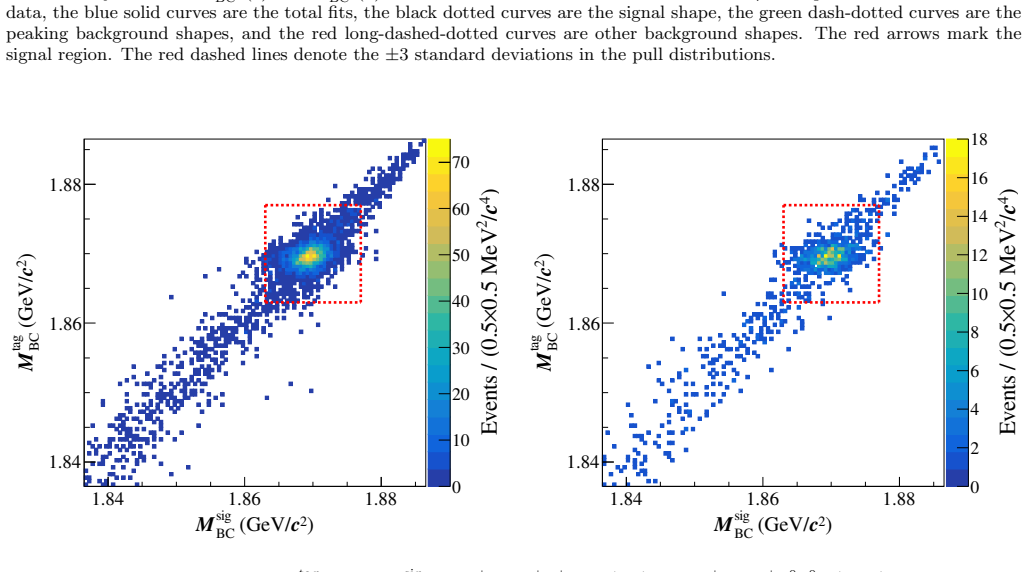
read the original abstract
We perform the first amplitude analysis of the singly Cabibbo-suppressed decays $D^+ \to \pi^+ \pi^{+(0)} \pi^{-(0)} \eta$, using $e^+e^-$ collision data collected with the BESIII detector at the center-of-mass energy of 3.773\,GeV, corresponding to an integrated luminosity of 20.3 $\rm{fb}^{-1}$. The absolute branching fractions of the $D^+ \to \pi^+ \pi^+ \pi^- \eta$ and $D^+ \to \pi^+ \pi^0 \pi^0 \eta$ decays are measured to be $(3.20\pm0.06_{\text{stat.}}\pm0.03_{\text{syst.}})\times 10^{-3}$ and $(2.43 \pm 0.11_{\text{stat.}} \pm 0.04_{\text{syst.}}) \times 10^{-3}$, respectively. % , both achieving three times better precision than the current PDG values. The decay process $D^{+}\to a_0(980)^{+}f_0(500)$ is observed for the first time with an unexpectedly large branching fraction. Moreover, we observe the decays $D^+ \to a_0(980)^{+(0)} \rho(770)^{0(+)}$ and measure the ratio $r_{+/0} \equiv \frac{\mathcal{B}(D^+ \to a_0(980)^+ \rho(770)^0)}{\mathcal{B}(D^+ \to a_0(980)^0 \rho(770)^+)}$ for the first time to be $0.55\pm0.08_{\text{stat.}}\pm0.05_{\text{syst.}}$. These results offer a novel insight into our comprehension of the nature of the $a_0(980)$ and $f_0(500)$ states.
Editorial analysis
A structured set of objections, weighed in public.
Referee Report
Summary. The manuscript performs the first amplitude analysis of the singly Cabibbo-suppressed decays D⁺ → π⁺π⁺π⁻η and D⁺ → π⁺π⁰π⁰η using 20.3 fb⁻¹ of e⁺e⁻ collision data at √s = 3.773 GeV collected with the BESIII detector. It measures the absolute branching fractions of these modes as (3.20 ± 0.06_stat ± 0.03_syst) × 10^{-3} and (2.43 ± 0.11_stat ± 0.04_syst) × 10^{-3}, respectively. The analysis claims the first observation of D⁺ → a₀(980)⁺ f₀(500) with an unexpectedly large branching fraction, the first observations of D⁺ → a₀(980)^{+(0)} ρ(770)^{0(+)}, and the first measurement of the ratio r_{+/0} ≡ B(D⁺ → a₀(980)⁺ ρ(770)⁰) / B(D⁺ → a₀(980)⁰ ρ(770)⁺) = 0.55 ± 0.08_stat ± 0.05_syst. These results are presented as offering insight into the nature of the a₀(980) and f₀(500) states.
Significance. If the amplitude analysis holds under scrutiny, the results are significant for light-meson spectroscopy and D-meson decay dynamics. The unexpectedly large rate for D⁺ → a₀(980)⁺ f₀(500) provides a new experimental handle on the structure of the light scalars (possible tetraquark, molecular, or qq̄ interpretations), while the measured ratio r_{+/0} tests isospin relations in these processes. The improved branching-fraction measurements for the inclusive three-body modes also tighten constraints on theoretical calculations of singly Cabibbo-suppressed D decays.
major comments (2)
- [Amplitude analysis section] Amplitude analysis section: The first-observation claim for D⁺ → a₀(980)⁺ f₀(500) and the 'unexpectedly large' branching fraction rest on the isobar-model fit uniquely isolating this component. The manuscript must demonstrate, with explicit quantitative tests, that alternative f₀(500) lineshapes (e.g., different Breit-Wigner parameters or Flatté forms) and the addition or removal of other partial waves or non-resonant terms leave the signal significance above 5σ and shift the extracted branching fraction by less than the quoted total uncertainty. Without such studies the observation is at risk of model dependence.
- [Results section] Results section (fit-quality and background modeling): The manuscript reports branching fractions with separate statistical and systematic uncertainties but does not state the χ²/dof of the nominal fit, the background-modeling procedure, or the resonance line-shape choices used for a₀(980), f₀(500), and ρ(770). These details are load-bearing for assessing whether the extracted amplitudes are robust.
minor comments (2)
- Ensure that all resonance parameters (masses, widths) used in the nominal fit are explicitly tabulated or referenced to standard values, and that any deviations are justified.
- The abstract and text use consistent notation for the ratio r_{+/0}; verify that the same definition appears in all tables and figures.
Simulated Author's Rebuttal
We thank the referee for the careful and constructive review of our manuscript. The comments highlight important aspects of the amplitude analysis and results presentation that we will address to strengthen the paper. We respond to each major comment below and will incorporate the necessary revisions.
read point-by-point responses
-
Referee: [Amplitude analysis section] Amplitude analysis section: The first-observation claim for D⁺ → a₀(980)⁺ f₀(500) and the 'unexpectedly large' branching fraction rest on the isobar-model fit uniquely isolating this component. The manuscript must demonstrate, with explicit quantitative tests, that alternative f₀(500) lineshapes (e.g., different Breit-Wigner parameters or Flatté forms) and the addition or removal of other partial waves or non-resonant terms leave the signal significance above 5σ and shift the extracted branching fraction by less than the quoted total uncertainty. Without such studies the observation is at risk of model dependence.
Authors: We agree that explicit robustness tests are required to support the first-observation claim and to quantify model dependence. In the revised manuscript we will add a new subsection detailing systematic variations of the f₀(500) lineshape (including alternative Breit-Wigner parameters and Flatté forms), as well as fits with additional partial waves and non-resonant terms. These studies will demonstrate that the signal significance remains above 5σ and that the extracted branching fraction for D⁺ → a₀(980)⁺ f₀(500) shifts by less than the total quoted uncertainty, thereby confirming the stability of the result. revision: yes
-
Referee: [Results section] Results section (fit-quality and background modeling): The manuscript reports branching fractions with separate statistical and systematic uncertainties but does not state the χ²/dof of the nominal fit, the background-modeling procedure, or the resonance line-shape choices used for a₀(980), f₀(500), and ρ(770). These details are load-bearing for assessing whether the extracted amplitudes are robust.
Authors: We acknowledge that these technical details were insufficiently documented. In the revised manuscript we will explicitly report the χ²/dof value of the nominal amplitude fit, provide a complete description of the background modeling procedure (including how sideband and Monte Carlo backgrounds are incorporated), and specify the exact resonance lineshape parameterizations and fixed parameters adopted for a₀(980), f₀(500), and ρ(770). revision: yes
Circularity Check
No circularity: direct experimental measurements from data
full rationale
The paper performs an amplitude analysis on collision data to extract absolute branching fractions, observe decay modes for the first time, and measure a ratio, all with statistical and systematic uncertainties. No derivation chain, fitted parameter, or self-citation reduces any claimed result to its own inputs by construction. The analysis uses standard isobar-model techniques on the provided dataset without invoking uniqueness theorems or ansatze from prior self-work that would force the outcomes. This is a self-contained experimental measurement against external benchmarks.
Axiom & Free-Parameter Ledger
free parameters (1)
- resonance amplitude magnitudes and phases
axioms (1)
- domain assumption The decay amplitude can be described by a coherent sum of resonant isobar contributions plus possible non-resonant terms.
Forward citations
Cited by 1 Pith paper
-
$CP$ violation in singly Cabibbo suppressed $D\to \pi a_0(980)$ decays
Long-distance rescattering generates O(10^{-3}) direct CP asymmetries in D→πa0(980) decays.
Reference graph
Works this paper leans on
-
[1]
Navaset al.(Particle Data Group), Phys
S. Navaset al.(Particle Data Group), Phys. Rev. D110, 030001 (2024)
2024
-
[2]
F. L. Braghin, J. Phys. G50, 095101 (2023)
2023
-
[3]
Ablikimet al.(BESIII Collaboration), Phys
M. Ablikimet al.(BESIII Collaboration), Phys. Rev. Lett.121, 081802 (2018)
2018
-
[4]
Ablikimet al.(BESIII Collaboration), Phys
M. Ablikimet al.(BESIII Collaboration), Phys. Rev. Lett.123, 112001 (2019)
2019
-
[5]
Ablikimet al.(BESIII Collaboration), Phys
M. Ablikimet al.(BESIII Collaboration), Phys. Rev. D 104, L071101 (2021)
2021
-
[6]
Ablikimet al.(BESIII Collaboration), Phys
M. Ablikimet al.(BESIII Collaboration), Phys. Rev. D 110, L111102 (2024)
2024
-
[7]
Hsiao, S.-Q
Y.-K. Hsiao, S.-Q. Yang, W.-J. Wei, and B.-C. Ke, JHEP 12, 226 (2025)
2025
-
[8]
Hsiao, Y
Y.-K. Hsiao, Y. Yu, and B.-C. Ke, Eur. Phys. J. C80, 895 (2020)
2020
-
[9]
Yu, Y.-K
Y. Yu, Y.-K. Hsiao, and B.-C. Ke, Eur. Phys. J. C81, 1093 (2021)
2021
-
[10]
R. L. Jaffe, Phys. Rev. D15, 267 (1977). 13 TABLE V. The energy difference (∆E) windows, ST yields in data (N α ST), ST efficiencies (ϵ α ST), DT efficiencies (ϵ α DT) for each tag mode ofD + →ηπ +π+π−. Note that the efficiencies do not include the BFs of all possible daughter particles. Tag mode ∆E (MeV)N α ST (×103)ϵ α ST(%)ϵ α DT(%) D− →K +π−π− (−25,24...
1977
-
[11]
T. V. Brito, F. S. Navarra, M. Nielsen, and M. E. Bracco, Phys. Lett. B608, 69 (2005)
2005
-
[12]
Klempt and A
E. Klempt and A. Zaitsev, Phys. Rept.454, 1 (2007)
2007
-
[13]
Alexandrou, J
C. Alexandrou, J. Berlin, M. Dalla Brida, J. Finkenrath, T. Leontiou, and M. Wagner, Phys. Rev. D97, 034506 (2018)
2018
-
[14]
Humanicet al.(ALICE Collaboration), Rev
T. Humanicet al.(ALICE Collaboration), Rev. Mex. Fis. Suppl.3, 0308039 (2022)
2022
-
[15]
J. D. Weinstein and N. Isgur, Phys. Rev. Lett.48, 659 (1982)
1982
-
[16]
Dai and M
L.-Y. Dai and M. R. Pennington, Phys. Lett. B736, 11 (2014)
2014
-
[17]
Sekihara and S
T. Sekihara and S. Kumano, Phys. Rev. D92, 034010 (2015)
2015
-
[18]
Duan, J.-Y
M.-Y. Duan, J.-Y. Wang, G.-Y. Wang, E. Wang, and D.-M. Li, Eur. Phys. J. C80, 1041 (2020)
2020
-
[19]
Ikeno, M
N. Ikeno, M. Bayar, and E. Oset, Eur. Phys. J. C81, 377 (2021)
2021
-
[20]
B.-C. Ke, J. Koponen, H.-B. Li, and Y. Zheng, Ann. Rev. Nucl. Part. Sci.73, 285 (2023)
2023
-
[21]
Cheng, C.-W
H.-Y. Cheng, C.-W. Chiang, and F. Xu, Phys. Rev. D 110, 094052 (2024)
2024
-
[22]
D. R. Boito, J. P. Dedonder, B. El-Bennich, O. Leitner, and B. Loiseau, Phys. Rev. D79, 034020 (2009)
2009
-
[23]
Cheng, C.-W
H.-Y. Cheng, C.-W. Chiang, and Z.-Q. Zhang, Phys. Rev. D105, 033006 (2022)
2022
-
[24]
L. R. Dai and E. Oset, Phys. Rev. D109, 054008 (2024)
2024
-
[25]
Ablikimet al.(BESIII Collaboration), Phys
M. Ablikimet al.(BESIII Collaboration), Phys. Rev. Lett.132, 131903 (2024)
2024
-
[26]
Ablikimet al.(BESIII Collaboration), Phys
M. Ablikimet al.(BESIII Collaboration), Phys. Rev. Lett.134, 011904 (2025)
2025
-
[27]
Ablikimet al.(BESIII), Phys
M. Ablikimet al.(BESIII), Phys. Rev. Lett.134, 201902 (2025)
2025
-
[28]
Ablikimet al.(BESIII Collaboration), Phys
M. Ablikimet al.(BESIII Collaboration), Phys. Rev. D 99, 092008 (2019)
2019
-
[29]
Ablikimet al.(BESIII Collaboration), Phys
M. Ablikimet al.(BESIII Collaboration), Phys. Rev. D 100, 072008 (2019)
2019
-
[30]
Ablikimet al.(BESIII Collaboration), Nucl
M. Ablikimet al.(BESIII Collaboration), Nucl. Instrum. Meth. A614, 345 (2010)
2010
-
[31]
Ablikimet al.(BESIII Collaboration), Chin
M. Ablikimet al.(BESIII Collaboration), Chin. Phys. C 37, 123001 (2013)
2013
-
[32]
Ablikimet al.(BESIII Collaboration), Chin
M. Ablikimet al.(BESIII Collaboration), Chin. Phys. C 48, 123001 (2024)
2024
-
[33]
Agostinelliet al.(GEANT4 Collaboration), Nucl
S. Agostinelliet al.(GEANT4 Collaboration), Nucl. In- strum. Meth. A506, 250 (2003)
2003
-
[34]
K. X. Huang, Z. J. Li, Z. Qian, J. Zhu, H. Y. Li, Y. M. Zhang, S. S. Sun, and Z. Y. You, Nucl. Sci. Tech.33, 142 (2022)
2022
-
[35]
Jadach, B
S. Jadach, B. F. L. Ward, and Z. Was, Phys. Rev. D63, 113009 (2001)
2001
-
[36]
D. J. Lange, Nucl. Instrum. Meth. A462, 152 (2001)
2001
-
[37]
R. G. Ping, Chin. Phys. C32, 599 (2008)
2008
-
[38]
J. C. Chen, G. S. Huang, X. R. Qi, D. H. Zhang, and Y. S. Zhu, Phys.Rev.D62, 034003 (2000)
2000
-
[39]
R. L. Yang, R. G. Ping, and H. Chen, Chin.Phys.Lett. 31, 061301 (2014)
2014
-
[40]
Richter-Was, Phys
E. Richter-Was, Phys. Lett. B303, 163 (1993)
1993
-
[41]
R. M. Baltrusaitiset al.(MARK-III Collaboration), Phys. Rev. Lett.56, 2140 (1986)
1986
-
[42]
Ablikimet al.(BESIII Collaboration), Phys
M. Ablikimet al.(BESIII Collaboration), Phys. Rev. D 111, L091501 (2025)
2025
-
[43]
Ablikimet al.(BESIII Collaboration), Phys
M. Ablikimet al.(BESIII Collaboration), Phys. Rev. D 110, 092006 (2024)
2024
-
[44]
Ablikimet al.(BESIII Collaboration), Chin
M. Ablikimet al.(BESIII Collaboration), Chin. Phys. C 49, 083001 (2025)
2025
-
[45]
Ablikimet al.(BESIII Collaboration), Phys
M. Ablikimet al.(BESIII Collaboration), Phys. Rev. Lett.124, 241803 (2020)
2020
-
[46]
See Supplemental Material at [URL] for the 2D fit, back- ground PDF modeling and symmetry considerations in amplitude construction, as well as systematic uncertain- ties of amplitude analysis and BF measurements
-
[47]
B. S. Zou and D. V. Bugg, Eur. Phys. J. A16, 537 (2003)
2003
-
[48]
J. D. Jackson, Nuovo Cim.34, 1644 (1964). 14 TABLE VII. The relative systematic uncertainties for the BF measurements ofD + →π +π+π−ηandD + →π +π0π0η. σsyst.(%)D + →π +π+π−η D + →π +π0π0η N tot ST 0.3 0.3 π± tracking 0.3 0.1 π± PID 0.1 0.1 π0/ηreconstruction 0.3 0.8 ∆Esig requirement 0.5 0.4 Amplitude model 0.3 0.7 2D fit 0.3 0.8 Cited BFs 0.5 0.5 MC stat...
1964
-
[49]
G. J. Gounaris and J. J. Sakurai, Phys. Rev. Lett.21, 244 (1968)
1968
-
[50]
Abeleet al., Phys
A. Abeleet al., Phys. Rev. D57, 3860 (1998)
1998
-
[51]
D. V. Bugg, B. S. Zou, and A. V. Sarantsev, Nucl. Phys. B471, 59 (1996)
1996
-
[52]
Rogozhnikov, J
A. Rogozhnikov, J. Phys. Conf. Ser.762, 012036 (2016)
2016
-
[53]
B. Liu, X. Xiong, G. Hou, S. Song, and L. Shen, EPJ Web Conf.214, 06033 (2019)
2019
-
[54]
Artusoet al.(CLEO Collaboration), Phys
M. Artusoet al.(CLEO Collaboration), Phys. Rev. D 85, 122002 (2012)
2012
-
[55]
Williams, JINST5, P09004 (2010)
M. Williams, JINST5, P09004 (2010)
2010
-
[56]
Ablikimet al.(BES Collaboration), Phys
M. Ablikimet al.(BES Collaboration), Phys. Lett. B 598, 149 (2004)
2004
-
[57]
Ablikimet al.(BESIII Collaboration), Phys
M. Ablikimet al.(BESIII Collaboration), Phys. Rev. D 104, 012016 (2021)
2021
-
[58]
L. L. Chau and H. Y. Cheng, Phys. Rev. Lett.56, 1655 (1986)
1986
-
[59]
Cheng and C.-W
H.-Y. Cheng and C.-W. Chiang, Phys. Rev. D81, 074021 (2010)
2010
-
[60]
Ablikimet al.(BESIII Collaboration), JHEP09, 077 (2023)
M. Ablikimet al.(BESIII Collaboration), JHEP09, 077 (2023)
2023
-
[61]
Ablikimet al.(BESIII Collaboration), Chin
M. Ablikimet al.(BESIII Collaboration), Chin. Phys. C 48, 083001 (2024)
2024
-
[62]
Cranmer, J
K. Cranmer, J. Pavez, and G. Louppe, (2015)
2015
discussion (0)
Sign in with ORCID, Apple, or X to comment. Anyone can read and Pith papers without signing in.