Driving-Cycle-Aware Shape and Topology Optimization of an Interior Permanent Magnet Synchronous Machine for a Traction Drive
Pith reviewed 2026-05-10 15:41 UTC · model grok-4.3
The pith
Driving-cycle-aware optimization reduces permanent magnet use by 10% in traction motors while keeping torque and efficiency.
A machine-rendered reading of the paper's core claim, the machinery that carries it, and where it could break.
Core claim
The paper establishes that a constraint-aware optimization pipeline, which reduces driving cycles to representative points via k-means clustering and combines binary topology optimization, Normalized Gaussian Networks, and spline shape optimization with Laplace-based mesh deformation, produces rotor designs that achieve up to 10% permanent magnet reduction while maintaining required torque capability and near-reference full-cycle efficiency, with validation through manufactured prototypes.
What carries the argument
The k-means clustering of driving cycles into representative points combined with Laplace-based mesh deformation to enable simultaneous binary topology optimization of flux barriers and spline shape optimization of magnet geometry under multiple constraints.
If this is right
- Rotor designs require less permanent magnet material for the same torque output in traction applications.
- Optimized machines achieve efficiency close to reference designs across full driving cycles.
- The workflow respects inverter voltage limits and mechanical overspeed constraints during optimization.
- Manufactured prototypes validate that simulated performance improvements hold in physical tests.
Where Pith is reading between the lines
- The clustering approach may extend to optimizing other electric machine types for application-specific duty cycles.
- Lower magnet content could reduce material costs and supply risks in electric vehicle production.
- Adding thermal or noise constraints to the same workflow might produce designs better suited for real-world integration.
Load-bearing premise
The k-means clustering of driving cycles into a small number of points sufficiently represents the full range of operating conditions so that optimized designs perform as predicted in actual vehicle use.
What would settle it
Full experimental testing or simulation of an optimized rotor on the complete un-clustered driving cycle that shows torque shortfalls or efficiency below the reference level would disprove the pipeline's effectiveness.
Figures




read the original abstract
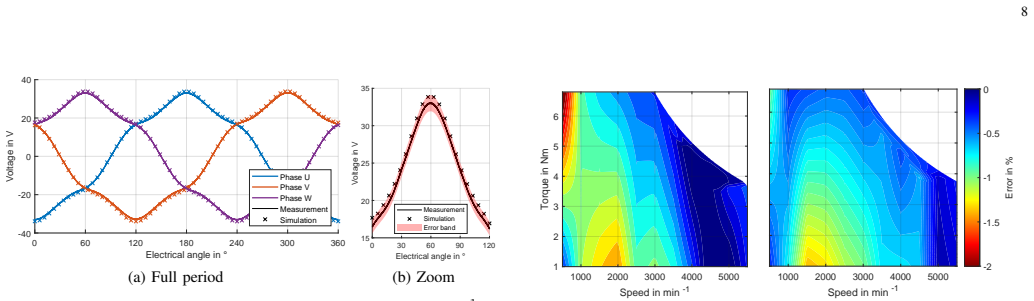
This paper presents a driving-cycle-aware shape and topology optimization workflow for interior permanent magnet synchronous machines used in traction drives. A k-means clustering approach reduces full driving cycles to representative operating points so that optimization remains computationally feasible while preserving realistic operating behavior. The workflow combines binary topology optimization, Normalized Gaussian Networks (NGnet), and spline-based shape optimization under electromagnetic, mechanical overspeed, and inverter voltage constraints. A Laplace-based mesh deformation strategy enables simultaneous optimization of magnet geometry and flux-barrier topology. Two optimized rotor designs are manufactured and tested experimentally. The central contribution is a validated, constraint-aware optimization pipeline that achieves permanent-magnet reduction of up to 10% while maintaining required torque capability and near-reference full-cycle efficiency.
Editorial analysis
A structured set of objections, weighed in public.
Referee Report
Summary. The manuscript presents a driving-cycle-aware shape and topology optimization workflow for interior permanent magnet synchronous machines (IPMSMs) in traction applications. It reduces full driving cycles to representative operating points via k-means clustering, integrates binary topology optimization with Normalized Gaussian Networks (NGnet) and spline-based shape optimization, enforces electromagnetic, mechanical overspeed, and inverter voltage constraints, and uses Laplace-based mesh deformation for simultaneous magnet and flux-barrier optimization. Two optimized rotor designs are manufactured and experimentally tested, with the central claim being a validated pipeline that achieves up to 10% permanent-magnet reduction while preserving required torque capability and near-reference full-cycle efficiency.
Significance. If the experimental results and full-cycle performance claims hold, the work would offer a practical, constraint-aware optimization pipeline for reducing rare-earth magnet content in EV traction motors without sacrificing performance. The combination of topology/shape optimization, driving-cycle reduction, and physical prototyping is a notable strength that could influence industrial design workflows, though the absence of detailed quantitative validation data in the current text limits assessment of its immediate applicability.
major comments (2)
- [Abstract] Abstract: the central claim of experimental validation for two manufactured designs with up to 10% magnet reduction and maintained torque/efficiency supplies no quantitative results, error bars, baseline comparisons to a reference design, or measurement protocols, rendering the performance assertions impossible to verify from the provided text.
- [Optimization workflow] k-means clustering approach (as described in the abstract and optimization workflow): optimization and constraint enforcement occur only on the reduced set of representative points, yet no post-optimization evaluation of the final designs on the full unreduced driving cycle is reported to quantify maximum deviations in torque or losses at un-clustered transients or edge cases; this directly undermines the 'near-reference full-cycle efficiency' claim.
Simulated Author's Rebuttal
We thank the referee for the constructive comments on our manuscript. We address each major comment below and indicate where revisions to the text are planned.
read point-by-point responses
-
Referee: [Abstract] Abstract: the central claim of experimental validation for two manufactured designs with up to 10% magnet reduction and maintained torque/efficiency supplies no quantitative results, error bars, baseline comparisons to a reference design, or measurement protocols, rendering the performance assertions impossible to verify from the provided text.
Authors: We agree that the abstract, constrained by length, omits specific quantitative results, error bars, baseline comparisons, and measurement protocols. These details appear in the experimental validation section of the full manuscript, where the two manufactured rotors are compared against the reference design. We will revise the abstract to incorporate key quantitative metrics, including the achieved magnet reduction, torque values, efficiency figures, and a reference to the experimental protocols. revision: yes
-
Referee: [Optimization workflow] k-means clustering approach (as described in the abstract and optimization workflow): optimization and constraint enforcement occur only on the reduced set of representative points, yet no post-optimization evaluation of the final designs on the full unreduced driving cycle is reported to quantify maximum deviations in torque or losses at un-clustered transients or edge cases; this directly undermines the 'near-reference full-cycle efficiency' claim.
Authors: Optimization and constraint enforcement were performed exclusively on the k-means clustered points to maintain computational tractability. The manuscript asserts near-reference full-cycle efficiency on the basis of this approach, but we acknowledge that an explicit post-optimization verification on the complete unreduced driving cycle—with quantified maximum deviations in torque and losses at un-clustered points—is not reported in sufficient detail. We will add this evaluation to the revised manuscript, including the observed deviations, to support the efficiency claim. revision: yes
Circularity Check
No circularity in optimization workflow or validation
full rationale
The paper describes a forward computational pipeline: k-means clustering reduces driving cycles to representative points, followed by binary topology optimization, NGnet, spline shape optimization, and Laplace mesh deformation under explicit electromagnetic, mechanical, and voltage constraints. Two rotor designs are manufactured and experimentally tested to support claims of up to 10% PM reduction with maintained torque and near-reference efficiency. No self-definitional equations, fitted parameters renamed as predictions, load-bearing self-citations, or ansatzes smuggled via prior work appear in the abstract or described workflow. Performance assertions rest on physical prototypes rather than quantities defined by the optimization inputs themselves, making the derivation chain self-contained against external benchmarks.
Axiom & Free-Parameter Ledger
free parameters (1)
- Number of k-means clusters
axioms (2)
- domain assumption k-means clustering of driving-cycle data preserves the essential torque and efficiency behavior needed for reliable optimization
- domain assumption Laplace-based mesh deformation produces valid, artifact-free geometry updates during simultaneous magnet and barrier optimization
Reference graph
Works this paper leans on
-
[1]
D. Aliprantis and O. Wasynczuk,Electric Machines: Theory and Anal- ysis Using the Finite Element Method. Cambridge, U.K.: Cambridge Univ. Press, 2022, doi: 10.1017/9781108529280
-
[2]
J. Pyrhonen, T. Jokinen, and V . Hrabovcova,Design of Rotat- ing Electrical Machines. Hoboken, NJ, USA: Wiley, 2013, doi: 10.1002/9781118701591
-
[3]
Topology Optimization for Electromagnetics: A Survey,
F. Lucchini, R. Torchio, V . Cirimele, P. Alotto, and P. Bettini, “Topology Optimization for Electromagnetics: A Survey,”IEEE Access, vol. 10, pp. 98593–98611, 2022, doi: 10.1109/ACCESS.2022.3206368
-
[4]
F. N. U. Nishanth and B. Wang, “Topology Optimization of Electric Machines: A Review,” inProc. IEEE Energy Convers. Congr. Expo. (ECCE), 2022, pp. 1–8, doi: 10.1109/ECCE50734.2022.9948073
-
[5]
O. Sigmund and K. Maute, “Topology optimization approaches: A comparative review,”Struct. Multidiscip. Optim., vol. 48, no. 6, pp. 1031–1055, Dec. 2013, doi: 10.1007/s00158-013-0978-6
-
[6]
Electrical Machine Design by optimization for E-motor Application: A Drive Cycle Approach,
J. F. Cardoso, C. Chillet, L. Gerbaud, and L. A. Belhaj, “Electrical Machine Design by optimization for E-motor Application: A Drive Cycle Approach,” inProc. Int. Conf. Elect. Mach. (ICEM), 2020, pp. 2514–2519, doi: 10.1109/ICEM49940.2020.9270888
-
[7]
Traction PMASR Motor Op- timization According to a Given Driving Cycle,
E. Carraro, M. Morandin, and N. Bianchi, “Traction PMASR Motor Op- timization According to a Given Driving Cycle,”IEEE Trans. Ind. Appl., vol. 52, no. 1, pp. 209–216, Jan. 2016, doi: 10.1109/TIA.2015.2477479
-
[8]
Large- scale electromagnetic design optimization of PM machines over a target operating cycle,
A. Fatemi, N. A. O. Demerdash, D. M. Ionel, and T. W. Nehl, “Large- scale electromagnetic design optimization of PM machines over a target operating cycle,” inProc. IEEE Energy Convers. Congr. Expo. (ECCE), 2015, pp. 4383–4390, doi: 10.1109/ECCE.2015.7310279
- [9]
-
[10]
A. Petrowski and S. Ben-Hamida,Evolutionary Algorithms. Hoboken, NJ, USA: Wiley, 2017
work page 2017
-
[11]
Space-time correlation properties of the magnetization process and eddy current losses: Theory,
G. Bertotti, “Space-time correlation properties of the magnetization process and eddy current losses: Theory,”J. Appl. Phys., vol. 54, no. 9, pp. 5293–5305, Sep. 1983, doi: 10.1063/1.332705
-
[12]
Overview and Comparison of Iron Loss Models for Electrical Machines,
A. Krings and J. Soulard, “Overview and Comparison of Iron Loss Models for Electrical Machines,”J. Electr. Eng., vol. 10, pp. 162–169, May 2010
work page 2010
-
[13]
S. Ferrari, G. Dilevrano, P. Ragazzo, P. Pescetto, and G. Pellegrino, “Fast Determination of Transient Short-Circuit Current of PM Synchronous Machines via Magnetostatic Flux Maps,”IEEE Trans. Ind. Appl., vol. 59, no. 4, pp. 4000–4009, Jul. 2023, doi: 10.1109/TIA.2023.3265952
-
[15]
Topology optimization and param- eter optimization hybridized by mesh smoothing for IPMSM design,
Z. Sun, T. Sato, and K. Watanabe, “Topology optimization and param- eter optimization hybridized by mesh smoothing for IPMSM design,” COMPEL, vol. 42, no. 5, pp. 1133–1147, 2023, doi: 10.1108/COMPEL- 12-2022-0426
-
[16]
A. Lamecki, “A Mesh Deformation Technique Based on Solid Mechan- ics for Parametric Analysis of High-Frequency Devices With 3-D FEM,” IEEE Trans. Microw. Theory Techn., vol. 64, no. 11, pp. 3400–3408, Nov. 2016, doi: 10.1109/TMTT.2016.2605672
-
[17]
A Mesh Deformation Algo- rithm and Its Application in Optimal Motor Design,
L. Yang, S. L. Ho, W. N. Fu, and L. Liu, “A Mesh Deformation Algo- rithm and Its Application in Optimal Motor Design,”IEEE Trans. Magn., vol. 52, no. 3, pp. 1–4, Mar. 2016, doi: 10.1109/TMAG.2015.2490249
-
[18]
S. Ray and R. Turi, “Determination of Number of Clusters in K-Means Clustering and Application in Colour Image Segmentation,” inProc. 4th Int. Conf. Adv. Pattern Recognit. Digit. Tech., 2000
work page 2000
-
[19]
Joint Committee for Guides in Metrology, 2008
JCGM 100:2008,Evaluation of Measurement Data—Guide to the Ex- pression of Uncertainty in Measurement. Joint Committee for Guides in Metrology, 2008
work page 2008
discussion (0)
Sign in with ORCID, Apple, or X to comment. Anyone can read and Pith papers without signing in.