Recognition: unknown
MicroVRide: Exploring 4-in-1 Virtual Reality Micromobility Simulator
Pith reviewed 2026-05-10 15:16 UTC · model grok-4.3
The pith
A single modular VR platform can simulate e-scooters, Segways, electric unicycles, and one-wheeled skateboards while preserving each vehicle's distinct physical controls.
A machine-rendered reading of the paper's core claim, the machinery that carries it, and where it could break.
Core claim
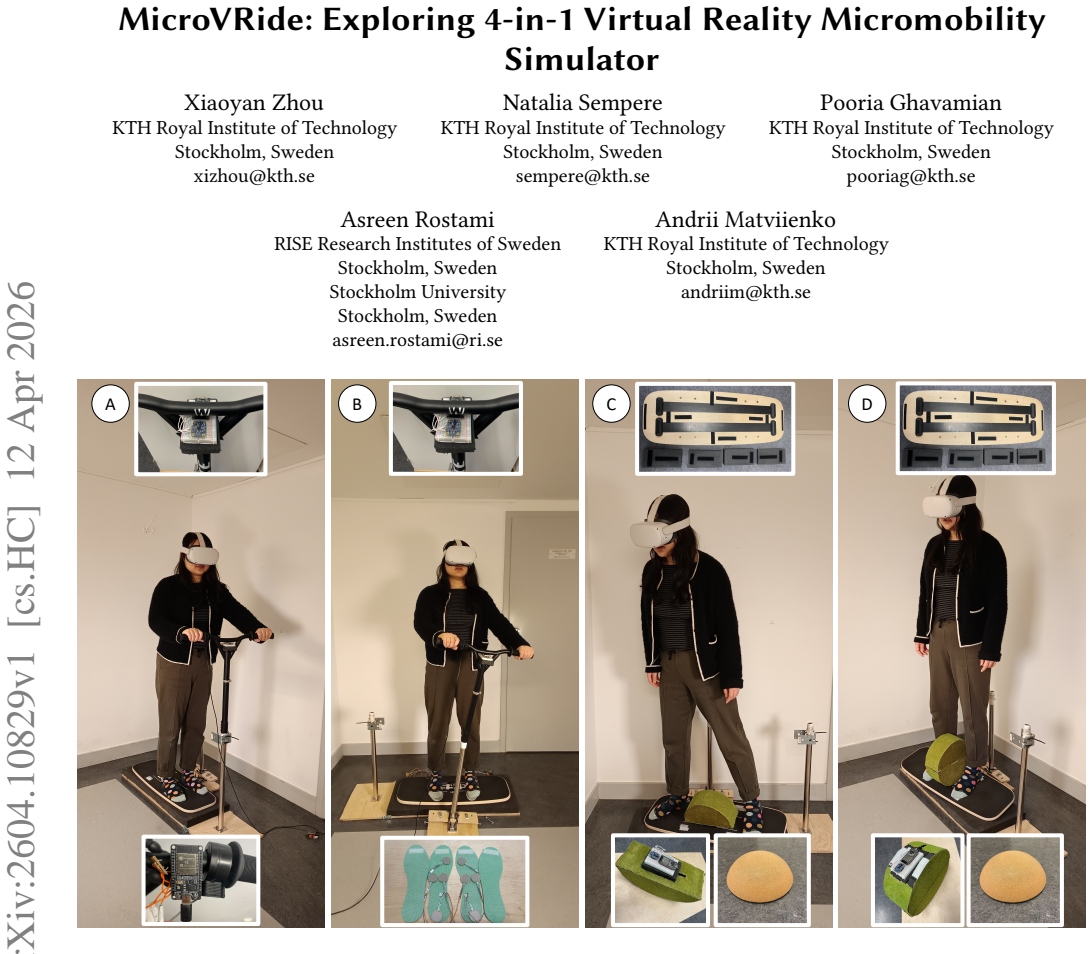
MicroVRide is a modular 4-in-1 VR micromobility simulator that supports e-scooters, Segways, electric unicycles, and one-wheeled skateboards on a single platform. The simulator preserves vehicle-specific physical constraints and control metaphors, enabling the study of diverse riding behaviors with minimal hardware reconfiguration. The authors contribute the simulator design and report a preliminary within-subject study (N = 12) that demonstrates feasibility and reveals distinct experiential profiles across vehicles.
What carries the argument
The modular hardware-software platform that switches vehicle modes while retaining each micromobility type's unique physical constraints and control metaphors.
If this is right
- Researchers can test multiple vehicle types in one session without rebuilding physical setups.
- Direct comparisons of rider behavior become possible across e-scooters, Segways, unicycles, and skateboards.
- Vehicle design changes can be evaluated for user experience before any physical prototypes are built.
- Safety training scenarios for new riders can be created in a repeatable, low-risk setting.
Where Pith is reading between the lines
- The simulator could be extended to include virtual traffic or weather to study how riders adapt under varied conditions.
- Data gathered here might help city planners decide where different micromobility vehicles can safely operate.
- Validation against real rides would strengthen the case for using this platform in regulatory or educational contexts.
Load-bearing premise
The virtual reality environment accurately reproduces the physical sensations, balance requirements, and control inputs of each real-world micromobility vehicle.
What would settle it
A side-by-side comparison where rider stability, speed selection, turning patterns, and reported experiences in the simulator are measured against the same metrics collected during actual outdoor rides on the four vehicles.
Figures


read the original abstract
Micromobility vehicles, such as e-scooters, Segways, skateboards, and unicycles, are increasingly adopted for short-distance travel due to their low weight and low emissions. Despite their growing popularity, we lack controlled, low-risk environments to study rider experiences and performance. While virtual reality (VR) simulators offer a promising approach by reducing safety risks and providing immersive experiences, micromobility simulators remain largely underexplored. We introduce MicroVRide, a modular 4-in-1 VR micromobility simulator that supports e-scooters, Segways, electric unicycles, and one-wheeled skateboards on a single platform. The simulator preserves vehicle-specific physical constraints and control metaphors, enabling the study of diverse riding behaviors with minimal hardware reconfiguration. We contribute the simulator design and report a preliminary within-subject study (N = 12) that demonstrates feasibility and reveals distinct experiential profiles across vehicles.
Editorial analysis
A structured set of objections, weighed in public.
Referee Report
Summary. The paper introduces MicroVRide, a modular 4-in-1 VR micromobility simulator that supports e-scooters, Segways, electric unicycles, and one-wheeled skateboards on a single platform while preserving vehicle-specific physical constraints and control metaphors. It reports a preliminary within-subject feasibility study (N=12) demonstrating feasibility and revealing distinct experiential profiles across vehicles.
Significance. If the simulator's fidelity to real vehicle dynamics holds, the modular platform would enable efficient, low-risk HCI studies of diverse micromobility behaviors, a valuable contribution given the growing adoption of these vehicles. The design's minimal reconfiguration aspect is a practical strength for experimentation. However, without grounding in real-world validation, the significance is currently limited to a system description and subjective feasibility report.
major comments (2)
- [Abstract / Study section] Abstract / Study section: The within-subject feasibility study with N=12 is said to reveal distinct experiential profiles, but provides no details on the specific measures (e.g., questionnaires, performance metrics), statistical analysis methods, error handling, or quantitative results. This makes it impossible to assess whether the data support the claims.
- [Simulator design / Introduction] Simulator design / Introduction: The central claim that MicroVRide 'preserves vehicle-specific physical constraints and control metaphors' is load-bearing for the contribution but lacks supporting evidence such as physics-engine validation against manufacturer specifications, measured roll/pitch/steering responses, balance recovery times, or any cross-comparison to real-vehicle riding data.
minor comments (2)
- Add a dedicated section or subsection detailing the hardware components, software implementation (e.g., Unity/Unreal physics parameters), and exact participant protocol to support reproducibility.
- Clarify in the study description how 'distinct experiential profiles' were identified (e.g., via specific statistical tests or qualitative coding) and report effect sizes or confidence intervals where applicable.
Simulated Author's Rebuttal
Thank you for the referee's constructive comments on our manuscript. We address each major comment below and indicate the revisions we plan to make.
read point-by-point responses
-
Referee: The within-subject feasibility study with N=12 is said to reveal distinct experiential profiles, but provides no details on the specific measures (e.g., questionnaires, performance metrics), statistical analysis methods, error handling, or quantitative results. This makes it impossible to assess whether the data support the claims.
Authors: We agree that the manuscript would benefit from greater detail on the study. Although presented as a preliminary feasibility assessment, we will expand the Study section in the revision to specify the questionnaires and performance metrics used, the statistical analysis methods applied (including any tests and handling of assumptions), error/outlier procedures, and quantitative results with supporting tables or figures. This will enable readers to evaluate the claims directly. revision: yes
-
Referee: The central claim that MicroVRide 'preserves vehicle-specific physical constraints and control metaphors' is load-bearing for the contribution but lacks supporting evidence such as physics-engine validation against manufacturer specifications, measured roll/pitch/steering responses, balance recovery times, or any cross-comparison to real-vehicle riding data.
Authors: This observation is valid. The manuscript describes the modular hardware and tuned Unity parameters intended to approximate vehicle-specific behaviors but does not include quantitative validation data. We will revise the Simulator design section to provide explicit implementation details on how constraints and control mappings are realized for each vehicle and will qualify the preservation claim while noting the lack of direct real-world comparisons as a limitation. Full empirical validation remains a valuable avenue for future work. revision: partial
- Quantitative empirical validation data (e.g., measured dynamics compared to real vehicles), as such measurements were not collected during the preliminary study.
Circularity Check
No circularity: system description and feasibility study are self-contained
full rationale
The paper introduces a modular VR micromobility simulator and reports a small within-subject feasibility study (N=12) with subjective experiential profiles. No equations, parameter fitting, predictions, or derivations appear in the provided text. The central claim rests on the hardware/software design description and user reports rather than any self-referential reduction or self-citation chain. This is a standard system paper with no load-bearing steps that reduce to their own inputs by construction.
Axiom & Free-Parameter Ledger
axioms (1)
- domain assumption VR environments can preserve vehicle-specific physical constraints and control metaphors sufficiently to study real riding behaviors
Reference graph
Works this paper leans on
-
[1]
Mustafa Al-Kefagy and Sava Pokrajac. 2021. E-bike Simulator-a virtual reality application that evaluates user interfaces in an urban traffic environment. (2021)
2021
-
[2]
Ammar Al-Taie, Andrii Matviienko, Joseph O’Hagan, Frank Pollick, and Stephen Anthony Brewster. 2025. Around the World in 60 Cyclists: Evaluat- ing Autonomous Vehicle-Cyclist Interfaces Across Cultures. InProceedings of the 2025 CHI Conference on Human Factors in Computing Systems (CHI ’25). As- sociation for Computing Machinery, New York, NY, USA, Article...
-
[3]
Barcelona Sun Segway. [n. d.]. A Beginner’s Guide to Riding a Segway. https: //www.barcelonasunsegway.com/a-beginners-guide-to-riding-a-segway/. Ac- cessed: 2026-01-22
2026
-
[4]
Ognjen Bobičić and Domokos Esztergár-Kiss. 2024. Enablers and barriers to mi- cromobility adoption: Urban and suburban contexts.Journal of Cleaner Production 484 (2024), 144346. doi:10.1016/j.jclepro.2024.144346
-
[5]
Buning, Anne Hardy, Jonathan Corcoran, Dorina Pojani, Zhenpeng Zou, and Milly Chen
Richard J. Buning, Anne Hardy, Jonathan Corcoran, Dorina Pojani, Zhenpeng Zou, and Milly Chen. 2025. Charting a research agenda for micromobility and tourism.Annals of Tourism Research Empirical Insights6, 1 (2025), 100164. doi:10. 1016/j.annale.2024.100164
-
[6]
Eunhee Chang, Hyun Taek Kim, and Byounghyun Yoo. 2020. Vir- tual Reality Sickness: A Review of Causes and Measurements.Inter- national Journal of Human–Computer Interaction36, 17 (2020), 1658–1682. arXiv:https://doi.org/10.1080/10447318.2020.1778351 doi:10.1080/10447318.2020. 1778351
-
[7]
Zoi Christoforou, Anastasios Kallianiotis, and Nadir Farhi. 2025. Design, De- velopment, and Validation of Driving Simulators for Enhancing the Safety and Sustainability of Electric Microvehicles.Sustainability17, 7 (2025). doi:10.3390/ su17073260
2025
-
[8]
Jiyong Chung, Hyeokmin Lee, Hosang Moon, and Eunghyuk Lee. 2022. The static and dynamic analyses of drivers’ gaze movement using vr driving simulator. Applied Sciences12, 5 (2022), 2362
2022
-
[9]
David Flaig, Hannes Imschweiler, Jana Heimel, and Gerrit Meixner. 2025. Imple- menting a VR-Enabled Bicycle Simulator: Integrating Physical Sensor and Actua- tor Data for a Realistic Simulation Experience. InIntelligent Human Computer Interaction, Dhananjay Singh, Jan-Willem van ’t Klooster, and Uma Shanker Tiwary (Eds.). Springer Nature Switzerland, Cham...
2025
-
[10]
Jelle Haasnoot, Riender Happee, Volkert van der Wijk, and Arend L. Schwab. 2024. Validation of a novel bicycle simulator with realistic lat- eral and roll motion.Vehicle System Dynamics62, 7 (2024), 1802–1826. arXiv:https://doi.org/10.1080/00423114.2023.2264418 doi:10.1080/00423114.2023. 2264418
-
[11]
Wei He, Xiang Li, Per Ola Kristensson, and Guo Li Lan. 2026. LocoScooter: Designing a Stationary Scooter-Based Locomotion System for Navigation in Virtual Reality. InProceedings of the 33rd IEEE Conference on Virtual Reality and 3D User Interfaces (VR 2026). IEEE, Piscataway, NJ, USA. Forthcoming
2026
-
[12]
Philipp Hock, Sebastian Benedikter, Jan Gugenheimer, and Enrico Rukzio. 2017. CarVR: Enabling In-Car Virtual Reality Entertainment. InProceedings of the 2017 CHI Conference on Human Factors in Computing Systems(Denver, Colorado, USA) (CHI ’17). Association for Computing Machinery, New York, NY, USA, 4034–4044. doi:10.1145/3025453.3025665
-
[13]
Morteza Hossein Sabbaghian, David Llopis-Castelló, and Alfredo García. 2023. A Safe Infrastructure for Micromobility: The Current State of Knowledge.Sustain- ability15, 13 (2023). doi:10.3390/su151310140
-
[14]
InMotion World. [n. d.]. How to Ride an Electric Unicycle (EUC) for Begin- ners. https://inmotionworld.com/blogs/blog/how-to-ride-an-electric-unicycle. Accessed: 2026-01-22
2026
-
[15]
2020.Safe Micromobility
International Transport Forum. 2020.Safe Micromobility. Technical Report. International Transport Forum (ITF), OECD. https://www.itf-oecd.org/safe- micromobility Accessed: 2026-01-22
2020
-
[16]
Anastasios Kallianiotis, Stergios Roumeliotis, Zoi Christoforou, Nadir Farhi, and Chang Chen. 2025. Implementing a Novel E-Bicycle Simulator
2025
-
[17]
Kanishka Kataria, J Chandana, Athira Raghumadhavan, Komal Gandhi, Kartik Raja, and Shilpa Gite. 2023. Virtual Reality Skateboard Extending Metaverse. Journal of Metaverse3, 2 (2023), 100–107
2023
-
[18]
Jonas Keppel, Marvin Prochazka, Stefan Lewin, Markus Stroehnisch, Marvin Strauss, André Zenner, Donald Degraen, Andrii Matviienko, and Stefan Schnee- gass. 2026. Determining Perception Thresholds for Real and Virtual Inclinations While Cycling in Virtual Reality. InProceedings of the 2026 CHI Conference on Human Factors in Computing Systems(Barcelona, Spa...
-
[19]
Théo Lefeuvre. [n. d.]. Electric scooter simulator in virtual reality. https://www. youtube.com/shorts/Hwd_wSWANd4
-
[20]
Zhixun Lin, Wei He, Xinyi Liu, Mingchen Ye, Xiang Li, and Ge Lin Kan. 2024. The Framework of NAVIS: Navigating Virtual Spaces with Immersive Scooters. InProceedings of the 23rd International Conference on Mobile and Ubiquitous Multimedia (MUM ’24). Association for Computing Machinery, New York, NY, USA, 448–450. doi:10.1145/3701571.3703381
-
[21]
Andrii Matviienko, Swamy Ananthanarayan, Shadan Sadeghian Borojeni, Yan- nick Feld, Wilko Heuten, and Susanne Boll. 2018. Augmenting bicycles and helmets with multimodal warnings for children. InProceedings of the 20th In- ternational Conference on Human-Computer Interaction with Mobile Devices and Services(Barcelona, Spain)(MobileHCI ’18). Association fo...
-
[22]
Andrii Matviienko, Hajris Hoxha, and Max Mühlhäuser. 2023. What does it mean to cycle in Virtual Reality? Exploring Cycling Fidelity and Control of VR Bicycle Simulators. InProceedings of the 2023 CHI Conference on Human Factors in Computing Systems(Hamburg, Germany)(CHI ’23). Association for Computing Machinery, New York, NY, USA, Article 879, 15 pages. ...
-
[23]
Andrii Matviienko, Florian Müller, Dominik Schön, Régis Fayard, Salar Abaspur, Yi Li, and Max Mühlhäuser. 2022. E-ScootAR: Exploring Unimodal Warnings for E-Scooter Riders in Augmented Reality. InExtended Abstracts of the 2022 CHI Conference on Human Factors in Computing Systems(New Orleans, LA, USA)(CHI EA ’22). Association for Computing Machinery, New Y...
-
[24]
Andrii Matviienko, Florian Müller, Marcel Zickler, Lisa Alina Gasche, Julia Abels, Till Steinert, and Max Mühlhäuser. 2022. Reducing Virtual Reality Sickness for Cyclists in VR Bicycle Simulators. InProceedings of the 2022 CHI Conference on Human Factors in Computing Systems(New Orleans, LA, USA)(CHI ’22). Association for Computing Machinery, New York, NY...
-
[25]
Lennart Ochel, Smit Saparia, My Weidel, Arne Johansson, and Katja Kircher
-
[26]
How We Roll: Realistic Cycling Simulator for Behavioural Research. In24th Driving Simulation Extended Reality Conference & Exhibition (DSC 2025 Europe MicroVRide: Exploring 4-in-1 Virtual Reality Micromobility Simulator CHI EA ’26, April 13–17, 2026, Barcelona, Spain XR), Stuttgart, Germany, September 24-26, 2025.Driving Simulation Association, 53–58
2025
-
[27]
Onewheel Wiki contributors. [n. d.]. Riding technique. https://onewheel.wiki/ Riding_technique. Accessed: 2026-01-22
2026
-
[28]
Baraah Qawasmeh, Jun-Seok Oh, and Valerian Kwigizile. 2024. Micro-Mobility Safety Assessment: Analyzing Factors Influencing the Micro-Mobility Injuries in Michigan by Mining Crash Reports.Future Transportation4, 4 (2024), 1580–1601. doi:10.3390/futuretransp4040076
-
[29]
2021.E-scooter simulator development and applications
Weitong Qi. 2021.E-scooter simulator development and applications. Master’s thesis. University of Missouri-Columbia
2021
-
[30]
Rider Guide. [n. d.]. How to Ride an Electric Scooter. https://riderguide.com/ safety/how-to-ride-an-electric-scooter/. Accessed: 2026-01-22
2026
-
[31]
Sandro Ropelato, Fabio Zünd, Stéphane Magnenat, Marino Menozzi, and Robert Sumner. 2018. Adaptive tutoring on a virtual reality driving simulator.In- ternational SERIES on information systems and management in creative emedia (CreMedia)2017, 2 (2018), 12–17
2018
-
[32]
Craig R. Sherman. 2006. Motion Sickness: Review of Causes and Pre- ventive Strategies.Journal of Travel Medicine9, 5 (03 2006), 251–256. arXiv:https://academic.oup.com/jtm/article-pdf/9/5/251/5246184/jtm9-0251.pdf doi:10.2310/7060.2002.24145
-
[33]
2024.City Micromobility Street Safety
The Wall Street Journal. 2024.City Micromobility Street Safety. https://www.wsj. com/lifestyle/cars/city-micromobility-street-safety-420ccae3 Accessed: 2026-01- 22
2024
-
[34]
Philipp Wintersberger, Andrii Matviienko, Andreas Schweidler, and Florian Michahelles. 2022. Development and Evaluation of a Motion-based VR Bicycle Simulator.Proc. ACM Hum.-Comput. Interact.6, MHCI, Article 210 (Sept. 2022), 19 pages. doi:10.1145/3546745
-
[35]
Ziyue Zhao, Yue Li, and Hai-Ning Liang. 2023. LeanOn: Simulating Balance Vehicle Locomotion in Virtual Reality. In2023 IEEE International Symposium on Mixed and Augmented Reality (ISMAR). 415–424. doi:10.1109/ISMAR59233.2023. 00056
-
[36]
Åkesson, Ludvig and Buhrman, Joel. 2018. DriVR - A driving school simulator in VR. Student Paper
2018
discussion (0)
Sign in with ORCID, Apple, or X to comment. Anyone can read and Pith papers without signing in.