Spectral Tur\'an problem for tmathcal{K}₄⁻-free unbalanced signed graphs
Pith reviewed 2026-05-10 16:09 UTC · model grok-4.3
The pith
The extremal unbalanced signed graphs maximizing the index and spectral radius among tK4--free ones with fixed order are characterized.
A machine-rendered reading of the paper's core claim, the machinery that carries it, and where it could break.
Core claim
The authors characterize the extremal graphs that achieve the maximum index and spectral radius among all tK4--free unbalanced signed graphs with given order. Here tK4 denotes the family of all graphs consisting of t copies of K4 that are allowed to share vertices, and tK4- is the set of all unbalanced signed graphs whose underlying graphs are in tK4.
What carries the argument
The tK4- family of unbalanced signed graphs, which acts as the forbidden substructure whose avoidance constrains the graphs whose spectral radius is to be maximized.
If this is right
- The maximum value of the spectral radius is attained precisely by the characterized graphs for each n.
- These results apply uniformly to all orders n.
- The characterization identifies the structures that are both free of tK4- and optimal in terms of spectral properties.
Where Pith is reading between the lines
- If the characterization is complete, it could be used to derive asymptotic growth rates for the maximum spectral radius as n tends to infinity.
- Similar methods might extend to other forbidden families in signed graphs or to other spectral parameters.
- Checking the result computationally for small values of t and n would provide verification.
Load-bearing premise
The extremal characterization is assumed to hold for every order n independently of particular sign patterns or graph connectivity.
What would settle it
Finding a tK4--free unbalanced signed graph on n vertices with a spectral radius strictly larger than that of the identified extremal graphs would disprove the characterization.
Figures
read the original abstract
Let $tK_4$ denote the family of all graphs consisting of $t$ copies of $K_4$ that are allowed to share vertices and $t\mathcal{K}_{4}^{-}$ be the set of all unbalanced signed graphs whose underlying graphs are elements of $tK_4$. In this paper, we characterize the extremal graphs that achieve the maximum index and spectral radius among all $t\mathcal{K}_{4}^{-}$-free unbalanced signed graphs with given order.
Editorial analysis
A structured set of objections, weighed in public.
Referee Report
Summary. The paper characterizes the extremal unbalanced signed graphs on n vertices that are free of tK4- (the family of unbalanced signed graphs whose underlying graphs consist of t, possibly vertex-overlapping, copies of K4) and that maximize the spectral radius of the signed adjacency matrix (also called the index). The characterization identifies specific signed graphs, obtained from signed Turán constructions, as the unique maximizers for each n.
Significance. If the claimed characterization holds, the result provides a precise spectral extremal function and graph description for this forbidden family in the signed-graph setting. This extends classical and spectral Turán theory to unbalanced signed graphs and supplies a concrete, falsifiable prediction for the maximum index. The manuscript's use of standard signed-graph tools (eigenvalue interlacing, Perron-Frobenius analysis on the signed adjacency matrix, and domination arguments for disconnected graphs) is a methodological strength that makes the central claim verifiable in principle.
minor comments (3)
- §2, Definition 2.3: the precise notion of 'unbalanced' for a signed graph containing multiple K4 copies is stated only informally; an explicit sign-pattern condition or reference to the balance equation would remove ambiguity for readers.
- Theorem 1.1 and the statement of the extremal graphs: the uniqueness claim is asserted for all n ≥ some n0, but the small-n cases are not separately verified or tabulated; adding a short table or remark for n < 10 would strengthen the presentation.
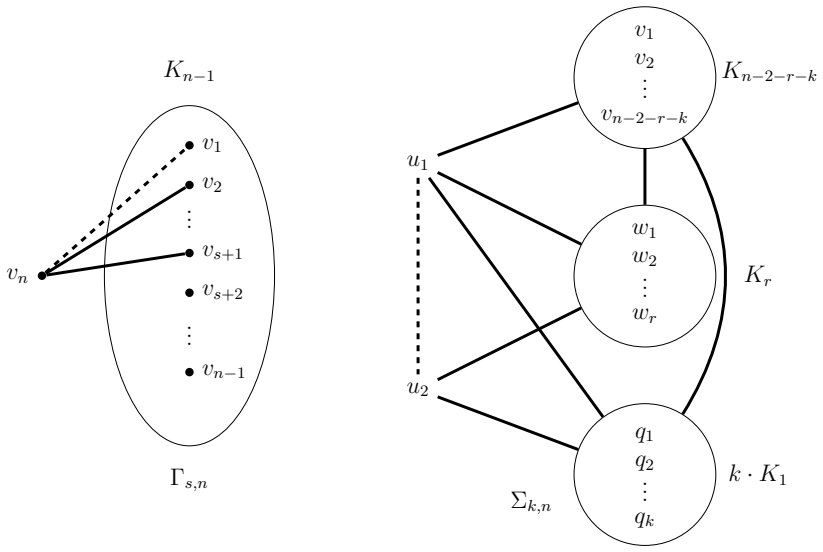
- Figure 1 (or the corresponding construction diagram): the edge signs are not labeled on the drawing; explicit +/− annotations or a caption clarifying the signing would improve clarity.
Simulated Author's Rebuttal
We thank the referee for the positive summary of our work on the spectral Turán problem for tK4--free unbalanced signed graphs and for recommending minor revision. No specific major comments were provided in the report, so we have no point-by-point responses to major issues. We are pleased that the referee recognized the methodological strengths of the paper, including the use of eigenvalue interlacing, Perron-Frobenius analysis, and domination arguments.
Circularity Check
No significant circularity detected
full rationale
The paper characterizes extremal tK4--free unbalanced signed graphs via standard signed-graph spectral methods (eigenvalue bounds, Perron-Frobenius on the signed adjacency matrix, and constructions from signed Turán graphs). Definitions of tK4 (overlapping copies) and tK4- (unbalanced signed realizations) are taken as given without internal derivation. No equations or steps reduce by construction to fitted inputs, self-definitions, or load-bearing self-citations; the central claim extends prior independent results uniformly to arbitrary n, with disconnected cases dominated by largest components. The derivation chain is self-contained against external benchmarks.
Axiom & Free-Parameter Ledger
Reference graph
Works this paper leans on
- [1]
-
[2]
M. Brunetti, Z. Stani´ c, Unbalanced signed graphs with extremal spectral radius or index, Comput. Appl. Math. 41 (2022) 118
work page 2022
-
[3]
P. J. Cameron, J. J. Seidel, S. V. Tsaranov, Signed graphs, root lattices, and Coxeter groups, J. Algebra 164 (1) (1994) 173–209
work page 1994
-
[4]
D. Cartwright, F. Harary, Structural balance: a generalization of Heider’s theory, Psychol. Rev. 63 (1956) 277–293
work page 1956
-
[5]
Chaiken, A combinatorial proof of the all minors matrix tree theorem, SIAM J
S. Chaiken, A combinatorial proof of the all minors matrix tree theorem, SIAM J. Algebraic Discrete Methods 3 (1982) 319–329
work page 1982
-
[6]
F. Chen, X. Yuan, Tur´ an problem forK − 4 -free signed graphs, Appl. Math. Comput. 477 (2024) 128814
work page 2024
-
[7]
G. Chen, X. Lei, S. Li, The exact Tur´ an number of disjoint graphs–a generalization of Simonovits’ theorem, and beyond, European J. Combin. 130 (2025) 104226
work page 2025
-
[8]
Harary, On the notion of balance of a signed graph, Michigan Math
F. Harary, On the notion of balance of a signed graph, Michigan Math. J. 2 (2) (1953) 143–146
work page 1953
-
[9]
Heider, Attitudes and cognitive organization, J
F. Heider, Attitudes and cognitive organization, J. Psychol. 21 (1) (1946) 107–112
work page 1946
-
[10]
Y. Hou, Z. Tang, D. Wang, On signed graphs with just two distinct Laplacian eigenvalues, Appl. Math. Comput. 351 (2019) 1–7
work page 2019
- [11]
-
[12]
Nikiforov, Bounds on graph eigenvalues II
V. Nikiforov, Bounds on graph eigenvalues II. Linear Algebra Appl. 427 (2007) 183–189
work page 2007
-
[13]
V. Nikiforov, The spectral radius of graphs without paths and cycles of specified length, Linear Algebra Appl. 432 (2010) 2243–2256
work page 2010
-
[14]
Nikiforov, The spectral radius of graphs with noK 2,t minor, Linear Algebra Appl
V. Nikiforov, The spectral radius of graphs with noK 2,t minor, Linear Algebra Appl. 531 (2017) 510–515
work page 2017
-
[15]
Z. Ni, J. Wang, L. Kang, Spectral extremal graphs for disjoint cliques, Electron. J. Combin. 30 (1) (2023) P1.20
work page 2023
-
[16]
G. Sun, F. Liu, K. Lan, A note on eigenvalues of signed graphs, Linear Algebra Appl. 652 (2022) 125–131
work page 2022
-
[17]
D. Wang, Y. Hou, D. Li, Extremal results forC − 3 -free signed graphs, Linear Algebra Appl. 681 (2024) 47–65
work page 2024
-
[18]
J. Wang, Y. Hou, X. Huang, Tur´ an problem of signed graph for negative odd cycle, Discrete Appl. Math. 362 (2025) 157–166
work page 2025
-
[19]
W. Wang, Z. Yan, J. Qian, Eigenvalues and chromatic number of a signed graph, Linear Algebra Appl. 619 (2021) 137–145. 12
work page 2021
-
[20]
Wang, Spectral Tur´ an problem forK − 5 -free signed graphs, Linear Algebra Appl
Y. Wang, Spectral Tur´ an problem forK − 5 -free signed graphs, Linear Algebra Appl. 691 (2024) 96–108
work page 2024
-
[21]
Y. Wang, H. Lin, The largest eigenvalue ofC − k -free signed graphs, Discrete Appl. Math. 372 (2025) 164–172
work page 2025
- [22]
-
[23]
W. Yuan, B. Wang, M. Zhai, On the spectral radii of graphs without given cycles, Electron. J. Linear Algebra 23 (2012) 599–606
work page 2012
-
[24]
Zaslavsky, Signed graphs, Discrete Appl
T. Zaslavsky, Signed graphs, Discrete Appl. Math. 4 (1) (1982) 47–74
work page 1982
-
[25]
T. Zaslavsky, Matrices in the theory of signed simple graphs, in Advances in Discrete Mathematics and Applications: Mysore, 2008, 207–229, Ramanujan Math. Soc. Lect. Notes Ser., 13, Ramanujan Math. Soc., Mysore, 2010
work page 2008
-
[26]
Zaslavsky, A mathematical bibliography of signed and gain graphs and allied areas, Electron
T. Zaslavsky, A mathematical bibliography of signed and gain graphs and allied areas, Electron. J. Combin. 5 (2018), Dynamic Surveys 8, 524 pages. 13
work page 2018
discussion (0)
Sign in with ORCID, Apple, or X to comment. Anyone can read and Pith papers without signing in.