The GMRT archive atomic gas survey -- IV. Consistency of the dark matter halo perturbation parameter from morphological and kinematic lopsidedness of galaxies
Pith reviewed 2026-05-10 14:49 UTC · model grok-4.3
The pith
Assuming lopsidedness arises from a lopsided dark matter halo, morphological and kinematic halo perturbation parameters match in the same radial range.
A machine-rendered reading of the paper's core claim, the machinery that carries it, and where it could break.
Core claim
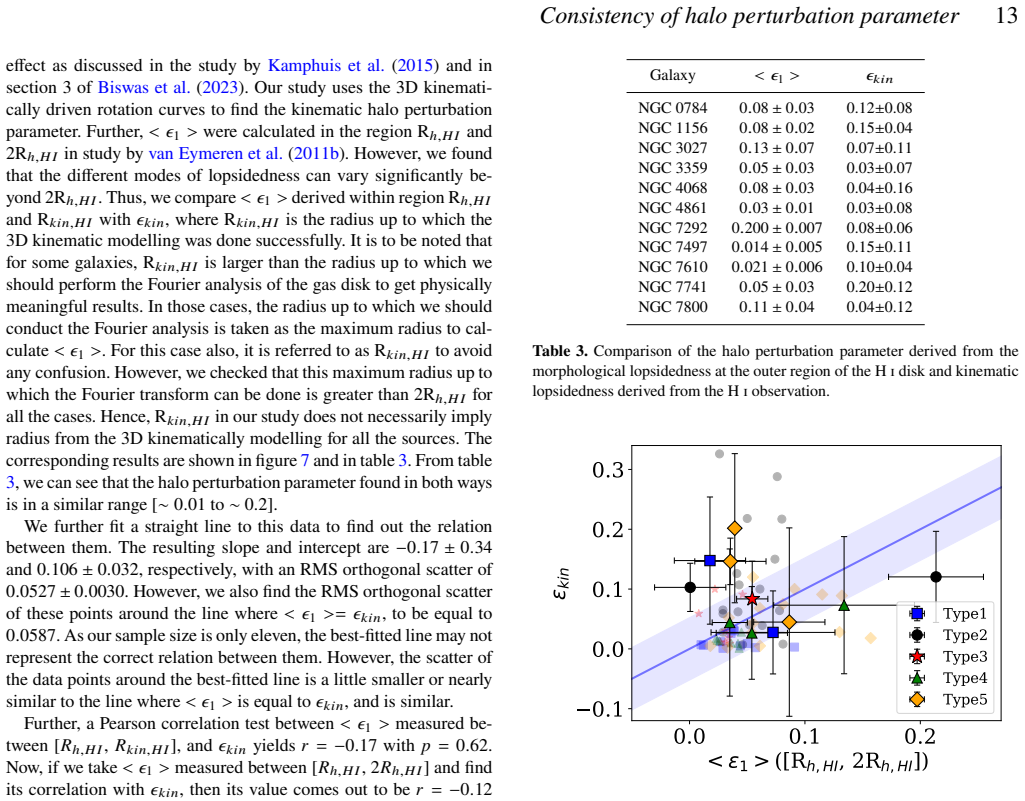
Assuming lopsidedness originates due to a lopsided halo, the morphological and kinematic halo perturbation parameters are found in the same radial range. The detected linear correlation between them is not statistically significant for the small sample of eleven galaxies. This approach provides a more uniform and physically consistent framework to test the theoretically expected similarity between morphological and kinematic halo perturbation parameters. Further, the discrepancy between them does not appear to depend on the nature of the rotation-curve asymmetry of the two sides of the galaxy.
What carries the argument
Fourier decomposition of surface brightness and velocity fields to quantify lopsidedness, combined with 3D kinematic modeling of rotation curves to derive halo perturbation parameters.
If this is right
- The method yields halo perturbation parameters from both morphological and kinematic data in identical radial ranges.
- Discrepancies between the parameters show no dependence on rotation-curve asymmetry types.
- Extending to larger samples can robustly assess the similarity of morphological and kinematic halo perturbations.
- Moderate lopsidedness is interpreted as a response to the halo potential rather than isolated events.
Where Pith is reading between the lines
- If confirmed with larger samples, this would indicate that dark matter halos commonly exhibit lopsidedness influencing galaxy disks.
- Such a framework could be applied to test halo asymmetry predictions from cosmological simulations of galaxy formation.
- Future observations might distinguish halo-driven lopsidedness from other causes like tidal interactions in specific galaxy types.
Load-bearing premise
Lopsidedness in galaxies originates primarily from a lopsided dark matter halo potential.
What would settle it
A larger sample of galaxies with similar Fourier and kinematic measurements showing no statistically significant correlation between morphological and kinematic halo perturbation parameters.
Figures



read the original abstract
The lopsidedness of galaxies is a commonly observed phenomenon, and through different studies, it has been observed that nearly 30% of galaxies show this phenomenon. In this work, we study morphological lopsidedness in both stellar and gas disks in the inner and outer regions using Fourier analysis techniques and compare the results for a sample of nearby galaxies with different morphologies and environments. Although lopsidedness can result from diverse factors like tidal interactions, gas accretion, and internal instability, recent studies suggest it is a common feature that is not solely reliant on rare events, and moderate lopsidedness most likely results from the disk's response to a lopsided dark matter halo potential. Assuming lopsidedness originates due to a lopsided halo, we find the morphological and kinematic halo perturbation parameters in the same radial range. Unlike previous studies, we use 3D kinematic modelled rotation curves for finding kinematic lopsidedness and, hence, kinematic halo perturbation parameter. Although the detected linear correlation between them is not statistically significant for our small sample of eleven galaxies, this approach provides a more uniform and physically consistent framework to test the theoretically expected similarity between morphological and kinematic halo perturbation parameters. Further, within this framework, the discrepancy between them does not appear to depend on the nature of the rotation-curve asymmetry of the two sides of the galaxy, in contrast to trends seen in earlier studies. In future work, we plan to extend this analysis to a substantially larger sample in order to robustly assess these findings.
Editorial analysis
A structured set of objections, weighed in public.
Referee Report
Summary. The paper analyzes morphological lopsidedness in stellar and gas disks of 11 nearby galaxies via Fourier techniques and derives kinematic lopsidedness from 3D modeled rotation curves. Assuming lopsidedness arises from a lopsided dark matter halo, it extracts morphological and kinematic halo perturbation parameters in matching radial ranges, reports a linear correlation between them (noted as not statistically significant), and presents the method as a uniform framework to test theoretical similarity. It further states that discrepancies do not depend on rotation-curve asymmetry type, unlike prior work.
Significance. If the assumption holds and larger samples confirm the correlation, the use of 3D kinematic modeling combined with uniform radial-range comparison would supply a more consistent, physically motivated framework than earlier studies for quantifying halo perturbation parameters. This could aid tests of asymmetric-halo models in galaxy formation. The paper earns credit for the 3D modeling approach and explicit acknowledgment that the correlation is not significant in the small sample.
major comments (2)
- Abstract: The linear correlation between morphological and kinematic halo perturbation parameters is stated to be not statistically significant for the sample of eleven galaxies, yet no correlation coefficient, p-value, fit uncertainties, error bars, or robustness checks (e.g., outlier removal or subsample tests) are provided. This information is required to assess the strength of the claimed consistency given the small sample size.
- Abstract: Both morphological and kinematic halo perturbation parameters are defined under the explicit assumption that lopsidedness originates from a lopsided dark matter halo potential. Any observed agreement is therefore partly by construction within this framework; the abstract acknowledges alternative origins (tidal interactions, gas accretion, internal instability) but describes no independent test of the assumption for the current sample, so the parameters' interpretation as halo properties remains conditional.
minor comments (1)
- Abstract: The statement that discrepancies 'do not appear to depend on the nature of the rotation-curve asymmetry' (in contrast to earlier studies) requires a specific citation to the supporting figure, table, or quantitative test to enable direct evaluation.
Simulated Author's Rebuttal
We thank the referee for their constructive and detailed report. We address each major comment below and have revised the manuscript to incorporate the requested clarifications and statistical details.
read point-by-point responses
-
Referee: Abstract: The linear correlation between morphological and kinematic halo perturbation parameters is stated to be not statistically significant for the sample of eleven galaxies, yet no correlation coefficient, p-value, fit uncertainties, error bars, or robustness checks (e.g., outlier removal or subsample tests) are provided. This information is required to assess the strength of the claimed consistency given the small sample size.
Authors: We agree that the abstract (and corresponding results section) would benefit from explicit statistical measures. In the revised manuscript we now report the Pearson correlation coefficient, associated p-value, uncertainties on the linear fit parameters, and error bars on the plotted points. We have also added a brief description of robustness tests (outlier removal and subsample checks) confirming that the correlation remains statistically insignificant. These additions are placed in both the abstract and the main text for completeness. revision: yes
-
Referee: Abstract: Both morphological and kinematic halo perturbation parameters are defined under the explicit assumption that lopsidedness originates from a lopsided dark matter halo potential. Any observed agreement is therefore partly by construction within this framework; the abstract acknowledges alternative origins (tidal interactions, gas accretion, internal instability) but describes no independent test of the assumption for the current sample, so the parameters' interpretation as halo properties remains conditional.
Authors: The referee is correct that the parameters are derived under the stated assumption and that the observed consistency is therefore conditional. We have revised the abstract and the discussion section to emphasize this point more explicitly, clarifying that the framework tests the theoretical expectation only if the lopsidedness is halo-driven. No independent test of the assumption is performed in the present small sample; we now state this limitation directly and note that future work with larger samples will explore possible discriminants (e.g., comparison with simulations or additional observables). revision: yes
Circularity Check
No significant circularity; observational comparison under explicit assumption
full rationale
The paper explicitly states the assumption that lopsidedness originates from a lopsided dark matter halo and uses it to interpret both morphological (Fourier) and kinematic (3D modeled rotation curves) measures as halo perturbation parameters. The two measurement techniques are independent, the comparison is presented as a test of expected similarity within the framework, and the detected correlation is reported as not statistically significant for the small sample. No equations, derivations, or steps reduce the reported consistency to the inputs by construction, and no load-bearing self-citations or self-definitional reductions are quoted in the provided text. The analysis remains self-contained as an observational study.
Axiom & Free-Parameter Ledger
axioms (1)
- domain assumption lopsidedness originates due to a lopsided dark matter halo potential
Reference graph
Works this paper leans on
-
[1]
E., Lynden-Bell D., Sancisi R., 1980, MNRAS, 193, 313 Begeman K
Baldwin J. E., Lynden-Bell D., Sancisi R., 1980, MNRAS, 193, 313 Begeman K. G., 1987, PhD thesis, University of Groningen, Kapteyn Astro- nomical Institute BershadyM.A.,VerheijenM.A.W.,SwatersR.A.,AndersenD.R.,Westfall K. B., Martinsson T., 2010, ApJ, 716, 198 Biswas P., Patra N. N., Roy N., Rashid M., 2022, MNRAS, 513, 168 Biswas P., Kalinova V., Roy N.,...
discussion (0)
Sign in with ORCID, Apple, or X to comment. Anyone can read and Pith papers without signing in.