Network Slice Embedding over Space Division Multiplexed Elastic Optical Networks
Pith reviewed 2026-05-10 15:23 UTC · model grok-4.3
The pith
Integrating compute placement with spectrum allocation in a coupled way improves slice acceptance and cuts costs in SDM elastic optical networks.
A machine-rendered reading of the paper's core claim, the machinery that carries it, and where it could break.
Core claim
The Waypoint Assisted Multi Segment Slice Mapping scheme integrates compute placement with spectrum allocation in a sequential but coupled manner to enable more flexible resource placement and improved spectrum efficiency for network slice embedding over SDM EONs.
What carries the argument
Waypoint Assisted Multi Segment Slice Mapping (WMSM) scheme, which performs sequential but coupled integration of compute placement and spectrum allocation.
Load-bearing premise
Sequential but coupled integration of compute placement and spectrum allocation will consistently outperform independent RMCSA approaches across all realistic traffic patterns and network topologies without introducing new bottlenecks.
What would settle it
A test on an alternate network topology or traffic pattern where WMSM shows no gain in acceptance ratio or provisioning cost compared with independent RMCSA would falsify the central claim.
Figures


read the original abstract
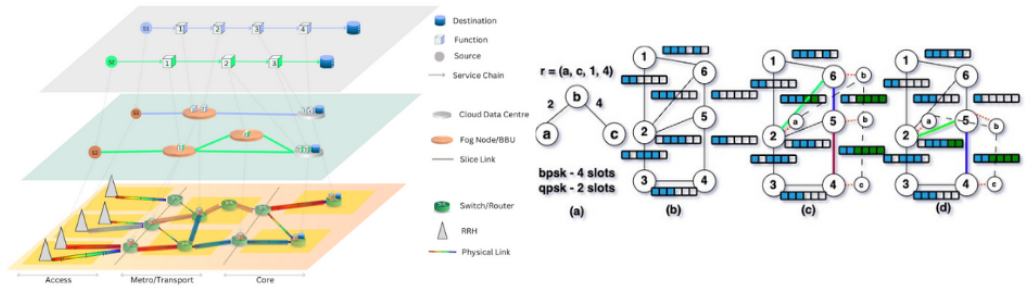
Network slicing over space division multiplexed elastic optical networks (SDM EONs) enables efficient multiservice provisioning on a shared optical substrate. However, embedding such slices requires coordinated spectrum and compute resource management under dynamic traffic, which most existing RMCSA studies treat independently. This paper focuses on the network slice embedding problem over space division multiplexed elastic optical networks (SDM EONs), aiming to develop efficient resource allocation strategies that ensure both high utilization and reliable service performance. While prior studies have investigated routing, modulation format, core, and spectrum allocation (RMCSA), they typically consider these dimensions separately from compute placement. To address this gap, this paper proposes a Waypoint Assisted Multi Segment Slice Mapping (WMSM) scheme, which integrates compute placement with spectrum allocation in a sequential but coupled manner to enable more flexible resource placement and improved spectrum efficiency. Numerical results show that WMSM improves acceptance ratios by up to 27% under high load conditions, while achieving up to 47% lower total provisioning cost relative to the baseline strategy. These results highlight the benefits of integrated compute spectrum provisioning and provide design insights for scalable, compute aware optical slice mapping.
Editorial analysis
A structured set of objections, weighed in public.
Referee Report
Summary. The manuscript proposes the Waypoint Assisted Multi Segment Slice Mapping (WMSM) scheme for embedding network slices over space division multiplexed elastic optical networks (SDM EONs). It integrates compute placement with spectrum allocation in a sequential but coupled manner, in contrast to prior RMCSA studies that treat these dimensions independently. Numerical results are reported to show up to 27% higher acceptance ratios and up to 47% lower total provisioning cost under high load conditions relative to a baseline strategy.
Significance. If the numerical results prove robust, the work would offer useful design insights for compute-aware slice mapping in SDM EONs and demonstrate the value of coupled provisioning for utilization and cost. The absence of reproducible simulation details and sensitivity analysis, however, prevents assessment of whether the reported gains generalize beyond the specific conditions tested.
major comments (3)
- [Abstract and Numerical Results] Abstract and Numerical Results section: the central claims of 'up to 27% improvement in acceptance ratios' and 'up to 47% lower total provisioning cost' under 'high load conditions' are unsupported because the manuscript provides no description of the network topology, SDM core count, traffic arrival process, demand distributions, load thresholds, or number of simulation runs with statistical validation. These omissions are load-bearing for the performance claims.
- [WMSM Scheme Description] WMSM scheme description: the sequential coupling of compute placement and spectrum allocation is presented without analysis of possible ordering artifacts or new contention points (e.g., early compute decisions blocking spectrum-efficient paths), leaving open whether the approach consistently outperforms independent RMCSA across varied traffic patterns.
- [Baseline Comparison] Baseline comparison: the RMCSA baseline strategy is referenced but not specified in terms of its compute-placement logic, optimization objectives, or implementation details, making it impossible to determine whether the reported gains arise from the proposed coupling or from differences in other modeling choices.
minor comments (1)
- [Notation and Presentation] Ensure the acronym WMSM is expanded on first use in the abstract and that all figures or tables reporting 'up to' gains include variance measures or confidence intervals.
Simulated Author's Rebuttal
We thank the referee for the thorough and constructive review. The feedback identifies key areas where additional detail will improve the manuscript's clarity, reproducibility, and defensibility of claims. We will prepare a major revision that incorporates the requested information on simulation parameters, scheme analysis, and baseline specification. Point-by-point responses follow.
read point-by-point responses
-
Referee: [Abstract and Numerical Results] Abstract and Numerical Results section: the central claims of 'up to 27% improvement in acceptance ratios' and 'up to 47% lower total provisioning cost' under 'high load conditions' are unsupported because the manuscript provides no description of the network topology, SDM core count, traffic arrival process, demand distributions, load thresholds, or number of simulation runs with statistical validation. These omissions are load-bearing for the performance claims.
Authors: We agree that the omitted simulation parameters prevent full assessment of the claims. In the revised manuscript we will insert a new subsection (e.g., 5.1 Simulation Setup) that explicitly describes the network topology, SDM core count per fiber, traffic arrival process, demand size and distribution, the load range labeled as 'high load', the number of independent runs performed, and the statistical validation method (including confidence intervals). These additions will directly support the reported acceptance-ratio and cost improvements. revision: yes
-
Referee: [WMSM Scheme Description] WMSM scheme description: the sequential coupling of compute placement and spectrum allocation is presented without analysis of possible ordering artifacts or new contention points (e.g., early compute decisions blocking spectrum-efficient paths), leaving open whether the approach consistently outperforms independent RMCSA across varied traffic patterns.
Authors: The WMSM design intentionally uses waypoint selection to couple the two stages and reduce blocking, yet we recognize that an explicit examination of ordering effects is missing. The revision will add a short analysis subsection that discusses potential contention points introduced by the sequential decisions, provides illustrative examples, and reports supplementary results under varied traffic patterns (different arrival intensities and burstiness levels) to show that the performance advantage holds consistently. revision: yes
-
Referee: [Baseline Comparison] Baseline comparison: the RMCSA baseline strategy is referenced but not specified in terms of its compute-placement logic, optimization objectives, or implementation details, making it impossible to determine whether the reported gains arise from the proposed coupling or from differences in other modeling choices.
Authors: We acknowledge the baseline description is insufficiently detailed. In the revision we will expand the comparison section to state the baseline's compute-placement rule (independent, load-based heuristic without spectrum awareness), its optimization objective (primarily blocking minimization), and its implementation (identical simulation engine and resource models as WMSM). This will isolate the benefit of the coupled provisioning and allow readers to verify the source of the observed gains. revision: yes
Circularity Check
No significant circularity; results are simulation outputs of a proposed algorithm
full rationale
The paper proposes the WMSM scheme as a sequential but coupled integration of compute placement and spectrum allocation for SDM EON slice embedding, then reports acceptance-ratio and cost improvements from numerical simulations versus a baseline RMCSA strategy. No mathematical derivation chain, first-principles prediction, or equation set is claimed; the central results are empirical outputs of the algorithm under high-load conditions. No self-citations appear as load-bearing premises, no parameters are fitted then relabeled as predictions, and no ansatz or uniqueness theorem is smuggled in. The evaluation is therefore self-contained against the simulation model and does not reduce to its own inputs by construction.
Axiom & Free-Parameter Ledger
axioms (1)
- domain assumption Dynamic traffic in SDM EONs requires coordinated spectrum and compute resource management
invented entities (1)
-
WMSM scheme
no independent evidence
Reference graph
Works this paper leans on
-
[1]
Routing and spectrum allocation in elastic optical networks: A tutorial,
B. C. Chatterjee, N. Sarma, and E. Oki, “Routing and spectrum allocation in elastic optical networks: A tutorial,”IEEE Communications Surveys & Tutorials, vol. 17, no. 3, p. 1776–1800, 2015
work page 2015
-
[2]
D. Wang, W. Zhang, H. He, and C. Liu, “Node-fusion: Topology-aware virtual network embedding algorithm for repeatable virtual network mapping over substrate nodes,”IEEE Access, vol. 9, pp. 142 581– 142 592, 2021
work page 2021
-
[3]
Virtual network embedding with coordinated node and link mapping,
N. M. M. K. Chowdhury, M. R. Rahman, and R. Boutaba, “Virtual network embedding with coordinated node and link mapping,” in Proceedings of IEEE INFOCOM, 2009, pp. 783–791
work page 2009
-
[4]
Virtual optical network embedding (vone) over elastic optical networks,
L. Gong and Z. Zhu, “Virtual optical network embedding (vone) over elastic optical networks,”Journal of Lightwave Technology, vol. 32, no. 3, pp. 450–460, Feb. 2014
work page 2014
-
[5]
A path growing approach to optical virtual network embedding in slice networks,
Y . Wang and Q. Hu, “A path growing approach to optical virtual network embedding in slice networks,”Journal of Lightwave Technology, vol. 39, no. 8, pp. 2253–2262, 2021
work page 2021
-
[6]
5g-crosshaul network slicing: Enabling multi-tenancy in mobile transport networks,
X. Li, R. Casellas, G. Landi, A. de la Oliva, X. Costa-Perez, A. Garcia- Saavedra, T. Deiss, L. Cominardi, and R. Vilalta, “5g-crosshaul network slicing: Enabling multi-tenancy in mobile transport networks,”IEEE Communications Magazine, vol. 55, no. 8, pp. 128–137, 2017
work page 2017
-
[7]
J. Gu, M. Zhu, Y . Wang, X. Cai, Y . Cai, J. Zhang, M. Lei, B. Hua, P. Gu, and G. Zhao, “Resource-efficient and qos guaranteed 5g ran slice migration in elastic metro aggregation networks using heuristic-assisted deep reinforcement learning,”Journal of Optical Communications and Networking, vol. 15, no. 11, pp. 854–870, 2023
work page 2023
-
[8]
Q. Zhang, X. Zhang, X. Gong, and L. Guo, “Crosstalk-avoid virtual optical network embedding over elastic optical networks with hetero- geneous multi-core fibers,”Journal of Lightwave Technology, vol. 40, no. 24, pp. 7687–7700, 2022
work page 2022
-
[9]
V . Kumar, J. Halder, A. Mitra, E. Oki, and B. C. Chatterjee, “Inter- core and inter-mode crosstalk-avoided virtual network embedding in spectrally-spatially elastic optical networks,” in2022 IEEE 23rd In- ternational Conference on High Performance Switching and Routing (HPSR), 2022, pp. 125–130
work page 2022
-
[10]
A dynamic vone algorithm considering topology for hybrid services in sdm-eon,
T. Jin, S. Yin, and S. Huang, “A dynamic vone algorithm considering topology for hybrid services in sdm-eon,” in2023 Opto-Electronics and Communications Conference (OECC), 2023, pp. 1–6
work page 2023
-
[11]
F. Tang, Y . Li, G. Shen, and G. N. Rouskas, “Minimizing inter-core crosstalk jointly in spatial, frequency, and time domains for scheduled lightpath demands in multi-core fiber-based elastic optical networks,” Journal of Lightwave Technology, vol. 38, no. 20, pp. 5595–5607, 2020
work page 2020
-
[12]
B. S. Heera, A. Sharma, V . Lohani1, and Y . N. Singh, “Routing, modulation, core and spectrum assignment techniques for crosstalk management in multi-core fiber based spatially multiplexed elastic optical networks.”Photonic Network Communications, vol. 48, pp. 35– 50, 2024
work page 2024
-
[13]
B. S. Heera, S. Petale, Y . N. Singh, and S. Subramaniam, “Rmcsa algorithm for congestion-aware and service latency aware dynamic service provisioning in software-defined sdm-eons,” 2024. [Online]. Available: https://arxiv.org/abs/2412.10685
-
[14]
Anycast planning in space division multiplexing elastic optical networks with multi-core fibers,
L. Zhang, N. Ansari, and A. Khreishah, “Anycast planning in space division multiplexing elastic optical networks with multi-core fibers,” IEEE Communications Letters, vol. 20, pp. 1983–1986, 2016
work page 1983
-
[15]
A survey of network virtualization,
N. M. M. K. Chowdhury and R. Boutaba, “A survey of network virtualization,”Computer Networks, vol. 54, no. 5, p. 862–876, 2010
work page 2010
-
[16]
A survey of green networking research,
A. P. Bianzino, C. Chaudet, D. Rossi, and J. Rougier, “A survey of green networking research,”IEEE Communications Surveys & Tutorials, vol. 14, no. 1, p. 3–20, 2012, discusses NP-hardness of multi-resource allocation problems
work page 2012
-
[17]
Survivable mul- tipath virtual network embedding against multiple failures for sdn/nfv,
S. Yin, S. Huang, H. Liu, B. Guo, T. Gao, and W. Li, “Survivable mul- tipath virtual network embedding against multiple failures for sdn/nfv,” IEEE Access, vol. 6, pp. 76 909–76 923, 2018
work page 2018
-
[18]
Online joint vnf chain composition and embedding for 5g networks,
J. Li, W. Shi, Q. Ye, W. Zhuang, X. Shen, and X. Li, “Online joint vnf chain composition and embedding for 5g networks,” in2018 IEEE Global Communications Conference (GLOBECOM), 2018, pp. 1–6. Fig. 2. Blocking Rate vs. Arrival Rate. Fig. 3. Spectrum Utilization vs. Arrival Rate. Fig. 4. Provisioning Cost vs. Arrival Rate. Fig. 5. Blocking Rate vs. Arrival...
work page 2018
discussion (0)
Sign in with ORCID, Apple, or X to comment. Anyone can read and Pith papers without signing in.