Causal inference for spatiotemporal point processes in the presence of outcome spillover and carryover
Pith reviewed 2026-05-10 14:53 UTC · model grok-4.3
The pith
Expected event counts in spatiotemporal point processes are identified under treatment allocations with spillover and carryover.
A machine-rendered reading of the paper's core claim, the machinery that carries it, and where it could break.
Core claim
The observed post-treatment process is represented as an unlabelled superposition of latent control and treatment components. On the observed design support, expected post-treatment event counts in any spacetime region under a given treatment allocation are identified under consistency, exchangeability, and positivity; off-support contrasts are identified relative to a regime-stable structural point-process model. Estimation is likelihood-based and implemented with stochastic EM, with nonasymptotic contraction guarantees for a blockwise hard-EM surrogate. The framework covers history-dependent processes including Poisson and Hawkes models.
What carries the argument
Unlabelled superposition of latent control and treatment point-process components, which decomposes the observed intensity to identify potential-outcome expectations indexed by full treatment allocations.
If this is right
- Plug-in estimators for cell-level and global causal functionals inherit nonasymptotic guarantees from the contraction of the blockwise hard-EM surrogate.
- The same identification and estimation apply directly to history-dependent processes such as Poisson and Hawkes models.
- Additional array conditions suffice for unnormalised growing-window contrasts.
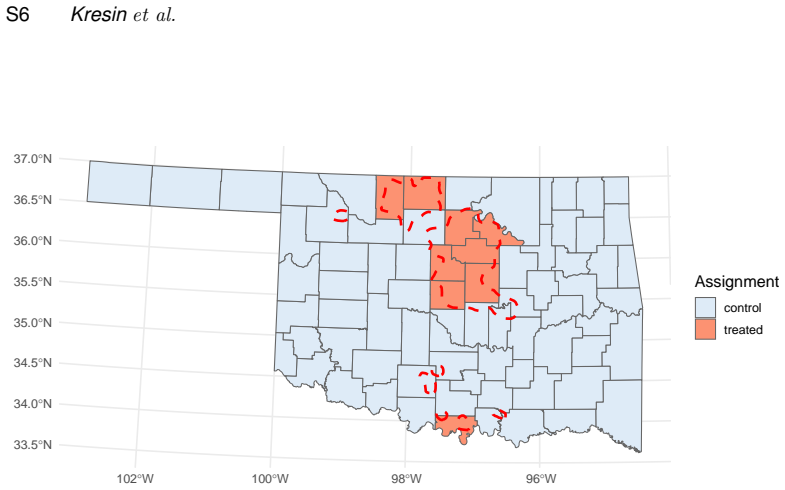
- The approach yields identified causal effects of wastewater injection on seismic activity in the Oklahoma application.
Where Pith is reading between the lines
- Similar superposition representations could be tested in other marked point-process settings, such as financial transaction streams, to separate baseline from intervention-driven events.
- Sensitivity checks that perturb the regime-stability assumption in simulation would quantify how much off-support identification depends on that modelling choice.
- The framework's handling of spillover suggests direct extensions to interference in network point processes where nodes influence one another's event rates.
Load-bearing premise
The observed events arise as an unlabelled mixture of control and treated latent processes whose off-support contrasts depend on a regime-stable model that is not directly testable from the data.
What would settle it
A dataset in which control and treatment events are distinguishable by mark or timing, yet the estimated causal contrasts diverge from those obtained by treating the events as an unlabelled superposition, would show the identification strategy fails.
Figures




read the original abstract
We develop a framework for causal inference with continuous spatiotemporal point-process outcomes under cell-level interventions and outcome spillover. Potential outcomes are indexed by full treatment allocations, and the observed post-treatment process is represented as an unlabelled superposition of latent control and treatment components. On the observed design support, expected post-treatment event counts in any spacetime region under a given treatment allocation are identified under consistency, exchangeability, and positivity; off-support contrasts are identified relative to a regime-stable structural point-process model. Estimation is likelihood-based and implemented with stochastic EM. To understand when this is feasible, we analyse a predictable blockwise hard-EM surrogate and show nonasymptotic contraction of estimation error to a statistical floor governed by locally ambiguous regions. This yields plug-in guarantees for cell-level and global causal functionals, and clarifies the additional array conditions needed for unnormalised growing-window contrasts. The framework covers history dependent spatiotemporal point processes including Poisson and Hawkes models, with applications to settings such as epidemiology, seismology, and finance. We provide an application assessing the causal effect of injecting wastewater into the ground on seismic activity in Oklahoma.
Editorial analysis
A structured set of objections, weighed in public.
Referee Report
Summary. The manuscript develops a causal inference framework for continuous spatiotemporal point processes under cell-level interventions with outcome spillover and carryover. Potential outcomes are indexed by full treatment allocations, and the observed post-treatment process is modeled as an unlabelled superposition of latent control and treatment components. On the observed design support, expected post-treatment event counts in any spacetime region are identified from consistency, exchangeability, and positivity alone. Off-support contrasts are identified relative to a regime-stable structural point-process model. Estimation is likelihood-based via stochastic EM, with nonasymptotic contraction analysis for a predictable blockwise hard-EM surrogate that yields plug-in guarantees for cell-level and global functionals. The framework applies to Poisson and Hawkes processes and is illustrated with an application to wastewater injection and seismic activity in Oklahoma.
Significance. If the regime-stable structural model is appropriate, the work provides a coherent extension of causal identification and estimation to dependent point-process outcomes with spillover, addressing a gap in settings such as epidemiology and seismology. The nonasymptotic contraction result for the EM surrogate and the explicit array conditions for growing-window contrasts are genuine strengths that go beyond standard asymptotic arguments and support reproducible plug-in inference.
major comments (2)
- [Identification and off-support contrasts] The identification of off-support contrasts (abstract and identification section) rests on the regime-stable structural point-process model whose kernel and baseline parameters are assumed invariant across treatment allocations. Because the observed process is an unlabelled superposition, any decomposition into latent components is unique only up to the parametric restrictions of this model; the manuscript does not supply a concrete test or sensitivity analysis for local misspecification of the stability assumption, which directly undermines the plug-in guarantees for any contrast that extrapolates beyond observed design support.
- [Estimation and theoretical analysis] § on nonasymptotic analysis: the contraction result for the predictable blockwise hard-EM surrogate is stated, yet the precise conditions required for unnormalised growing-window contrasts (including the array conditions mentioned in the abstract) are not fully verifiable from the provided description. These conditions are load-bearing for the claimed plug-in guarantees on global functionals and must be stated explicitly with the relevant measurability and boundedness assumptions.
minor comments (2)
- [Model setup] Notation for the latent control and treatment components would benefit from an explicit diagram or table clarifying the superposition mapping and the regime-stability restrictions.
- [Application] The application section would be strengthened by reporting the specific parametric form chosen for the regime-stable Hawkes kernel and any diagnostic checks performed on the stability assumption.
Simulated Author's Rebuttal
We thank the referee for their careful reading and constructive suggestions, which have prompted us to strengthen the presentation of our identification and estimation results. We respond to each major comment below and indicate the revisions we will make.
read point-by-point responses
-
Referee: [Identification and off-support contrasts] The identification of off-support contrasts (abstract and identification section) rests on the regime-stable structural point-process model whose kernel and baseline parameters are assumed invariant across treatment allocations. Because the observed process is an unlabelled superposition, any decomposition into latent components is unique only up to the parametric restrictions of this model; the manuscript does not supply a concrete test or sensitivity analysis for local misspecification of the stability assumption, which directly undermines the plug-in guarantees for any contrast that extrapolates beyond observed design support.
Authors: We agree that the regime-stable structural model is a substantive modeling assumption required to identify off-support contrasts, since the unlabelled superposition alone does not yield unique latent-component decompositions. The manuscript presents identification results conditional on this invariance of kernel and baseline parameters. While we do not claim the assumption is testable from the observed data without additional structure, we acknowledge that readers would benefit from guidance on its plausibility. In the revision we will add a dedicated sensitivity subsection that perturbs the kernel parameters within ranges consistent with the observed design support and reports the resulting variation in the extrapolated contrasts. This will not alter the formal identification statements but will make the practical scope of the plug-in guarantees more transparent. revision: yes
-
Referee: [Estimation and theoretical analysis] § on nonasymptotic analysis: the contraction result for the predictable blockwise hard-EM surrogate is stated, yet the precise conditions required for unnormalised growing-window contrasts (including the array conditions mentioned in the abstract) are not fully verifiable from the provided description. These conditions are load-bearing for the claimed plug-in guarantees on global functionals and must be stated explicitly with the relevant measurability and boundedness assumptions.
Authors: We appreciate the referee’s observation that the array conditions supporting the nonasymptotic contraction for unnormalised growing-window contrasts are referenced in the abstract but not stated with full precision in the main text. The analysis relies on standard measurability of the filtration, uniform boundedness of the intensity functions on compact sets, and specific moment-array conditions that ensure the contraction mapping applies uniformly. In the revised manuscript we will restate the relevant theorem with an explicit list of these assumptions (including the precise array conditions) and expand the proof sketch to verify each one. This change will make the plug-in guarantees for global functionals directly verifiable without altering the underlying contraction result. revision: yes
Circularity Check
No significant circularity: identification rests on external assumptions and estimation uses standard latent-variable methods with independent guarantees
full rationale
The derivation chain begins with standard causal assumptions (consistency, exchangeability, positivity) to identify on-support expectations for post-treatment event counts under a given allocation; these are not derived from or equivalent to the observed superposition by construction. Off-support contrasts are identified only relative to an additional regime-stable structural point-process model (covering Poisson and Hawkes), which is posited as an untestable modeling assumption rather than recovered from data or fitted parameters. Likelihood-based estimation via stochastic EM, together with the nonasymptotic contraction analysis of the blockwise hard-EM surrogate, yields plug-in guarantees whose error floor is governed by locally ambiguous regions; this analysis does not reduce the target causal functionals to the fitted quantities tautologically. No self-citation load-bearing steps, uniqueness theorems imported from prior author work, or ansatz smuggling appear in the identification or estimation claims. The framework is therefore self-contained against external benchmarks once the stated assumptions are granted.
Axiom & Free-Parameter Ledger
axioms (2)
- domain assumption Consistency, exchangeability, and positivity for identification on observed design support
- ad hoc to paper Regime-stable structural point-process model for off-support contrasts
invented entities (1)
-
Latent control and treatment components
no independent evidence
Reference graph
Works this paper leans on
-
[1]
andλ 1(· |θ ′ 1), compute predicted post- treatment countsC j,0 andC j,1 (via compensator integrals or fast simulation), and define D+ j = Cobs j −C j,0 +, D − j = Cj,0 −C obs j +. LargeD + j flags excess mass the control model cannot explain and suggests flipping control labels to treatment inI j;D − j suggests the reverse. A single proposal is generated...
work page 2025
-
[2]
For any predictable setS⊂D, define the component compensated martingales M ⋆ k (S) :=N k(S)− Z S λ⋆ k(τ)dτ, k∈ {0,1}, and the superposed compensated martingale M ⋆(S) :=N(S)− Z S λ⋆(τ)dτ=M ⋆ 0 (S) +M ⋆ 1 (S). Throughout the analysis, we index complete-data likelihoods and intensities by a labelling r= (r i)i≥1 ∈ {0,1} N. Only the firstN(D) entries affect ...
work page 1975
-
[3]
log bλr′ ri(γi) bλr′ (γi) −log bλr ri(γi) bλr(γi) # +
For the remainder of this proof, we writeD:=D (m) for brevity. Forv∈[0,1] also define the interpolated intensity bλr,v(τ) := bλr(τ) +v∆ bλr(τ). Using the decomposition X k∈{0,1} Z D logbλr k(τ)dN r k(τ) = Z D logbλr(τ)dN(τ) + X k∈{0,1} Z D log bλr k(τ) bλr(τ) dN r k(τ), we may write the objective (restricted toD) as a sum of a total-intensity log- likelih...
work page 2007
discussion (0)
Sign in with ORCID, Apple, or X to comment. Anyone can read and Pith papers without signing in.