Recognition: unknown
Detection and analysis of white-light emission in solar flares through light curve diagnostics
Pith reviewed 2026-05-10 16:11 UTC · model grok-4.3
The pith
A light-curve method detects white-light emission in 65 percent of flares, including C-class events down to C1.0.
A machine-rendered reading of the paper's core claim, the machinery that carries it, and where it could break.
Core claim
The central claim is that white-light emission is present in approximately 65 percent of solar flares within the studied active region, including 60 percent of C-class flares and a confirmed C1.0 event, established by identifying pixels whose background-subtracted rapid radiative pulses are significantly stronger during the flare than in the surrounding quiet periods.
What carries the argument
The light-curve diagnostic that isolates rapid radiative pulses after subtracting the slowly varying background and compares their strength inside versus outside the flare interval.
If this is right
- White-light emission can occur in two separate phases within a single flare.
- Different spatial regions inside the same flare can exhibit distinct white-light properties.
- The majority of C-class flares below C5.0 still produce detectable white-light emission.
- Systematic application of the method makes weak white-light flares observable for the first time.
Where Pith is reading between the lines
- If the 65 percent rate holds across other active regions, white-light emission would be viewed as a standard rather than exceptional feature of flare energy release.
- Detection of a C1.0 white-light flare implies that even smaller events may heat the lower atmosphere more frequently than previously assumed.
- The two-phase structure and regional differences suggest the method could be used to map how energy reaches the photosphere at different times and locations.
Load-bearing premise
The rapid pulses that remain after background subtraction are genuine white-light continuum emission from the flare rather than instrumental artifacts or unrelated transients.
What would settle it
Simultaneous observations with a different instrument or higher-resolution spectrograph that show no corresponding continuum brightening in the pixels the method flags during a C-class flare would falsify the claim.
Figures




read the original abstract
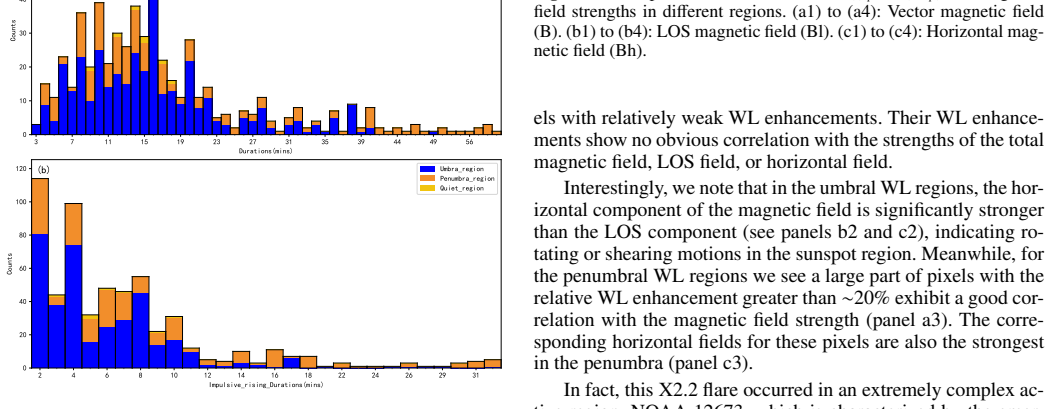
White-light flares (WLFs) are crucial for understanding the energy transport and heating processes in the lower solar atmosphere. Systematic studies are highly necessary. However, most WLFs are very weak and difficult to detect. To address this, we propose a new method of detecting WLFs. Through the observations of SDO/HMI, the light curve of each pixel in the flaring region can be obtained. By subtracting the slowly varying background, we obtained a series of rapidly varying radiative pulses. Pixels for which radiative pulses during flares significantly exceed those occurring before and after the flare were identified as WL emission regions. We applied our method to the detection of the X2.2 flare on September 6, 2017 and validated the method. We found that the WL emission in this flare exhibits two phases, and that different regions show distinct WL emission properties. We also detected the WL emission in all the flares (1 X-class, 2 M-class, and 20 C-class) occurred in active region NOAA 12887. It was found that 15 of the 23 flares are WLFs (1 X-class, 2 M-class, and 12 C-class). The occurrence rate of WLFs in this active region is $\sim65\%$. Surprisingly, the occurrence rate of WLFs in C-class flares even reaches up to $60\%$. It should be noted that most of these C-class WLFs are below C5.0. In addition, a C1.0 WLF was identified; this is the lowest GOES-class event with confirmed WL emission to date. These results demonstrate that WL emission is ubiquitous in most flares, even down to C-class events.
Editorial analysis
A structured set of objections, weighed in public.
Referee Report
Summary. The paper proposes a new detection method for white-light flares (WLFs) based on SDO/HMI continuum filtergrams. For each pixel in the flaring region, the light curve is extracted, a slowly varying background is subtracted to isolate rapid radiative pulses, and pixels are flagged as WLF regions if the flare-time pulses significantly exceed the pre- and post-flare pulse levels. The method is first validated on the X2.2 flare of 2017 September 6 and then applied to all 23 flares (1 X-class, 2 M-class, 20 C-class) that occurred in NOAA AR 12887. Fifteen events are classified as WLFs (including 12 C-class and one C1.0), yielding an occurrence rate of ~65 % and the claim that white-light emission is ubiquitous even in weak C-class flares.
Significance. If the detections prove robust, the result would be highly significant for solar-flare physics. It would demonstrate that white-light continuum emission occurs in the majority of flares, including events as weak as C1.0, thereby tightening constraints on energy transport and heating mechanisms in the lower solar atmosphere. The single-active-region statistical sample and the extension of the method to archival HMI data would also provide a practical route for future systematic surveys.
major comments (3)
- [§3] §3 (validation on X2.2 flare): The method is validated only on the strong X2.2 event; no quantitative cross-check against independent white-light diagnostics (AIA 1600/1700 Å, ground-based continuum imaging, or RHESSI) is performed for any of the 20 C-class flares. Because the central ubiquity claim (12/20 C-class WLFs, 60 % rate) rests on these unverified detections, the absence of such a test is load-bearing.
- [§2] §2 (detection criterion): The requirement that flare-time pulses 'significantly exceed' pre- and post-flare levels is never quantified; no numerical threshold, σ-level, or statistical significance test is defined, and no uncertainty is propagated through the background-subtraction step. For C-class events whose signals lie near the noise floor, this renders the classification criterion subjective and difficult to reproduce.
- [§4] §4 (C-class results and C1.0 event): The identification of the C1.0 flare as the weakest confirmed WLF relies solely on the pulse-exceedance criterion. No assessment is given of possible HMI-specific contaminants (flare-induced line-profile shifts within the 6173 Å filter, residual scattered light, or high-frequency noise after slow-background removal) that could mimic the reported rapid pulses.
minor comments (3)
- [Figures 6–8] Figure captions for the C-class light-curve panels should explicitly state the GOES class and the time interval used for background subtraction so that readers can assess the robustness of each detection.
- [§4] The occurrence-rate calculation (15/23 ≈ 65 %) is stated in the abstract and §4 but is not shown with the exact numerator/denominator breakdown or Poisson uncertainties; adding this would improve clarity.
- [§1] A short paragraph comparing the new method with earlier HMI-based WLF searches (e.g., those using 45 s or 135 s cadence data) would help place the work in context.
Simulated Author's Rebuttal
We thank the referee for their thorough and constructive review. The comments have prompted us to clarify the method, strengthen the statistical rigor, and better address potential limitations. We respond point by point to the major comments below.
read point-by-point responses
-
Referee: [§3] §3 (validation on X2.2 flare): The method is validated only on the strong X2.2 event; no quantitative cross-check against independent white-light diagnostics (AIA 1600/1700 Å, ground-based continuum imaging, or RHESSI) is performed for any of the 20 C-class flares. Because the central ubiquity claim (12/20 C-class WLFs, 60 % rate) rests on these unverified detections, the absence of such a test is load-bearing.
Authors: The X2.2 flare validation relies on consistency with the well-documented two-phase WL emission and ribbon morphology from prior multi-wavelength studies of this event. For the C-class sample, simultaneous high-cadence continuum data from other instruments were unavailable in the HMI-only dataset. We have added a limitations subsection that discusses this constraint and provides qualitative consistency checks using co-temporal AIA 1600 Å brightenings for several C-class events. We acknowledge that a full quantitative cross-validation would require new coordinated observations and have noted this explicitly as future work. revision: partial
-
Referee: [§2] §2 (detection criterion): The requirement that flare-time pulses 'significantly exceed' pre- and post-flare levels is never quantified; no numerical threshold, σ-level, or statistical significance test is defined, and no uncertainty is propagated through the background-subtraction step. For C-class events whose signals lie near the noise floor, this renders the classification criterion subjective and difficult to reproduce.
Authors: We agree that the criterion must be made quantitative. The revised manuscript now defines 'significantly exceed' as the maximum flare-time pulse amplitude exceeding the largest pre- or post-flare pulse by at least 3σ, where σ is the standard deviation of the background-subtracted pre-flare light curve. We have added the explicit formula, error propagation for the background subtraction, and an example calculation for a representative C-class event to ensure reproducibility. revision: yes
-
Referee: [§4] §4 (C-class results and C1.0 event): The identification of the C1.0 flare as the weakest confirmed WLF relies solely on the pulse-exceedance criterion. No assessment is given of possible HMI-specific contaminants (flare-induced line-profile shifts within the 6173 Å filter, residual scattered light, or high-frequency noise after slow-background removal) that could mimic the reported rapid pulses.
Authors: We have inserted a new subsection that evaluates HMI-specific artifacts. The rapid, impulsive character of the detected pulses (rise times < 1 min, aligned with the GOES peak) is inconsistent with slowly varying scattered light or residual high-frequency noise after background removal. For line-profile shifts, we note that the HMI filter transmission is narrow and the spatial coherence of the signals with the flaring ribbons argues against a filter artifact. Error bars from the background subtraction are now shown for the C1.0 light curves. revision: yes
- Quantitative cross-checks with independent white-light diagnostics for the C-class events, which would require additional simultaneous observations not present in the current dataset.
Circularity Check
No significant circularity; purely observational detection criterion applied to public data
full rationale
The paper proposes and applies a direct observational detection method: subtract slow background from SDO/HMI pixel light curves to isolate rapid radiative pulses, then flag pixels where flare-time pulses exceed pre- and post-flare levels as white-light emission regions. This threshold-based criterion is defined once and applied uniformly to count flares meeting it (15/23 total, 12/20 C-class), yielding the reported ~65% occurrence rate. No parameters are fitted to the target data in a way that makes the count a statistical prediction by construction, no self-citations are invoked to justify the core premise, and no equations or uniqueness theorems reduce the result to its inputs. Validation on the X2.2 flare is presented as an independent check before extension to weaker events. The chain is self-contained against the public HMI dataset with no load-bearing loops.
Axiom & Free-Parameter Ledger
free parameters (1)
- pulse significance threshold
axioms (1)
- domain assumption HMI intensity measurements accurately capture white-light continuum emission from flares without dominant instrumental or scattered-light artifacts
Reference graph
Works this paper leans on
-
[1]
L., Appleton, P
Alatalo, K., Cales, S. L., Appleton, P. N., et al. 2014, ApJ, 794, L13
2014
-
[2]
2024, ApJ, 975, 69
Cai, Y ., Hou, Y ., Li, T., & Liu, J. 2024, ApJ, 975, 69
2024
-
[3]
P., Wachter, R., et al
Couvidat, S., Rajaguru, S. P., Wachter, R., et al. 2012, Sol. Phys., 278, 217
2012
-
[4]
2005, ApJ, 623, 1195
Deng, N., Liu, C., Yang, G., Wang, H., & Denker, C. 2005, ApJ, 623, 1195
2005
-
[5]
Emslie, A. G. & Sturrock, P. A. 1982, Sol. Phys., 80, 99–112
1982
-
[6]
2013, RAA, 13, 1509
Fang, C., Chen, P.-F., Li, Z., et al. 2013, RAA, 13, 1509
2013
-
[7]
& Ding, M
Fang, C. & Ding, M. D. 1995, Astronomy and Astrophysics Supplement, 110, 99
1995
-
[8]
R., Hudson, H
Fletcher, L., Dennis, B. R., Hudson, H. S., et al. 2011, Space Science Reviews, 159, 19–106
2011
-
[9]
& Hudson, H
Fletcher, L. & Hudson, H. S. 2008, ApJ, 675, 1645–1655
2008
-
[10]
2023, Sol
Gan, W., Zhu, C., Deng, Y ., et al. 2023, Sol. Phys., 298
2023
-
[11]
Q., Rieger, E., Zhang, H
Gan, W. Q., Rieger, E., Zhang, H. Q., & Fang, C. 1992, ApJ, 397, 694
1992
-
[12]
S., V olvach, A
Gopasyuk, O. S., V olvach, A. E., & Yakubovskaya, I. V . 2022, Geomagnetism and Aeronomy, 62, 888–894
2022
-
[13]
G., Sadykov, V
Granovsky, S., Kosovichev, A. G., Sadykov, V . M., Kerr, G. S., & Allred, J. C. 2025, ApJ, 988, 74
2025
-
[14]
Hanser, F. A. & Sellers, F. B. 1996, in GOES-8 and Beyond, ed. E. R. Washwell (SPIE)
1996
-
[15]
2017, NatCo, 8, 2002
Hao, Q., Yang, K., Cheng, X., et al. 2017, NatCo, 8, 2002
2017
-
[16]
D., Li, Y ., & Carlsson, M
Hong, J., Ding, M. D., Li, Y ., & Carlsson, M. 2018, ApJ, 857, L2
2018
-
[17]
J., Zhang, J., Li, T., Yang, S
Hou, Y . J., Zhang, J., Li, T., Yang, S. H., & Li, X. H. 2018, A&A, 619, A100
2018
-
[18]
Hudson, H. S. & Ohki, K. 1972, Sol. Phys., 23, 155
1972
-
[19]
S., Wolfson, C
Hudson, H. S., Wolfson, C. J., & Metcalf, T. R. 2006, Sol. Phys., 234, 79–93
2006
-
[20]
B., Mathioudakis, M., Crockett, P
Jess, D. B., Mathioudakis, M., Crockett, P. J., & Keenan, F. P. 2008, ApJL, 688, L119
2008
-
[21]
2024, Sol
Jing, Z., Li, Y ., Feng, L., et al. 2024, Sol. Phys., 299
2024
-
[22]
F., Hawley, S
Kowalski, A. F., Hawley, S. L., Carlsson, M., et al. 2015, Sol. Phys., 290, 3487–3523
2015
-
[23]
S., Hudson, H
Krucker, S., Hilaire, P. S., Hudson, H. S., et al. 2015, ApJ, 802, 19
2015
-
[24]
C., et al
Kuhar, M., Krucker, S., Martínez Oliveros, J. C., et al. 2016, ApJ, 816, 6
2016
-
[25]
R., Title, A
Lemen, J. R., Title, A. M., Akin, D. J., et al. 2011, Sol. Phys., 275, 17–40
2011
-
[26]
2018, ApJL, 867, L5
Liu, L., Cheng, X., Wang, Y ., et al. 2018, ApJL, 867, L5
2018
-
[27]
E., Avrett, E
Machado, M. E., Avrett, E. H., Falciani, R., et al. 1986, in The Lower Atmo- sphere of Solar Flares, 483–488
1986
-
[28]
E., Emslie, A
Machado, M. E., Emslie, A. G., & Avrett, E. H. 1989, Sol. Phys., 124, 303–317
1989
-
[29]
A., van Driel-Gesztelyi, L., Hudson, H
Matthews, S. A., van Driel-Gesztelyi, L., Hudson, H. S., & Nitta, N. V . 2003, A&A, 409, 1107–1125
2003
-
[30]
R., Canfield, R
Metcalf, T. R., Canfield, R. C., Avrett, E. H., & Metcalf, F. T. 1990, ApJ, 350, 463 Mravcová, L. & Švanda, M. 2017, New A, 57, 14
1990
-
[31]
1989, Sol
Neidig, D. 1989, Sol. Phys., 121
1989
-
[32]
& Cliver, E
Neidig, D. & Cliver, E. 1983, Sol. Phys., 88
1983
-
[33]
Neidig, D. F. & Wiborg, Jr., P. H. 1984, Sol. Phys., 92, 217
1984
-
[34]
D., Thompson, B
Pesnell, W. D., Thompson, B. J., & Chamberlin, P. C. 2011, Sol. Phys., 275, 3–15
2011
-
[35]
H., Schou, J., Bush, R
Scherrer, P. H., Schou, J., Bush, R. I., et al. 2011, Sol. Phys., 275, 207–227
2011
-
[36]
2023, ApJL, 952, L6
Song, D.-C., Tian, J., Li, Y ., et al. 2023, ApJL, 952, L6
2023
-
[37]
& Tian, H
Song, Y . & Tian, H. 2018, ApJ, 867, 159
2018
-
[38]
2020, ApJL, 893, L13
Song, Y ., Tian, H., Zhu, X., et al. 2020, ApJL, 893, L13
2020
-
[39]
L., Guo, Y ., Tian, H., et al
Song, Y . L., Guo, Y ., Tian, H., et al. 2018, ApJ, 854, 64
2018
-
[40]
L., Tian, H., Zhang, M., & Ding, M
Song, Y . L., Tian, H., Zhang, M., & Ding, M. D. 2018, A&A, 613, A69
2018
-
[41]
Song, Y . L. & Zhang, M. 2016, ApJ, 826, 173 Švanda, M., Jurˇcák, J., Kašparová, J., & Kleint, L. 2018, ApJ, 860, 144
2016
-
[42]
& Liu, C
Wang, H. & Liu, C. 2010, ApJ, 716, L195
2010
-
[43]
2012, ApJ, 757, L5
Wang, S., Liu, C., & Wang, H. 2012, ApJ, 757, L5
2012
-
[44]
& Imada, S
Watanabe, K. & Imada, S. 2020, ApJ, 891, 88
2020
-
[45]
2017, ApJ, 850, 204
Watanabe, K., Kitagawa, J., & Masuda, S. 2017, ApJ, 850, 204
2017
-
[46]
2010, Astronomische Nachrichten, 331, 596–598
Xu, Y ., Cao, W., Jing, J., & Wang, H. 2010, Astronomische Nachrichten, 331, 596–598
2010
-
[47]
2025, ApJ, 986, L15
Xu, Z., Yan, X., Li, Z., et al. 2025, ApJ, 986, L15
2025
-
[48]
2017, ApJL, 849, L21 Article number, page 14 of 14
Yang, S., Zhang, J., Zhu, X., & Song, Q. 2017, ApJL, 849, L21 Article number, page 14 of 14
2017
discussion (0)
Sign in with ORCID, Apple, or X to comment. Anyone can read and Pith papers without signing in.