Mobility-edge-embedded Hofstadter butterfly from a tilt-induced quasiperiodic potential
Pith reviewed 2026-05-21 01:32 UTC · model grok-4.3
The pith
Aligning a periodic potential at an angle to square-lattice axes creates a mobility-edge-embedded Hofstadter butterfly.
A machine-rendered reading of the paper's core claim, the machinery that carries it, and where it could break.
Core claim
Using a tight-binding model, the authors show that the tilt-induced potential generates a Harper-like equation in which the fractal splitting pattern originates from one-dimensional quasiperiodic potentials while mobility edges arise from effective long-range hopping. This produces a mobility-edge-embedded Hofstadter butterfly whose fractal dimension lies between 0.8 and 1.0, markedly higher than the 0.4-0.6 range of the standard butterfly.
What carries the argument
The tilt-induced quasiperiodic potential, created by aligning a periodic potential at an angle to the lattice axes, which generates effective long-range hopping responsible for the mobility edges within the fractal spectrum.
If this is right
- The fractal pattern and mobility edges coexist in an experimentally realizable optical-lattice setup.
- The spectrum is denser than that of the standard Hofstadter butterfly, with fractal dimension 0.8-1.0.
- The Harper-like equation derived from the model isolates the one-dimensional quasiperiodic origin of the fractals from the long-range hopping origin of the mobility edges.
- Varying the tilt angle provides a tunable handle on the quasiperiodic strength and resulting localization properties.
Where Pith is reading between the lines
- Changing the tilt angle could move the mobility-edge positions continuously through the spectrum, offering a new control knob for localization studies.
- The same tilt mechanism might be extended to other lattice geometries to produce analogous embedded butterflies in three dimensions.
- Transport measurements in cold-atom experiments could directly probe the coexistence by observing diffusive versus localized dynamics within the same energy window.
Load-bearing premise
The effective long-range hopping produced by the tilt creates mobility edges that cleanly divide extended and localized states without substantial interference from the two-dimensional lattice geometry or higher-order corrections.
What would settle it
Numerical computation of participation ratios or inverse participation ratios across the energy spectrum for varying tilt angles and potential amplitudes; absence of clear mobility edges separating regions of extended versus localized states would falsify the claim.
Figures
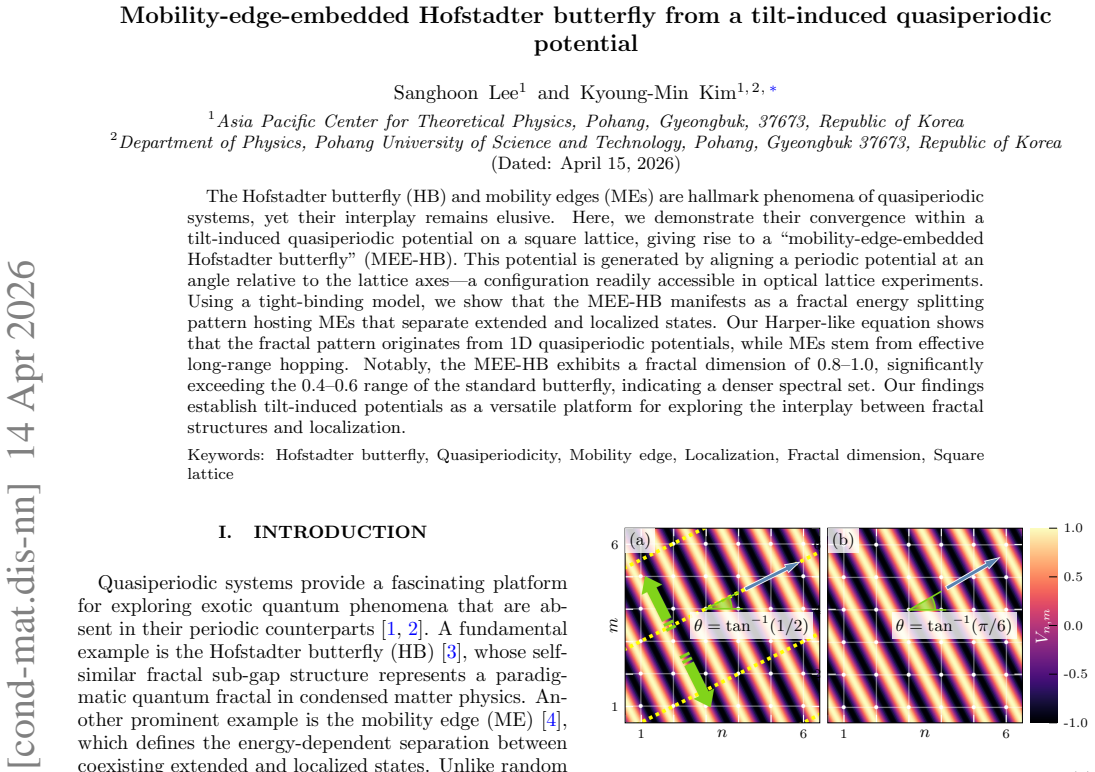


read the original abstract
The Hofstadter butterfly (HB) and mobility edges (MEs) are hallmark phenomena of quasiperiodic systems, yet their interplay remains elusive. Here, we demonstrate their coexistence within a tilt-induced quasiperiodic potential on a square lattice, giving rise to a ``mobility-edge-embedded Hofstadter butterfly'' (MEE-HB). This potential is generated by aligning a periodic potential at an angle relative to the lattice axes -- a configuration readily accessible in optical lattice experiments. Using a tight-binding model, we show that the MEE-HB manifests as a fractal energy splitting pattern hosting MEs that separate extended and localized states. Our Harper-like equation shows that the fractal pattern originates from one-dimensional quasiperiodic potentials, while MEs stem from effective long-range hopping. Notably, the MEE-HB exhibits a fractal dimension of \(0.8\)--\(1.0\), significantly exceeding the \(0.4\)--\(0.6\) range of the standard butterfly, indicating a denser spectrum. Our findings establish tilt-induced potentials as a versatile platform for exploring the interplay between fractal structures and localization.
Editorial analysis
A structured set of objections, weighed in public.
Referee Report
Summary. The manuscript introduces a tilt-induced quasiperiodic potential on a square lattice, generated by aligning a periodic potential at an angle to the lattice axes. Using a tight-binding model, it derives a Harper-like equation that produces a mobility-edge-embedded Hofstadter butterfly (MEE-HB) featuring fractal energy splitting, with mobility edges separating extended and localized states. The work reports a fractal dimension of 0.8-1.0 for this spectrum, higher than the 0.4-0.6 range of the standard Hofstadter butterfly, and positions the setup as experimentally accessible in optical lattices.
Significance. If the effective reduction holds without significant 2D interference, the result would establish a new, tunable platform for exploring the coexistence of fractal spectra and localization transitions in quasiperiodic systems. The elevated fractal dimension suggests a denser spectrum that could inform studies of localization in tilted or higher-dimensional potentials, with direct relevance to cold-atom experiments.
major comments (2)
- [Abstract] Abstract (paragraph on Harper-like equation and effective long-range hopping): The central claim that the fractal pattern originates purely from 1D quasiperiodicity while mobility edges arise solely from effective long-range hopping requires explicit demonstration that residual anisotropic couplings or incommensurate modulations from the orthogonal lattice direction remain perturbative and do not mix extended and localized character. Without quantitative bounds on higher-order tilt harmonics or surviving 2D lattice effects, the clean separation of states and the reported increase in fractal dimension to 0.8-1.0 cannot be taken as established.
- [Numerical results] Model and numerical results sections: The fractal dimension range 0.8-1.0 is presented without reported error bars, finite-size scaling analysis, or convergence checks under variations in system size, tilt angle, or potential amplitude. This omission directly affects the robustness of the claim that the MEE-HB spectrum is denser than the standard butterfly.
minor comments (2)
- [Abstract] The abstract and main text would benefit from a clearer statement of the precise angle and amplitude values used to generate the reported spectra, along with a brief discussion of how the tilt configuration maps to experimental optical-lattice parameters.
- [Figures] Figure captions should explicitly list the lattice sizes, boundary conditions, and diagonalization method employed when displaying the MEE-HB spectrum and fractal-dimension estimates.
Simulated Author's Rebuttal
We thank the referee for their detailed and constructive feedback on our manuscript. We address the major comments point by point below and outline the revisions we will implement to strengthen our claims.
read point-by-point responses
-
Referee: [Abstract] Abstract (paragraph on Harper-like equation and effective long-range hopping): The central claim that the fractal pattern originates purely from 1D quasiperiodicity while mobility edges arise solely from effective long-range hopping requires explicit demonstration that residual anisotropic couplings or incommensurate modulations from the orthogonal lattice direction remain perturbative and do not mix extended and localized character. Without quantitative bounds on higher-order tilt harmonics or surviving 2D lattice effects, the clean separation of states and the reported increase in fractal dimension to 0.8-1.0 cannot be taken as established.
Authors: We appreciate this comment and agree that making the perturbative nature explicit would strengthen the manuscript. In our derivation, the Harper-like equation is obtained by considering the dominant quasiperiodic modulation along the tilted direction, with the orthogonal lattice direction contributing through effective long-range terms that we argue are weak for incommensurate angles. To provide quantitative support, we will add in the revised version a detailed analysis of the residual 2D effects, including bounds on the amplitude of higher-order harmonics and numerical evidence that they do not significantly alter the localization properties for the parameter regimes studied. This will include calculations showing the fractal dimension remains in the 0.8-1.0 range even with small perturbations. revision: yes
-
Referee: [Numerical results] Model and numerical results sections: The fractal dimension range 0.8-1.0 is presented without reported error bars, finite-size scaling analysis, or convergence checks under variations in system size, tilt angle, or potential amplitude. This omission directly affects the robustness of the claim that the MEE-HB spectrum is denser than the standard butterfly.
Authors: We acknowledge the validity of this observation. The fractal dimension was estimated from the scaling of the number of distinct energy levels with system size, but we did not include error bars or extensive convergence tests in the original submission. In the revised manuscript, we will incorporate a finite-size scaling analysis, reporting the fractal dimension with associated uncertainties obtained from linear fits over multiple system sizes and different tilt angles. We will also demonstrate convergence with respect to potential amplitude, thereby confirming the robustness of the 0.8-1.0 range and its distinction from the standard Hofstadter butterfly's 0.4-0.6. revision: yes
Circularity Check
No significant circularity; derivation proceeds from explicit tight-binding model to effective Harper-like equation without self-referential fitting or load-bearing self-citation.
full rationale
The paper constructs the tilt-induced quasiperiodic potential on the square lattice from a geometric alignment of a periodic potential, then derives the effective long-range hopping and Harper-like equation directly from the tight-binding Hamiltonian. No equation reduces the MEE-HB fractal spectrum or mobility edges to a pre-fitted parameter or to a prior self-citation that itself assumes the target result. The reported fractal dimension range and separation of extended/localized states follow from numerical diagonalization of the derived model rather than from renaming or reparameterizing known inputs. The central claim therefore remains self-contained against external benchmarks such as standard Hofstadter or Aubry-André models.
Axiom & Free-Parameter Ledger
free parameters (2)
- tilt angle
- potential amplitude
axioms (1)
- domain assumption Tight-binding approximation accurately describes the low-energy physics of the optical lattice.
Reference graph
Works this paper leans on
-
[1]
tilt-induced quasiperiodic model (TQM)
reveals that the fractal dimension of the MEE-HB spectrum (0.8–1.0) significantly exceeds that of the stan- dard HB (0.4–0.6), serving as a hallmark characteristic of the system (Sec. V). Finally, we discuss experimental realizations in optical lattices (Sec. VI) and highlight the advantages of this tilt-induced approach over alternative configurations (S...
-
[2]
over the tilt-angle rangeθ∈[0, π/4]. We visual- ize the spectra in the (θ, E) plane through a density of states (DOS) obtained by Lorentzian broadening of the discrete eigenvalues, with the spectral weight normalized by the total number of states. Figure 3(a) illustrates the evolution of the resulting DOS map for a weak potential strength (λ= 1) in the (θ...
-
[3]
For the fractal-dimension analysis in Fig. 5(d), we used the dual representation of the effective Harper-like model with a larger system size 6400 to improve spectral resolution. A more detailed analysis of theν-dependence is provided in Supplementary Note 3. C. Box counting method To obtain the fractal dimension shown in Fig. 5, we applied a box-counting...
work page 2026
-
[4]
J. Sokoloff, Unusual band structure, wave functions and electrical conductance in crystals with incommensurate periodic potentials, Phys. Rep.126, 189 (1985)
work page 1985
-
[5]
Maci´ a, The role of aperiodic order in science and tech- nology, Rep
E. Maci´ a, The role of aperiodic order in science and tech- nology, Rep. Prog. Phys.69, 397 (2005)
work page 2005
-
[7]
S. Das Sarma, S. He, and X. C. Xie, Mobility edge in a model one-dimensional potential, Phys. Rev. Lett.61, 2144 (1988)
work page 1988
-
[8]
S. S. Kondov, W. R. McGehee, J. J. Zirbel, and B. De- Marco, Three-dimensional anderson localization of ultra- cold matter, Science334, 66 (2011)
work page 2011
-
[9]
Y. E. Kraus, Z. Ringel, and O. Zilberberg, Four- dimensional quantum hall effect in a two-dimensional quasicrystal, Phys. Rev. Lett.111, 226401 (2013)
work page 2013
- [10]
-
[11]
L. Du, Q. Chen, A. D. Barr, A. R. Barr, and G. A. Fiete, Floquet hofstadter butterfly on the kagome and triangu- lar lattices, Phys. Rev. B98, 245145 (2018)
work page 2018
-
[12]
M. Koshino, H. Aoki, K. Kuroki, S. Kagoshima, and T. Osada, Hofstadter butterfly and integer quantum hall effect in three dimensions, Phys. Rev. Lett.86, 1062 (2001)
work page 2001
-
[13]
S. Lee, T. Cadez, and K.-M. Kim, Structural constraints on mobility edges in one-dimensional quasiperiodic sys- tems (2026), arXiv:2601.15799 [cond-mat.dis-nn]
work page internal anchor Pith review Pith/arXiv arXiv 2026
-
[14]
L. Wang, Z. Wang, J. Liu, and S. Chen, Exact multiple complex mobility edges and quantum state engineering in coupled one-dimensional quasicrystals, Phys. Rev. B 112, 104207 (2025)
work page 2025
-
[15]
S. Ganeshan, J. H. Pixley, and S. Das Sarma, Nearest neighbor tight binding models with an exact mobility edge in one dimension, Phys. Rev. Lett.114, 146601 (2015)
work page 2015
-
[16]
Y. E. Kraus, Y. Lahini, Z. Ringel, M. Verbin, and O. Zil- berberg, Topological states and adiabatic pumping in quasicrystals, Phys. Rev. Lett.109, 106402 (2012)
work page 2012
-
[17]
M. Aidelsburger, M. Atala, M. Lohse, J. T. Barreiro, B. Paredes, and I. Bloch, Realization of the hofstadter hamiltonian with ultracold atoms in optical lattices, Phys. Rev. Lett.111, 185301 (2013)
work page 2013
-
[19]
F. A. An, K. Padavi´ c, S. Scherg, A. Janot, and B. Gad- way, Interactions and mobility edges: Observing the generalized aubry–andr´ e model, Phys. Rev. Lett.126, 040603 (2021)
work page 2021
-
[20]
H. P. L¨ uschen, S. Scherg, T. Kohlert, M. Schreiber, P. Bordia, X. Li, S. Das Sarma, and I. Bloch, Single- particle mobility edge in a one-dimensional quasiperiodic optical lattice, Phys. Rev. Lett.120, 160404 (2018)
work page 2018
-
[21]
F. A. An, K. Padavi´ c, E. J. Meier, S. Hegde, S. Gane- shan, J. H. Pixley, S. Vishveshwara, and B. Gadway, In- teractions and mobility edges: Observing the generalized aubry-andr´ e model, Phys. Rev. Lett.126, 040603 (2021)
work page 2021
-
[22]
C. R. Dean, L. Wang, P. Maher, C. Forsythe, F. Ghahari, Y. Gao, J. Katoch, M. Ishigami, P. Moon, M. Koshino, T. Taniguchi, K. Watanabe, K. L. Shepard, J. Hone, and P. Kim, Hofstadter’s butterfly and the fractal quantum hall effect in moir´ e superlattices, Nature497, 598 (2013)
work page 2013
-
[23]
L. A. Ponomarenko, R. V. Gorbachev, G. L. Yu, D. C. Elias, R. Jalil, A. A. Patel, A. Mishchenko, A. S. Mayorov, C. R. Woods, J. R. Wallbank, M. Mucha- Kruczynski, B. A. Piot, M. Potemski, I. V. Grigorieva, K. S. Novoselov, F. Guinea, V. I. Fal’ko, and A. K. Geim, Cloning of dirac fermions in graphene superlattices, Na- ture497, 594 (2013)
work page 2013
-
[24]
B. Hunt, J. D. Sanchez-Yamagishi, A. F. Young, M. Yankowitz, B. J. LeRoy, K. Watanabe, T. Taniguchi, P. Moon, M. Koshino, P. Jarillo-Herrero, and R. C. Ashoori, Massive dirac fermions and hofstadter butter- fly in a van der waals heterostructure, Science340, 1427 (2013)
work page 2013
-
[25]
K. P. Nuckolls, M. G. Scheer, D. Wong, M. Oh, R. L. Lee, J. Herzog-Arbeitman, K. Watanabe, T. Taniguchi, B. Lian, and A. Yazdani, Spectroscopy of the fractal hof- stadter energy spectrum, Nature639, 60 (2025)
work page 2025
-
[26]
L. S. Liebovitch and T. Toth, A fast algorithm to deter- mine fractal dimensions by box counting, Phys. Lett. A 141, 386 (1989)
work page 1989
-
[27]
Pradhan, Hofstadter butterfly in the falicov–kimball model on some finite 2d lattices, J
S. Pradhan, Hofstadter butterfly in the falicov–kimball model on some finite 2d lattices, J. Phys. Condens. Mat- ter28, 505502 (2016)
work page 2016
-
[28]
L. Li, M. Abram, A. Prem, and S. Haas, Hofstadter butterflies in topological insulators, inRecent Topics on Topology - From Classical to Modern Applications, edited by P. Bracken (IntechOpen, London, 2024) Chap. 1
work page 2024
-
[29]
J. Biddle and S. Das Sarma, Predicted mobility edges in one-dimensional incommensurate optical lattices: An ex- actly solvable model of anderson localization, Phys. Rev. Lett.104, 070601 (2010)
work page 2010
- [31]
-
[32]
S. Aubry and G. Andr´ e, Analyticity breaking and ander- son localization in incommensurate lattices, inAnn. Isr. 12 Phys. Soc., Vol. 3 (1980) p. 18
work page 1980
-
[33]
C. M. Soukoulis and E. N. Economou, Localization in one-dimensional lattices in the presence of incommensu- rate potentials, Phys. Rev. Lett.48, 1043 (1982)
work page 1982
-
[34]
X. Li, X. Li, and S. Das Sarma, Mobility edges in one-dimensional bichromatic incommensurate potentials, Phys. Rev. B96, 085119 (2017)
work page 2017
- [35]
-
[36]
Vicsek,Fractal Growth Phenomena(World Scientific, 1992)
T. Vicsek,Fractal Growth Phenomena(World Scientific, 1992)
work page 1992
-
[37]
Falconer,Fractal Geometry: Mathematical Founda- tions and Applications, 3rd ed
K. Falconer,Fractal Geometry: Mathematical Founda- tions and Applications, 3rd ed. (Wiley, 2014)
work page 2014
-
[38]
D. R. Hofstadter, Energy levels and wave functions of bloch electrons in rational and irrational magnetic fields, Phys. Rev. B14, 2239 (1976)
work page 1976
-
[39]
M. Wilkinson and E. J. Austin, Spectral dimension and dynamics for harper’s equation, Phys. Rev. B50, 1420 (1994)
work page 1994
- [40]
-
[41]
K. Viebahn, M. Sbroscia, E. Carter, J.-C. Yu, and U. Schneider, Matter-wave diffraction from a quasicrys- talline optical lattice, Phys. Rev. Lett.122, 110404 (2019)
work page 2019
- [42]
- [43]
- [44]
- [45]
-
[46]
J. Dalibard, F. Gerbier, G. Juzeli¯ unas, and P. ¨Ohberg, Colloquium: Artificial gauge potentials for neutral atoms, Rev. Mod. Phys.83, 1523 (2011)
work page 2011
-
[47]
L. Tarruell, D. Greif, T. Uehlinger, G. Jotzu, and T. Esslinger, Creating, moving and merging dirac points with a fermi gas in a tunable honeycomb lattice, Nature 483, 302 (2012)
work page 2012
discussion (0)
Sign in with ORCID, Apple, or X to comment. Anyone can read and Pith papers without signing in.