Heat transport in magnetohydrodynamic duct flow regimes with conducting and insulating walls
Pith reviewed 2026-05-10 14:44 UTC · model grok-4.3
The pith
Four distinct flow regimes emerge in magnetohydrodynamic ducts with side-wall heating, each showing different heat transport measured by the time-dependent Nusselt number.
A machine-rendered reading of the paper's core claim, the machinery that carries it, and where it could break.
Core claim
In the explored range of magnetic field strengths, buoyancy forces, and wall conductivities, and with inlet vortex promoters present, the flow organizes into four characteristic regimes. The Nusselt number, which measures the enhancement of heat transfer over pure conduction, is computed as a function of time for each regime, and its mean and fluctuating statistics are compared to rank the heat-removal capability of each flow type.
What carries the argument
The four flow regimes identified by their large-scale structures together with the time series of the Nusselt number Nu(t) that quantifies convective heat transport from the heated walls.
If this is right
- Regimes in which buoyancy opposes the main flow develop backflow regions that change the mixing and therefore shift the average Nusselt number.
- Switching between conducting and insulating walls alters the electric-current paths, the resulting Lorentz forces, and the velocity field that carries heat.
- The statistical moments of Nu(t) supply a quantitative basis for choosing duct orientation and wall material to maximize heat extraction.
- Fluctuations in Nu(t) differ across regimes, so some configurations deliver steadier heat removal while others exhibit larger temporal variability.
Where Pith is reading between the lines
- If the four-regime map remains valid at reactor-scale Reynolds numbers, blanket designs could deliberately select flow orientations that lock the coolant into the highest-Nusselt regime.
- Inlet vortex promoters appear to steer the flow into one regime or another, suggesting that inlet geometry could be engineered to favor efficient heat transport.
- The reported differences in Nusselt statistics between regimes imply corresponding differences in wall-temperature fluctuations and therefore in thermal-stress loads on the duct structure.
Load-bearing premise
The direct numerical simulations capture the coupled magnetic, buoyancy, and wall-conductivity effects accurately enough that the four identified flow types and their Nusselt-number statistics remain representative when the duct size and flow speeds are scaled up to reactor conditions.
What would settle it
A laboratory experiment or higher-resolution simulation that observes only two or three persistent flow patterns instead of four, or that records Nusselt-number statistics lying outside the reported ranges for the same control parameters, would falsify the classification.
Figures


read the original abstract
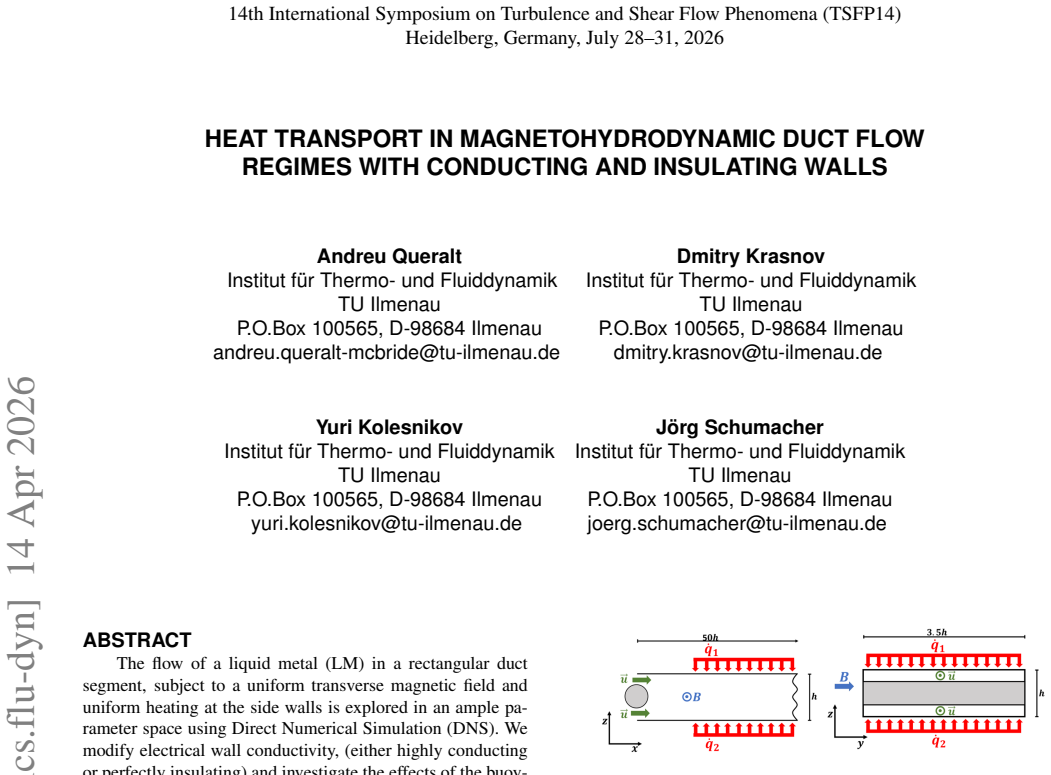
The flow of a liquid metal (LM) in a rectangular duct segment, subject to a uniform transverse magnetic field and uniform heating at the side walls is explored in an ample parameter space using Direct Numerical Simulation (DNS). We modify electrical wall conductivity, (either highly conducting or perfectly insulating) and investigate the effects of the buoyancy force, both in horizontally and vertically orientated ducts. In the latter case, it may be directed either with the flow or against the flow, creating backflow regions. In this parameter space and with the presence of vortex promoters at the inlet of the duct we identify $4$ types of flow. We calculate the Nusselt number $Nu(t)$ for each of them and study the statistical properties to compare their heat transfer capabilities in future fusion reactor blankets.
Editorial analysis
A structured set of objections, weighed in public.
Referee Report
Summary. The manuscript uses direct numerical simulations to study liquid-metal flow in a rectangular duct under a uniform transverse magnetic field with uniform side-wall heating. It varies wall electrical conductivity (highly conducting or perfectly insulating), buoyancy orientation (horizontal duct, vertical with or against the flow), and includes vortex promoters at the inlet. In this setup the authors identify four distinct flow types, compute time-dependent Nusselt numbers for each, and examine their statistical properties with a view toward heat-transfer performance in fusion-reactor blankets.
Significance. If the four regimes and their Nusselt statistics prove robust, the work would supply useful comparative data on how wall conductivity and buoyancy direction affect heat transport in MHD duct flows, directly relevant to liquid-metal blanket design. The breadth of the explored parameter space is a positive feature, but the absence of any reported validation or resolution checks limits the immediate utility of the results.
major comments (2)
- [Abstract] Abstract: The central claim that four flow types have been identified 'with the presence of vortex promoters at the inlet' is load-bearing for the stated application to fusion blankets. The manuscript supplies no promoter-free reference simulations at the same (Ha, Re, Gr) values, nor any quantification of how the promoters modify the buoyancy-MHD interaction or the time-averaged Nu. Without this, it is unclear whether the reported regimes are representative of actual blanket geometries.
- [Methods / Results] Methods / Results sections: The abstract and the provided description indicate a DNS campaign over an ample parameter space, yet no grid-resolution details, convergence tests, benchmark validations, or uncertainty estimates on the reported Nu(t) statistics are mentioned. These omissions directly affect the reliability of the regime classification and the statistical comparisons that underpin the heat-transfer conclusions.
minor comments (2)
- Notation for the four flow types should be introduced explicitly (e.g., as Type I–IV or Regime A–D) with a clear table or figure that maps each type to the combination of wall conductivity and buoyancy direction.
- The time-averaging window and sampling frequency used to obtain the statistical properties of Nu(t) should be stated explicitly so that the reported means and fluctuations can be reproduced.
Simulated Author's Rebuttal
We thank the referee for the constructive and detailed review of our manuscript. We address each major comment point by point below, indicating where revisions will be made to improve clarity and reliability.
read point-by-point responses
-
Referee: [Abstract] Abstract: The central claim that four flow types have been identified 'with the presence of vortex promoters at the inlet' is load-bearing for the stated application to fusion blankets. The manuscript supplies no promoter-free reference simulations at the same (Ha, Re, Gr) values, nor any quantification of how the promoters modify the buoyancy-MHD interaction or the time-averaged Nu. Without this, it is unclear whether the reported regimes are representative of actual blanket geometries.
Authors: The vortex promoters form an explicit part of the inlet boundary condition in our DNS setup, chosen to trigger the unsteady regimes of interest within feasible integration times for the explored parameter space. We agree that the absence of direct promoter-free comparisons at identical (Ha, Re, Gr) leaves open the question of how much the promoters alter the buoyancy-MHD coupling. In the revised manuscript we will add a dedicated paragraph in the methods section explaining the physical motivation for the promoters (mimicking upstream perturbations in blanket channels) and will include a brief quantitative comparison, where possible, of time-averaged Nu with and without promoters using a subset of existing data or short auxiliary runs. We will also note the limitation explicitly for blanket design interpretation. revision: partial
-
Referee: [Methods / Results] Methods / Results sections: The abstract and the provided description indicate a DNS campaign over an ample parameter space, yet no grid-resolution details, convergence tests, benchmark validations, or uncertainty estimates on the reported Nu(t) statistics are mentioned. These omissions directly affect the reliability of the regime classification and the statistical comparisons that underpin the heat-transfer conclusions.
Authors: We acknowledge that the original submission omitted explicit documentation of these numerical controls. In the revised manuscript we will expand the numerical methods section with (i) grid resolutions and stretching parameters for each wall-conductivity and buoyancy case, (ii) resolution criteria relative to the Hartmann-layer thickness and Kolmogorov scale, (iii) convergence tests demonstrating that time-averaged Nu and its fluctuations are insensitive to further grid refinement, (iv) benchmark comparisons against published MHD duct flow data where available, and (v) uncertainty estimates on the reported Nu statistics obtained from block-averaging over the statistically stationary intervals. revision: yes
Circularity Check
No circularity: results obtained directly from DNS without fitted inputs or self-referential derivations
full rationale
The paper performs direct numerical simulations of MHD duct flow with buoyancy and varying wall conductivities, identifying four flow regimes solely from the computed velocity and temperature fields in the presence of inlet vortex promoters. Nusselt number time series and their statistics are extracted post-simulation as diagnostic outputs. No equations, parameters, or uniqueness claims are fitted to subsets of the data and then re-predicted; no self-citation chain supplies a load-bearing premise; and no ansatz or renaming of prior results is invoked to generate the central findings. The study is therefore self-contained computational exploration.
Axiom & Free-Parameter Ledger
axioms (1)
- domain assumption Incompressible magnetohydrodynamic flow with Boussinesq buoyancy approximation
Reference graph
Works this paper leans on
-
[1]
Arlt, T., Priede, J. & B ¨uhler, L. 2017 The effect of finite- conductivity Hartmann walls on the linear stability of Hunt’s flow.J. Fluid Mech.822, 880–891. Bejan, A. 2004Convection heat transfer , third edition. John Wiley & Sons. Braiden, L., Krasnov, D., Molokov, S., Boeck, T. & B¨uhler, L. 2016 Transition to turbulence in Hunt’s flow in a moderate ma...
work page 2017
-
[2]
Wiley-VCH Verlag GmbH & Co. KGaA, Weinheim, special Issue: 92nd Annual Meeting of the Inter- national Association of Applied Mathematics and Mechan- ics (GAMM). Molokov, S., Moreau, R. & Moffat, H. K. 2007Magnetohy- drodynamics: Historical Evolution and Trends. Springer. Priede, J., Aleksandrova, S. & Molokov, S. 2010 Linear stabil- ity of Hunt’s flow.J. ...
work page 2010
-
[3]
Smolentsev, S., Saedi, S., Malang, S. & Abdou, M. 2013 Nu- merical study of corrosion of ferritic/martensitic steels in the flowing PbLi with and without a magnetic field.Journal of Nuclear Materials771, 294–304. 6
work page 2013
discussion (0)
Sign in with ORCID, Apple, or X to comment. Anyone can read and Pith papers without signing in.