Recognition: unknown
Projection of purification performance for the RELICS experiment
Pith reviewed 2026-05-10 14:07 UTC · model grok-4.3
The pith
A model validated on prototype data projects that RELICS-10 and RELICS-50 will reach the low impurity levels needed for sub-keV recoil detection.
A machine-rendered reading of the paper's core claim, the machinery that carries it, and where it could break.
Core claim
The paper claims that a comprehensive purity evolution model, driven by measured material outgassing rates and non-uniform transport processes, has been validated on prototype data and can therefore be used to forecast the purification performance of the RELICS-10 and RELICS-50 detectors, ensuring impurity concentrations remain low enough to preserve sub-keV signals.
What carries the argument
The purity evolution model that combines measured outgassing rates with non-uniform impurity transport through circulation, vaporization, and condensation.
If this is right
- RELICS-10 is expected to reach the impurity target required for efficient detection of reactor neutrino recoils.
- RELICS-50 is likewise projected to maintain sufficiently low impurity levels during data taking.
- The validated model supplies a quantitative basis for scaling purification strategies from prototype to full-size chambers.
- Design choices for circulation and purification hardware can be evaluated against the projected performance curves.
Where Pith is reading between the lines
- The same modeling approach could be adapted to forecast purity in other liquid-xenon experiments that rely on low impurity levels.
- If the projections hold, experimenters could reduce the number of full-scale purity tests needed before physics runs begin.
- Real-time monitoring of outgassing changes might be folded into the model to adjust purification rates during operation.
- The framework offers a template for predicting impurity budgets in any dual-phase xenon time-projection chamber.
Load-bearing premise
The model assumes that the outgassing rates measured from materials and the non-uniform transport mechanisms observed in the prototype will continue to describe impurity behavior at the full scale of the RELICS-10 and RELICS-50 detectors.
What would settle it
A direct measurement of the actual impurity concentration inside the completed RELICS-10 detector after a period of operation would show whether the projected purity level matches reality.
Figures




read the original abstract
The RELICS (REactor neutrino LIquid xenon Coherent elastic Scattering) experiment employs a dual-phase liquid xenon time projection chamber to search for Coherent Elastic Neutrino-Nucleus Scattering (CE$\nu$NS) induced by reactor neutrinos. To detect these sub-keV nuclear recoils and minimize signal attenuation, it is critical to maintain a sufficiently low impurity concentration in the detector. This work presents a comprehensive purity evolution model developed to describe impurity migration inside the detector. Utilizing measured material outgassing rates as input parameters, the model incorporates non-uniform transport mechanisms of the impurities, including circulation, vaporization, and condensation. The model is validated using data from a dedicated prototype detector. Based on this validated model, projections for the purification performance of the upcoming RELICS-10 and RELICS-50 detectors are provided.
Editorial analysis
A structured set of objections, weighed in public.
Referee Report
Summary. The manuscript presents a purity evolution model for the RELICS dual-phase liquid xenon time projection chamber aimed at minimizing impurity concentrations to enable sub-keV nuclear recoil detection in CEνNS searches. The model takes measured material outgassing rates as inputs and incorporates non-uniform transport processes (circulation, vaporization, and condensation). It is validated against data from a dedicated prototype detector, and the validated model is then used to project purification performance for the planned RELICS-10 and RELICS-50 detectors.
Significance. If the projections are reliable, this work provides essential guidance for the purification system design and operational parameters of the RELICS experiment, directly supporting its goal of observing reactor neutrino CEνNS. The approach of grounding the model in measured outgassing rates and prototype validation data is a positive feature that could inform similar liquid xenon detectors in neutrino or dark matter experiments.
major comments (2)
- [Validation section] Validation section: The manuscript states that the model is validated using prototype data but provides insufficient details on data exclusion criteria, error propagation methods, or quantitative measures of agreement (such as residuals or goodness-of-fit metrics) between the model predictions and measurements. This information is load-bearing for assessing the reliability of the subsequent projections.
- [Section 5] Projections for RELICS-10 and RELICS-50 (Section 5): The extrapolation assumes that the non-uniform transport mechanisms remain quantitatively accurate at larger scales without geometry- or flow-dependent deviations. No sensitivity analysis is presented on how changes in surface-to-volume ratio, circulation path lengths, or vapor-liquid interface dynamics might alter effective purification rates, which directly affects the credibility of the projected impurity levels.
minor comments (2)
- [Abstract] The abstract introduces the RELICS acronym but does not repeat the full experiment name, which could improve readability for a broad audience.
- [Figures] Figure captions and legends could more explicitly distinguish between different impurity species and transport processes to aid interpretation of the model results.
Simulated Author's Rebuttal
We thank the referee for the careful and constructive review of our manuscript. We appreciate the positive evaluation of the work's significance for the RELICS experiment and similar liquid xenon detectors. We address each major comment below and have revised the manuscript to incorporate the requested clarifications and analysis.
read point-by-point responses
-
Referee: [Validation section] Validation section: The manuscript states that the model is validated using prototype data but provides insufficient details on data exclusion criteria, error propagation methods, or quantitative measures of agreement (such as residuals or goodness-of-fit metrics) between the model predictions and measurements. This information is load-bearing for assessing the reliability of the subsequent projections.
Authors: We agree that the validation section requires more explicit detail to allow readers to assess the model's reliability. In the revised manuscript we have expanded this section with: (i) the data exclusion criteria (runs with known temporary leaks or calibration anomalies were removed, representing <8% of the dataset); (ii) the error-propagation procedure, which employs Monte Carlo sampling over the measured uncertainties in outgassing rates and transport coefficients; and (iii) quantitative agreement metrics, including residual plots and a reduced chi-squared value of 1.15. These additions directly address the referee's concern and strengthen the foundation for the subsequent projections. revision: yes
-
Referee: [Section 5] Projections for RELICS-10 and RELICS-50 (Section 5): The extrapolation assumes that the non-uniform transport mechanisms remain quantitatively accurate at larger scales without geometry- or flow-dependent deviations. No sensitivity analysis is presented on how changes in surface-to-volume ratio, circulation path lengths, or vapor-liquid interface dynamics might alter effective purification rates, which directly affects the credibility of the projected impurity levels.
Authors: We acknowledge the value of quantifying scale-up uncertainties. The revised manuscript now includes a dedicated sensitivity analysis subsection in Section 5. We varied the surface-to-volume ratio, circulation path lengths, and vapor-liquid interface parameters over ranges consistent with the geometric scaling from the prototype to RELICS-10 and RELICS-50, using uncertainties derived from the prototype measurements. The results show that the projected impurity concentrations remain below the CEνNS threshold in all explored scenarios, with the most conservative cases still satisfying the requirement. This analysis has been added to improve the credibility of the projections. revision: yes
Circularity Check
Purity model uses measured outgassing rates and prototype validation to project performance without self-referential reduction
full rationale
The derivation begins with externally measured material outgassing rates as input parameters, builds a model that includes circulation, vaporization, and condensation transport terms, validates the full model against independent data from a dedicated prototype detector, and then applies the validated model to generate projections for the larger RELICS-10 and RELICS-50 detectors. None of these steps reduces a claimed prediction to a fitted parameter or prior result by construction; the projections are extrapolations whose validity depends on the scaling assumption for transport mechanisms rather than on any definitional equivalence or self-citation chain. The paper therefore remains self-contained against external benchmarks.
Axiom & Free-Parameter Ledger
free parameters (1)
- material outgassing rates
axioms (1)
- domain assumption Non-uniform transport mechanisms (circulation, vaporization, condensation) accurately describe impurity migration inside the detector.
Reference graph
Works this paper leans on
-
[1]
To further test the model on a different detector design, the Run 9 run with the overflow chamber uses more operation changes
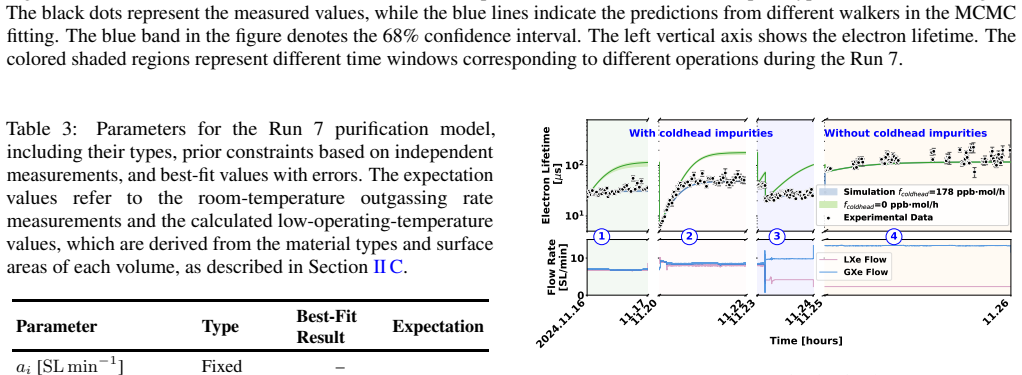
Run 9 Configuration and Operation: Overflow Chamber In Run 7, the system lacks the flexibility to adjust the gas-to-liquid circulation flow ratio, and operations are often not continuous. To further test the model on a different detector design, the Run 9 run with the overflow chamber uses more operation changes. This gives more data on purity changes, ke...
2025
-
[2]
Based on the actual detector design, which features the diving bell structure as shown in Fig
Purification Model for Run 7 In Run 7, impurity exchange occurs between these volumes as circulation proceeds, allowing for the formulation of evolution equations that describe the impurity concentration in each region. Based on the actual detector design, which features the diving bell structure as shown in Fig. 2, six distinct regions are defined. The e...
-
[3]
Purification Model for Run 9 In the Run 9 configuration, the diving bell is replaced with an overflow chamber, as shown in Fig. 4. Consequently, the system is partitioned into five control volumes, and the room-temperature gas detector is omitted. While the circulation system maintains the circulation mode as LIMO or LIGO and the overall process and volum...
-
[4]
Despite operational interruptions, parameters intrinsic to the detector and purifier are found to remain stable across runs
Fitting Results and Parameter Estimation for Run 7 In fitting the model, circulation rates are fixed from flow meter data, while other parameters are either free or constrained by prior measurements. Despite operational interruptions, parameters intrinsic to the detector and purifier are found to remain stable across runs. The parameter estimation in this...
2024
-
[5]
The fitting results for the temporal evolution of the electron lifetime are presented in Fig
Fitting Results and Parameter Estimation for Run 9 Using the same methodology described above, the purity evolution data from Run 9, as mentioned in Section II B, is also fitted with the purification model formulated in Section III B 2. The fitting results for the temporal evolution of the electron lifetime are presented in Fig. 14, and the corresponding ...
2025
-
[6]
Coherent effects of a weak neutral current.Phys
D Z Freedman. Coherent effects of a weak neutral current.Phys. Rev., D, v. 9, no. 5, pp. 1389-1392, 03 1974
1974
-
[7]
Isotopic and chiral structure of neutral current
VB Kopeliovich and LL Frankfurt. Isotopic and chiral structure of neutral current. Technical report, Leningrad Inst. of Nuclear Physics, 1974
1974
-
[8]
Future perspectives for a weak mixing angle measurement in coherent elastic neutrino nucleus scattering experiments.Physics Letters B, 784:159–162, 2018
BC Cañas, EA Garcés, OG Miranda, and A Parada. Future perspectives for a weak mixing angle measurement in coherent elastic neutrino nucleus scattering experiments.Physics Letters B, 784:159–162, 2018
2018
-
[9]
The diffuse supernova neutrino background
John F Beacom. The diffuse supernova neutrino background. Annual Review of Nuclear and Particle Science, 60(1):439–462, 2010
2010
-
[10]
Curtailing the Dark Side in Non-Standard Neutrino Interactions.JHEP, 04:116, 2017
Pilar Coloma et al. Curtailing the Dark Side in Non-Standard Neutrino Interactions.JHEP, 04:116, 2017
2017
-
[11]
C. J. Horowitz et al. Neutrino-nucleon scattering in supernova matter from the virial expansion.Phys. Rev. C, 95(2):025801, 2017
2017
-
[12]
Akimov et al
D. Akimov et al. Observation of coherent elastic neutrino-nucleus scattering.Science, 357(6356):1123–1126, 2017
2017
-
[13]
First measurement of coherent elastic neutrino-nucleus scattering on argon.Physical review letters, 126(1):012002, 2021
D Akimov, JB Albert, P An, C Awe, PS Barbeau, B Becker, V Belov, I Bernardi, MA Blackston, L Blokland, et al. First measurement of coherent elastic neutrino-nucleus scattering on argon.Physical review letters, 126(1):012002, 2021
2021
-
[14]
Evidence of coherent elastic neutrino-nucleus scattering with coherent’s germanium array.Physical Review Letters, 134(23):231801, 2025
S Adamski, M Ahn, PS Barbeau, V Belov, I Bernardi, C Bock, A Bolozdynya, R Bouabid, J Browning, B Cabrera-Palmer, et al. Evidence of coherent elastic neutrino-nucleus scattering with coherent’s germanium array.Physical Review Letters, 134(23):231801, 2025
2025
-
[15]
First Indication of Solar 8B Neutrinos via Coherent Elastic Neutrino-Nucleus Scattering with XENONnT
Elena Aprile et al. First Indication of Solar 8B Neutrinos via Coherent Elastic Neutrino-Nucleus Scattering with XENONnT. Phys. Rev. Lett., 133(19):191002, 2024
2024
-
[16]
First Indication of Solar 8B Neutrinos through Coherent Elastic Neutrino-Nucleus Scattering in PandaX-4T
Zihao Bo et al. First Indication of Solar 8B Neutrinos through Coherent Elastic Neutrino-Nucleus Scattering in PandaX-4T. Phys. Rev. Lett., 133(19):191001, 2024
2024
-
[17]
Ackermann et al
N. Ackermann et al. Direct observation of coherent elastic antineutrino–nucleus scattering.Nature, 643(8074):1229–1233, 2025
2025
-
[18]
Liquid xenon detectors for particle physics and astrophysics.Reviews of Modern Physics, 82(3):2053–2097, 2010
E Aprile and T Doke. Liquid xenon detectors for particle physics and astrophysics.Reviews of Modern Physics, 82(3):2053–2097, 2010
2053
-
[19]
Reactor neutrino liquid xenon coherent elastic scattering experiment.Physical Review D, 110(7):072011, 2024
Chang Cai, Guocai Chen, Jiangyu Chen, Rundong Fang, Fei Gao, Xiaoran Guo, Jiheng Guo, Tingyi He, Chengjie Jia, Gaojun Jin, et al. Reactor neutrino liquid xenon coherent elastic scattering experiment.Physical Review D, 110(7):072011, 2024
2024
-
[20]
Physics with reactor neutrinos
Xin Qian and Jen-Chieh Peng. Physics with reactor neutrinos. Reports on Progress in Physics, 82(3):036201, 2019
2019
-
[21]
Development of a dual-phase xenon time projection chamber prototype for the relics experiment.The European Physical Journal C, 86(4):348, 2026
Lingfeng Xie, Jiajun Liu, Yifei Zhao, Chang Cai, Guocai Chen, Jiangyu Chen, Huayu Dai, Rundong Fang, Hongrui Gao, Fei Gao, et al. Development of a dual-phase xenon time projection chamber prototype for the relics experiment.The European Physical Journal C, 86(4):348, 2026
2026
-
[22]
Design and characterization of a photosensor system for the relics experiment.Journal of Instrumentation, 21(02):P02039, 2026
Jijun Yang, Ruize Li, Chang Cai, Guocai Chen, Jiangyu Chen, Huayu Dai, Rundong Fang, Fei Gao, Jingfan Gu, Xiaoran Guo, et al. Design and characterization of a photosensor system for the relics experiment.Journal of Instrumentation, 21(02):P02039, 2026
2026
-
[23]
Preparation and measurement of an 37 ar source for liquid xenon detector calibration: X.-n
Xu-Nan Guo, Chang Cai, Fei Gao, Yang Lei, Kai-Hang Li, Chun-Lei Su, Ze-Peng Wu, Xiang Xiao, Ling-Feng Xie, Yi-Fei Zhao, et al. Preparation and measurement of an 37 ar source for liquid xenon detector calibration: X.-n. guo et al.Nuclear Science and Techniques, 37(1):14, 2026
2026
-
[24]
O’Hanlon.A User’s Guide to Vacuum Technology
John F. O’Hanlon.A User’s Guide to Vacuum Technology. John Wiley & Sons, Hoboken, NJ, 3 edition, 2003
2003
-
[25]
Fedchak, Julia K
James A. Fedchak, Julia K. Scherschligt, Sefer Avdiaj, Daniel S. Barker, Stephen P. Eckel, Ben Bowers, Scott O’Connell, and Perry Henderson. Outgassing rate comparison of seven geometrically similar vacuum chambers of different materials and heat treatments.Journal of Vacuum Science & Technology 21 B, 39(2):024201, 2021
2021
-
[26]
Outgassing of space materials at low temperature
Guillaume Rioland, Mathieu Hubert, Baptiste Houret, and Delphine Faye. Outgassing of space materials at low temperature. InContamination, Coatings, Materials and Planetary Protection (CCMPP 2021). NASA Goddard Space Flight Center, 2021. CCMPP-2021 conference presentation
2021
-
[27]
Outgassing properties of vacuum materials
Paolo Chiggiato. Outgassing properties of vacuum materials. InCAS–CERN Accelerator School: Vacuum for Particle Accelerators. CERN, 2006. CERN Accelerator School lecture notes
2006
-
[28]
Wiley New York, 1999
Johannes Brandrup, Edmund H Immergut, Eric A Grulke, Akihiro Abe, and Daniel R Bloch.Polymer handbook, volume 89. Wiley New York, 1999
1999
-
[29]
Gas permeation properties of poly (arylene ether ketone) and its mixed matrix membranes with polypyrrole
Görkem Mergen. Gas permeation properties of poly (arylene ether ketone) and its mixed matrix membranes with polypyrrole. Master’s thesis, Middle East Technical University, 2003
2003
-
[30]
Oxygen diffusivity and permeation through polymers at elevated temperature.Polymer, 150:326–342, 2018
Mathew C Celina and Adam Quintana. Oxygen diffusivity and permeation through polymers at elevated temperature.Polymer, 150:326–342, 2018
2018
-
[31]
On ptfe transfer and thermoactivation mechanism of wear.Wear, 158(1-2):61–69, 1992
V A Smurugov, AI Senatrev, VG Savkin, VV Biran, and AI Sviridyonok. On ptfe transfer and thermoactivation mechanism of wear.Wear, 158(1-2):61–69, 1992
1992
-
[32]
Nonisothermal crystallization kinetics of polytetrafluoroethylene.Polymer Engineering & Science, 40(6):1293–1297, 2000
Yongsok Seo. Nonisothermal crystallization kinetics of polytetrafluoroethylene.Polymer Engineering & Science, 40(6):1293–1297, 2000
2000
-
[33]
Chu Chu, Long Long Ma, Hyder Alawi, Wenchao Ma, YiFei Zhu, Junhao Sun, Yao Lu, Yixian Xue, and Guanyi Chen. Mechanistic exploration of polytetrafluoroethylene thermal plasma gasification through multiscale simulation coupled with experimental validation.Nature Communications, 15(1):1654, 2024
2024
-
[34]
George Bakale, Ulrich Sowada, and Werner F. Schmidt. Effect of an electric field on electron attachment to sulfur hexafluoride, nitrous oxide, and molecular oxygen in liquid argon and xenon. The Journal of Physical Chemistry, 80(23):2556–2559, 1976
1976
-
[35]
Rb 83/kr 83 m production and cross-section measurement with 3.4 mev and 20 mev proton beams.Physical Review C, 105(1):014604, 2022
Dan Zhang, Yifan Li, Jie Bao, Changbo Fu, Mengyun Guan, Yuan He, Xiangdong Ji, Huan Jia, Yao Li, Jianglai Liu, et al. Rb 83/kr 83 m production and cross-section measurement with 3.4 mev and 20 mev proton beams.Physical Review C, 105(1):014604, 2022
2022
-
[36]
Table of radionuclides, monographie bipm-5, vol
MM Bé, V Chisté, C Dulieu, E Browne, V Chechev, N Kuzmenko, R Helmer, A Nichols, E Schönfeld, and R Dersch. Table of radionuclides, monographie bipm-5, vol. 7.Bureau International des Poids et Mesures, Sèvres, 2013
2013
-
[37]
Plante, E
G. Plante, E. Aprile, J. Howlett, and Y . Zhang. Liquid-phase purification for multi-tonne xenon detectors.Eur. Phys. J. C, 82(10):860, 2022
2022
-
[38]
Pierotti
Robert A. Pierotti. The solubility of gases in liquids.The Journal of Physical Chemistry, 67(9):1840–1845, 1963
1963
-
[39]
emcee: the mcmc hammer.Publications of the Astronomical Society of the Pacific, 125(925):306, 2013
Daniel Foreman-Mackey, David W Hogg, Dustin Lang, and Jonathan Goodman. emcee: the mcmc hammer.Publications of the Astronomical Society of the Pacific, 125(925):306, 2013
2013
-
[40]
Daniel Foreman-Mackey, Will M Farr, Manodeep Sinha, Anne M Archibald, David W Hogg, Jeremy S Sanders, Joe Zuntz, Peter KG Williams, Andrew RJ Nelson, Miguel de Val-Borro, et al. emcee v3: A python ensemble sampling toolkit for affine-invariant mcmc.arXiv preprint arXiv:1911.07688, 2019
-
[41]
Chapter 57 - markov chain monte carlo methods: Computation and inference
Siddhartha Chib. Chapter 57 - markov chain monte carlo methods: Computation and inference. volume 5 ofHandbook of Econometrics, pages 3569–3649. Elsevier, 2001
2001
-
[42]
Cambridge university press, 2003
David JC MacKay.Information theory, inference and learning algorithms. Cambridge university press, 2003
2003
-
[43]
Low-energy calibration of xenon1t with an internal 37 ar source.The European Physical Journal C, 83(6):542, 2023
E Aprile, K Abe, F Agostini, S Ahmed Maouloud, M Alfonsi, L Althueser, B Andrieu, E Angelino, JR Angevaare, VC Antochi, et al. Low-energy calibration of xenon1t with an internal 37 ar source.The European Physical Journal C, 83(6):542, 2023
2023
-
[44]
A review of nest models for liquid xenon and an exhaustive comparison with other approaches.Frontiers in Detector Science and Technology, 2:1480975, 2025
Matthew Szydagis, Jon Balajthy, Grant A Block, Jason P Brodsky, Ethan Brown, Jacob E Cutter, Sophia J Farrell, Junying Huang, Alvine C Kamaha, Ekaterina S Kozlova, et al. A review of nest models for liquid xenon and an exhaustive comparison with other approaches.Frontiers in Detector Science and Technology, 2:1480975, 2025
2025
-
[45]
Experimental study of ionization yield of liquid xenon for electron recoils in the energy range 2.8–80 kev.Journal of Instrumentation, 9(11):P11014–P11014, 2014
D Yu Akimov, VV Afanasyev, IS Alexandrov, V A Belov, AI Bolozdynya, AA Burenkov, Yu V Efremenko, DA Egorov, A V Etenko, MA Gulin, et al. Experimental study of ionization yield of liquid xenon for electron recoils in the energy range 2.8–80 kev.Journal of Instrumentation, 9(11):P11014–P11014, 2014
2014
discussion (0)
Sign in with ORCID, Apple, or X to comment. Anyone can read and Pith papers without signing in.