Optimal Battery Bidding under Decision-Dependent State-of-Charge Uncertainties
Pith reviewed 2026-05-10 14:44 UTC · model grok-4.3
The pith
Modeling decision-dependent state-of-charge uncertainty in battery bids maximizes revenue while securing frequency reserve delivery.
A machine-rendered reading of the paper's core claim, the machinery that carries it, and where it could break.
Core claim
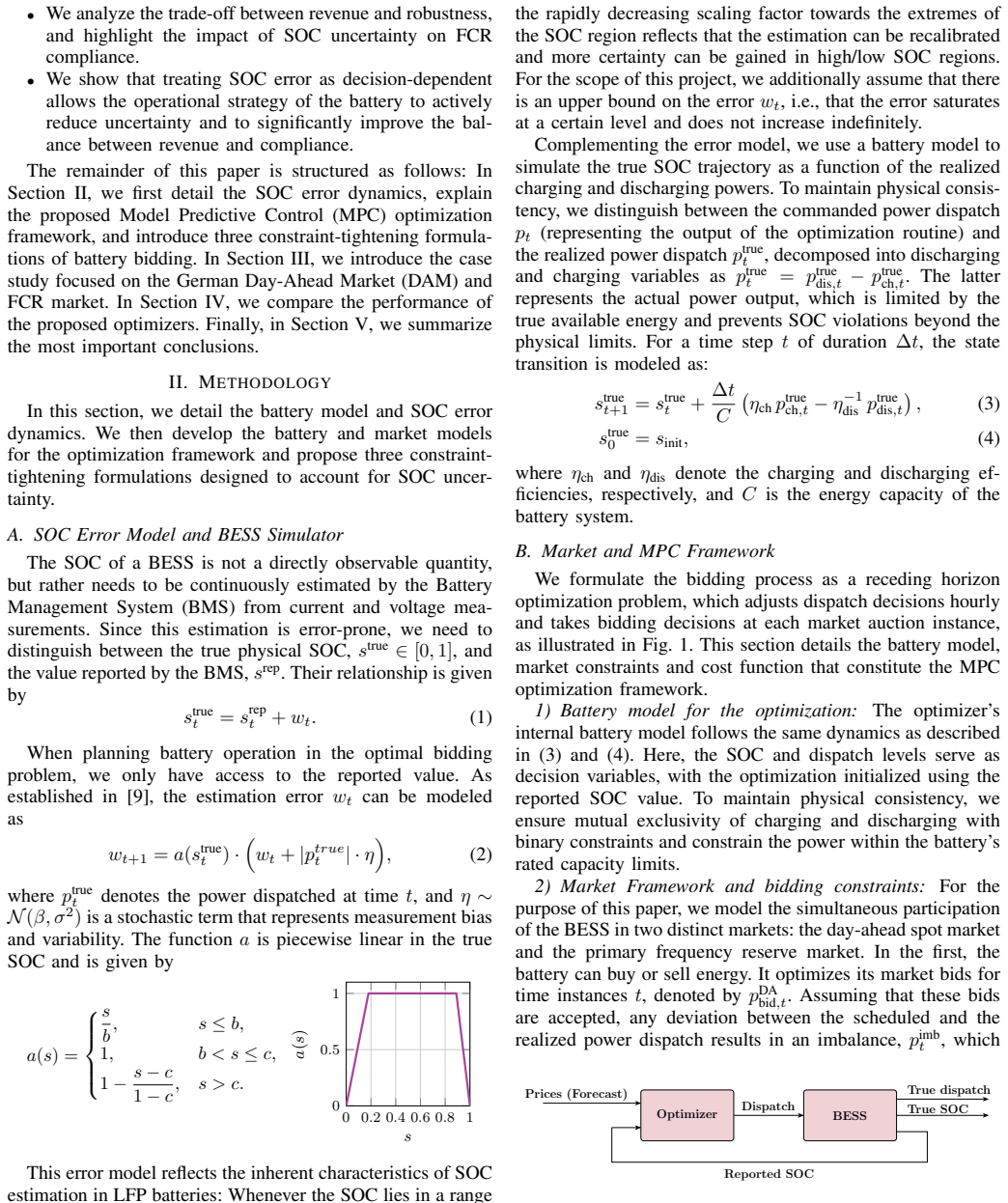
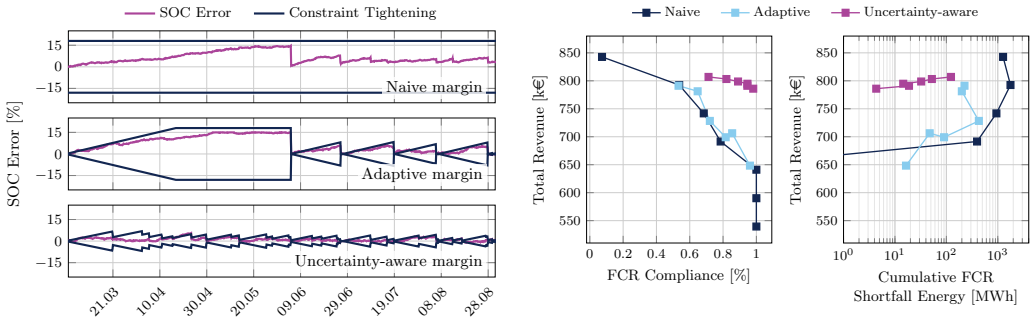
Neglecting SOC uncertainty leads to delivery failures in frequency reserve provision. Three constraint-tightening approaches are developed, with the uncertainty-aware model that accounts for the endogenous, decision-dependent uncertainty outperforming the fixed-margin and adaptive-margin formulations by maximizing revenue while maintaining reliability, as confirmed through numerical experiments.
What carries the argument
Uncertainty-aware optimization model that explicitly incorporates the decision-dependent nature of SOC estimation errors into constraint tightening for battery bidding.
If this is right
- Ignoring SOC uncertainty results in frequent failures to meet reserve obligations.
- Robust constraint tightening protects against these failures across all proposed methods.
- The uncertainty-aware model provides the best trade-off between revenue and reliability.
- Decision-dependent modeling is required to achieve optimal bidding outcomes.
Where Pith is reading between the lines
- The framework could apply to other market products beyond frequency reserves, such as energy arbitrage.
- Real-time implementation might require fast approximations of the uncertainty model.
- Integration with machine learning for SOC estimation could further refine the decision-dependency.
Load-bearing premise
The model accurately represents how bidding decisions affect SOC uncertainty levels.
What would settle it
A test on out-of-sample market data where the uncertainty-aware bids fail to show higher revenue or lower failure rates than the adaptive-margin approach.
Figures
read the original abstract
Lithium Iron Phosphate (LFP) Battery Energy Storage Systems (BESSs) are a key enabler of the energy transition. However, they are known to exhibit significant inaccuracies in the estimation of their State of Charge (SOC). Such estimation errors can directly impact the participation of BESSs in electricity markets. In this work, we demonstrate that neglecting SOC uncertainty in battery bidding can lead to significant delivery failures, including the inability to meet promised frequency reserves. To address this risk, we investigate bidding strategies that account for SOC uncertainty. We propose three constraint-tightening optimization approaches of increasing complexity: (i) a fixed-margin formulation, (ii) an adaptive-margin optimizer, and (iii) an uncertainty-aware optimization model. The latter explicitly accounts for the decision-dependent nature of the uncertainty. Numerical results demonstrate that while all three approaches robustify against SOC uncertainty, the uncertainty-aware formulation outperforms the others in maximizing revenue while ensuring reliable frequency reserve provision. This highlights the significance of treating SOC uncertainty as an endogenous process within the operational strategy.
Editorial analysis
A structured set of objections, weighed in public.
Referee Report
Summary. The manuscript addresses the impact of state-of-charge (SOC) estimation inaccuracies on lithium iron phosphate battery energy storage systems (BESS) participating in electricity markets for frequency reserves. It proposes three constraint-tightening optimization formulations of increasing complexity: a fixed-margin approach, an adaptive-margin optimizer, and an uncertainty-aware model that explicitly incorporates the decision-dependent nature of SOC uncertainty via tightening constraints. Numerical simulations demonstrate that all three robustify against SOC uncertainty, but the uncertainty-aware formulation achieves the highest revenue while maintaining reliable reserve delivery.
Significance. If the numerical results hold under the stated assumptions, the work is significant for power systems optimization because it treats SOC uncertainty as an endogenous process rather than an exogenous parameter. This provides a concrete, implementable framework for improving BESS bidding reliability and profitability. The clear separation of the three formulations and the consistent cross-scenario numerical comparisons constitute a strength that could inform market design and operational practice.
minor comments (3)
- Abstract: the claim of outperformance would be strengthened by a brief parenthetical note on the simulation horizon, market data source, or number of scenarios evaluated.
- Section 4 (uncertainty-aware model): the explicit tightening constraints are well-defined, but a short remark on how the decision-dependent uncertainty bounds were calibrated from empirical SOC error data would improve reproducibility.
- Figure 3 and Table 2: axis labels and column headers should explicitly state the units and the fixed parameter values used across all three formulations to facilitate direct comparison.
Simulated Author's Rebuttal
We thank the referee for the positive assessment of our manuscript, including the recognition of its significance in treating SOC uncertainty as an endogenous, decision-dependent process. We appreciate the recommendation for minor revision and the constructive framing of our three constraint-tightening formulations.
Circularity Check
No significant circularity detected in derivation or claims
full rationale
The paper defines three explicit optimization formulations (fixed-margin, adaptive-margin, uncertainty-aware) with constraint-tightening rules for SOC uncertainty. The uncertainty-aware model incorporates decision-dependent uncertainty directly via stated constraints rather than fitting or redefining outputs as inputs. Performance comparisons (revenue maximization and reserve reliability) are obtained from numerical simulations under fixed parameter settings across scenarios, with no reduction of any result to self-definition, renamed fits, or self-citation chains. All load-bearing steps remain independent of the target claims and rest on external evaluation.
Axiom & Free-Parameter Ledger
Reference graph
Works this paper leans on
-
[1]
Flexibility requirements and the role of storage in future European power systems,
D. Koolen, M. De Felice, and S. Busch, “Flexibility requirements and the role of storage in future European power systems,”Publications Office of the European Union, 2023
work page 2023
-
[2]
M. I. Gonzalez Cuenca, “Overview of the energy storage deployment in Europe: an analysis of current status and policy framework on energy storage,”Publications Office of the European Union, 2025
work page 2025
-
[3]
Batteries and Secure Energy Transitions,
IEA, “Batteries and Secure Energy Transitions,”International Energy Agency, 2024
work page 2024
-
[4]
Optimizing a battery energy storage system for primary frequency control,
A. Oudalov, D. Chartouni, and C. Ohler, “Optimizing a battery energy storage system for primary frequency control,”IEEE Transactions on Power Systems, vol. 22, Aug. 2007
work page 2007
-
[5]
The development of stationary battery storage systems in Germany – A market review,
J. Figgeneret al., “The development of stationary battery storage systems in Germany – A market review,”Journal of Energy Storage, vol. 29, Jun. 2020
work page 2020
-
[6]
Innovation landscape brief: Utility-scale batteries,
IRENA, “Innovation landscape brief: Utility-scale batteries,”Interna- tional Renewable Energy Agency, 2019
work page 2019
-
[7]
Unlocking the potential of battery storage with the dynamic stacking of multiple applications,
S. Englberger, A. Jossen, and H. Hesse, “Unlocking the potential of battery storage with the dynamic stacking of multiple applications,”Cell Reports Physical Science, vol. 1, Nov. 2020
work page 2020
-
[8]
D. J ¨ost, L. N. Palaniswamy, K. L. Quade, and D. U. Sauer, “Towards ro- bust state estimation for LFP batteries: Model-in-the-loop analysis with hysteresis modelling and perspectives for other chemistries,”Journal of Energy Storage, vol. 92, Jul. 2024
work page 2024
-
[9]
Powin and Tierra Climate, “The economic value of SOC accuracy: Quantifying revenue impacts of state-of-charge estimation in LFP battery systems,” Whitepaper, Mar. 2025
work page 2025
-
[10]
K. Jacqu ´e, L. Koltermann, J. Figgener, S. Zurm ¨uhlen, and D. U. Sauer, “The influence of frequency containment reserve on the operational data and the state of health of the hybrid stationary large-scale storage system,”Energies, Feb. 2022
work page 2022
-
[11]
T. Thien, D. Schweer, D. V . Stein, A. Moser, and D. U. Sauer, “Real-world operating strategy and sensitivity analysis of frequency containment reserve provision with battery energy storage systems in the German market,”Journal of Energy Storage, vol. 13, Oct. 2017
work page 2017
-
[12]
Overcoming SOC inaccuracies in LFP batteries: How to increase revenue and simplify operations,
Accure Battery Intelligence, “Overcoming SOC inaccuracies in LFP batteries: How to increase revenue and simplify operations,” Whitepaper, 2024
work page 2024
-
[13]
European Commission, “Commission regulation (EU) 2017/1485 of 2 August 2017 establishing a guideline on electricity transmission system operation,”Official Journal of the European Union, vol. L220, Aug. 2017
work page 2017
-
[14]
S. Schwunk, N. Armbruster, S. Straub, J. Kehl, and M. Vetter, “Particle filter for state of charge and state of health estimation for lithium–iron phosphate batteries,”Journal of Power Sources, vol. 239, Oct. 2013
work page 2013
-
[15]
J. Li, J. Klee Barillas, C. Guenther, and M. A. Danzer, “A comparative study of state of charge estimation algorithms for LiFePO4 batteries used in electric vehicles,”Journal of Power Sources, vol. 230, May 2013
work page 2013
-
[16]
W. Liet al., “Electrochemical model-based state estimation for lithium- ion batteries with adaptive unscented Kalman filter,”Journal of Power Sources, vol. 476, Nov. 2020
work page 2020
-
[17]
M. S. Hossain Lipuet al., “Data-driven state of charge estimation of lithium-ion batteries: Algorithms, implementation factors, limitations and future trends,”Journal of Cleaner Production, vol. 277, Dec. 2020
work page 2020
-
[18]
State-of-charge estimation of Li-ion battery in electric vehicles: A deep neural network approach,
D. N. T. How, M. A. Hannan, M. S. H. Lipu, K. S. M. Sahari, P. J. Ker, and K. M. Muttaqi, “State-of-charge estimation of Li-ion battery in electric vehicles: A deep neural network approach,”IEEE Transactions on Industry Applications, vol. 56, Sep. 2020
work page 2020
-
[19]
How state of charge estimations can make or break your BESS project,
TW AICE Technologies GmbH, “How state of charge estimations can make or break your BESS project,” Whitepaper, Apr. 2024
work page 2024
-
[20]
Homo- thetic tube model predictive control,
S. V . Rakovi ´c, B. Kouvaritakis, R. Findeisen, and M. Cannon, “Homo- thetic tube model predictive control,”Automatica, vol. 48, Aug. 2012
work page 2012
-
[21]
Well-functioning balancing markets: A prerequisite for wind power integration,
L. Vandezande, L. Meeus, R. Belmans, M. Saguan, and J.-M. Glachant, “Well-functioning balancing markets: A prerequisite for wind power integration,”Energy Policy, vol. 38, Jul. 2010
work page 2010
-
[22]
The role of modeling battery degradation in bulk power system optimizations,
B. Xu, “The role of modeling battery degradation in bulk power system optimizations,”MRS Energy & Sustainability, vol. 9, Sep. 2022. 6
work page 2022
discussion (0)
Sign in with ORCID, Apple, or X to comment. Anyone can read and Pith papers without signing in.