Voltage-Programmable Photon Statistics Using a High-Extinction Thin-film Lithium Niobate Modulator
Pith reviewed 2026-05-10 15:06 UTC · model grok-4.3
The pith
A high-extinction thin-film lithium niobate modulator enables voltage-controlled switching between Poissonian and super-Poissonian photon statistics.
A machine-rendered reading of the paper's core claim, the machinery that carries it, and where it could break.
Core claim
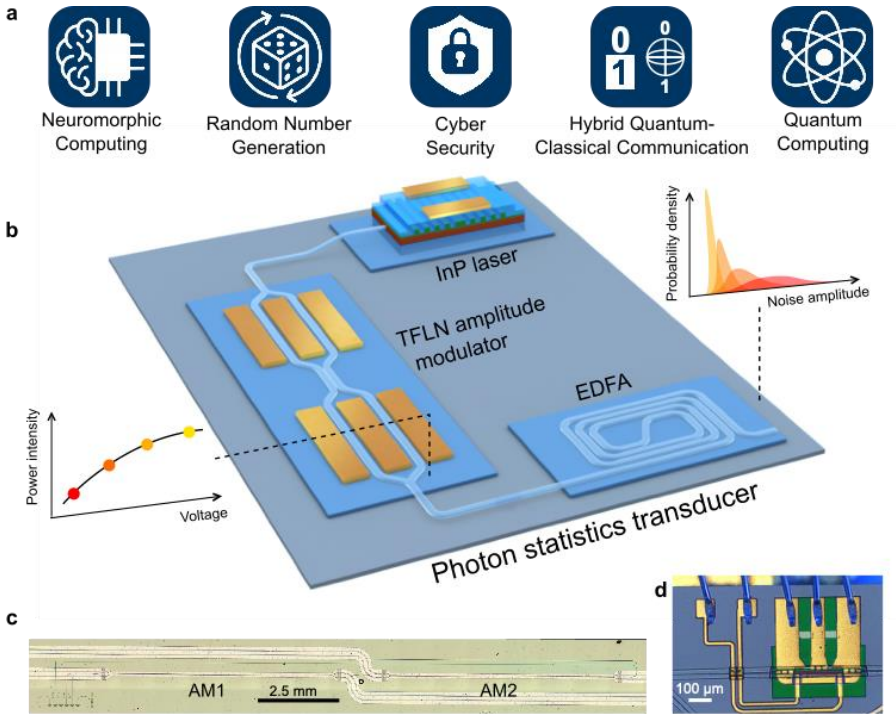
The paper claims that a cascaded thin-film lithium niobate Mach-Zehnder amplitude modulator with more than 50 dB extinction functions as a photon statistics transducer. Precise voltage-driven suppression and release of coherent seed light from an integrated InP laser, combined with erbium-doped fiber amplifier dynamics, produces deterministic shaping of photon-number distributions at nanosecond timescales, allowing smooth tuning of the second-order coherence g2(0) from 1.0 to 1.7 and photon-flux control down to sub-photon levels.
What carries the argument
The photon statistics transducer: a high-extinction broadband electro-optic device that shapes photon-number distributions by controlling seed-light suppression at nanosecond timescales through its interplay with amplifier gain dynamics.
If this is right
- Photon statistics become a real-time programmable feature controlled solely by electronic voltage signals.
- Statistical modulation is established as a new functional primitive that can be added to integrated photonic systems.
- Photon flux can be controlled down to sub-photon levels while maintaining the ability to switch between statistical regimes.
- Controlled entropy and randomness become accessible resources for secure communication and neuromorphic processing.
- The approach supports future hybrid systems that bridge classical and quantum light by enabling transitions between statistical regimes.
Where Pith is reading between the lines
- The same seed-suppression principle could be applied to non-classical sources to extend control into quantum statistical regimes.
- Voltage programmability opens the possibility of embedding feedback loops that adapt photon statistics on the fly within larger circuits.
- Similar transducer designs might be realized on other material platforms or at different wavelengths to broaden the range of usable amplifiers.
- The method offers a route to simplify the generation of specific statistical states without requiring complex source engineering.
Load-bearing premise
The high-extinction modulator's seed suppression together with the amplifier's gain dynamics produces only the intended statistical changes without adding uncontrolled noise or higher-order correlations.
What would settle it
If the second-order coherence g2(0) stays fixed at 1.0 for all applied voltages or if measured photon statistics show excess noise or correlations not predicted by the seed-suppression model, the claim of deterministic voltage-controlled statistical shaping would be falsified.
Figures


read the original abstract
Controlling the statistical properties of light, namely the fluctuations in photon arrival, entropy and number, is essential for both classical and quantum photonics. While integrated systems provide tunable control over amplitude, phase, and wavelength, real-time modulation of photon statistics has remained a long-standing challenge. Herein, we introduce the concept and experimental realization of a photon statistics transducer: a high-extinction, broadband electro-optic device capable of deterministically shaping photon-number distributions at nanosecond timescales. Our approach employs a cascaded thin-film lithium niobate (TFLN) Mach-Zehnder amplitude modulator delivering more than 50 dB extinction, enabling precise suppression and release of coherent seed light from an integrated InP laser. By exploiting the interplay between seed suppression and erbium-doped fiber amplifier dynamics, we demonstrate smooth, voltage-controlled switching between Poissonian and super-Poissonian photon statistics, with second-order coherence g2(0) tunable from 1.0 to 1.7. Complementary measurements with superconducting nanowire single-photon detectors further show photon-flux control down to sub-photon levels, highlighting the potential for future operation with non-classical sources. The photon statistics transducer thus establishes statistical modulation as a new functional primitive in integrated photonics. Applications range from entropy generation and secure communication to neuromorphic and hybrid quantum-classical processing, where controlled randomness and entropy are essential resources. By enabling programmable transitions between statistical regimes using only electronic drive signals, our work lays the foundation for adaptive, entropy-aware photonic systems that bridge classical and quantum domains.
Editorial analysis
A structured set of objections, weighed in public.
Referee Report
Summary. The manuscript introduces and experimentally demonstrates a 'photon statistics transducer' consisting of a cascaded high-extinction (>50 dB) thin-film lithium niobate Mach-Zehnder amplitude modulator driven by an integrated InP laser seed. By voltage-controlled suppression of the coherent seed and its interplay with erbium-doped fiber amplifier gain dynamics, the device achieves deterministic, nanosecond-scale tuning of photon-number statistics, with the second-order coherence g²(0) varying smoothly from 1.0 (Poissonian) to 1.7 (super-Poissonian). Complementary SNSPD measurements confirm photon-flux control down to sub-photon levels. The work frames this as a new functional primitive in integrated photonics for applications including entropy generation, secure communication, and hybrid quantum-classical processing.
Significance. If the reported measurements hold, the result is significant because it adds real-time, electronically programmable control over photon statistics as a practical primitive in integrated optics, addressing a long-standing gap between amplitude/phase modulation and statistical properties. The experimental evidence—g²(0) traces, >50 dB extinction, and SNSPD flux data—supports a mechanism that does not require non-classical sources, thereby offering a scalable route to controlled entropy in classical and quantum photonic systems. The approach is notable for its use of standard components (TFLN modulator + EDFA) to achieve the claimed tunability without introducing dominant uncontrolled noise in the presented regime.
minor comments (3)
- [Abstract] Abstract: the specific claims for g²(0) range (1.0–1.7) and extinction (>50 dB) are stated without cross-references to the corresponding figures or sections; adding one-sentence pointers would improve immediate accessibility for readers.
- [Device and Methods] Section on device characterization (likely §3 or §4): the description of the cascaded MZM configuration and the precise voltage-drive waveforms used for the g²(0) sweeps could be expanded with a schematic or timing diagram to aid reproducibility of the nanosecond-scale switching.
- [Results/Figures] Figure captions for the g²(0) and flux data: ensure error bars, number of averaged traces, and any filtering applied to the SNSPD histograms are explicitly stated so that the statistical significance of the 1.0–1.7 tuning range is immediately clear.
Simulated Author's Rebuttal
We thank the referee for their positive assessment of our manuscript and for recommending minor revision. We are pleased that the significance of demonstrating real-time, voltage-controlled tuning of photon statistics (g²(0) from 1.0 to 1.7) via a high-extinction TFLN modulator and EDFA dynamics is recognized as addressing a gap in integrated photonics. No specific major comments were provided in the report, so we have no point-by-point revisions to address at this stage. We will incorporate any minor editorial suggestions during the revision process.
Circularity Check
No significant circularity
full rationale
The paper is an experimental demonstration of a voltage-programmable photon statistics transducer based on a high-extinction TFLN Mach-Zehnder modulator interacting with EDFA dynamics. Central claims (g2(0) tunable from 1.0 to 1.7, >50 dB extinction, sub-photon flux control) are supported by direct measurements with SNSPDs, spectrum, power dependence, and time-resolved data. No derivation chain, first-principles prediction, or equation set is presented that reduces by construction to fitted inputs, self-definitions, or self-citation load-bearing steps. The mechanism is described mechanistically and validated experimentally without internal reduction to its own outputs.
Axiom & Free-Parameter Ledger
axioms (2)
- standard math Coherent seed light from an integrated InP laser exhibits Poissonian photon statistics
- domain assumption Interplay between modulator suppression and EDFA dynamics produces super-Poissonian statistics
invented entities (1)
-
photon statistics transducer
no independent evidence
Reference graph
Works this paper leans on
-
[1]
Carmichael, H. J. & Walls, D. F. A quantum-mechanical master equation treatment of the dynamical Stark effect. J. Phys. B: At. Mol. Phys. 9, 1199–1219 (1976)
work page 1976
-
[2]
Dong, B. et al. Partial coherence enhances parallelized photonic computing. Nature 632, 55–62 (2024)
work page 2024
-
[3]
Esposito, M. et al. Photon number statistics uncover the fluctuations in non-equilibrium lattice dynamics. Nat Commun 6, 10249 (2015)
work page 2015
-
[4]
Zubizarreta Casalengua, E., López Carreño, J. C., Laussy, F. P. & Valle, E. D. Conventional and Unconventional Photon Statistics. Laser & Photonics Reviews 14, 1900279 (2020)
work page 2020
-
[5]
Cordier, M., Schemmer, M., Schneeweiss, P., Volz, J. & Rauschenbeutel, A. Tailoring Photon Statistics with an Atom - Based Two-Photon Interferometer. Phys. Rev. Lett. 131, 183601 (2023)
work page 2023
-
[6]
Mirmoosa, M. S., Setälä, T. & Norrman, A. Quantum state engineering and photon statistics at electromagnetic time interfaces. Phys. Rev. Research 7, 013120 (2025)
work page 2025
-
[7]
Tey, L. S., Muniandy, S. V. & Chong, W. Y. Distinguishing photon -count fluctuation characteristics of classical and quantum light sources using non-Markovian processes. Phys. Rev. E 111, 044138 (2025)
work page 2025
- [8]
-
[9]
Brückerhoff-Plückelmann, F. et al. Probabilistic photonic computing with chaotic light. Nat Commun 15, 10445 (2024)
work page 2024
-
[10]
Guo, Y. et al. Photon statistics and bunching of a chaotic semiconductor laser. Opt. Express 26, 5991 (2018)
work page 2018
-
[11]
Goetz, J. et al. Photon Statistics of Propagating Thermal Microwaves. Phys. Rev. Lett. 118, 103602 (2017)
work page 2017
-
[12]
Magaña-Loaiza, O. S. et al. Multiphoton quantum-state engineering using conditional measurements. npj Quantum Inf 5, 80 (2019)
work page 2019
-
[13]
Pankratov, A. L. et al. Detection of single-mode thermal microwave photons using an underdamped Josephson junction. Nat Commun 16, 3457 (2025)
work page 2025
-
[14]
Doronin, I. V. et al. Second-order coherence properties of amplified spontaneous emission. Opt. Express 27, 10991 (2019)
work page 2019
-
[15]
Sozos, K. et al. High-speed photonic neuromorphic computing using recurrent optical spectrum slicing neural networks. Commun Eng 1, 24 (2022). 25/28
work page 2022
-
[16]
Nerenberg, S., Neill, O. D., Marcucci, G. & Faccio, D. Photon number -resolving quantum reservoir computing. Optica Quantum 3, 201 (2025)
work page 2025
-
[17]
Bente, I. et al. The potential of multidimensional photonic computing. Nat Rev Phys 7, 439–450 (2025)
work page 2025
-
[18]
Brückerhoff-Plückelmann, F. et al. Probabilistic photonic computing for AI. Nat Comput Sci 5, 377–387 (2025)
work page 2025
-
[19]
Xu, R. et al. Hybrid photonic integrated circuits for neuromorphic computing [Invited]. Opt. Mater. Express 13, 3553 (2023)
work page 2023
-
[20]
Williams, C. R. S., Salevan, J. C., Li, X., Roy, R. & Murphy, T. E. Fast physical random number generator using amplified spontaneous emission. Opt. Express 18, 23584 (2010)
work page 2010
-
[21]
Wang, B. et al. Efficient quantum random number generation via simultaneously detecting photons in temporal and spatial dimensions. Sci Rep 15, 18996 (2025)
work page 2025
-
[22]
Allevi, A. & Bondani, M. Novel scheme for secure data transmission based on mesoscopic twin beams and photon - number-resolving detectors. Sci Rep 12, 15621 (2022)
work page 2022
-
[23]
Spagnolo, M. et al. Experimental photonic quantum memristor. Nat. Photon. 16, 318–323 (2022)
work page 2022
-
[24]
Austin, T., Bilodeau, S., Hayman, A. et al. Hybrid quantum-classical photonic neural networks. npj Unconv. Comput . 2, 29 (2025)
work page 2025
-
[25]
Guo, X., Ding, Y., Duan, Y. & Ni, X. Nonreciprocal metasurface with space –time phase modulation. Light Sci Appl 8, 123 (2019)
work page 2019
-
[26]
Bankwitz, J. R. et al. Towards “smart transceivers” in FPGA -controlled lithium-niobate-on-insulator integrated circuits for edge computing applications [Invited]. Opt. Mater. Express 13, 3667 (2023)
work page 2023
-
[27]
Sludds, A. et al. Delocalized photonic deep learning on the internet’s edge. Science 378, 270–276 (2022)
work page 2022
-
[28]
Lomonte, E. et al. Single-photon detection and cryogenic reconfigurability in lithium niobate nanophotonic circuits. Nat Commun 12, 6847 (2021)
work page 2021
-
[29]
Zhu, D. et al. Spectral control of nonclassical light pulses using an integrated thin-film lithium niobate modulator. Light Sci Appl 11, 327 (2022)
work page 2022
-
[30]
Hu, Y. et al. On-chip electro-optic frequency shifters and beam splitters. Nature 599, 587–593 (2021)
work page 2021
-
[31]
Bruck, R. et al. All-optical spatial light modulator for reconfigurable silicon photonic circuits. Optica 3, 396 (2016). 26/28
work page 2016
-
[32]
Foster, A. P. et al. Tunable Photon Statistics Exploiting the Fano Effect in a Waveguide. Phys. Rev. Lett. 122, 173603 (2019)
work page 2019
-
[33]
Jumpertz, L., Schires, K., Carras, M., Sciamanna, M. & Grillot, F. Chaotic light at mid -infrared wavelength. Light Sci Appl 5, e16088–e16088 (2016)
work page 2016
-
[34]
Zhang, J. et al. One-sided device-independent random number generation through fiber channels. Light Sci Appl 14, 25 (2025)
work page 2025
- [35]
-
[36]
Li, P. et al. Scalable parallel ultrafast optical random bit generation based on a single chaotic microcomb. Light Sci Appl 13, 66 (2024)
work page 2024
-
[37]
Liu, S. et al. High speed ultra-broadband amplitude modulators with ultrahigh extinction >65 dB. Opt. Express 25, 11254 (2017)
work page 2017
-
[38]
Jin, M., Chen, J.-Y., Sua, Y. M. & Huang, Y.-P. High-extinction electro-optic modulation on lithium niobate thin film. Opt. Lett. 44, 1265–1268 (2019)
work page 2019
-
[39]
Valdez, F., Mere, V. & Mookherjea, S. 100 GHz bandwidth, 1 volt integrated electro -optic Mach–Zehnder modulator at near-IR wavelengths. Optica 10, 578 (2023)
work page 2023
-
[40]
Xu, M. et al. High-performance coherent optical modulators based on thin-film lithium niobate platform. Nat Commun 11, 3911 (2020)
work page 2020
-
[41]
Wang, M., Ribero, A., Xing, Y. & Bogaerts, W. Tolerant, broadband tunable 2 × 2 coupler circuit. Opt. Express 28, 5555 (2020)
work page 2020
-
[42]
Attaining self -regulation: A social cognitive perspective,
Fiber Amplifiers. in Applications of Nonlinear Fiber Optics 131–178 (Elsevier, 2008). doi:10.1016/B978 -012374302- 2.50005-X
-
[43]
Caputo, S. et al. Noise Level Modulation for Secure Optical Communications. IEEE Access 12, 148693–148705 (2024)
work page 2024
-
[44]
Katamadze, K. G., Avosopiants, G. V., Bogdanova, N. A., Bogdanov, Yu. I. & Kulik, S. P. Multimode thermal states with multiphoton subtraction: Study of the photon-number distribution in the selected subsystem. Phys. Rev. A 101, 013811 (2020)
work page 2020
-
[45]
Xie, X. et al. A 3.584 Tbps coherent receiver chip on InP-LiNbO3 wafer-level integration platform. Light Sci Appl 14, 172 (2025). 27/28
work page 2025
-
[46]
Sun, J. et al. High-power, electrically-driven continuous-wave 1.55-μm Si-based multi-quantum well lasers with a wide operating temperature range grown on wafer -scale InP -on-Si (100) heterogeneous substrate. Light Sci Appl 13, 71 (2024)
work page 2024
-
[47]
Zhang, M., Wang, C., Kharel, P., Zhu, D. & Lončar, M. Integrated lithium niobate electro -optic modulators: when performance meets scalability. Optica 8, 652 (2021)
work page 2021
-
[48]
Liu, Y. et al. A photonic integrated circuit–based erbium-doped amplifier. Science 376, 1309–1313 (2022)
work page 2022
-
[49]
Rath, P. et al. Superconducting single-photon detectors integrated with diamond nanophotonic circuits. Light Sci Appl 4, e338–e338 (2015)
work page 2015
-
[50]
Alleviation of DC drift in a thin-film lithium niobate modulator utilizing Ar+ ion milling,
Jiakang Shi, Zhilin Ye, Zhen Liu, Zhong Yan, Kunpeng Jia, Liqiang Zhang, Daohan Ge, and Shining Zhu, "Alleviation of DC drift in a thin-film lithium niobate modulator utilizing Ar+ ion milling," Opt. Lett. 50, 1703-1706 (2025)
work page 2025
- [51]
-
[52]
Sun, S. et al. Bias-drift-free Mach–Zehnder modulators based on a heterogeneous silicon and lithium niobate platform. Photon. Res., PRJ 8, 1958–1963 (2020)
work page 1958
-
[53]
Lohmann, P., Wendland, D., Lenzini, F. & Pernice, W. H. P. High system efficiency nonlinear frequency conversion on thin-film lithium niobate. Opt. Lett. 50, 3844 (2025)
work page 2025
-
[54]
Bao, R. et al. An Erbium-Doped Waveguide Amplifier on Thin Film Lithium Niobate with an Output Power Exceeding 100 mW. Laser & Photonics Reviews 19, 2400765 (2025)
work page 2025
-
[55]
Cai, M. et al. Gain Dynamics in Integrated Waveguide Amplifier Based on Erbium-Doped Thin-Film Lithium Niobate. ACS Photonics 11, 4923–4932 (2024)
work page 2024
-
[56]
Wang, Y., Shen, B., Wang, B. et al. Unifying optical gain and electro -optical dynamics in Er -doped thin -film lithium niobate platform. Nat Commun 16, 10462 (2025)
work page 2025
-
[57]
Li, M. et al. Heterogeneously-integrated lasers on thin film lithium niobate . Nanophotonics, vol. 14, no. 26, 2025, pp. 4739-4748
work page 2025
-
[58]
Liu, Y. et al. Modeling EDFA Gain: Approaches and Challenges. Photonics 8, (2021)
work page 2021
-
[59]
Tünnermann, H., Neumann, J., Kracht, D. & Weßels, P. Gain dynamics and refractive index changes in fiber amplifiers: a frequency domain approach. Opt. Express, OE 20, 13539–13550 (2012). 28/28
work page 2012
discussion (0)
Sign in with ORCID, Apple, or X to comment. Anyone can read and Pith papers without signing in.