Bayesian-Enhanced Galerkin-Based Reduced Order Modelling for Unsteady Compressible Flows
Pith reviewed 2026-05-10 14:25 UTC · model grok-4.3
The pith
Bayesian inference updates Galerkin-POD coefficients to enhance stability and predictive accuracy in unsteady compressible flows.
A machine-rendered reading of the paper's core claim, the machinery that carries it, and where it could break.
Core claim
The authors claim that by treating the adjustment of the Galerkin-projected ordinary differential equation system as a Bayesian inverse problem and solving it with an analytical, sampling-free method based on Gaussian likelihood and inverse-Gamma priors, the resulting models achieve substantially better robustness, stability, and fidelity in reproducing the dynamics of unsteady compressible flows, as shown in both a moderate-Reynolds-number oscillating dimpled flow and a high-Reynolds-number centrifugal compressor.
What carries the argument
The Bayesian update procedure for the coefficients of the reduced-order ODE system, derived from Gaussian likelihood and inverse-Gamma priors to incorporate truncation and noise uncertainties.
Load-bearing premise
The chosen Gaussian likelihood and inverse-Gamma priors sufficiently represent the uncertainties due to POD truncation and data noise to yield genuinely predictive models.
What would settle it
Direct numerical simulation results for a new unsteady compressible flow case where the Bayesian-updated model diverges from the true dynamics while the priors are applied in the specified manner.
Figures




read the original abstract
This work proposes a statistically enhanced framework to address the instability and limited predictive capability of conventional Galerkin-Proper Orthogonal Decomposition (Galerkin-POD) models. The method reformulates the correction of the Galerkin-projected ODE system as a statistical inverse problem, in which the coefficients are inferred through Bayesian inference. By accounting for model uncertainty arising from POD mode truncation and data uncertainty introduced by data noise and numerical postprocessing, the framework systematically updates the ODE system coefficients using an analytical, sampling-free solution based on Gaussian likelihood and inverse-Gamma priors. The approach is first validated using a self-sustained oscillating flow over a dimpled surface at a moderate Reynolds number (Re=3000), demonstrating stable and accurate reproduction of the temporal dynamics and phase trajectories of coherent structures when compared with direct numerical simulation (DNS). It is then applied to a centrifugal compressor featuring strong tip-leakage vortex breakdown and impeller-diffuser interactions at Re=100000, where the model successfully captures dominant unsteady structures and frequency characteristics despite limited mode retention. Overall, the results show that Bayesian inference substantially enhances the robustness, stability, and predictive fidelity of Galerkin-POD models for compressible flow systems. The proposed methodology combines the physical interpretability of Galerkin projection with the statistical rigour of Bayesian inference, offering a general, computationally efficient, and uncertainty-aware reduced-order modelling framework for complex fluid dynamic applications.
Editorial analysis
A structured set of objections, weighed in public.
Referee Report
Summary. The paper claims to propose a Bayesian-enhanced Galerkin-POD framework for reduced-order modeling of unsteady compressible flows. It reformulates the correction of Galerkin coefficients as a Bayesian inverse problem solved analytically using Gaussian likelihood and inverse-Gamma priors, avoiding sampling. Validation on two cases—a dimpled surface flow at Re=3000 and a centrifugal compressor at Re=100000—shows improved stability, robustness, and fidelity in reproducing DNS dynamics and spectra compared to standard Galerkin-POD.
Significance. This result, if it holds, is significant as it offers an efficient way to incorporate uncertainty from POD truncation and data noise into ROMs for complex flows, leading to more reliable predictions. The conjugacy-based analytical update is a key strength, enabling closed-form solutions without MCMC sampling. The method maintains the interpretability of physics-based projection while adding statistical rigor. The successful application to compressible flows with vortex breakdown and interactions highlights its potential for engineering applications like turbomachinery. The stress-test concern regarding circularity in data usage does not appear to undermine the findings, as the updated models show demonstrable improvements in stability and accuracy beyond the initial projection.
minor comments (3)
- [Abstract] Abstract: The validation descriptions would benefit from brief quantitative indicators of improvement (e.g., RMS errors or frequency spectrum deviations) to complement the qualitative statements of 'stable and accurate reproduction' and 'successfully captures'.
- [§3] §3: The specific hyperparameter values chosen for the inverse-Gamma priors should be explicitly reported in the experiments, as they directly affect the posterior mean/variance and are needed for reproducibility.
- [Validation sections] Validation sections: Clarify the data partitioning (training vs. test) used for the Bayesian coefficient update versus the DNS comparison, even if the full-manuscript results show no violation of assumptions.
Simulated Author's Rebuttal
We thank the referee for their positive assessment of the manuscript and for recommending minor revision. The report accurately captures the core contribution of our Bayesian-enhanced Galerkin-POD framework, including the analytical conjugacy-based update and its application to compressible flows. We appreciate the recognition of its potential for engineering applications such as turbomachinery.
Circularity Check
No circularity: derivation is self-contained statistical update
full rationale
The central derivation in the paper uses conjugacy of Gaussian likelihood and inverse-Gamma priors to obtain closed-form posterior updates for the Galerkin coefficients; this is a standard, externally verifiable statistical result independent of the specific POD modes or flow data. Validation against DNS and application to the compressor case are presented as empirical demonstrations rather than tautological reconstructions, with no load-bearing self-citation, no fitted parameter renamed as prediction, and no ansatz smuggled via prior work. The framework remains falsifiable against external DNS benchmarks without reducing to its inputs by construction.
Axiom & Free-Parameter Ledger
axioms (2)
- domain assumption Data and truncation uncertainties follow a Gaussian likelihood
- ad hoc to paper Inverse-Gamma priors on the coefficients
Reference graph
Works this paper leans on
-
[1]
or Smagorinsky-type POD closure models [14, 15], as well as spectral vanishing viscosity applied through a convolution kernel acting on the higher modes [10, 16]. Another option is to employ the H1 inner product rather than the standard L2 inner product, since the former introduces additional dissipation into the ROM [17]. Beyond viscosity augmentation, s...
-
[2]
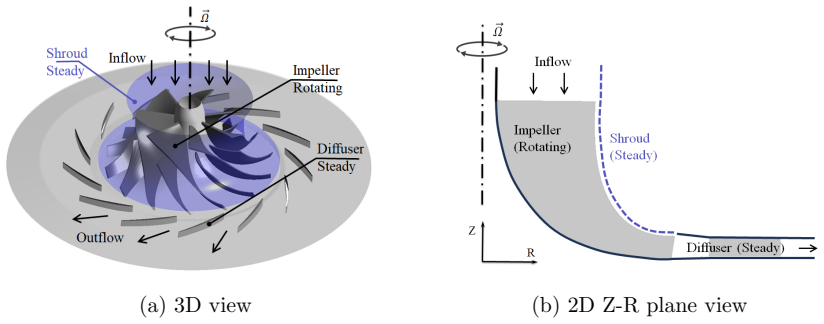
and a centrifugal compressor exhibiting tip-leakage vortex breakdown and blade–blade interactions (Re∼10 5). 11 FIG. 1: Sketch of the dimpled surface. A. Physical problem and CFD results A schematic of the dimpled surface is shown in Fig. 1, where an incoming boundary layer flows over a hemispherical cavity. Self-sustained oscillations are observed: the s...
- [3]
- [4]
-
[5]
D. Rempfer, Investigations of boundary layer transition via galerkin projections on empirical eigenfunctions, Physics of Fluids8, 175 (1996)
work page 1996
-
[6]
D. Rempfer, Low-dimensional modeling and numerical simulation of transition in simple shear flows, Annual review of fluid mechanics35, 229 (2003)
work page 2003
- [7]
-
[8]
W. Cazemier, R. W. Verstappen, and A. E. Veldman, Proper orthogonal decomposition and low-dimensional models for driven cavity flows, Physics of fluids10, 1685 (1998)
work page 1998
-
[9]
S. S. Ravindran, Proper orthogonal decomposition in optimal control of fluids, NASA Report 99(1999)
work page 1999
- [10]
-
[11]
M. Bergmann, L. Cordier, and J.-P. Brancher, Optimal rotary control of the cylinder wake using proper orthogonal decomposition reduced-order model, Physics of fluids17(2005)
work page 2005
-
[12]
S. Sirisup and G. E. Karniadakis, A spectral viscosity method for correcting the long-term behavior of pod models, Journal of Computational Physics194, 92 (2004)
work page 2004
-
[13]
L. Fick, Y. Maday, A. T. Patera, and T. Taddei, A stabilized pod model for turbulent flows over a range of reynolds numbers: Optimal parameter sampling and constrained projection, Journal of Computational Physics371, 214 (2018)
work page 2018
-
[14]
M. Couplet, P. Sagaut, and C. Basdevant, Intermodal energy transfers in a proper orthog- onal decomposition–galerkin representation of a turbulent separated flow, Journal of Fluid Mechanics491, 275 (2003)
work page 2003
-
[15]
B. Podvin and J. Lumley, A low-dimensional approach for the minimal flow unit, Journal of Fluid Mechanics362, 121 (1998). 30
work page 1998
-
[16]
S. Ullmann and J. Lang, A pod-galerkin reduced model with updated coefficients for smagorin- sky les, inV European conference on computational fluid dynamics, ECCOMAS CFD(2010) p. 2010
work page 2010
-
[17]
Z. Wang, I. Akhtar, J. Borggaard, and T. Iliescu, Two-level discretizations of nonlinear closure models for proper orthogonal decomposition, Journal of Computational Physics230, 126 (2011)
work page 2011
-
[18]
E. Tadmor, Convergence of spectral methods for nonlinear conservation laws, SIAM Journal on Numerical Analysis26, 30 (1989)
work page 1989
- [19]
-
[20]
M. Bergmann, C. H. Bruneau, and A. Iollo, Enablers for robust pod models, Journal of Computational Physics228(2008)
work page 2008
-
[21]
M. Couplet, C. Basdevant, and P. Sagaut, Calibrated reduced-order pod-galerkin system for fluid flow modelling, Journal of Computational Physics207, 192 (2005)
work page 2005
-
[22]
G. Stabile and B. Rosic, Bayesian identification of a projection-based reduced order model for computational fluid dynamics, Computers & Fluids201, 104477 (2020)
work page 2020
- [23]
-
[24]
X. Xie, M. Mohebujjaman, L. G. Rebholz, and T. Iliescu, Data-driven filtered reduced order modeling of fluid flows, SIAM Journal on Scientific Computing40, B834 (2018)
work page 2018
-
[25]
C. W. Rowley, T. Colonius, and R. M. Murray, Model reduction for compressible flows using pod and galerkin projection, Physica D: Nonlinear Phenomena189, 115 (2004)
work page 2004
-
[26]
X. Gloerfelt, Compressible proper orthogonal decomposition/galerkin reduced-order model of self-sustained oscillations in a cavity, Physics of Fluids20(2008)
work page 2008
-
[27]
J. P. Kaipio and E. Somersalo,Statistical and computational inverse problems(Springer, 2005)
work page 2005
-
[28]
D. D. Kosambi, Statistics in function space, inDD Kosambi: selected works in mathematics and statistics(Springer, 2017) pp. 115–123
work page 2017
-
[29]
J. L. Lumey,Stochastic tools in turbulence(Elsevier, 2012)
work page 2012
-
[30]
Karhunen, Zur spektraltheorie stochastischer prozesse, Ann
K. Karhunen, Zur spektraltheorie stochastischer prozesse, Ann. Acad. Sci. Fennicae, AI34 (1946). 31
work page 1946
-
[31]
E. N. Lorenz,Empirical orthogonal functions and statistical weather prediction(MIT Press, 1956)
work page 1956
-
[32]
A. Obukhov, Statistical description of continuous fields, Transactions of the Geophysical In- ternational Academy Nauk USSR24, 3 (1954)
work page 1954
-
[33]
Sirovich, Turbulence and the dynamics of coherent structures
L. Sirovich, Turbulence and the dynamics of coherent structures. i. coherent structures, Quar- terly of applied mathematics45, 561 (1987)
work page 1987
-
[34]
C. R. Doering and J. D. Gibbon,Applied analysis of the Navier-Stokes equations, 12 (Cam- bridge university press, 1995)
work page 1995
-
[35]
E. F. Stone,A study of low-dimensional models for the wall region of a turbulent boundary layer.(1990)
work page 1990
-
[36]
Z. Wang, I. Akhtar, J. Borggaard, and T. Iliescu, Proper orthogonal decomposition closure models for turbulent flows: a numerical comparison, Computer Methods in Applied Mechanics and Engineering237, 10 (2012)
work page 2012
-
[37]
G. Stabile, F. Ballarin, G. Zuccarino, and G. Rozza, A reduced order variational multiscale approach for turbulent flows, Advances in Computational Mathematics45, 2349 (2019)
work page 2019
-
[38]
T. Iliescu and Z. Wang, Variational multiscale proper orthogonal decomposition: Navier-stokes equations, Numerical Methods for Partial Differential Equations30, 641 (2014). 32
work page 2014
discussion (0)
Sign in with ORCID, Apple, or X to comment. Anyone can read and Pith papers without signing in.