A strong second-order two-stage explicit/implicit technique with spectral orthogonal basis Galerkin finite element method for two-dimensional Gray-Scott model
Pith reviewed 2026-05-10 16:02 UTC · model grok-4.3
The pith
The two-stage explicit/implicit scheme with spectral orthogonal basis Galerkin FEM is unconditionally stable, second-order accurate in time, and qth-order convergent in space for the 2D Gray-Scott model.
A machine-rendered reading of the paper's core claim, the machinery that carries it, and where it could break.
Core claim
The paper constructs a two-stage explicit/implicit time-stepping scheme combined with a spectral orthogonal basis Galerkin finite element method for the 2D Gray-Scott model. It proves that this scheme is unconditionally stable, second-order accurate in time, and qth-order convergent in space (q ≥ 2) in the L^∞(0,T; [L^∞(Ω)]²) norm. The stability arises from the error balancing between the explicit and implicit stages, while the spectral basis minimizes spatial discretization errors.
What carries the argument
The two-stage explicit/implicit time discretization paired with the spectral orthogonal basis in the Galerkin finite element method, which balances temporal errors and reduces spatial errors.
If this is right
- The method permits arbitrarily large time steps without loss of stability for long-time simulations.
- Spatial convergence order can be increased by selecting higher-degree orthogonal basis functions.
- Numerical solutions preserve the qualitative features of pattern formation in the Gray-Scott system.
- The approach computes solutions efficiently compared to fully implicit methods due to the explicit stage.
- Theoretical bounds hold in the maximum norm, ensuring pointwise accuracy on the solution components.
Where Pith is reading between the lines
- The error-balancing two-stage idea could extend to other stiff reaction-diffusion systems such as the Brusselator.
- The spectral basis might reduce the number of degrees of freedom needed for resolving fine-scale patterns.
- Similar schemes could be tested on three-dimensional or irregularly shaped domains for broader applicability.
- Adaptive time-step selection could be combined with the unconditional stability to optimize computational cost.
Load-bearing premise
The errors introduced by the explicit first stage are exactly offset by the error reduction in the implicit second stage, maintaining overall stability without any time-step restriction.
What would settle it
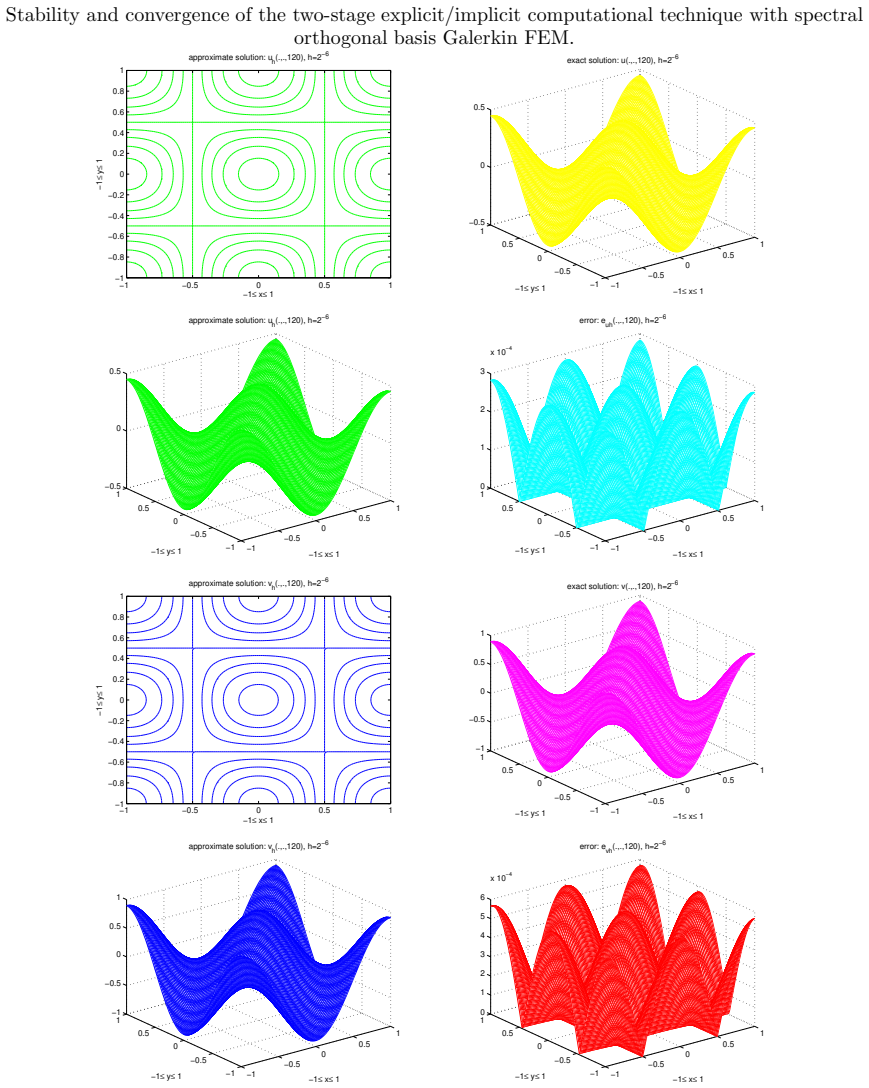
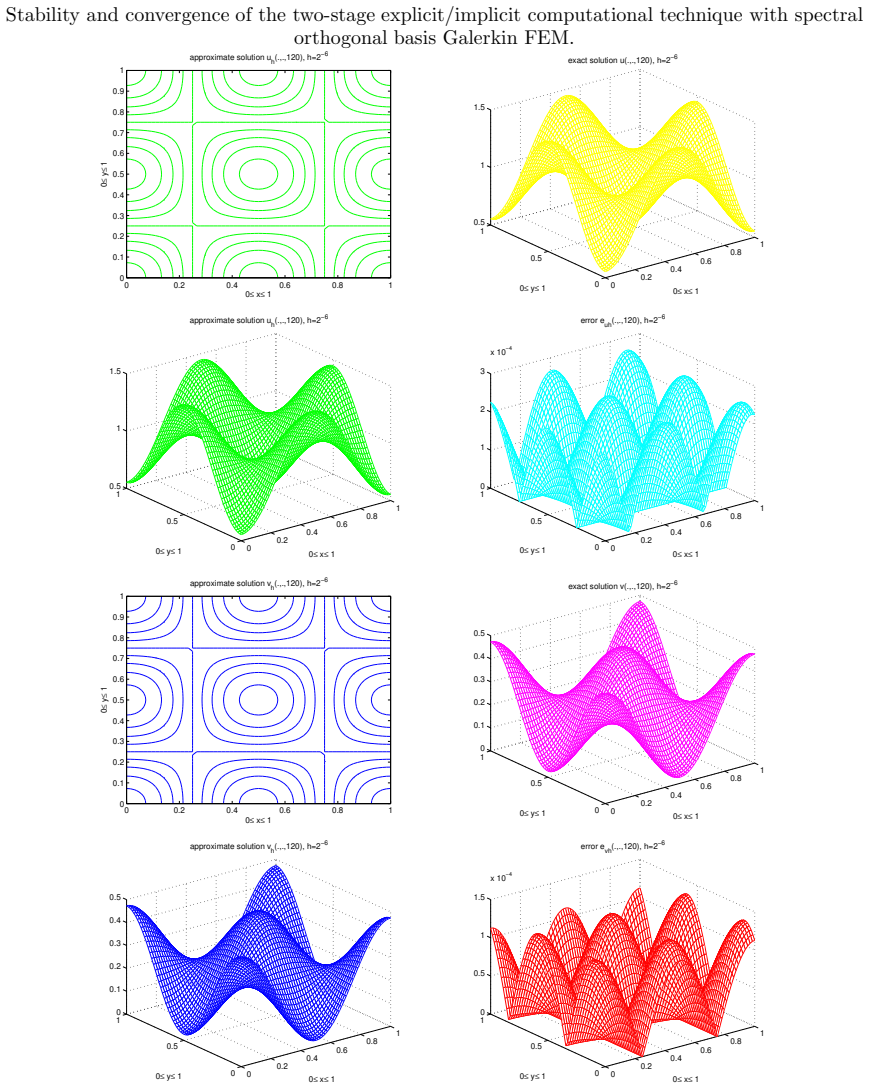
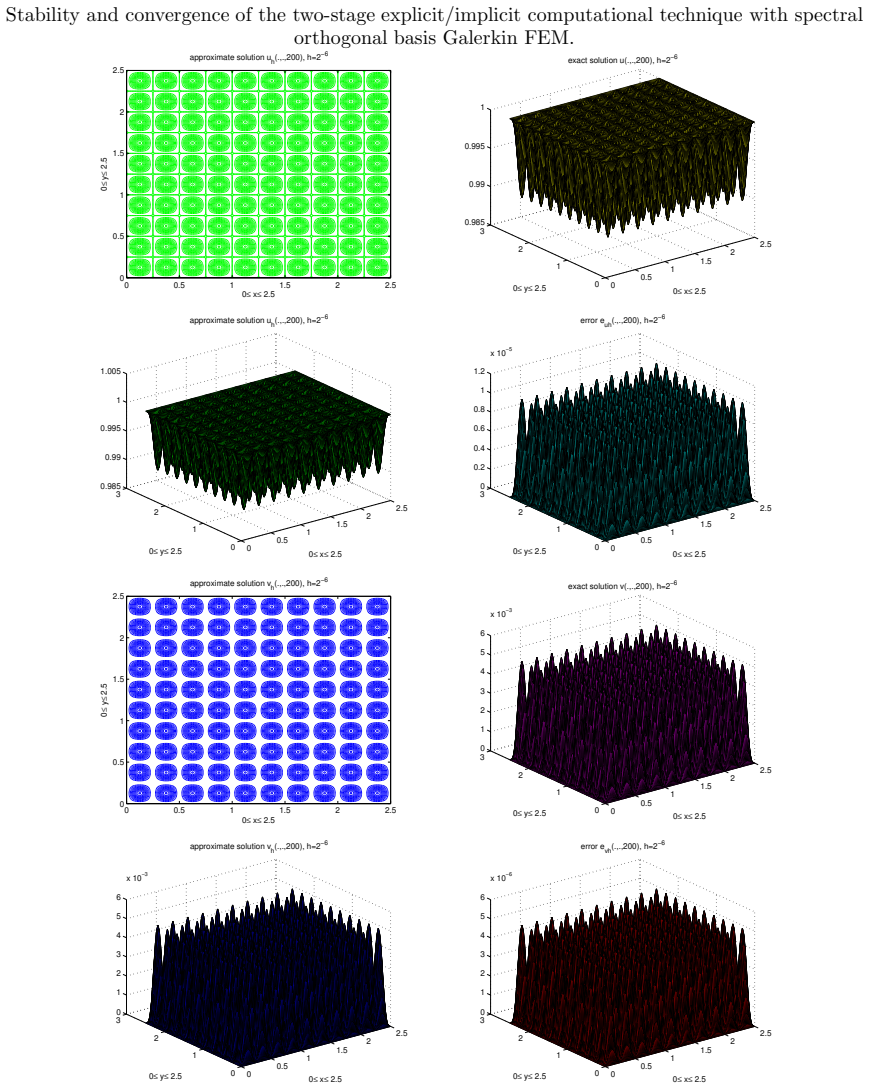
A numerical experiment on the Gray-Scott model with a manufactured exact solution where the observed convergence rate in the L^∞ norm falls below second order in time or q in space for increasing refinements, or where instability appears for large time steps.
Figures
read the original abstract
This paper proposes a strong second-order two-step explicit/implicit technique with spectral orthogonal basis Galerkin finite element method for solving a two-dimensional Gray-Scott model subject to appropriate initial and boundary conditions. The constructed approach discretizes at the first stage utilizing a second-order explicit method while a second-order implicit scheme is employed at the second phase. The space derivatives are approximated with the Galerkin finite element formulation combined with a spectral orthogonal basis. With this combination, the errors increased at the first stage are balanced by the errors decreased at the second phase so that the stability is maintained. Furthermore, the use of the spectral orthogonal basis minimizes the space errors. Thus, the new computational approach calculates efficiently numerical solutions and preserves a strong stability and high-order accuracy. The theoretical studies indicate that the proposed strategy is unconditionally stable, temporal second-order accurate and spatial $qth$-order convergent using the $L^{\infty}(0,T;[L^{\infty}(\Omega)]^{2})$-norm, where $q$ is an integer greater than or equal $2$. Some numerical examples are performed to confirm the theory and to demonstrate the efficiency of the developed algorithm.
Editorial analysis
A structured set of objections, weighed in public.
Referee Report
Summary. The manuscript proposes a two-stage explicit/implicit time discretization combined with a spectral orthogonal basis Galerkin finite element method for the two-dimensional Gray-Scott reaction-diffusion system. It asserts that the scheme is unconditionally stable, second-order accurate in time, and q-th order accurate in space (q ≥ 2) in the L^∞(0,T; [L^∞(Ω)]²) norm, with stability maintained by balancing error growth in the explicit stage against error reduction in the implicit stage, and supports the claims via theoretical analysis and numerical experiments.
Significance. If the unconditional stability and convergence claims can be rigorously established, the method would provide a useful high-order tool for long-time simulations of the Gray-Scott model without time-step restrictions, which is relevant for studying pattern formation in stiff nonlinear reaction-diffusion systems. The spectral orthogonal basis approach could also offer efficiency gains in spatial approximation if the error control is clearly demonstrated.
major comments (1)
- [theoretical studies] The central stability claim (abstract and theoretical studies section) rests on the informal assertion that 'errors increased at the first stage are balanced by the errors decreased at the second phase' to achieve an L^∞ bound without time-step restriction. No explicit error estimates, energy method, discrete maximum principle, or convex-splitting argument is supplied to show how the implicit stage uniformly suppresses local growth from the explicit treatment of the cubic reaction terms in the Gray-Scott system; this mechanism is load-bearing for the unconditional stability result.
minor comments (2)
- [abstract] The notation 'qth-order' in the abstract should be standardized to 'q-th order' for readability.
- [introduction] The vector-valued L^∞ norm is introduced without a brief definition or reference to the componentwise supremum; adding this in the introduction or preliminaries would improve clarity.
Simulated Author's Rebuttal
We thank the referee for the detailed review and constructive feedback on our manuscript. The primary concern regarding the rigor of the unconditional stability analysis is addressed point by point below. We will revise the manuscript to strengthen the theoretical foundations while preserving the core contributions of the two-stage scheme and spectral Galerkin approach.
read point-by-point responses
-
Referee: [theoretical studies] The central stability claim (abstract and theoretical studies section) rests on the informal assertion that 'errors increased at the first stage are balanced by the errors decreased at the second phase' to achieve an L^∞ bound without time-step restriction. No explicit error estimates, energy method, discrete maximum principle, or convex-splitting argument is supplied to show how the implicit stage uniformly suppresses local growth from the explicit treatment of the cubic reaction terms in the Gray-Scott system; this mechanism is load-bearing for the unconditional stability result.
Authors: We agree that the stability argument in the theoretical studies section is presented at a high level and would benefit from a fully rigorous derivation. In the revised version, we will expand this section to include explicit a priori error estimates. We will employ a discrete energy method combined with a maximum-norm bound on the reaction terms, showing that the implicit stage damps the local growth induced by the explicit treatment of the cubic nonlinearity. This will establish the L^∞(0,T; [L^∞(Ω)]²) stability bound independent of the time-step size, while retaining the second-order temporal accuracy. The spatial q-order convergence (q ≥ 2) under the spectral orthogonal basis will be derived via standard approximation theory for the Galerkin projection. These additions will directly address the balancing mechanism and remove any informality from the current presentation. revision: yes
Circularity Check
No circularity: stability asserted via separate theoretical analysis, not by definitional reduction
full rationale
The abstract states that the two-stage explicit/implicit discretization combined with spectral orthogonal Galerkin FEM yields unconditional stability because 'the errors increased at the first stage are balanced by the errors decreased at the second phase so that the stability is maintained.' This is presented as a consequence of the method's construction, followed by the claim that 'theoretical studies indicate' the L^∞ stability and convergence orders. No equations are shown reducing the stability bound to a fitted parameter or to the balancing statement itself by construction. No self-citations, uniqueness theorems, or ansatzes imported from prior work appear. The derivation chain is therefore self-contained against external benchmarks; the balancing claim is an informal design rationale rather than a load-bearing tautology.
Axiom & Free-Parameter Ledger
axioms (2)
- domain assumption The Gray-Scott model admits sufficiently smooth solutions in the function spaces used for the error analysis
- domain assumption The spectral orthogonal basis is complete and satisfies the necessary approximation properties on the domain
Reference graph
Works this paper leans on
-
[1]
M. Abbaszadeh, M. Dehghan, I. M. Navon. ”A POD reduced-ord er model based on spectral Galerkin method for solving the space-fractional Gray-Scott model with e rror estimate”, Engrg Computers, 38(3) (2022), 2245-2268
work page 2022
-
[2]
A. Ali, S. Haq. ”A Computational modeling of the behavior of the tw o-dimensional reaction-diffusion Brusselator system,” Appl. Math. Model. 34(12) (2010), 3896-39 09
work page 2010
-
[3]
U. M. Ascher, S. J. Ruuth. ”Implicit-explicit methods for time-de pendent partial differential equations”, SIAM J. Numer. Anal., 32(1995), 797-823
work page 1995
-
[4]
W. Chen. ”Implicit explicit multistep finite element methods for nonlin ear convection diffusion prob- lems”, Numer. Meth. Part. Diff. Eq., 17(2001), 93-104
work page 2001
-
[5]
M. Dehghan, A. Shokri. ”Numerical solution of the nonlinear Klein- Gordon Equation using radial basis functions”, J. Comput. Appl. Math. 230(2) (2009), 400-410
work page 2009
-
[6]
M. Dehghan and M. Abbaszadeh. ”Numerical study of three-dim ensional Turing patterns using a mesh- less method based on moving kriging element free Galerkin (EFG) appr oach”, Comput. Math. Appl., 72(3) (2016), 427-454
work page 2016
-
[7]
M. Dehghan, A. Nikpour. ”Numerical solution of the system of se cond-order boundary value problems using the local radial basis functions based differential quadratur e collocation method”, Appl. Math. Model., 37(18-19) (2013), 8578-8599
work page 2013
-
[8]
F. Gao, X. Wang. ”A modified weak Galerkin finite element method fo r Sobolev equation”, J. Comput. Math., 33(2015), 307-322
work page 2015
- [9]
-
[10]
A. Golbabai, A. Nikpour. ”Computing a numerical solution of two d imensional nonlinear Schr¨ odinger equation on complexly shaped domains by RBF Based differential quad rature method”, J. Comput. Phys., 322(2016), 586-602
work page 2016
-
[11]
P. Gray, S. K. Scott. ”Sustained oscillations and other exotic p atterns of behavior in isothermal reac- tions”, The J. Phys. Chem., 89(1985), 22-32
work page 1985
- [12]
-
[13]
J. K. Hale, L. A. Peletier, W. C. Troy. ”Exact homoclinic and hete roclinic solutions of the Gray-Scott model for autocatalysis”, SIAM J. Appl. Math., 61(1) (2000), 102 -130
work page 2000
- [14]
-
[15]
A. Madzvamuse. ”Time-stepping schemes for moving grid finite e lements applied to reaction-diffusion systems on fixed and growing domains”, J. Comput. Phys., 214(200 6), 239-263
-
[16]
J. S. McGough, K. Riley. ”Pattern formation in the Gray-Scott model”, Nonl. Anal.: Real World Appl., 5(1) (2004), 105-121. 19
work page 2004
-
[17]
R. C. Mittal, R. Rohila. ”Numerical simulation of reaction-diffusion systems by modified cubic B-spline differential quadrature method”, Chaos, Solitons & Fractals, 92( 2016), 9-19
work page 2016
- [18]
- [19]
- [20]
- [21]
- [22]
-
[23]
Y. Nishiura, D. Ueyama. ”Spatio-temporal chaos for the Gray -Scott model”, Physica D: Nonl. Phenon.,150(3-4) (2001), 137-162
work page 2001
- [24]
- [25]
-
[26]
W. N. Reynolds, J. E. Pearson, S. Ponce-Dawson. ”Dynamics o f self-replicating spots in reaction- diffusion systems”, Phys. Rev. E, 56(1997), 185-198
work page 1997
-
[27]
S. J. Ruuth. ”Implicit-explicit methods for reaction-diffusion pr oblems in pattern formation”, J. Math. Biol., 34(1995), 148-176
work page 1995
- [28]
-
[29]
E. Tian, R. I. K. Rahman. ”A local RBF-based differential quadr ature method for solving the Gray-Scott model”, Numer. meth. Part. Diff. Eq., 42(1) (2026), 42 : e70065
work page 2026
-
[30]
V. K. Vanag, I. R. Epstein. ”Diffusive instabilities in heterogeneo us systems”, The J. Chem. Phys. 119(2003), 7297-7307
work page 2003
-
[31]
Y. L. Wu, C. Shu. ”Development of RBF-DQ method for derivativ e approximation and its application to simulate natural convection in concentric annuli”, Comput. Mech ., 29(2002), 477-485
work page 2002
-
[32]
P. A. Zegeling, H. P. Kok. ”Adaptive moving mesh computations f or reaction-diffusion systems”, J. Comput. Appl. Math., 168(1-2) (2004), 519-528
work page 2004
- [33]
-
[34]
K. Zhang, J. C.-F. Wong, R. Zhang. ”Second-order implicit-exp licit scheme for the Gray-Scott model”, J. Comput. Appl. Math., 213(2008), 559-581. 20 Stability and convergence of the two-stage explicit/implicit computa tional technique with spectral orthogonal basis Galerkin FEM. −1 ≤ x≤ 1 −1 ≤ y≤ 1 approximate solution: uh(.,.,120), h=2−6 −1 −0.5 0 0.5 1 ...
work page 2008
discussion (0)
Sign in with ORCID, Apple, or X to comment. Anyone can read and Pith papers without signing in.