Stability and Geometry of Attractors in Neural Cellular Automata
Pith reviewed 2026-05-10 14:02 UTC · model grok-4.3
The pith
Neural cellular automata exhibit periodic and quasi-periodic attractors that form early in training rather than fixed points.
A machine-rendered reading of the paper's core claim, the machinery that carries it, and where it could break.
Core claim
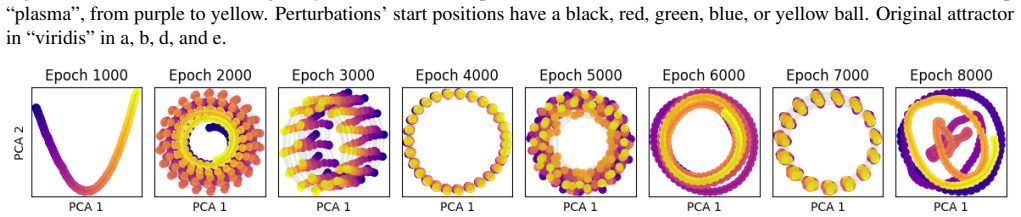
In the deterministic growing-gecko neural cellular automaton, direct visualization of cell-state trajectories combined with Lyapunov and Fourier spectra shows that the learned attractor is not a fixed point but instead supports oscillatory, periodic, and quasi-periodic motion. These behaviors are already present early in training. Strong perturbations displace the system into a distinct secondary attractor separate from the original one.
What carries the argument
Lyapunov and Fourier spectra computed on the long-term cell-state trajectories of the neural cellular automaton, which classify the attractor type and detect periodic components.
If this is right
- Visual similarity after a few dozen steps is insufficient to confirm that an NCA has reached a fixed point.
- Periodic and quasi-periodic regimes emerge within the first stages of training and persist.
- Large external perturbations can switch the automaton between distinct dynamical modes.
- Long-horizon stability requires spectral methods rather than short visual inspection alone.
Where Pith is reading between the lines
- Designers of NCAs for static output tasks may need to add explicit damping terms if fixed-point behavior is required.
- The same spectral diagnostics could be applied to other cellular-automaton families to test whether periodic attractors are widespread.
- If multiple coexisting modes prove common, training procedures could be extended to select among them rather than assuming convergence to one.
- Stochastic update rules might alter the geometry of these attractors, offering a direct experimental comparison.
Load-bearing premise
That the attractor types and perturbation responses seen in this single deterministic gecko model are representative of neural cellular automata in general.
What would settle it
A neural cellular automaton whose Fourier spectrum after full training contains only a zero-frequency peak and whose largest Lyapunov exponent is strictly negative would falsify the claim that periodic and quasi-periodic attractors are typical.
Figures


read the original abstract
Throughout the literature on Neural Cellular Automata (NCAs), it is often taken for granted that the systems learn attractors. This is shown through evolving the system for many timesteps and noting visual similarity to the goal state. There remain many questions after such an analysis. Namely, what kind of attractors do we have? Is their behavior ordered or chaotic? Can we estimate stability over very long time horizons? What really happens in the attractor when perturbations are applied? In this paper, we present a case study to help answer these questions, with methods drawn from the literature on dynamical systems theory. We use the growing gecko NCA of Mordvintsev et al. (2020) with deterministic cell updates as a case study. To the best of the authors' knowledge, we present the first visualizations of NCA attractor dynamics. We also analyze them using the Lyapunov and Fourier spectra, to reveal that the NCA displays oscillatory, periodic and quasi-periodic behavior, and that these behaviors arise early during training. This challenges the belief that NCAs learn fixed point attractors. Finally, we show that large perturbations to the attractor states can throw the NCAs into a secondary mode separate from the original attractor. We hope that this initial foray into NCA attractor dynamics expands the toolkit for NCA researchers to analyze the robustness and stability of their systems.
Editorial analysis
A structured set of objections, weighed in public.
Referee Report
Summary. The paper applies dynamical-systems tools (Lyapunov spectra, Fourier spectra, and perturbation response) to the deterministic growing-gecko NCA of Mordvintsev et al. (2020). It claims that the learned dynamics exhibit oscillatory, periodic, and quasi-periodic behavior that appears early in training, that these behaviors can be visualized directly, and that large perturbations can drive the system into a distinct secondary mode; the authors argue this challenges the common assumption that NCAs converge to fixed-point attractors.
Significance. If the spectral classifications are shown to be robust, the work supplies a concrete methodological bridge between NCA training and classical attractor analysis, moving the field beyond visual similarity checks. The use of an existing, published model and the explicit reporting of early-training onset are positive features.
major comments (3)
- [Results (spectral analysis)] Results section on Fourier and Lyapunov spectra: the manuscript reports no explicit convergence tests of the spectra with respect to trajectory length or observation horizon. In a high-dimensional grid system, finite windows can produce spurious frequency peaks or near-zero Lyapunov exponents from slow drifts or numerical accumulation; without such checks the assignment of persistent quasi-periodic attractors remains provisional.
- [Perturbation experiments] Methods and results on perturbation response: the claim that large perturbations throw the system into a 'secondary mode separate from the original attractor' is supported only by a single deterministic gecko instance. No quantitative measure of mode separation (e.g., distance between invariant sets or return-time statistics) or tests on additional NCA architectures are provided, weakening the generality of the stability conclusion.
- [Training dynamics subsection] Training-time analysis: the statement that the observed behaviors 'arise early during training' is not accompanied by a systematic sweep across multiple random seeds or a quantitative threshold for when the spectral signature stabilizes; a single-run observation is insufficient to support the training-dynamics claim.
minor comments (2)
- [Figures 2-4] Figure captions for the attractor visualizations should explicitly state the integration length, step size, and any down-sampling used, so that readers can reproduce the displayed trajectories.
- [Methods] Notation for the cell-state update rule and the precise definition of the deterministic update (e.g., whether stochasticity is fully removed) should be restated in the methods section for self-contained reading.
Simulated Author's Rebuttal
We thank the referee for their constructive comments, which have prompted us to enhance the methodological rigor of our analysis. We address each major comment in turn below.
read point-by-point responses
-
Referee: [Results (spectral analysis)] Results section on Fourier and Lyapunov spectra: the manuscript reports no explicit convergence tests of the spectra with respect to trajectory length or observation horizon. In a high-dimensional grid system, finite windows can produce spurious frequency peaks or near-zero Lyapunov exponents from slow drifts or numerical accumulation; without such checks the assignment of persistent quasi-periodic attractors remains provisional.
Authors: We agree that convergence tests are important for validating the spectral analysis in high-dimensional systems. Although our computations used extended trajectories (over 1000 steps) where spectra appeared stable upon visual inspection, we did not report formal convergence checks. In the revised manuscript, we add an appendix detailing the dependence of the Lyapunov spectrum and Fourier peaks on trajectory length, demonstrating convergence of the key exponents and frequencies for lengths beyond 500 steps. This strengthens the evidence for persistent quasi-periodic behavior. revision: yes
-
Referee: [Perturbation experiments] Methods and results on perturbation response: the claim that large perturbations throw the system into a 'secondary mode separate from the original attractor' is supported only by a single deterministic gecko instance. No quantitative measure of mode separation (e.g., distance between invariant sets or return-time statistics) or tests on additional NCA architectures are provided, weakening the generality of the stability conclusion.
Authors: As this work is framed as a case study on the growing gecko NCA, the perturbation results illustrate the existence of a secondary mode for this specific model. We acknowledge the limitation to a single instance and lack of tests on other architectures. In the revision, we introduce quantitative metrics: the time-averaged distance in a low-dimensional embedding between the pre- and post-perturbation trajectories, and histograms of return times showing that the system does not return to the original attractor within the simulation horizon. We do not claim broad generality and have updated the text to emphasize the case-study nature. revision: partial
-
Referee: [Training dynamics subsection] Training-time analysis: the statement that the observed behaviors 'arise early during training' is not accompanied by a systematic sweep across multiple random seeds or a quantitative threshold for when the spectral signature stabilizes; a single-run observation is insufficient to support the training-dynamics claim.
Authors: The early emergence of the attractor behaviors was observed by computing spectra at various training checkpoints in our primary run. We concur that a single seed limits the strength of the claim regarding training dynamics. The revised manuscript includes a plot of spectral features (dominant frequencies and Lyapunov exponents) versus training epoch, with a quantitative threshold defined as when the top Fourier peak stabilizes within 5% variation. While we have not performed a multi-seed sweep due to computational constraints, this provides more systematic evidence for the reported seed and we qualify the claim accordingly. revision: partial
Circularity Check
Empirical case study applies external dynamical-systems methods to prior NCA model with no internal derivations
full rationale
The paper is a case study that applies standard Lyapunov and Fourier spectral techniques from the dynamical systems literature to the deterministic growing gecko NCA previously published by Mordvintsev et al. (2020). No equations, parameters, or predictions are defined or fitted inside the paper and then reused as outputs; the central observations about oscillatory/periodic/quasi-periodic behavior are direct measurements on trajectories of an externally supplied model. No self-citations are load-bearing, no uniqueness theorems are invoked, and no ansatzes or renamings of known results occur. The analysis is therefore self-contained against external benchmarks.
Axiom & Free-Parameter Ledger
axioms (2)
- domain assumption Lyapunov spectra and Fourier spectra are appropriate and sufficient to classify attractor type (fixed point vs. periodic vs. quasi-periodic) in high-dimensional grid systems.
- domain assumption The deterministic update rule and finite grid size do not introduce artifacts that invalidate the spectral measurements.
Reference graph
Works this paper leans on
-
[1]
Barandiaran, M. and Stovold, J. (2025). Growing Reservoirs with Developmental Graph Cellular Automata. InProc. ALIFE 2025: The 2025 Conference on Artificial Life, pages 225–
work page 2025
-
[2]
MIT Press. Bernardini, D. and Litak, G. (2016). An overview of 0–1 test for chaos.Journal of the Brazilian Society of Mechanical Sciences and Engineering, 38(5):1433–1450. Chow, P. C. K. and Bentley, P. J. (2025). Development necessitates evolutionarily conserved factors.Scientific Reports, 15(1):9910. Crauel, H. and Flandoli, F. (1994). Attractors for ra...
work page 2016
-
[3]
Pajouheshgar, E., Xu, Y ., and S ¨usstrunk, S. (2026). Discovering partial differential equations with neural cellular automata. Artificial Life, pages 1–19. Pontes-Filho, S., Nichele, S., and Lepperød, M. (2025). Reservoir computing with evolved critical neural cellular automata. In ALIFE 2025: Ciphers of Life: Proceedings of the Artificial Life Conferen...
work page 2026
-
[4]
Randazzo, E., Mordvintsev, A., Niklasson, E., Levin, M., and Greydanus, S. (2020). Self-classifying mnist digits.Distill, 5(8):e00027–002. Sandri, M. (1996). Numerical calculation of lyapunov exponents. Mathematica Journal, 6(3):78–84. Stovold, J. (2025). Identity Increases Stability in Neural Cellular Automata. InProc. ALIFE 2025: The 2025 Conference on ...
work page 2020
-
[5]
Westview press. Tesfaldet, M., Nowrouzezahrai, D., and Pal, C. (2022). Attention- based neural cellular automata.Advances in Neural Information Processing Systems, 35:8174–8186. Van der Pol, B. (1926). Lxxxviii. on “relaxation-oscillations”.The London, Edinburgh, and Dublin Philosophical Magazine and Journal of Science, 2(11):978–992. Variengien, A., Nich...
discussion (0)
Sign in with ORCID, Apple, or X to comment. Anyone can read and Pith papers without signing in.