Improving Network Clock Synchronization by Marking Congestion
Pith reviewed 2026-05-10 13:50 UTC · model grok-4.3
The pith
Marking packets that experience queuing delay lets synchronization protocols correct for variable network delays and achieve much higher accuracy.
A machine-rendered reading of the paper's core claim, the machinery that carries it, and where it could break.
Core claim
By having switches mark packets that experienced queuing delay, time synchronization protocols such as NTP and PTP can filter out or correct for the variable delays that degrade accuracy. This in-network indication allows the receiver to distinguish between packets affected by congestion and those with more stable delays, leading to lower root-mean-squared clock offset errors.
What carries the argument
The congestion marking mechanism, which uses standard but unused fields in IP, PTP, or NTP headers to indicate that a packet experienced queuing at a switch.
If this is right
- Performance of min-RTT and median-delay filters improves by 90 percent in one-hop hardware setups.
- Root-mean-squared clock offset estimation error reduces by 30 to 80 percent across different network conditions.
- Effective over multiple hops both analytically and in simulation.
- Requires only simple changes at switches, no deep packet inspection or protocol modifications.
Where Pith is reading between the lines
- Similar marking could help other applications that rely on low-variance delay measurements, such as certain distributed databases.
- If marking accuracy holds in real mixed-traffic networks, it might allow relaxing the need for high-precision hardware clocks at every node.
- Extending the marking to carry more detail about the amount of queuing could further refine corrections.
Load-bearing premise
Switches can detect and mark packets that experienced queuing delay reliably, with few false positives or negatives, and receivers can use this information to correct errors even when multiple hops and mixed traffic are involved.
What would settle it
A test in a multi-hop network with realistic mixed traffic where using the congestion marks produces no reduction or an increase in clock offset error compared to unmarked operation.
Figures






read the original abstract
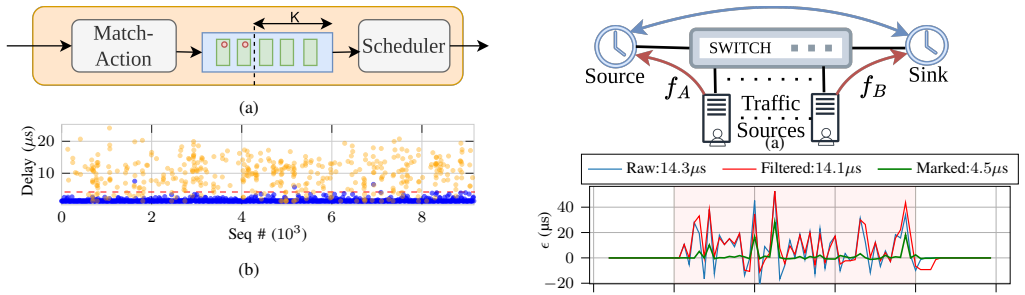
Achieving consistent time across devices in distributed systems often involves exchanging timestamped messages over a network. Precise time synchronization is crucial for applications such as cellular networks, industrial automation, and transactional databases. However, delay variation in synchronization packets-often caused by congestion from competing traffic-degrades synchronization accuracy. Detecting whether a packet experienced congestion can help improve synchronization through filtering and statistical methods. We propose an in-network congestion indication and filtering mechanism for synchronization messages used in protocols such as the Network Time Protocol (NTP) and Precision Time Protocol (PTP). Network devices mark packets that experienced queuing, allowing clocks to correct errors caused by varying delays. Our approach requires only simple changes at switches or routers, avoiding deep packet inspection or protocol modifications. The method is backward compatible, using standard but currently unused fields in IP, PTP, or NTP headers. We implement our method on a Tofino P4 target and demonstrate an improvement of over 80% in synchronization performance over a single hop. Moreover, we show that the performance of traditional statistical filters, such as min-RTT and median-delay, is improved by 90% over the one-hop hardware setup. We further demonstrate the effectiveness of our proposed method across multiple hops, both analytically and through simulation. Congestion marking improves the root-mean-squared clock offset estimation error by 30% to 80%, depending on network conditions and filtering techniques.
Editorial analysis
A structured set of objections, weighed in public.
Referee Report
Summary. The paper proposes an in-network mechanism to mark synchronization packets (for NTP/PTP) that experienced queuing delay, using simple modifications to unused header fields at programmable switches. Receivers can then use these marks to filter or correct variable delays, improving clock offset estimation. A Tofino P4 implementation demonstrates >80% improvement in single-hop synchronization performance and 90% better statistical filters (min-RTT, median-delay); multi-hop benefits of 30-80% RMS error reduction are shown via analysis and simulation.
Significance. If the marking reliably identifies queuing with low error rates, the work provides a practical, backward-compatible enhancement to time synchronization in congested networks. The hardware demonstration and quantitative gains offer concrete evidence of feasibility for applications in cellular, industrial, and database systems, leveraging existing header fields and P4 without protocol changes.
major comments (2)
- [Hardware Implementation] Hardware Implementation section: The P4 program details for detecting queuing delay (e.g., queue occupancy thresholds, timing of mark relative to egress queuing point, and handling of Tofino queue-state access granularity) are insufficient. This is load-bearing for the >80% single-hop improvement claim, as the skeptic correctly notes that non-negligible false positives/negatives would prevent the statistical filters from reliably discarding bad samples.
- [Multi-hop Evaluation] Multi-hop Evaluation section: The analytic and simulation arguments presuppose that per-hop marks remain available and interpretable at the receiver even under mixed traffic and multiple hops. The manuscript does not address mark preservation, potential overwriting in standard headers, or aggregation, which directly affects the reported 30-80% RMS error reductions.
minor comments (2)
- [Abstract] Abstract: Performance claims are stated without error bars, confidence intervals, or explicit traffic models/exclusion criteria, reducing the ability to assess robustness.
- [Results] Results presentation: Figures and tables reporting the 80% and 30-80% gains would benefit from including variability metrics and baseline comparisons under identical conditions.
Simulated Author's Rebuttal
We thank the referee for the constructive feedback on our manuscript. The comments highlight important areas where additional detail will strengthen the presentation of our results. We address each major comment below and will revise the manuscript to incorporate clarifications and expansions as described.
read point-by-point responses
-
Referee: [Hardware Implementation] Hardware Implementation section: The P4 program details for detecting queuing delay (e.g., queue occupancy thresholds, timing of mark relative to egress queuing point, and handling of Tofino queue-state access granularity) are insufficient. This is load-bearing for the >80% single-hop improvement claim, as the skeptic correctly notes that non-negligible false positives/negatives would prevent the statistical filters from reliably discarding bad samples.
Authors: We agree that the current description of the P4 implementation is high-level and would benefit from greater specificity to allow independent assessment of the false-positive/negative rates. In the revised manuscript we will expand the Hardware Implementation section to specify: (i) the queue-occupancy threshold used to set the mark (any non-zero occupancy at the time the packet is processed), (ii) the pipeline stage at which the mark is written (immediately prior to enqueueing, using ingress metadata), and (iii) the Tofino queue-state access method (via the standard queueing metadata register with single-packet granularity). These parameters were chosen precisely to keep false positives low in our testbed, which underpins the reported >80 % improvement; we will also add a short paragraph quantifying the observed error rate under the evaluated traffic mixes. revision: yes
-
Referee: [Multi-hop Evaluation] Multi-hop Evaluation section: The analytic and simulation arguments presuppose that per-hop marks remain available and interpretable at the receiver even under mixed traffic and multiple hops. The manuscript does not address mark preservation, potential overwriting in standard headers, or aggregation, which directly affects the reported 30-80% RMS error reductions.
Authors: We acknowledge that an explicit treatment of mark propagation was omitted. We will add a dedicated paragraph in the Multi-hop Evaluation section explaining that the mechanism relies on currently unused or reserved header fields (e.g., selected PTP reserved bits or the IP DSCP field when not otherwise employed). Because these fields are not modified by standard forwarding or by the majority of middleboxes, the mark is preserved hop-by-hop. Our analytic model and simulations carry the mark as a per-packet Boolean flag; when a packet traverses multiple congested hops the flag simply indicates that at least one queuing event occurred, which is the information required by the downstream filters. We will also note the (rare) case of field overwriting and how an operator could fall back to a dedicated DSCP value or an IP option to avoid it. revision: yes
Circularity Check
No circularity: empirical hardware implementation and simulations are self-contained
full rationale
The paper reports direct measurements from a Tofino P4 hardware implementation and simulations showing 30-80% RMS error reduction via congestion marking. No derivation chain, equations, or predictions reduce to fitted inputs or self-citations by construction. Claims rest on experimental results rather than tautological definitions or load-bearing self-references.
Axiom & Free-Parameter Ledger
axioms (1)
- domain assumption Network switches can detect queuing and mark packets using currently unused fields in IP/PTP/NTP headers without breaking existing protocol compatibility.
Reference graph
Works this paper leans on
-
[1]
Packet over Transport aspects – Synchronization, quality and availabil- ity targets,
“Packet over Transport aspects – Synchronization, quality and availabil- ity targets,”ITU-T G.8271, International Telecommunications Union, 2020
work page 2020
-
[2]
Clock Synchronization in Future Industrial Networks: Applications, Challenges, and Directions,
R. N. Gore, E. Lisova, J. Akerberg, and M. Bjorkman, “Clock Synchronization in Future Industrial Networks: Applications, Challenges, and Directions,” in12th AEIT International Annual Conference, AEIT 2020. Institute of Electrical and Electronics Engineers Inc., sep 2020. [Online]. Available: https://ieeexplore.ieee.org/document/9241154
-
[3]
Spanner: Google’s globally distributed database,
J. C. Corbett, J. Dean, M. Epstein, A. Fikes, C. Frost, J. J. Furman, S. Ghemawat, A. Gubarev, C. Heiser, P. Hochschild, W. Hsieh, S. Kan- thak, E. Kogan, H. Li, A. Lloyd, S. Melnik, D. Mwaura, D. Nagle, S. Quinlan, R. Rao, L. Rolig, Y . Saito, M. Szymaniak, C. Taylor, R. Wang, and D. Woodford, “Spanner: Google’s globally distributed database,”ACM Trans. ...
work page 2013
-
[4]
Rfc 1305: Network time protocol (version 3) specification,
D. L. Mills, “Rfc 1305: Network time protocol (version 3) specification,” Implementation and Analysis, 1992
work page 1992
-
[5]
J. C. Eidson, M. Fischer, and J. White, “Ieee-1588™ standard for a precision clock synchronization protocol for networked measurement and control systems,” inProceedings of the 34th Annual Precise Time and Time Interval Systems and Applications Meeting, 2002, pp. 243– 254
work page 2002
-
[6]
P. Banerjee and D. Matsakis,Network Time Protocol (NTP) and Precise Time Protocol (PTP). Cham: Springer Nature Switzerland, 2023, pp. 141–152. [Online]. Available: https://doi.org/10.1007/978-3-031-30780-5 7
-
[7]
Analysis of kalman filtering for clock synchronization in ptp-unaware networks,
C. Novaes, I. Freire, A. Klautau, I. Almeida, and E. Medeiros, “Analysis of kalman filtering for clock synchronization in ptp-unaware networks,” in2021 IEEE Latin-American Conference on Communications (LATIN- COM), 2021, pp. 1–6
work page 2021
-
[8]
Exploiting a natural network effect for scalable, fine-grained clock synchronization,
Y . Geng, S. Liu, Z. Yin, A. Naik, B. Prabhakar, M. Rosenblum, and A. Vahdat, “Exploiting a natural network effect for scalable, fine-grained clock synchronization,” in15th USENIX Symposium on Networked Systems Design and Implementation (NSDI 18). Renton, W A: USENIX Association, Apr. 2018, pp. 81–94. [Online]. Available: https://www.usenix.org/conference...
work page 2018
-
[9]
Opti- mizing the ptp control loop,
T. Kernen, M. Machnikowski, G. Shabat, and H. Shteingart, “Opti- mizing the ptp control loop,” in2024 IEEE International Symposium on Precision Clock Synchronization for Measurement, Control, and Communication (ISPCS), 2024, pp. 1–7
work page 2024
-
[10]
Fundamental limits on synchronizing clocks over networks,
N. M. Freris, S. R. Graham, and P. R. Kumar, “Fundamental limits on synchronizing clocks over networks,”IEEE Transactions on Automatic Control, vol. 56, no. 6, pp. 1352–1364, 2011
work page 2011
-
[11]
N. Zilberman, M. Grosvenor, D. A. Popescu, N. Manihatty-Bojan, G. Antichi, M. W´ojcik, and A. W. Moore, “Where has my time gone?” in Passive and Active Measurement, M. A. Kaafar, S. Uhlig, and J. Amann, Eds. Cham: Springer International Publishing, 2017, pp. 201–214
work page 2017
-
[12]
Ieee 1588 transparent clock architecture for fpga-based network devices,
N. Moreira, A. Astarloa, J. Lazaro, A. Garcia, and E. Ormaetxea, “Ieee 1588 transparent clock architecture for fpga-based network devices,” in 2013 IEEE International Symposium on Industrial Electronics, 2013, pp. 1–6
work page 2013
-
[13]
Toward higher precision: An introduction to ptp and its significance to ntp practitioners,
R. Ratzel and R. Greenstreet, “Toward higher precision: An introduction to ptp and its significance to ntp practitioners,” Queue, vol. 10, no. 8, p. 40–53, Aug. 2012. [Online]. Available: https://doi.org/10.1145/2346916.2354406
-
[14]
The addition of explicit congestion notification (ecn) to ip,
K. Ramakrishnan, S. Floyd, and D. Black, “The addition of explicit congestion notification (ecn) to ip,” Tech. Rep., 2001
work page 2001
-
[15]
Measuring the state of ecn readiness in servers, clients,and routers,
S. Bauer, R. Beverly, and A. Berger, “Measuring the state of ecn readiness in servers, clients,and routers,” inProceedings of the 2011 ACM SIGCOMM Conference on Internet Measurement Conference, ser. IMC ’11. New York, NY , USA: Association for Computing Machinery, 2011, p. 171–180. [Online]. Available: https://doi.org/10.1145/2068816.2068833
-
[16]
Tuning ecn for data center networks,
H. Wu, J. Ju, G. Lu, C. Guo, Y . Xiong, and Y . Zhang, “Tuning ecn for data center networks,” inProceedings of the 8th International Conference on Emerging Networking Experiments and Technologies, ser. CoNEXT ’12. New York, NY , USA: Association for Computing Machinery, 2012, p. 25–36. [Online]. Available: https://doi.org/10.1145/2413176.2413181
-
[17]
Towards llm-based failure localization in production-scale networks,
P. Namyar, Y . Li, W. Wang, N. Dukkipati, K. Yap, J. Gong, C. Chen, P. Gao, D. Ray, G. Kumar, Y . Ma, R. Govindan, and A. Vahdat, “Firefly: Scalable, ultra-accurate clock synchronization for datacenters,” inProceedings of the ACM SIGCOMM 2025 Conference, ser. SIGCOMM ’25. New York, NY , USA: Association for Computing Machinery, 2025, p. 434–452. [Online]....
-
[18]
P4: programming protocol-independent packet processors,
P. Bosshart, D. Daly, G. Gibb, M. Izzard, N. McKeown, J. Rexford, C. Schlesinger, D. Talayco, A. Vahdat, G. Varghese, and D. Walker, “P4: programming protocol-independent packet processors,”SIGCOMM Comput. Commun. Rev., vol. 44, no. 3, p. 87–95, Jul. 2014. [Online]. Available: https://doi.org/10.1145/2656877.2656890
-
[19]
Probabilistic clock synchronization,
F. Cristian, “Probabilistic clock synchronization,”Distributed computing, vol. 3, no. 3, pp. 146–158, 1989
work page 1989
-
[20]
Moongen: A scriptable high-speed packet generator,
P. Emmerich, S. Gallenm ¨uller, D. Raumer, F. Wohlfart, and G. Carle, “Moongen: A scriptable high-speed packet generator,” inProceedings of the 2015 Internet Measurement Conference, 2015
work page 2015
-
[21]
Towards a network aware model of the time uncertainty bound in precision time protocol,
Y . Deshpande, P. Diederich, and W. Kellerer, “Towards a network aware model of the time uncertainty bound in precision time protocol,” inIEEE INFOCOM 2023 - IEEE Conference on Computer Communications Workshops (INFOCOM WKSHPS), 2023, pp. 1–2
work page 2023
-
[22]
Chrony: Versatile implementation of the network time protocol,
R. P. Curnow and M. Lichvar, “Chrony: Versatile implementation of the network time protocol,” 2003, open-source NTP client and server implementation. [Online]. Available: https://chrony.tuxfamily.org/
work page 2003
-
[23]
R. Cochran, “Linux ptp,” https://github.com/richardcochran/linuxptp, 2025, version X.Y
work page 2025
-
[24]
Improving the ptp synchronization accu- racy under asymmetric delay conditions,
M. L ´evesque and D. Tipper, “Improving the ptp synchronization accu- racy under asymmetric delay conditions,” in2015 IEEE International Symposium on Precision Clock Synchronization for Measurement, Con- trol, and Communication (ISPCS), 2015, pp. 88–93
work page 2015
-
[25]
Improvement of synchronization accu- racy in ieee 1588 using a queuing estimation method,
T. Murakami and Y . Horiuchi, “Improvement of synchronization accu- racy in ieee 1588 using a queuing estimation method,” in2009 Interna- tional Symposium on Precision Clock Synchronization for Measurement, Control and Communication, 2009, pp. 1–5
work page 2009
-
[26]
S. Lee, “An enhanced ieee 1588 time synchronization algorithm for asymmetric communication link using block burst transmission,”IEEE Communications Letters, vol. 12, no. 9, pp. 687–689, 2008, funding Information: Manuscript received May 30, 2008. The associate editor coordinating the review of this letter and approving it for publication was Y .-C. Wu. Th...
work page 2008
-
[27]
Evaluation of kalman filtering for network time keeping,
A. Bletsas, “Evaluation of kalman filtering for network time keeping,” IEEE Transactions on Ultrasonics, Ferroelectrics, and Frequency Con- trol, vol. 52, no. 9, pp. 1452–1460, 2005
work page 2005
-
[28]
Clock skew estimation using kalman filter and ieee 1588v2 ptp for telecom networks,
Z. Chaloupka, N. Alsindi, and J. Aweya, “Clock skew estimation using kalman filter and ieee 1588v2 ptp for telecom networks,”IEEE Communications Letters, vol. 19, no. 7, pp. 1181–1184, 2015
work page 2015
-
[29]
Clock synchronization using linear programming, multicasts, and tempera- ture compensation,
H. Puttnies, E. Schweissguth, D. Timmermann, and J. Schacht, “Clock synchronization using linear programming, multicasts, and tempera- ture compensation,” in2019 IEEE Global Communications Conference (GLOBECOM), 2019, pp. 1–6
work page 2019
-
[30]
Graham: Synchronizing clocks by leveraging local clock properties,
A. Najafi and M. Wei, “Graham: Synchronizing clocks by leveraging local clock properties,” in19th USENIX Symposium on Networked Systems Design and Implementation (NSDI 22). Renton, W A: USENIX Association, Apr. 2022, pp. 453–466. [Online]. Available: https://www.usenix.org/conference/nsdi22/presentation/najafi
work page 2022
-
[31]
Timely: Rtt- based congestion control for the datacenter,
R. Mittal, V . T. Lam, N. Dukkipati, E. Blem, H. Wassel, M. Ghobadi, A. Vahdat, Y . Wang, D. Wetherall, and D. Zats, “Timely: Rtt- based congestion control for the datacenter,” inProceedings of the 2015 ACM Conference on Special Interest Group on Data Communication, ser. SIGCOMM ’15. New York, NY , USA: Association for Computing Machinery, 2015, p. 537–55...
-
[32]
H. Kirrmann, C. Honegger, D. Ilie, and I. Sotiropoulos, “Performance of a full-hardware ptp implementation for an iec 62439-3 redundant iec 61850 substation automation network,” in2012 IEEE International Sym- posium on Precision Clock Synchronization for Measurement, Control and Communication Proceedings, 2012, pp. 1–6
work page 2012
-
[33]
NetTimeLogic GmbH, “PTP Transparent Clock,” https: //www.nettimelogic.com/ptp-transparent-clock.php, n.d., accessed: 2025-12-18
work page 2025
-
[34]
Verifying the perfor- mance of transparent clocks in ptp systems,
J. Burch, K. Green, J. Nakulski, and D. V ook, “Verifying the perfor- mance of transparent clocks in ptp systems,” in2009 International Sym- posium on Precision Clock Synchronization for Measurement, Control and Communication, 2009, pp. 1–6
work page 2009
-
[35]
Performance analysis of time synchronization precision of ptp in smart substations,
H. Liu, J. Liu, T. Bi, J. Li, W. Yang, and D. Zhang, “Performance analysis of time synchronization precision of ptp in smart substations,” in 2015 IEEE International Symposium on Precision Clock Synchronization for Measurement, Control, and Communication (ISPCS), 2015, pp. 37– 42
work page 2015
-
[36]
Relaxing Restrictions on Explicit Congestion Notification (ECN) Experimentation,
D. L. Black, “Relaxing Restrictions on Explicit Congestion Notification (ECN) Experimentation,” RFC 8311, Jan. 2018. [Online]. Available: https://www.rfc-editor.org/info/rfc8311
work page 2018
-
[37]
When tcp meets recon- figurations: A comprehensive measurement study,
K. Aykurt, J. Zerwas, A. Blenk, and W. Kellerer, “When tcp meets recon- figurations: A comprehensive measurement study,”IEEE Transactions on Network and Service Management, vol. 21, no. 2, pp. 1372–1386, 2024
work page 2024
-
[38]
T. Jones and G. A. Koenig, “A clock synchronization strategy for mini- mizing clock variance at runtime in high-end computing environments,” in2010 22nd International Symposium on Computer Architecture and High Performance Computing, 2010, pp. 207–214
work page 2010
-
[39]
The performance impact of heavy-tailed distributions,
W. Whitt, “The performance impact of heavy-tailed distributions,” Queueing Systems survey and references, 1990s, discusses long tail delays in networking queue systems
-
[40]
Modeling, simulation and measurements of queuing delay under long-tail internet traffic,
M. Garetto, “Modeling, simulation and measurements of queuing delay under long-tail internet traffic,” Ph.D. dissertation, Universit `a di Torino, 2003
work page 2003
-
[41]
Delay bounds for networks with heavy-tailed and self-similar traffic,
J. Liebeherr, A. Burchard, and F. Ciucu, “Delay bounds for networks with heavy-tailed and self-similar traffic,”arXiv, 2009. [Online]. Available: https://arxiv.org/pdf/0911.3856
-
[42]
Delay distribution of packet delay under heavy-tailed traffic,
P. Wanget al., “Delay distribution of packet delay under heavy-tailed traffic,” inSimulation Demonstrations, 2020, tail distribution analysis showing heavy tail behavior
work page 2020
-
[43]
Sim2hw: Modeling latency offset between network simulations and hardware measurements,
J. Sp ¨ath, M. Helm, B. Jaeger, and G. Carle, “Sim2hw: Modeling latency offset between network simulations and hardware measurements,” in Proceedings of the 3rd GNNet Workshop on Graph Neural Networking Workshop, ser. GNNet ’24. New York, NY , USA: Association for Computing Machinery, 2024, p. 20–26. [Online]. Available: https://doi.org/10.1145/3694811.3697820
-
[44]
J. R. Norris,Markov chains. Cambridge university press, 1998, no. 2
work page 1998
-
[45]
Sundial: Fault-tolerant clock synchronization for datacenters,
Y . Li, G. Kumar, H. Hariharan, H. Wassel, P. Hochschild, D. Platt, S. Sabato, M. Yu, N. Dukkipati, P. Chandra, and A. Vahdat, “Sundial: Fault-tolerant clock synchronization for datacenters,” in14th USENIX Symposium on Operating Systems Design and Implementation (OSDI 20), 2020
work page 2020
-
[46]
A. Shpiner, Y . Revah, and T. Mizrahi, “Multi-path time protocols,” in 2013 IEEE International Symposium on Precision Clock Synchronization for Measurement, Control and Communication (ISPCS) Proceedings, 2013, pp. 1–6
work page 2013
-
[47]
A. Finkenzeller, O. Butowski, E. Regnath, M. Hamad, and S. Steinhorst, “Ptpsec: Securing the precision time protocol against time delay attacks using cyclic path asymmetry analysis,” inIEEE INFOCOM 2024 - IEEE Conference on Computer Communications, 2024, pp. 461–470
work page 2024
-
[48]
Dscc : Dynamic synergistic congestion control for lossless rdma datacenter networks,
J. Zhuge, Z. Gao, Y . Tian, J. Wang, S. Yun, and X. Gong, “Dscc : Dynamic synergistic congestion control for lossless rdma datacenter networks,”Computer Networks, vol. 280, p. 112151, 2026. [Online]. Available: https://www.sciencedirect.com/science/article/pii/ S1389128626001635
work page 2026
-
[49]
A quantitative model for the parameter setting of red with tcp traffic,
T. Ziegler, C. Brandauer, and S. Fdida, “A quantitative model for the parameter setting of red with tcp traffic,” inInternational Workshop on Quality of Service. Springer, 2001, pp. 202–216
work page 2001
-
[50]
On designing improved controllers for aqm routers supporting tcp flows,
C. Hollot, V . Misra, D. Towsley, and W.-B. Gong, “On designing improved controllers for aqm routers supporting tcp flows,” inProceed- ings IEEE INFOCOM 2001. Conference on Computer Communications. Twentieth Annual Joint Conference of the IEEE Computer and Commu- nications Society (Cat. No.01CH37213), vol. 3, 2001, pp. 1726–1734 vol.3
work page 2001
-
[51]
Virtualized congestion control,
B. Cronkite-Ratcliff, A. Bergman, S. Vargaftik, M. Ravi, N. McKeown, I. Abraham, and I. Keslassy, “Virtualized congestion control,” in Proceedings of the 2016 ACM SIGCOMM Conference, ser. SIGCOMM ’16. New York, NY , USA: Association for Computing Machinery, 2016, p. 230–243. [Online]. Available: https://doi.org/10.1145/2934872. 2934889
-
[52]
M. Alizadeh, A. Greenberg, D. A. Maltz, J. Padhye, P. Patel, B. Prabhakar, S. Sengupta, and M. Sridharan, “Data center tcp (dctcp),” SIGCOMM Comput. Commun. Rev., vol. 40, no. 4, p. 63–74, Aug
-
[53]
Symbiotic routing in future data centers
[Online]. Available: https://doi.org/10.1145/1851275.1851192
-
[54]
Pet: Multi-agent independent ppo-based automatic ecn tuning for high-speed data center networks,
K. Cheng, T. Wang, X. Du, S. Du, and H. Cai, “Pet: Multi-agent independent ppo-based automatic ecn tuning for high-speed data center networks,”arXiv preprint arXiv:2405.11956, 2024
-
[55]
Rlecn—a learning based dynamic threshold control of ecn,
E.-S. Jung, H. S. Kimet al., “Rlecn—a learning based dynamic threshold control of ecn,”ICT Express, vol. 9, no. 6, pp. 1007–1012, 2023
work page 2023
-
[56]
Acc: Au- tomatic ecn tuning for high-speed datacenter networks,
S. Yan, X. Wang, X. Zheng, Y . Xia, D. Liu, and W. Deng, “Acc: Au- tomatic ecn tuning for high-speed datacenter networks,” inProceedings of the 2021 ACM SIGCOMM 2021 Conference, 2021, pp. 384–397
work page 2021
-
[57]
Haecn: Hierarchical automatic ecn tuning with ultra-low overhead in datacenter networks,
J. Hu, Y . Wang, Z. Zhou, S. Rao, R. Xin, J. Wang, and S. He, “Haecn: Hierarchical automatic ecn tuning with ultra-low overhead in datacenter networks,” inAlgorithms and Architectures for Parallel Processing, Z. Tari, K. Li, and H. Wu, Eds. Singapore: Springer Nature Singapore, 2024, pp. 324–343. APPENDIXA CONDITIONS FORIMPROVEMENT A. Condition for Varian...
work page 2024
discussion (0)
Sign in with ORCID, Apple, or X to comment. Anyone can read and Pith papers without signing in.