MAS-CCD: New technique for measuring low-level charge content based on the multiple amplifier architecture
Pith reviewed 2026-05-10 13:26 UTC · model grok-4.3
The pith
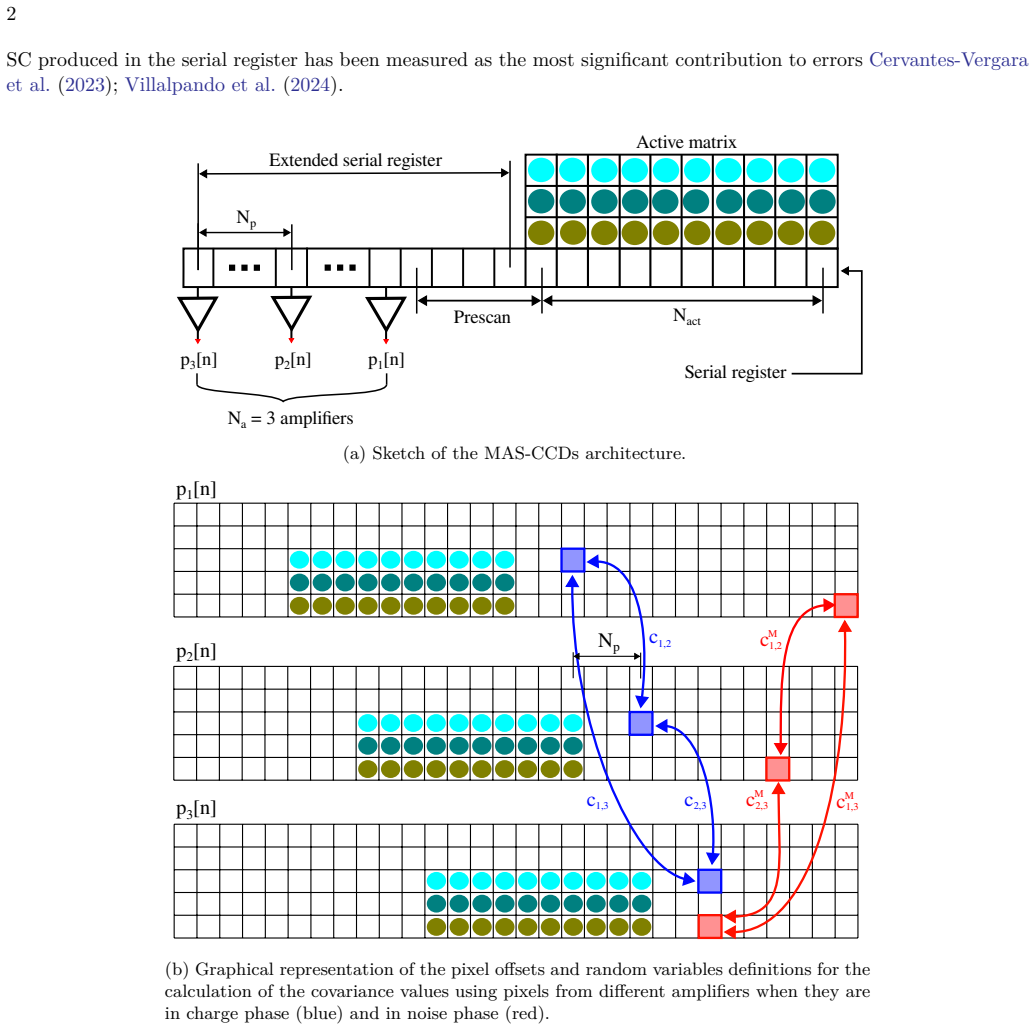
Covariance analysis of multiple amplifiers measures spurious charge in MAS-CCDs by observing the same charge packet at different times.
A machine-rendered reading of the paper's core claim, the machinery that carries it, and where it could break.
Core claim
The paper claims that covariance analysis performed on the outputs of the multiple amplifiers in the MAS-CCD, each of which registers the same charge packet but at staggered times due to the device architecture, yields a fast and accurate estimate of spurious charge generated by gate clocking.
What carries the argument
Covariance between the signals from the multiple output amplifiers of the MAS-CCD, which senses one charge packet at different moments to separate the spurious component.
If this is right
- The technique allows fast and precise spurious charge measurements where conventional methods are difficult to apply.
- It avoids the lengthy empirical tuning that trades off against full-well capacity.
- Simulations confirm the underlying model, establishing basic feasibility.
- The method could support reliable large-scale characterization of sensor performance.
Where Pith is reading between the lines
- Similar covariance techniques might apply to noise characterization in other multi-output detector architectures.
- Quicker spurious charge assessment could shorten iteration cycles when developing low-noise sensors for astronomy.
- Hardware integration of the analysis might enable ongoing clocking optimization during actual observations.
Load-bearing premise
The covariance between amplifier outputs isolates only the spurious charge contribution without significant interference from other noise sources or readout effects under normal operating conditions.
What would settle it
Direct comparison on the same MAS-CCD device showing that covariance-derived spurious charge values differ substantially from those obtained by established independent measurement techniques under matched conditions.
Figures


read the original abstract
Low-noise detectors are a key technology for the next generation of astronomical instruments aimed at spectroscopy of faint objects and the search for exoplanets. In this context, the multiple-amplifier sensing charge-coupled device (MAS-CCD) emerges as a promising technology for future scientific instruments. A critical parameter affecting the performance of these devices is spurious charge, produced by the clocking of the gates. Its measurement is typically challenging with existing methods. In practice, the optimization of this parameter often relies on empirical procedures that require significant time and careful consideration of the trade-off with full-well capacity. In this work, we present a new technique to estimate spurious charge based on covariance analysis of the output amplifiers of the MAS-CCD, which measures the same charge packet in different amplifiers at different times. The method enables fast and precise measurements of spurious charge under operating conditions where conventional approaches are difficult to apply. We develop the theoretical framework of the method and validate the model through simulations. The results demonstrate the feasibility of this approach and suggest that it could serve as a basis for reliable large-scale characterization of sensor performance.
Editorial analysis
A structured set of objections, weighed in public.
Referee Report
Summary. The manuscript introduces a new technique for estimating spurious charge in MAS-CCDs by performing covariance analysis on outputs from multiple amplifiers that measure the same charge packet at different times. It develops a theoretical framework deriving the method from the covariance properties of the multi-amplifier architecture and validates the model through simulations that recover the input spurious charge under idealized noise conditions.
Significance. If the central assumption holds under real operating conditions, the technique would provide a fast, precise method for characterizing spurious charge in MAS-CCDs without the empirical trade-offs of conventional approaches, supporting optimization of low-noise detectors for faint-object spectroscopy and exoplanet searches. The simulation-based validation demonstrates internal consistency of the covariance isolation under the stated assumptions and represents a clear strength in establishing theoretical feasibility.
major comments (1)
- The load-bearing assumption that covariance between amplifier outputs isolates spurious charge without significant interference from other correlated noise sources (e.g., residual charge-transfer inefficiency, clock-induced charge variations, or amplifier 1/f noise) is validated only in simulations assuming idealized, uncorrelated noise. No experimental data from actual MAS-CCD devices is presented to confirm performance under typical operating conditions, leaving the claim that the method works 'under operating conditions where conventional approaches are difficult to apply' only partially supported.
Simulated Author's Rebuttal
We thank the referee for their constructive review and for recognizing the potential significance of the covariance-based technique for spurious charge measurement in MAS-CCDs. We address the major comment below.
read point-by-point responses
-
Referee: The load-bearing assumption that covariance between amplifier outputs isolates spurious charge without significant interference from other correlated noise sources (e.g., residual charge-transfer inefficiency, clock-induced charge variations, or amplifier 1/f noise) is validated only in simulations assuming idealized, uncorrelated noise. No experimental data from actual MAS-CCD devices is presented to confirm performance under typical operating conditions, leaving the claim that the method works 'under operating conditions where conventional approaches are difficult to apply' only partially supported.
Authors: We agree that the validation is performed exclusively through simulations under idealized noise assumptions and that the manuscript contains no experimental data from real MAS-CCD devices. The paper's contribution centers on deriving the covariance isolation from the multi-amplifier architecture and demonstrating recovery of the input spurious charge in controlled simulations. We recognize that additional correlated noise sources could affect the measurement in practice. In revision we will add an explicit discussion of these assumptions and potential interferences, and we will moderate the language in the abstract and conclusions to state that applicability under real operating conditions requires future experimental confirmation. This revision will clarify the scope of the current results. revision: partial
- No experimental data from actual MAS-CCD devices under real operating conditions is available in the present work to test the method against other correlated noise sources.
Circularity Check
No significant circularity in covariance-based derivation
full rationale
The paper derives its spurious-charge estimator from the statistical property that multiple amplifiers observe the identical charge packet at staggered times, allowing covariance to isolate the common-mode spurious contribution under the stated noise model. This step follows directly from the MAS-CCD architecture and the definition of covariance; it does not rename a fitted parameter as a prediction, invoke a self-citation as a uniqueness theorem, or smuggle an ansatz. The theoretical framework is developed from first principles of the readout chain and is validated only in simulation; no load-bearing step reduces to the target quantity by construction. The derivation therefore remains self-contained.
Axiom & Free-Parameter Ledger
axioms (1)
- domain assumption The same charge packet is measured by different amplifiers at different times with additive noise.
Reference graph
Works this paper leans on
-
[1]
Alessandri, C., Abusleme, A., Guzman, D., et al. 2015, Monthly Notices of the Royal Astronomical Society, 455, 1443, doi: 10.1093/mnras/stv2410 Barak, L., Bloch, I. M., Botti, A., et al. 2022, Phys. Rev. Appl., 17, 014022, doi: 10.1103/PhysRevApplied.17.014022 Besuner, R., et al
-
[2]
https://arxiv.org/abs/2503.07923 Botti, A. M., Cervantes-Vergara, B. A., Chavez, C. R., et al. 2024, IEEE Transactions on Electron Devices, 71, 3732, doi: 10.1109/TED.2024.3392711 Cervantes-Vergara, B. A., Perez, S., Estrada, J., et al. 2023, Journal of Instrumentation, 18, P08016, doi: 10.1088/1748-0221/18/08/P08016 Holland, S. E. 2023, Astronomische Nac...
discussion (0)
Sign in with ORCID, Apple, or X to comment. Anyone can read and Pith papers without signing in.