Inverse scattering beyond Born approximation via rotation-equivariance-aware neural network and low-rank structure
Pith reviewed 2026-05-10 13:59 UTC · model grok-4.3
The pith
A rotation-equivariance-aware neural network maps full scattering data to Born data so a low-rank solver can recover the medium even outside the Born regime.
A machine-rendered reading of the paper's core claim, the machinery that carries it, and where it could break.
Core claim
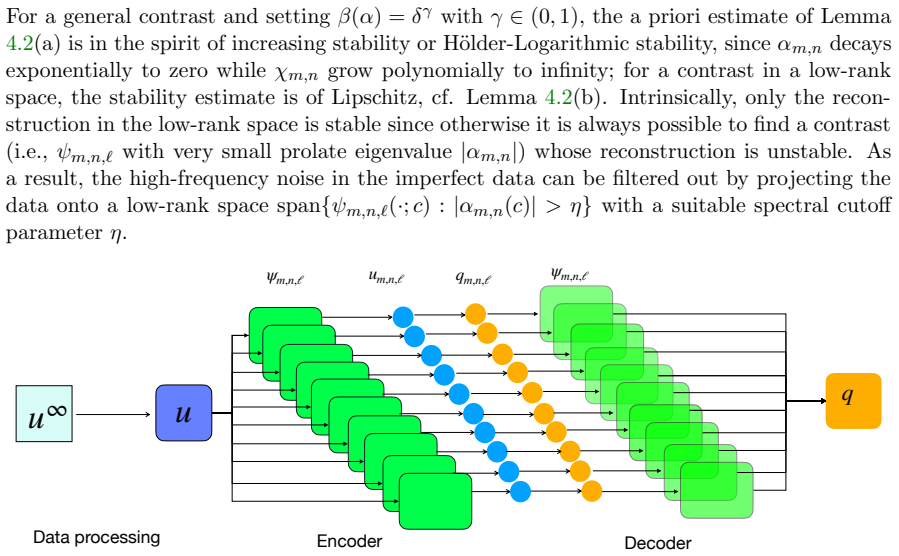
The hybrid ULR method integrates a rotation-equivariance-aware neural network that models the data corrector mapping full scattering data to Born data together with a low-rank inverse Born solver; the network incorporates reciprocity and rotation-equivariance while the low-rank structure filters high-frequency noise and yields a regularized solution supported by theoretical stability in the Born region.
What carries the argument
Rotation-equivariance-aware neural network acting as a data corrector paired with a low-rank structure serving as the inverse Born solver.
Where Pith is reading between the lines
- The symmetry-respecting correction could transfer to other wave-based inverse problems where data reciprocity or rotational invariance is present but measurements are noisy.
- Replacing the low-rank solver with physics-informed constraints might further reduce reliance on training data volume.
- The method's extension to limited apertures suggests it could handle real sensor geometries where full surrounding measurements are unavailable.
Load-bearing premise
The neural network learns an accurate nonlinear mapping from full scattering data to Born data without introducing systematic errors that the subsequent low-rank solver cannot reliably filter, especially outside the Born regime.
What would settle it
Numerical test cases with scatterers strong enough to violate the Born approximation in which the hybrid reconstruction shows large pointwise errors relative to the true medium while the low-rank step fails to suppress the network-induced perturbations.
Figures





read the original abstract
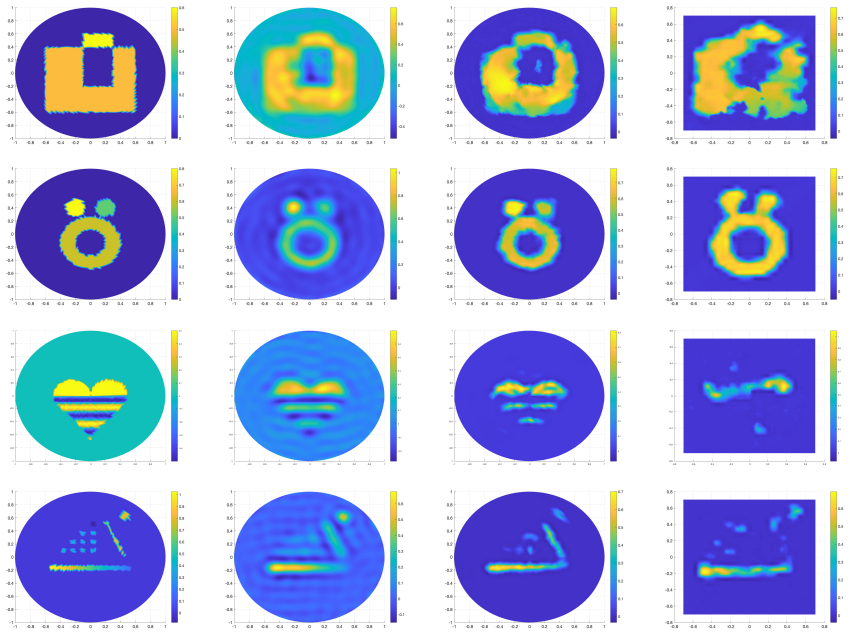
This work proposes a hybrid method (ULR) which integrates a rotation-equivariance-aware neural network and a low-rank structure to solve the two dimensional inverse medium scattering problem. The neural network is to model the data corrector which maps the full data to the Born data, and the low-rank structure is to design an inverse Born solver that finds a regularized solution from the perturbed Born data. The proposed rotation-equivariance-aware neural network naturally incorporates the reciprocity relation and the rotation-equivariance in inverse scattering, while the low-rank structure effectively filters high-frequency noise in the output of the neural network and leads to a regularized method supported by theoretical stability in the Born region. For a comparative study, we replace the low-rank inverse Born solver by another rotation-equvariance-aware neural network to propose a two-step neural network (UU). Furthermore, we extend the proposed methods (ULR and UU) to tackle the more challenging case with only limited aperture data. A variety of numerical experiments are conducted to compare the proposed ULR, UU, and a black-box neural network.
Editorial analysis
A structured set of objections, weighed in public.
Referee Report
Summary. The manuscript proposes a hybrid method (ULR) for the 2D inverse medium scattering problem that uses a rotation-equivariance-aware neural network to map full scattering data to Born data, followed by a low-rank inverse Born solver to produce a regularized reconstruction. It also introduces a two-step neural network variant (UU), extends both approaches to limited-aperture data, and presents numerical comparisons against a black-box neural network.
Significance. If the neural-network residual remains a controlled high-frequency perturbation compatible with the low-rank Born analysis, the hybrid construction would supply a theoretically grounded route to stable reconstructions beyond the linear Born regime while exploiting reciprocity and rotational symmetry. The explicit separation of a learned corrector from a classical regularized solver is a constructive contribution to physics-informed inverse-problem methods.
major comments (3)
- [Abstract] Abstract: the assertion that the low-rank structure 'effectively filters high-frequency noise in the output of the neural network and leads to a regularized method supported by theoretical stability in the Born region' is not accompanied by any a-priori or a-posteriori bound on ||NN(full data) – true Born data|| or on the spectral content of the residual. Without such control, the stability theorem for the low-rank Born solver does not transfer to the composite ULR output.
- [Numerical experiments] Numerical experiments section: the reported comparisons of ULR against UU and the black-box network demonstrate improved reconstructions, yet contain no quantitative assessment of residual magnitude versus contrast strength or frequency decomposition of the NN error. These diagnostics are required to confirm that the low-rank step is actually operating inside the regime where its stability guarantee applies.
- [Method] Method section on the neural-network architecture: the claim that the rotation-equivariance-aware network 'naturally incorporates the reciprocity relation and the rotation-equivariance' needs an explicit statement of how these symmetries are enforced (e.g., via data augmentation, equivariant layers, or a symmetry-preserving loss) so that the reader can verify the architectural design.
minor comments (2)
- Figure captions should explicitly state the contrast values, noise levels, and aperture angles used in each panel so that the limited-aperture results can be reproduced.
- Notation for the low-rank parameter and the Born data operator should be introduced once and used consistently throughout the theoretical and algorithmic sections.
Simulated Author's Rebuttal
We thank the referee for the constructive and detailed comments. We address each major comment below and indicate the revisions we will make to strengthen the manuscript.
read point-by-point responses
-
Referee: [Abstract] Abstract: the assertion that the low-rank structure 'effectively filters high-frequency noise in the output of the neural network and leads to a regularized method supported by theoretical stability in the Born region' is not accompanied by any a-priori or a-posteriori bound on ||NN(full data) – true Born data|| or on the spectral content of the residual. Without such control, the stability theorem for the low-rank Born solver does not transfer to the composite ULR output.
Authors: We agree that an explicit bound on the neural-network residual would permit a direct transfer of the stability theorem. The current manuscript supports the claim via numerical evidence that the residual remains small and high-frequency for the tested contrasts and frequencies. In the revision we will add quantitative residual diagnostics (norm versus contrast and frequency decomposition) and will rephrase the abstract to state that the low-rank step supplies regularization when the NN error is empirically controlled, as verified in our experiments. revision: yes
-
Referee: [Numerical experiments] Numerical experiments section: the reported comparisons of ULR against UU and the black-box network demonstrate improved reconstructions, yet contain no quantitative assessment of residual magnitude versus contrast strength or frequency decomposition of the NN error. These diagnostics are required to confirm that the low-rank step is actually operating inside the regime where its stability guarantee applies.
Authors: We accept that the requested quantitative diagnostics would better confirm the operating regime of the low-rank solver. We will insert additional figures and tables in the Numerical experiments section that report the L² residual norm between NN output and true Born data as a function of contrast strength, together with spectral decompositions of the error to demonstrate its high-frequency character. revision: yes
-
Referee: [Method] Method section on the neural-network architecture: the claim that the rotation-equivariance-aware network 'naturally incorporates the reciprocity relation and the rotation-equivariance' needs an explicit statement of how these symmetries are enforced (e.g., via data augmentation, equivariant layers, or a symmetry-preserving loss) so that the reader can verify the architectural design.
Authors: We will expand the Method section with an explicit description of the symmetry mechanisms. Rotation-equivariance is realized by equivariant convolutional layers constructed from irreducible representations of the rotation group, while reciprocity is enforced by training-data augmentation that includes reciprocal configurations together with a reciprocity-consistent loss term. revision: yes
Circularity Check
No circularity; hybrid NN + low-rank derivation is self-contained with independent training and regularization steps.
full rationale
The paper trains a rotation-equivariance-aware NN on data to map full scattering observations to Born data, then applies a separate low-rank inverse Born solver whose stability analysis is drawn from the standard Born regime. No equation reduces a claimed prediction to a fitted parameter by construction, no load-bearing premise rests on self-citation, and the low-rank filter is presented as an external regularization technique rather than an ansatz derived from the NN itself. Numerical comparisons with UU and black-box NN further treat the components as distinct. The derivation chain therefore contains no self-definitional or fitted-input reductions.
Axiom & Free-Parameter Ledger
free parameters (1)
- low-rank parameter
Reference graph
Works this paper leans on
-
[1]
F. B¨ urgel, K. S. Kazimierski, and A. Lechleiter. Algorithm 1001: Ipscatt—a matlab toolbox for the inverse medium problem in scattering.ACM Transactions on Mathematical Software (TOMS), 45(4):1–20, 21 (a) Ground truthq 5 10 15 20 25 30 35 40 45 50 55 10 20 30 40 50 60 70 80 90 100 -0.06 -0.04 -0.02 0 0.02 0.04 0.06 0.08 0.1 (b)ℜu 5 10 15 20 25 30 35 40 4...
work page 2019
-
[2]
F. Cakoni and D. Colton.A qualitative approach to inverse scattering theory. A Qualitative Approach to Inverse Scattering Theory, 2014
work page 2014
- [3]
- [4]
- [5]
- [6]
-
[7]
X. Chen, Z. Wei, M. Li, and P. Rocca. A review of deep learning approaches for inverse scattering problems (invited review).Progress In Electromagnetics Research, 167:67–81, 2020
work page 2020
-
[8]
D. L. Colton and R. Kress.Inverse acoustic and electromagnetic scattering theory, volume 93. Springer, 1998
work page 1998
- [9]
-
[10]
Y. Gao, H. Liu, X. Wang, and K. Zhang. On an artificial neural network for inverse scattering problems. Journal of Computational Physics, 448:110771, 2022
work page 2022
-
[11]
I. Goodfellow, Y. Bengio, A. Courville, and Y. Bengio.Deep learning, volume 1. MIT press Cambridge, 2016
work page 2016
- [12]
-
[13]
P. Greengard and K. Serkh. On generalized prolate spheroidal functions –preliminary report. Technical report, Technical Report YALEU/DCS/TR–1542, 2018. 22 Figure 14: Reconstruction of number “4” and its rotation. Left to right: ground truth, reconstructions by ULR, UU, and U, respectively. In the first row, we test an in-distribution contrast. In the seco...
work page 2018
-
[14]
Y. Khoo and L. Ying. Switchnet: A neural network model for forward and inverse scattering problems. SIAM Journal on Scientific Computing, 41(5):A3182–A3201, 2019
work page 2019
-
[15]
A. Kirsch and N. Grinberg.The factorization method for inverse problems, volume 36. OUP Oxford, 2007
work page 2007
-
[16]
A. Kirsch and R. Kress. On an integral equation of the first kind in inverse acoustic scattering. InInverse Problems: Proceedings of the Conference held at the Mathematical Research Institute at Oberwolfach, Black Forest, May 18–24, 1986, pages 93–102. Springer, 1986
work page 1986
-
[17]
A. Kirsch and R. Kress. A numerical method for an inverse scattering problem. InInverse and ill-posed problems, pages 279–289. Elsevier, 1987
work page 1987
-
[18]
A. Kirsch and R. Kress. An optimization method in inverse acoustic scattering.Boundary elements IX, 3:3–18, 1987
work page 1987
- [19]
-
[20]
K. Li, B. Zhang, and H. Zhang. Reconstruction of inhomogeneous media by an iteration algorithm with a learned projector.Inverse Problems, 40(7):075008, 2024
work page 2024
-
[21]
S. Meng. Data-driven basis for reconstructing the contrast in inverse scattering: Picard criterion, regu- larity, regularization, and stability.SIAM Journal on Applied Mathematics, 83(5):2003–2026, 2023
work page 2003
-
[22]
S. Meng and B. Zhang. A kernel machine learning for inverse source and scattering problems.SIAM Journal on Numerical Analysis, 62(3):1443–1464, 2024
work page 2024
-
[23]
J. Ning, F. Han, and J. Zou. A direct sampling-based deep learning approach for inverse medium scattering 23 Figure 15: Reconstruction of out-distributional contrasts with limited aperture data. From left to right: ground truth, reconstructions by ULR, UU, and U, respectively. problems.Inverse Problems, 40(1):015005, 2024
work page 2024
- [24]
-
[25]
O. Ronneberger, P. Fischer, and T. Brox. U-net: Convolutional networks for biomedical image segmen- tation. InInternational Conference on Medical image computing and computer-assisted intervention, pages 234–241. Springer, 2015
work page 2015
-
[26]
D. Slepian. Prolate spheroidal wave functions, fourier analysis and uncertainty—iv: extensions to many dimensions; generalized prolate spheroidal functions.Bell System Technical Journal, 43(6):3009–3057, 1964
work page 1964
-
[27]
D. Slepian and H. O. Pollak. Prolate spheroidal wave functions, fourier analysis and uncertainty—i.Bell System Technical Journal, 40(1):43–63, 1961
work page 1961
-
[28]
K. Xu, C. Zhang, X. Ye, and R. Song. Fast full-wave electromagnetic inverse scattering based on scalable cascaded convolutional neural networks.IEEE Transactions on Geoscience and Remote Sensing, 60, 2022
work page 2022
- [29]
- [30]
-
[31]
Y. Zhou, L. Audibert, S. Meng, and B. Zhang. Exploring low-rank structure for an inverse scattering problem with far-field data.SIAM Journal on Applied Mathematics, 86(1):179–205, 2026. 25
work page 2026
discussion (0)
Sign in with ORCID, Apple, or X to comment. Anyone can read and Pith papers without signing in.