Recognition: unknown
A quadratic form generalization of rational dinv
Pith reviewed 2026-05-10 14:21 UTC · model grok-4.3
The pith
A quadratic form on the gap poset recovers the dinv statistic for Young subdiagrams and defines nonnegative cross-dinv.
A machine-rendered reading of the paper's core claim, the machinery that carries it, and where it could break.
Core claim
We introduce the quadratic form Q on functions on G. Its evaluation on the indicator of an upward closed subset recovers dinv exactly. The symmetric bilinear form associated to Q equals the cross-dinv on pairs of subdiagrams and is nonnegative. This implies the inequality showing effective positive definiteness for decreasing functions on G.
What carries the argument
The quadratic form Q on the vector space of real-valued functions on the gap poset G of the numerical semigroup generated by two coprime integers a and b.
Load-bearing premise
The quadratic form Q is defined in a particular way using the poset structure so that it matches the dinv values on the indicator functions of upward closed subsets.
What would settle it
Finding an upward closed subset D in some gap poset G for which the computed value of Q on the indicator of D does not equal the Gorsky-Mazin dinv statistic of D would falsify the main claim.
Figures


read the original abstract
We introduce a quadratic form $Q$ on the space of functions on the gap poset $G$ of the numerical semigroup $\langle a,b\rangle$. We prove combinatorially that when evaluated on the indicator function of an upward closed subset $D$, this quadratic form precisely recovers the Gorsky--Mazin $\mathtt{dinv}$ statistic of $D$, viewed as a Young subdiagram of $G$. Furthermore, we prove Theorem~1.2 that when evaluated on a pair of subdiagrams of $G$, the symmetric bilinear form associated with $Q$ is equal to a novel cross-$\mathtt{dinv}$ statistic, which is nonnegative. Combining these, we prove the inequality \[ Q(\mathbf{n})\geq \dfrac{1}{|G|}\,\|\mathbf{n}\|_\infty^2\] if $\mathbf{n}$ is a real-valued decreasing function on $G$, showing an effective positive definiteness of $Q$ on the corresponding cone. Theorem~1.2, the main engine of the paper, was autoformalized in Lean/Mathlib by AxiomProver.
Editorial analysis
A structured set of objections, weighed in public.
Referee Report
Summary. The manuscript introduces a quadratic form Q on the space of functions on the gap poset G of the numerical semigroup ⟨a,b⟩ with a,b coprime. It claims a combinatorial proof that Q evaluated on the indicator function of an upward-closed subset D recovers the Gorsky-Mazin dinv statistic of D viewed as a Young subdiagram of G. Theorem 1.2 asserts that the associated symmetric bilinear form equals a novel cross-dinv statistic which is nonnegative (autoformalized in Lean/Mathlib), and these facts are combined to prove the inequality Q(n) ≥ (1/|G|) ‖n‖_∞² for real-valued decreasing functions n on G, establishing effective positive definiteness on the cone of decreasing functions.
Significance. If the combinatorial identifications hold, the work supplies a quadratic-form generalization of rational dinv that recovers the statistic on indicators and extends via nonnegative cross-dinv to an inequality on real decreasing functions. The Lean autoformalization of Theorem 1.2 is a clear strength, furnishing machine-checked support for the nonnegativity engine that underpins the main inequality. This supplies a rigorous, parameter-free bridge between poset combinatorics, quadratic forms, and dinv statistics.
minor comments (2)
- [§2] §2: the explicit coordinate formula for the quadratic form Q on the gap poset would benefit from an accompanying small example (e.g., a=3, b=5) showing recovery of dinv on a concrete upward-closed set.
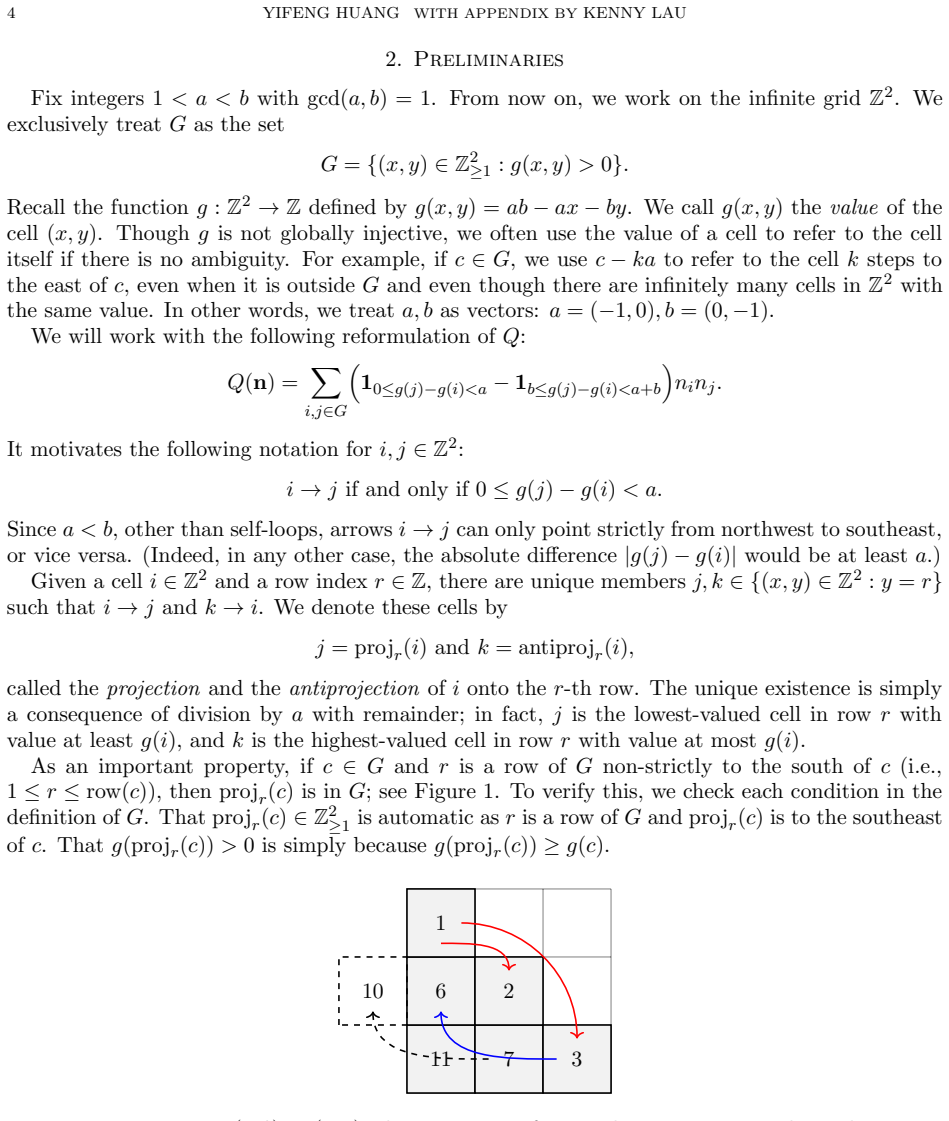
- [Introduction] Introduction and §3: a short diagram of the gap poset G together with the partial order would improve readability for readers outside numerical-semigroup combinatorics.
Simulated Author's Rebuttal
We thank the referee for their positive and encouraging report, which accurately summarizes the main contributions of the manuscript, and for recommending acceptance.
Circularity Check
No significant circularity
full rationale
The paper explicitly defines the quadratic form Q on functions over the gap poset G of the numerical semigroup generated by coprime a and b. It then supplies a combinatorial proof that Q applied to the indicator of an upward-closed subset D recovers the Gorsky-Mazin dinv statistic, relying on the standard poset structure rather than defining Q in terms of dinv. Theorem 1.2 identifies the associated symmetric bilinear form with a novel combinatorially nonnegative cross-dinv statistic on pairs of subdiagrams; this identification is machine-checked via Lean/Mathlib formalization by AxiomProver, providing independent verification. The inequality Q(n) ≥ (1/|G|) ||n||_∞² for real decreasing n is derived directly from the two preceding facts. No step reduces by construction to its own inputs, no parameters are fitted to data, and no load-bearing claim rests on self-citation chains. The derivation is self-contained against external combinatorial and formal benchmarks.
Axiom & Free-Parameter Ledger
axioms (1)
- domain assumption The gap poset G of the numerical semigroup generated by two coprime integers admits a natural partial order whose upward-closed subsets correspond to Young subdiagrams.
invented entities (1)
-
Quadratic form Q
no independent evidence
Reference graph
Works this paper leans on
-
[1]
A. M. Garsia and M. Haiman,A remarkableq, t-Catalan sequence andq-Lagrange inversion, J. Algebraic Combin. 5(1996), no. 3, 191–244
1996
-
[2]
Gorsky and M
E. Gorsky and M. Mazin,Compactified Jacobians andq, t-Catalan numbers, J. Combin. Theory Ser. A120(2013), no. 1, 49–63
2013
-
[3]
Gorsky and M
E. Gorsky and M. Mazin,Compactified Jacobians andq, t-Catalan numbers, II, J. Algebraic Combin.39(2014), no. 1, 153–186
2014
-
[4]
Huang, R
Y. Huang, R. Jiang, and A. Oblomkov,The Quot scheme of points on torus knot singularities, In preparation
-
[5]
Loehr and G
N. Loehr and G. Warrington,Nested quantum Dyck paths and∇(s λ), Int. Math. Res. Not. IMRN (2008), RNM157
2008
-
[6]
The Mathlib Community, The Lean Mathematical Library, inProceedings of the 9th ACM SIGPLAN International Conference on Certified Programs and Proofs (CPP 2020), ACM, 2020
2020
-
[7]
de Moura, S
L. de Moura, S. Kong, J. Avigad, F. van Doorn, and J. von Raumer, The Lean theorem prover (system description), inAutomated Deduction – CADE-25, Lecture Notes in Computer Science 9195, Springer, 2015, 378–388
2015
-
[8]
Oblomkov, J
A. Oblomkov, J. Rasmussen, and V. Shende.The Hilbert scheme of a plane curve singularity and the HOMFLY homology of its link, Geom. Topol.22(2018), no. 2, 645–691. With an appendix by Eugene Gorsky
2018
discussion (0)
Sign in with ORCID, Apple, or X to comment. Anyone can read and Pith papers without signing in.