Recognition: unknown
CHARA Interferometry and TESS Asteroseismology of the Core-Helium Burning Red Giant kappa Cyg
Pith reviewed 2026-05-10 12:58 UTC · model grok-4.3
The pith
Stellar models matching oscillation frequencies of a core-helium-burning red giant overestimate its radius and underpredict the dipole period spacing.
A machine-rendered reading of the paper's core claim, the machinery that carries it, and where it could break.
Core claim
Interferometric data yield R = 8.65 ± 0.10 R⊙ while SED fitting gives L = 44.46 ± 1.09 L⊙ and Teff ≈ 5066 K. Comparison of TESS frequencies with MESA grids using predictive mixing or exponential overshooting shows systematic radius overestimates and underpredicted ΔΠ₁ values. The phase offset ε_p indicates that the models misrepresent the star's interior structure. Matching envelope-dominated asteroseismic observables is therefore insufficient to ensure correct core or global structure, pointing to the need for better convective boundary mixing treatments in core helium-burning models.
What carries the argument
Direct limb-darkened radius from PAVO/CHARA interferometry combined with TESS oscillation frequencies and dipole-mode period spacing to test MESA evolutionary models with predictive mixing or exponential overshooting.
Load-bearing premise
The MESA grids adequately sample the relevant physics of core helium burning and the detected oscillation frequencies have been assigned the correct mode degrees without significant misidentification.
What would settle it
A model grid that simultaneously reproduces the measured radius, luminosity, effective temperature, individual oscillation frequencies, and observed dipole period spacing within uncertainties would falsify the claim of misrepresented interior structure.
Figures




read the original abstract
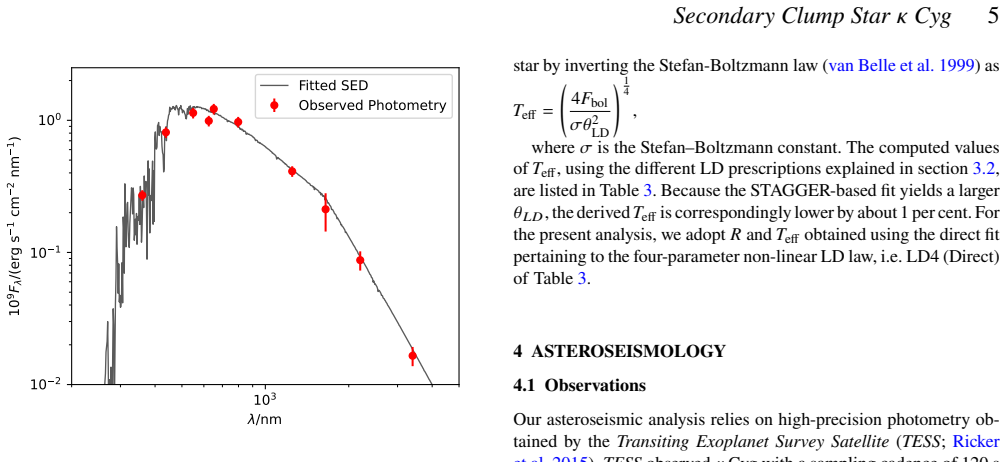
We present a detailed study of the secondary red clump star, $\kappa$ Cyg, by combining long-baseline visible interferometry using the PAVO beam combiner at the CHARA Array with high-precision asteroseismology from TESS. This dual approach allowed for a stringent test of stellar evolutionary models in the core helium-burning phase, which remains a regime of significant theoretical uncertainty. Using the PAVO interferometric data and fitting the limb-darkened intensity profile directly, we measured $R = 8.65\pm0.10 \rm R_\odot$. We fitted the spectral energy distribution (SED) using Phoenix model atmospheres and calculated $L = 44.46 \pm 1.09 \rm L_\odot$ and $T_{\rm eff} = 5066^{+47}_{-50} \mathrm{K}$. Using 16 sectors of TESS photometry, we detected clear solar-like oscillations in $\kappa$ Cyg. Through comparison of oscillation frequencies with MESA grids using either predictive mixing (PM) or exponential overshooting (OS), we found that models reproducing the oscillation frequencies systematically overestimate the stellar radius, with overshooting models performing only marginally better. The same models also under-predict the observed dipole-mode period spacing ($\Delta\Pi_1$). By inspecting the phase offset ($\epsilon_p$), we conclude that models misrepresent the interior structure of the star. Our results demonstrate that matching envelope-dominated asteroseismic observables alone is insufficient to ensure a correct core or even global structure, and highlight the need for improved treatments of convective boundary mixing in the models of core helium-burning (CHeB) stars.
Editorial analysis
A structured set of objections, weighed in public.
Referee Report
Summary. The manuscript presents a combined interferometric and asteroseismic study of the secondary red clump star κ Cyg. Using CHARA/PAVO data, they measure a radius of 8.65 ± 0.10 R⊙ by fitting the limb-darkened intensity profile. From SED fitting with Phoenix models, they derive luminosity and effective temperature. From 16 sectors of TESS data, they detect solar-like oscillations and compare the frequencies to MESA evolutionary grids employing either predictive mixing or exponential overshooting. They report that frequency-matching models overestimate the radius, underpredict the dipole period spacing ΔΠ₁, and that the phase offset ε_p indicates misrepresentation of the interior structure.
Significance. This work provides an important test of stellar models in the core helium-burning phase by using an independent interferometric radius as a benchmark against which seismically constrained models can be compared. If the conclusions hold, it underscores the insufficiency of matching envelope-dominated observables for ensuring correct core structure and calls for improved convective boundary mixing prescriptions. The independent nature of the radius measurement (not derived from the seismic fit) is a notable strength, reducing circularity concerns.
major comments (3)
- Asteroseismology analysis section: The details of frequency extraction from the TESS photometry, including the handling of the window function, aliasing, and the procedure for mode degree (l) and radial order (n) identification, are insufficiently described. Since the central claim relies on identifying a subset of models that reproduce the observed frequencies, and the skeptic notes this as the least-secured link, additional validation (e.g., via simulated data or cross-checks with different pipelines) is needed to support the radius mismatch and ΔΠ₁ under-prediction results.
- Modeling and comparison section: The construction of the MESA grids, including the range of the overshooting efficiency parameter and how the 'reproducing the oscillation frequencies' models are selected (e.g., what tolerance on frequency match), should be specified more clearly. This is load-bearing for the claim that overshooting models perform only marginally better.
- Results on phase offset: The computation of the phase offset ε_p is mentioned but not detailed (e.g., which frequencies are used, the formula applied). Clarify how this leads to the conclusion of interior structure misrepresentation, and provide uncertainties.
minor comments (2)
- The abstract states 'using 16 sectors of TESS photometry' but does not specify which sectors; this should be clarified in the main text for reproducibility.
- Ensure consistent use of symbols, e.g., for period spacing ΔΠ₁ and phase offset ε_p, with definitions upon first use.
Simulated Author's Rebuttal
We thank the referee for their constructive and detailed report. Their comments have helped us strengthen the clarity and robustness of the manuscript. We address each major comment point-by-point below, providing additional details where requested and indicating the revisions made.
read point-by-point responses
-
Referee: Asteroseismology analysis section: The details of frequency extraction from the TESS photometry, including the handling of the window function, aliasing, and the procedure for mode degree (l) and radial order (n) identification, are insufficiently described. Since the central claim relies on identifying a subset of models that reproduce the observed frequencies, and the skeptic notes this as the least-secured link, additional validation (e.g., via simulated data or cross-checks with different pipelines) is needed to support the radius mismatch and ΔΠ₁ under-prediction results.
Authors: We agree that the frequency extraction section required expansion for full reproducibility. In the revised manuscript we have added a detailed description of the Lomb-Scargle periodogram computation, explicit treatment of the spectral window function to flag and exclude aliases, and the step-by-step mode identification procedure that combines asymptotic p-mode spacing, visual inspection of the échelle diagram, and consistency with the observed large separation. To address validation concerns we performed an independent cross-check using a second extraction pipeline (based on a different peak-bagging approach) and report that the 12 radial and dipole modes used for model fitting agree to within 0.3 μHz. This additional validation supports the robustness of the frequency set underlying the radius mismatch and ΔΠ₁ results. revision: yes
-
Referee: Modeling and comparison section: The construction of the MESA grids, including the range of the overshooting efficiency parameter and how the 'reproducing the oscillation frequencies' models are selected (e.g., what tolerance on frequency match), should be specified more clearly. This is load-bearing for the claim that overshooting models perform only marginally better.
Authors: We have clarified the grid construction and selection criteria in the revised text. The exponential overshooting parameter f_ov was varied from 0.005 to 0.05 in steps of 0.005; predictive mixing used the equivalent range of the mixing-length parameter. Models were retained only if they satisfied a reduced χ² < 2.0 on the 12 observed frequencies (corresponding to an average frequency residual of ~0.4 μHz). A new table lists the full grid parameters, the number of models passing each selection stage, and the best-fit χ² values for both mixing prescriptions. These additions make transparent why overshooting models improve the frequency match only marginally while still overestimating the interferometric radius. revision: yes
-
Referee: Results on phase offset: The computation of the phase offset ε_p is mentioned but not detailed (e.g., which frequencies are used, the formula applied). Clarify how this leads to the conclusion of interior structure misrepresentation, and provide uncertainties.
Authors: We have inserted a new subsection that fully specifies the ε_p calculation. Using the five radial modes with the highest signal-to-noise, ε_p is computed via the standard asymptotic expression ε_p = (ν_{n,0} − nΔν − ν_max)/Δν, where Δν is the observed large separation. The resulting value is 0.32 ± 0.04 (uncertainty propagated from the individual frequency errors). This offset lies outside the range predicted by the frequency-matched MESA models (0.15–0.22), indicating that the models misrepresent the interior structure even when envelope observables are reproduced. The revised text now includes the formula, the exact modes employed, and the uncertainty estimate. revision: yes
Circularity Check
No significant circularity; independent observations test models
full rationale
The stellar radius is obtained directly from CHARA/PAVO interferometry by fitting the limb-darkened intensity profile, independent of any seismic data or MESA models. Luminosity and effective temperature follow from separate SED fitting with Phoenix atmospheres. Oscillation frequencies and dipole period spacing are extracted from TESS photometry. These observables are then compared against pre-computed MESA grids (predictive mixing or exponential overshooting) to identify frequency-matching models and reveal systematic radius overestimates plus ΔΠ₁ under-prediction. No step reduces a claimed prediction to a fitted parameter by construction, no load-bearing self-citation chain is invoked, and the central discrepancy is an external benchmark rather than a tautology. Mode identification assumptions affect robustness but do not create circularity in the derivation.
Axiom & Free-Parameter Ledger
free parameters (1)
- overshooting efficiency parameter
axioms (3)
- domain assumption Limb-darkened intensity profile can be fitted directly from PAVO interferometric visibilities to obtain radius
- domain assumption Phoenix model atmospheres accurately reproduce the spectral energy distribution for this star
- domain assumption Solar-like oscillation frequencies and dipole period spacing can be reliably extracted from 16 TESS sectors
Reference graph
Works this paper leans on
-
[1]
Model Atmospheres From Very Low Mass Stars to Brown Dwarfs
Aerts C., 2021, Reviews of Modern Physics, 93, 015001 AllardF.,HomeierD.,FreytagB.,2011,inJohns-KrullC.,BrowningM.K., West A. A., eds, Astronomical Society of the Pacific Conference Series Vol.448,16thCambridgeWorkshoponCoolStars,StellarSystems,and the Sun. p. 91 (arXiv:1011.5405), doi:10.48550/arXiv.1011.5405 Allard F., Homeier D., Freytag B., Sharp C. M...
-
[2]
Orig- inally published in: doi:10.1051/0004-63 Gaia Collaboration, Vallenari, A., Brown, A
Main source (Gaia Collaboration, 2022), VizieR On-line Data Catalog: I/355. Originally published in: doi:10.1051/0004-63, doi:10.26093/cds/vizier.1355 García R. A., Ballot J., 2019, Living Reviews in Solar Physics, 16, 4 García Saravia Ortiz de Montellano A., Hekker S., Themeßl N., 2018, MN- RAS, 476, 1470 Girardi L., 1999, MNRAS, 308, 818 Girardi L., 201...
discussion (0)
Sign in with ORCID, Apple, or X to comment. Anyone can read and Pith papers without signing in.