JWST spectroscopy of SN 2010da/NGC 300 ULX-1: a surviving star hidden by dust
Pith reviewed 2026-05-10 12:50 UTC · model grok-4.3
The pith
The donor star in SN 2010da has survived its outburst and returned to a heavily dust-obscured state.
A machine-rendered reading of the paper's core claim, the machinery that carries it, and where it could break.
Core claim
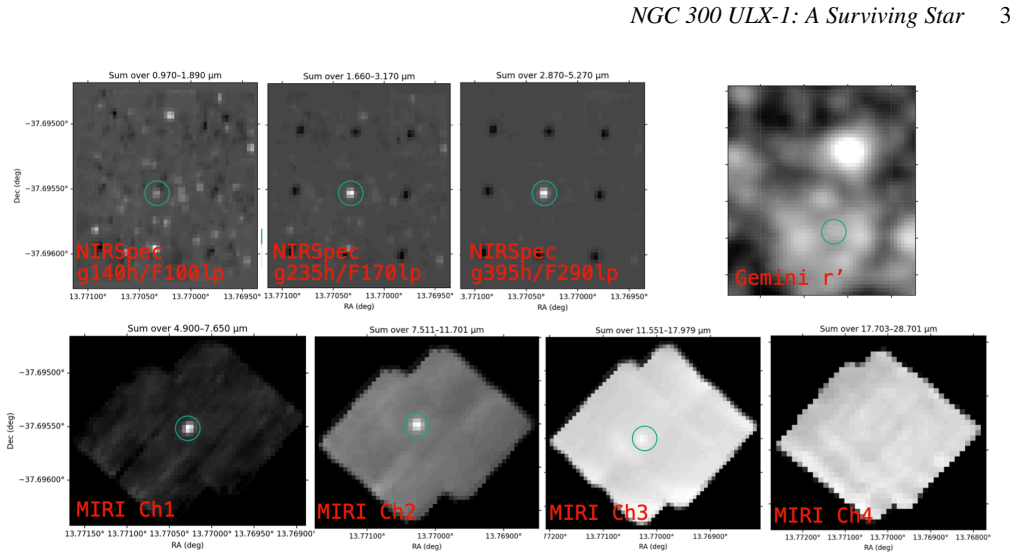
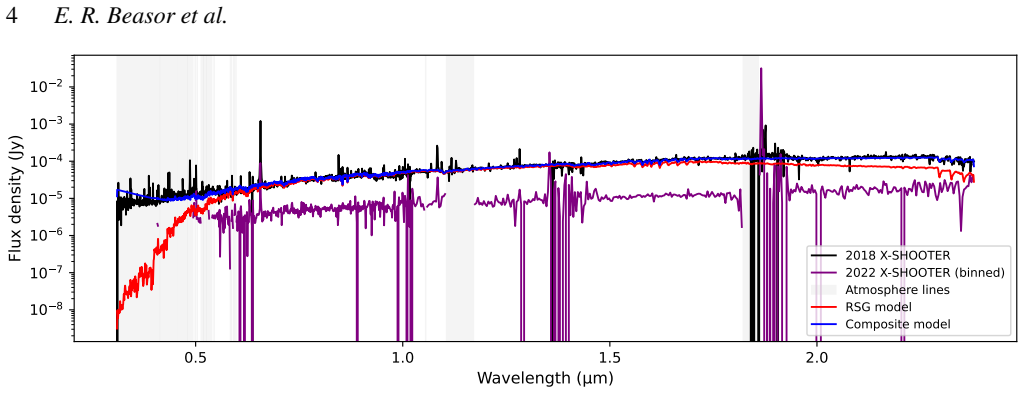
The donor star survived the 2010 outburst as a luminous AGB star that is now again hidden inside an optically thick warm dust shell. JWST data show the source has faded, lost its red-supergiant spectral signatures, and returned to a mid-infrared SED best reproduced by silicon-carbide grains, with a bolometric luminosity log(L/Lsun) = 4.11 that indicates a surviving star rather than a fading remnant.
What carries the argument
Radiative-transfer modeling of the JWST mid-infrared SED that identifies silicon-carbide dust and yields the bolometric luminosity of the central source.
If this is right
- The 2010 outburst initiated sustained super-Eddington accretion that temporarily altered the circumstellar environment.
- Eruptive mass loss and dust formation can be studied in real time through the transient red-supergiant phase of this donor.
- Similar ULX systems may cycle between dust-obscured and temporarily visible states.
- Binary interaction can drive the observed changes in dust composition and stellar appearance on decade timescales.
Where Pith is reading between the lines
- Future infrared monitoring could track changes in dust temperature and composition as the system evolves.
- The presence of silicon-carbide dust may indicate that the donor has undergone carbon-rich evolution driven by binary mass transfer.
- This case suggests that some neutron-star ULXs host AGB donors capable of surviving super-Eddington episodes without disruption.
- The revised timeline offers a template for interpreting other transient ULX or supernova impostor events.
Load-bearing premise
The modeling of the mid-infrared SED uniquely identifies silicon-carbide dust and the measured luminosity comes from a surviving star rather than residual emission from other components.
What would settle it
Continued monitoring that shows the luminosity dropping well below log(L/Lsun) = 4 or the disappearance of the 11-micron emission feature would falsify the surviving-star interpretation.
Figures


read the original abstract
We present new James Webb Space Telescope ($JWST$) NIRSpec and MIRI integral-field spectroscopy of the remarkable system SN~2010da / NGC~300 ULX-1, the only known ultraluminous X-ray source powered by a neutron star with a supergiant donor. Our new data, taken in November 2024, reveal that the optical and near-infrared counterpart has dramatically faded since 2018 and no longer exhibits molecular absorption features characteristic of a red supergiant. Instead, the spectral energy distribution shows the donor has returned to its pre-outburst appearance, and is dominated by infrared continuum consistent with an optically thick warm ($\approx$900~K) dust shell. The bolometric luminosity indicates the presence of a surviving luminous source with $\log(L/L_{\odot})=4.11\pm0.02$. Radiative transfer modelling of the mid-infrared spectral energy distribution (SED) reveals a broad emission feature peaking near $\sim$11\,$\mu$m, best reproduced by silicon carbide (SiC) dust grains, a composition typically associated with carbon-rich evolved stars. We rule out a failed supernova scenario, which would predict a large drop in luminosity and continued fading. We conclude that the donor star is likely an AGB star that has survived and is now heavily enshrouded - having returned to a dust-obscured state following a transient post-outburst phase in which the system appeared as a red supergiant. We propose a revised evolutionary timeline in which the 2010 outburst initiated sustained super-Eddington accretion and temporarily altered the circumstellar environment. These observations provide rare insight into eruptive mass loss, dust formation, and binary interaction in a unique system.
Editorial analysis
A structured set of objections, weighed in public.
Referee Report
Summary. The manuscript presents new JWST NIRSpec and MIRI integral-field spectroscopy of SN 2010da/NGC 300 ULX-1 taken in November 2024. It reports that the optical/NIR counterpart has faded dramatically since 2018, no longer exhibits molecular absorption features of a red supergiant, and the SED is now dominated by warm (~900 K) dust continuum consistent with an optically thick shell. Radiative transfer modeling of the mid-IR SED identifies a broad ~11 μm emission feature best reproduced by silicon carbide (SiC) grains. The integrated bolometric luminosity is log(L/L⊙)=4.11±0.02, which the authors interpret as evidence for a surviving luminous source. They rule out a failed-supernova scenario and conclude that the donor is a surviving AGB star that has returned to a dust-obscured state after a transient post-outburst red-supergiant phase, proposing a revised evolutionary timeline for the system.
Significance. If the central claims hold, the work supplies rare direct observational constraints on donor-star evolution, eruptive mass loss, and dust formation in a neutron-star ULX. The fading and return to a dust-dominated state are well-supported by the new spectroscopy and provide a concrete timeline for binary interaction effects. The luminosity measurement and SiC identification, if robustly demonstrated, would strengthen links between carbon-rich AGB stars and ULX donors.
major comments (2)
- [Radiative transfer modelling] Radiative transfer modelling section: the statement that the ~11 μm feature is 'best reproduced by silicon carbide (SiC) dust grains' requires quantitative model-comparison statistics (e.g., Δχ², BIC, or posterior odds) against plausible alternatives such as silicates, amorphous carbon, or mixed compositions. Without these, the unique association with a carbon-rich AGB star remains under-constrained and directly affects the evolutionary interpretation.
- [Luminosity and scenario exclusion] Bolometric luminosity derivation and failed-supernova exclusion: the integrated log(L/L⊙)=4.11±0.02 is presented as requiring a surviving central star, yet the manuscript does not provide explicit luminosity budgets or SED fits testing alternative heating sources (ongoing super-Eddington accretion, residual outburst energy, or light echoes). This assumption is load-bearing for rejecting the failed-supernova scenario and for the claim of a surviving AGB donor.
minor comments (2)
- [Observations] The abstract and main text should explicitly state the wavelength coverage and resolution of the NIRSpec and MIRI data used for the SED construction.
- [Modelling] Clarify the exact dust temperature and optical-depth assumptions adopted in the radiative-transfer grid; these are stated as ≈900 K but the fitting procedure and parameter ranges are not detailed.
Simulated Author's Rebuttal
We thank the referee for their thoughtful and constructive report. We address each major comment below and have revised the manuscript to strengthen the analysis where possible.
read point-by-point responses
-
Referee: [Radiative transfer modelling] Radiative transfer modelling section: the statement that the ~11 μm feature is 'best reproduced by silicon carbide (SiC) dust grains' requires quantitative model-comparison statistics (e.g., Δχ², BIC, or posterior odds) against plausible alternatives such as silicates, amorphous carbon, or mixed compositions. Without these, the unique association with a carbon-rich AGB star remains under-constrained and directly affects the evolutionary interpretation.
Authors: We agree that quantitative model-comparison statistics are needed to robustly support the SiC identification. In the revised manuscript we have added a new subsection to the radiative transfer modelling section that presents fits to alternative compositions (amorphous silicates, amorphous carbon, and silicate-carbon mixtures). We report Δχ² and BIC values showing that the SiC model is statistically preferred (ΔBIC > 15 relative to the next-best single-component model). We also note that mixed compositions remain viable at lower significance and have updated the evolutionary discussion to reflect this more nuanced interpretation. revision: yes
-
Referee: [Luminosity and scenario exclusion] Bolometric luminosity derivation and failed-supernova exclusion: the integrated log(L/L⊙)=4.11±0.02 is presented as requiring a surviving central star, yet the manuscript does not provide explicit luminosity budgets or SED fits testing alternative heating sources (ongoing super-Eddington accretion, residual outburst energy, or light echoes). This assumption is load-bearing for rejecting the failed-supernova scenario and for the claim of a surviving AGB donor.
Authors: We appreciate the referee drawing attention to this point. The quoted luminosity is obtained by direct integration of the observed SED from optical through mid-IR. In the revised manuscript we have added an explicit paragraph discussing alternative heating mechanisms. Residual outburst energy is disfavored because the IR luminosity has remained stable since 2018 with no continued fading; light echoes are inconsistent with the spatially unresolved IFU data; and ongoing super-Eddington accretion would be expected to produce detectable X-ray variability that is not observed. While we have not performed full radiative-transfer modeling of an accretion disk (which would require additional free parameters not constrained by the current data), the combination of stable high luminosity and lack of X-ray activity continues to rule out a failed-supernova scenario. We have made these arguments more quantitative in the text. revision: partial
Circularity Check
No circularity: results follow from new JWST spectra and standard radiative-transfer fitting to observed SED.
full rationale
The paper's central conclusions rest on direct interpretation of fresh observational data (NIRSpec/MIRI spectra showing faded optical/NIR counterpart, ~900 K dust continuum, and ~11 μm feature) combined with conventional radiative-transfer modeling to match the mid-IR SED and integrate bolometric luminosity. No equation or modeling step defines a quantity in terms of itself or renames a fitted parameter as an independent prediction. The SiC identification and surviving-star interpretation are presented as inferences from the data fit, not as inputs that are then recovered by construction. Self-citations to prior observations of the same source are used only for context and do not carry the load-bearing uniqueness claims. The derivation chain therefore remains externally anchored to the new spectra rather than internally tautological.
Axiom & Free-Parameter Ledger
free parameters (2)
- Dust temperature =
~900 K
- Bolometric luminosity =
log(L/Lsun) = 4.11 +/- 0.02
axioms (1)
- domain assumption Standard assumptions of radiative transfer codes for optically thick dust shells apply without significant deviations from spherical symmetry or unusual grain properties.
Reference graph
Works this paper leans on
-
[1]
Abbott B. P ., et al., 2017, Phys. Rev. Lett., 118, 221101 Adams S. M., Kochanek C. S., Gerke J. R., Stanek K. Z., Dai X., 2017, MN- RAS, 468, 4968 MNRAS 000, 1–8 (2026) 8 E. R. Beasor et al. Aghakhanloo M., et al., 2023a, MNRAS, 521, 1941 Aghakhanloo M., et al., 2023b, MNRAS, 526, 456 Amari S., Lewis R. S., Anders E., 1994, Geochimica Cosmochimica Acta ,...
-
[2]
2026, in Encyclopedia of Astrophysics, Volume 2, Vol
pp 508–532 (arXiv:2509.22990), doi:10.1016/B978-0-443-21439-4.00147-4 Smith N., Hartigan P ., 2006, ApJ, 638, 1045 Smith N., Gehrz R. D., Hinz P . M., Hoffmann W. F., Hora J. L., Mamajek E. E., Meyer M. R., 2003, AJ, 125, 1458 Smith N., Li W., Filippenko A. V ., Chornock R., 2011a, Monthly Notices of the Royal Astronomical Society, 412, 1522 Smith N., Li ...
discussion (0)
Sign in with ORCID, Apple, or X to comment. Anyone can read and Pith papers without signing in.