Optimal constant for the trace inequality in BV for domains with corners
Pith reviewed 2026-05-10 12:39 UTC · model grok-4.3
The pith
The optimal constant in the BV trace inequality is explicitly determined for domains with a specific class of corner singularities.
A machine-rendered reading of the paper's core claim, the machinery that carries it, and where it could break.
Core claim
For domains belonging to a particular class of singularities, the optimal constant in the trace inequality for functions of bounded variation is computed explicitly.
What carries the argument
The optimal constant C in the trace inequality ∫_{∂Ω} |u| dH^{n-1} ≤ C |Du|(Ω) (up to lower-order terms), obtained by analyzing the contribution of jumps and the geometry at each corner.
If this is right
- The trace operator from BV(Ω) to L1(∂Ω) is bounded with the sharp constant for every domain in the class.
- All variational problems or existence proofs that use the trace inequality on these domains can now employ the precise constant instead of a looser general bound.
- The constant is determined solely by the opening angles of the corners and is independent of the rest of the domain geometry.
Where Pith is reading between the lines
- The same local-corner analysis might be used to obtain lower bounds on the constant for domains with more complicated singularities by approximation.
- Numerical minimization of the Rayleigh quotient for the trace inequality on a polygonal domain could be compared directly with the paper's formula to verify the result.
- If the class can be enlarged, the same technique might yield explicit constants for domains with cracks or cusps.
Load-bearing premise
The domain must belong to the restricted class of singularities for which the constant can be reduced to a local geometric computation at the corners.
What would settle it
Take a concrete domain from the class, such as a square, and a sequence of BV functions that concentrate near a corner; if the ratio of boundary integral to total variation exceeds the paper's explicit value, the claimed constant is not optimal.
Figures


read the original abstract
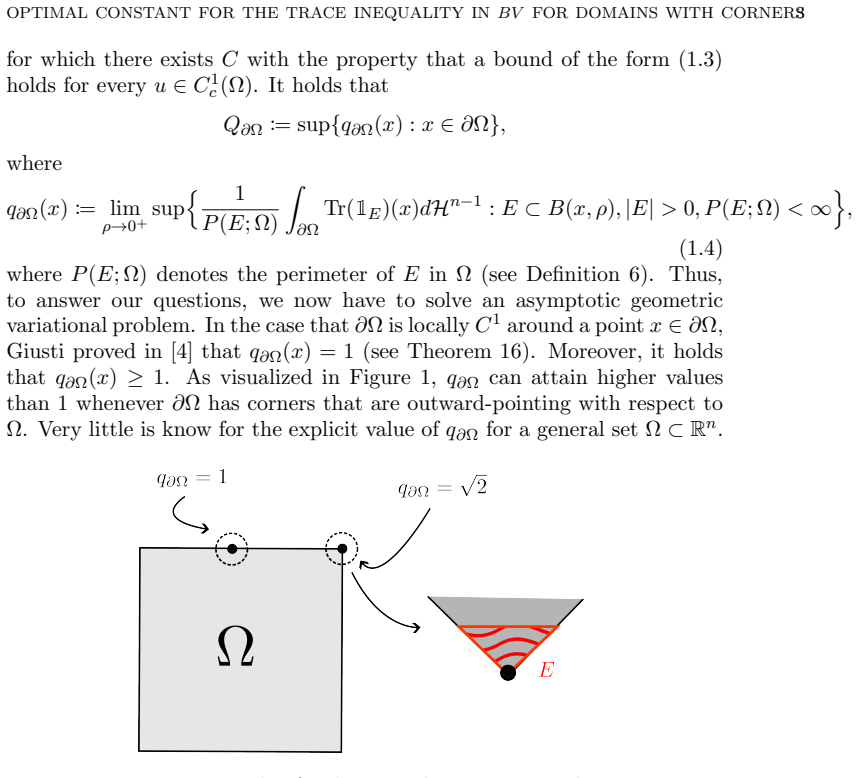
We determine the explicit value of the optimal constant in the trace inequality for functions of bounded variations in the case the domain has a particular class of singularities.
Editorial analysis
A structured set of objections, weighed in public.
Referee Report
Summary. The manuscript determines the explicit value of the optimal constant in the trace inequality for functions of bounded variation (BV) on domains belonging to a specific class of domains with corner singularities (finite number of corners with opening angles in a closed interval bounded away from 0 and 2π, together with a global Lipschitz condition away from the corners). The proof reduces the global inequality to local model problems at each corner, solves the model problems via explicit test functions or duality, obtains the upper bound by a covering argument, and establishes sharpness by a sequence of functions concentrating at the worst corner.
Significance. If the result holds, it supplies an explicit optimal constant for the BV trace inequality on a concrete class of non-smooth domains, extending the classical theory for Lipschitz or smooth domains. The localization to model corner problems together with the explicit construction of test functions and the verification of sharpness via concentrating sequences constitute a clear methodological strength, yielding a computable constant rather than a mere existence statement.
minor comments (3)
- In the introduction, a brief comparison of the obtained constant with the known value for smooth domains would help readers gauge the effect of the corners.
- §3, the covering argument: the dependence of the global constant on the number of corners and on the Lipschitz constant of the boundary away from the corners is stated but not quantified; an explicit estimate would improve readability.
- In the duality argument for the model problem (around Eq. (4.5)), the verification that the chosen test functions saturate the bound could be expanded by one or two lines to make the optimality transparent.
Simulated Author's Rebuttal
We thank the referee for the positive evaluation of the manuscript, the clear summary of our results, and the recommendation for minor revision. No specific major comments were raised in the report.
Circularity Check
No significant circularity; derivation is self-contained
full rationale
The paper reduces the global trace inequality to local model problems near corners, solves the model problems explicitly using test functions and duality arguments, and establishes sharpness via concentrating sequences. All steps rely on standard BV theory, covering arguments, and direct computation of constants from the geometry of the singularities; no equation reduces to a fitted parameter renamed as prediction, no load-bearing premise rests on self-citation, and no ansatz is smuggled in. The central claim is therefore independent of its own inputs and receives the default non-circularity finding.
Axiom & Free-Parameter Ledger
Reference graph
Works this paper leans on
-
[1]
G. Anzellotti and M. Giaquinta , Funzioni BV e tracce , Rendiconti del Seminario Matematico della Universit \`a di Padova, 60 (1978), pp. 1--21
work page 1978
-
[2]
D. L. Cohn , Measure theory , vol. 5, Springer, 2013
work page 2013
-
[3]
R. Cristoferi and G. Gravina , On the relaxation of functionals with contact terms on non-smooth domains , Indiana University, 72 (2023), pp. 197--238
work page 2023
-
[4]
E. Giusti , Boundary value problems for non-parametric surfaces of prescribed mean curvature , Annali della Scuola Normale Superiore di Pisa-Classe di Scienze, 3 (1976), pp. 501--548
work page 1976
-
[5]
Leoni , A first course in Sobolev spaces , American Mathematical Soc., 2017
G. Leoni , A first course in Sobolev spaces , American Mathematical Soc., 2017
work page 2017
-
[6]
F. Maggi , Sets of finite perimeter and geometric variational problems: an introduction to Geometric Measure Theory , no. 135, Cambridge University Press, 2012
work page 2012
-
[7]
Modica , Gradient theory of phase transitions with boundary contact energy , Ann
L. Modica , Gradient theory of phase transitions with boundary contact energy , Ann. Inst. H. Poincar\' e Anal. Non Lin\' e aire, 4 (1987), pp. 487--512
work page 1987
discussion (0)
Sign in with ORCID, Apple, or X to comment. Anyone can read and Pith papers without signing in.