Noncoherent Maximum Likelihood Detection for LoRa Signals in Multipath Fading
Pith reviewed 2026-05-10 13:05 UTC · model grok-4.3
The pith
A noncoherent maximum likelihood detector for LoRa signals in Rician multipath fading matches or exceeds coherent detectors using only channel statistics.
A machine-rendered reading of the paper's core claim, the machinery that carries it, and where it could break.
Core claim
The noncoherent ML detection rule is derived by averaging the likelihood function over the Rician fading distribution. It achieves performance equivalent to existing coherent detectors in time-invariant channels and surpasses them under Doppler shifts, all without relying on channel estimation or preamble-extracted reference signals.
What carries the argument
The noncoherent maximum likelihood detection rule formulated from the Rician multipath channel statistics, which eliminates dependence on instantaneous CSI.
If this is right
- Channel estimation overhead is eliminated for LoRa receivers in multipath settings.
- Detection remains reliable without extracting reference signals from the preamble.
- Performance holds or improves when Doppler shift is present compared with coherent alternatives.
- The low-complexity scheme suits battery-constrained LoRa devices operating in urban or indoor multipath.
Where Pith is reading between the lines
- Receiver architectures for other chirp-based modulations could adopt similar noncoherent formulations to reduce synchronization demands.
- In rapidly varying channels the avoidance of CSI tracking may lower overall latency beyond what the paper simulates.
- Field measurements in real LoRa deployments could confirm whether the Rician assumption holds closely enough for the performance gains to appear.
Load-bearing premise
The fading channel follows a Rician multipath model whose statistics are known and stationary enough to allow the noncoherent likelihood to be written without instantaneous channel values.
What would settle it
A direct comparison in a time-invariant Rician channel where the NCML detector shows higher error rates than a coherent detector supplied with perfect CSI would disprove the equivalence claim.
Figures

read the original abstract
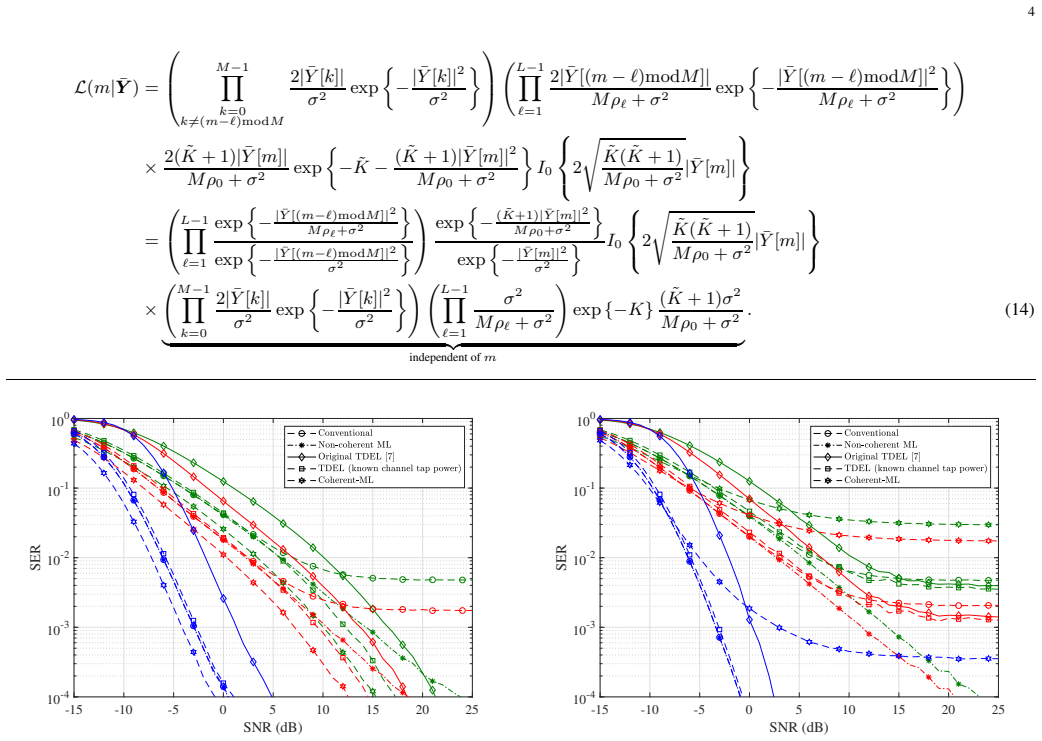
This letter derives the noncoherent (NC) maximum likelihood (ML) detection rule for LoRa signals under Rician multi-path fading channel. The proposed NC-ML detection only requires the channel statistic, not the actual instantaneous channel state information (CSI), which eliminates the overhead associated with channel estimation. Simulation results show that despite the low-complexity, the proposed detection scheme significantly improves the performance of LoRa detection over multipath channel. Notably, in time-invariant channel, the NCML receiver can achieve an equivalently good performance as compared to existing coherent schemes, and even surpasses them when Doppler shift is present, while not relying on the channel estimation nor reference signal extracted from the preamble.
Editorial analysis
A structured set of objections, weighed in public.
Referee Report
Summary. The manuscript derives the noncoherent maximum likelihood (NCML) detection rule for LoRa signals in Rician multipath fading by marginalizing the likelihood over the known channel distribution. It claims that this detector requires only stationary channel statistics (K-factor and power-delay profile) rather than instantaneous CSI, eliminating preamble-based estimation overhead. Simulations are reported to show that NCML matches coherent performance in time-invariant channels and exceeds it under Doppler, while remaining low-complexity.
Significance. If the derivation is exact and the performance claims prove robust, the result would be useful for LoRa deployments in multipath and mobile environments by removing channel-estimation overhead. The approach follows standard marginalization techniques but applies them specifically to LoRa chirp waveforms; credit is due for the explicit noncoherent formulation and the reported Doppler gains.
major comments (2)
- [§III] §III (NCML Derivation): The likelihood is obtained by integrating the conditional density over the Rician distribution with fixed K and PDP; the headline claims of equivalence to coherent receivers (time-invariant case) and superiority under Doppler therefore rest on these parameters being known exactly and stationary. No sensitivity analysis or mismatch simulations are provided, leaving open whether the reported gains survive realistic statistic estimation error.
- [§IV] §IV (Simulation Results, Figs. 3–5): The coherent baselines appear to assume perfect instantaneous CSI while NCML uses perfect statistics; the cross-scheme comparison is therefore asymmetric. Adding curves for coherent detection with realistic preamble-based estimation error (and NCML with estimated K/PDP) would be required to substantiate the “surpasses them when Doppler shift is present” claim.
minor comments (2)
- [Eq. (3)] Eq. (3) and surrounding text: the definition of the noncoherent metric could explicitly state the integration limits and the normalization constant to facilitate reproduction.
- [Table I] Table I: the listed simulation parameters (K-factor, number of paths, Doppler range) should be cross-referenced to the exact values used in each figure for clarity.
Simulated Author's Rebuttal
We thank the referee for the constructive comments and the opportunity to improve our manuscript. We respond to each major comment below.
read point-by-point responses
-
Referee: [§III] §III (NCML Derivation): The likelihood is obtained by integrating the conditional density over the Rician distribution with fixed K and PDP; the headline claims of equivalence to coherent receivers (time-invariant case) and superiority under Doppler therefore rest on these parameters being known exactly and stationary. No sensitivity analysis or mismatch simulations are provided, leaving open whether the reported gains survive realistic statistic estimation error.
Authors: The NCML derivation in Section III assumes that the Rician K-factor and power delay profile are known and stationary, which is a standard assumption for noncoherent detection based on channel statistics. These parameters can be obtained from long-term channel measurements or estimated over multiple packets in LoRa networks, avoiding the overhead of instantaneous CSI estimation. The equivalence to coherent detection in time-invariant channels and the gains under Doppler are shown under this model. We acknowledge the lack of mismatch analysis in the original manuscript. To address this, we have added a new subsection in the revised version discussing the sensitivity to statistic estimation errors, including simulation results for mismatched K and PDP. revision: partial
-
Referee: [§IV] §IV (Simulation Results, Figs. 3–5): The coherent baselines appear to assume perfect instantaneous CSI while NCML uses perfect statistics; the cross-scheme comparison is therefore asymmetric. Adding curves for coherent detection with realistic preamble-based estimation error (and NCML with estimated K/PDP) would be required to substantiate the “surpasses them when Doppler shift is present” claim.
Authors: We agree that the initial simulations compare the ideal cases. However, the key advantage of NCML is its operation without any channel estimation, which is particularly beneficial when Doppler makes instantaneous CSI acquisition unreliable. In the revised manuscript, we have updated the simulation results to include a practical coherent detector that uses preamble-based estimation under Doppler spread. The updated figures demonstrate that NCML maintains its performance while the practical coherent scheme suffers degradation, thereby supporting the claim. We have also clarified in the text that NCML statistics are assumed known but can be estimated independently. revision: yes
Circularity Check
NCML derivation is first-principles marginalization with no reduction to inputs
full rationale
The paper derives the noncoherent ML detector by integrating the conditional likelihood over the known Rician multipath distribution to obtain a decision rule that depends only on channel statistics. This is a standard application of the ML criterion under the stated model assumptions and does not involve any fitted parameters renamed as predictions, self-definitional loops, or load-bearing self-citations. Simulation comparisons to coherent receivers are presented as empirical outcomes under the model, not forced equivalences. No steps in the provided derivation chain reduce by construction to the paper's own inputs.
Axiom & Free-Parameter Ledger
axioms (2)
- domain assumption Rician multipath fading channel model with known statistics
- standard math Maximum likelihood optimality criterion for detection
Reference graph
Works this paper leans on
-
[1]
Understanding the limits of LoRa W AN,
F. Adelantado et. al., “Understanding the limits of LoRa W AN,” IEEE Commun. Mag. , vol. 55, no. 9, pp. 34-40, Sep. 2017
work page 2017
-
[2]
LoRa wireless li nk per- formance in multipath underground mines,
L. Emmanuel, W. Farjow and X. Fernando, “LoRa wireless li nk per- formance in multipath underground mines,” in Proc. Int. Conf. Innov. Intell. Informat., Comput., Technol. , Sakhier, Bahrain, 2019, pp. 1-4
work page 2019
-
[3]
Theoretical pe rformance of LoRa system in multipath and interference channels,
C. Demeslay, P . Rostaing and R. Gautier, “Theoretical pe rformance of LoRa system in multipath and interference channels,” IEEE Internet Things J. , vol. 9, no. 9, pp. 6830-6843, May 2022
work page 2022
-
[4]
Approximate BER performan ce of LoRa modulation with heavy multipath interference,
J. Liu, Y . Y an, H. Y u and B. Ma, “Approximate BER performan ce of LoRa modulation with heavy multipath interference,” IEEE Wireless Commun. Lett. , vol. 12, no. 5, pp. 853-857, May 2023
work page 2023
-
[5]
Study of frequency domain e qual- ization for chirp spread spectrum systems,
K. Huang, R. Tao, and Y . Wang, “Study of frequency domain e qual- ization for chirp spread spectrum systems,” in Proc. IEEE Int. Conf. Wireless Commun. Netw. Inf. Security , Beijing, China, 2010, pp. 132– 136
work page 2010
-
[6]
Time-delay-estimation-liked detect ion algorithm for LoRa signals over multipath channels,
Y . Guo and Z. Liu, “Time-delay-estimation-liked detect ion algorithm for LoRa signals over multipath channels,” IEEE Wireless Commun. Lett. , vol. 9, no. 7, pp. 1093-1096, Jul. 2020
work page 2020
-
[7]
Simple and effic ient LoRa receiver scheme for multipath channel,
C. Demeslay, P . Rostaing and R. Gautier, “Simple and effic ient LoRa receiver scheme for multipath channel,” IEEE Internet Things J. , vol. 9, no. 17, pp. 15771-15785, Sep. 2022
work page 2022
-
[8]
AN1200.13: SX1272/3/6/7/8: LoRa Modem , SemTech, Camarillo, CA, USA, Jul. 2013
work page 2013
-
[9]
Block interleaved chirp spreading LoRa m odulation over multipath channels,
J. Liu et. al., “Block interleaved chirp spreading LoRa m odulation over multipath channels,” IEEE Trans. V eh. Technol. , vol. 73, no. 7, pp. 10840-10844, Jul. 2024
work page 2024
-
[10]
Goldsmith, Wireless Communications
A. Goldsmith, Wireless Communications. Cambridge Univ. Press, 2005
work page 2005
-
[11]
https://www.itu.int/oth/R0A0E00000C/en
ITU, International Telecommunication Union Guidelinesn for ev aluation of radio transmission technologies for IMT-2000, Recommendation ITU- R M.1225, 1997. https://www.itu.int/oth/R0A0E00000C/en
work page 2000
-
[12]
Generalized mom ent-based method for SNR estimation,
M. Bakkali, A. Stephenne and S. Affes, “Generalized mom ent-based method for SNR estimation,” in Proc. IEEE Wireless Communications and Networking Conference , Hong Kong, China, 2007, pp. 2226–2230
work page 2007
discussion (0)
Sign in with ORCID, Apple, or X to comment. Anyone can read and Pith papers without signing in.