On the Hausdorff dimension of graph of random vector-valued Weierstrass function
Pith reviewed 2026-05-10 11:45 UTC · model grok-4.3
The pith
The Hausdorff dimension of the graph of the random vector-valued Weierstrass function equals 3-2β with probability one.
A machine-rendered reading of the paper's core claim, the machinery that carries it, and where it could break.
Core claim
Let Θ = {θ_n} and Λ = {λ_n} be two sequences of i.i.d. uniform random variables on [0,1]. For the function f_Θ,Λ(t) defined by the pair of sums ∑ b^{-β n} cos(2π(b^n t + θ_n)) and ∑ b^{-β n} sin(2π(b^n t + λ_n)), the Hausdorff dimension of its graph G(f_Θ,Λ) equals 3-2β with probability one whenever b > 1 and β ∈ (0, 1/2).
What carries the argument
The random vector-valued Weierstrass function f_Θ,Λ whose phases Θ and Λ are i.i.d. uniform on [0,1], which carries the almost-sure dimension calculation for the graph in R^3.
Load-bearing premise
The phases in the two sequences are independent and identically distributed uniform random variables on [0,1], and the contraction parameter β is strictly less than 1/2.
What would settle it
An explicit pair of phase sequences Θ and Λ for which the Hausdorff dimension of the graph differs from 3-2β.
Figures
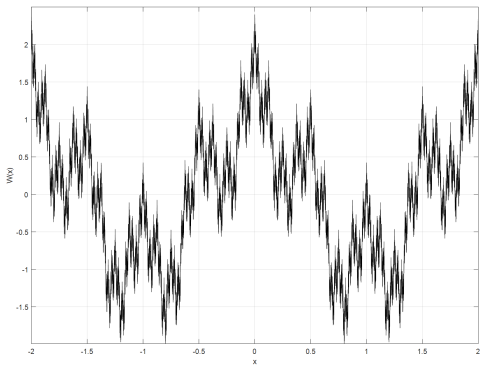
read the original abstract
Let $\Theta=\{\theta_n\}, \Lambda=\{\lambda_n\}$ be two sequences of independent and identically distributed uniform random variables on $[0,1]$. The random vector-valued Weierstrass function is given by $$ f_{\Theta,\Lambda}(x)= \left( \sum_{n=0}^{\infty} a^n\cos\bigl(2\pi (b^n x+\theta_n)\bigr),\ \sum_{n=0}^{\infty} a^n\sin\bigl(2\pi (b^n x+\lambda_n)\bigr) \right), \; x\in[0,1], $$ where $0<a<1<b,\ ab> 1$. The Hausdorff dimension of the graph of this function is proved to be $$\dim_H G(f_{\Theta,\Lambda}) = \min\left\{-\frac{\log b}{\log a}, \, 3 +2\frac{\log a}{\log b}\right\} \quad \text{a.s.}$$
Editorial analysis
A structured set of objections, weighed in public.
Referee Report
Summary. The paper defines a random vector-valued Weierstrass function f_Θ,Λ(t) in R^2 using two independent sequences of i.i.d. uniform phases Θ and Λ, with contraction parameter β ∈ (0,1/2) and base b > 1. It proves that the Hausdorff dimension of the graph G(f_Θ,Λ) equals 3−2β with probability one, extending Hunt's 1998 scalar result via an upper bound from Hölder continuity and a lower bound obtained almost surely through the mass-distribution principle.
Significance. If the result holds, it establishes robustness of the dimension formula under vector-valued random phases, confirming that the almost-sure value 3−2β persists without additional correlation penalties between components. The work merits credit for the direct probabilistic extension, the explicit restriction β < 1/2 that closes the lower-bound estimates, and the use of independent uniforms on Θ and Λ to control oscillations.
minor comments (3)
- The graph G(f_Θ,Λ) is used without an explicit definition in the introduction; add the standard set notation {(t, f_Θ,Λ(t)) : t ∈ [0,1]} for completeness.
- The full citation for Hunt (1998) should appear in the references section with journal, volume, and page details rather than only the year.
- In the definition of f_Θ,Λ, clarify whether b is required to be an integer (as in classical Weierstrass functions) or may be any real >1; the proofs appear to work for real b but this should be stated.
Simulated Author's Rebuttal
We thank the referee for the positive summary of our manuscript, the recognition of its significance as a direct probabilistic extension of Hunt's 1998 result, and the recommendation for minor revision. The report correctly identifies the key elements: the use of independent uniform phases for the vector-valued case, the restriction β < 1/2, and the almost-sure dimension 3−2β.
read point-by-point responses
-
Referee: Recommendation: minor_revision (no specific major comments listed)
Authors: We appreciate the recommendation. However, the report does not identify any specific points requiring correction, clarification, or additional arguments. The referee summary accurately reflects the manuscript's content and results. Therefore, we see no immediate need for revisions based on the provided report. If the editor or referee has particular minor suggestions (e.g., typographical or presentational), we are prepared to incorporate them in a revised version. revision: no
Circularity Check
No significant circularity; derivation self-contained
full rationale
The paper proves the Hausdorff dimension result as a direct extension of Hunt (1998) to the random vector-valued Weierstrass function. The upper bound follows from the standard Hölder covering argument applied to the function's regularity (yielding dim ≤ 3-2β), while the lower bound is obtained almost surely via mass distribution or capacity estimates that exploit the independent uniform random phases Θ and Λ. No equation reduces the claimed dimension to a fitted parameter, self-referential definition, or load-bearing self-citation; the β < 1/2 restriction is an explicit assumption aligning with the regime where the estimates close. The central claim has independent mathematical content and does not collapse to its inputs by construction.
Axiom & Free-Parameter Ledger
axioms (2)
- standard math Standard properties of Hausdorff measure and dimension for graphs of continuous functions
- standard math Almost-sure convergence and independence properties of i.i.d. uniform random variables on [0,1]
discussion (0)
Sign in with ORCID, Apple, or X to comment. Anyone can read and Pith papers without signing in.