Recognition: unknown
Analysis of Lyman-beta and Lyman-gamma Lines in a Pre-Eruptive and Eruptive Prominence with Solar Orbiter SPICE Observations
Pith reviewed 2026-05-10 11:55 UTC · model grok-4.3
The pith
Lyman beta and gamma line observations with SPICE show changes in density, temperature, and optical thickness in a solar prominence before and during eruption.
A machine-rendered reading of the paper's core claim, the machinery that carries it, and where it could break.
Core claim
The central claim is that SPICE observations of the Lyman beta and Lyman gamma lines in an off-limb prominence allow the derivation of changes in physical parameters such as density, temperature, and optical thickness between pre-eruptive and eruptive phases. Spatial and temporal analysis of line profiles reveals enhanced variations during eruption, and a simple geometric model using paired 2D GONG H alpha images yields the radial velocity at the onset of eruption. This method offers a means to calculate radial velocity from two-dimensional images and accounts for potential Doppler effects in the spectra.
What carries the argument
The Lyman beta and Lyman gamma line profiles, whose integrated intensities and widths are analyzed for variations, combined with a simple geometric model applied to pairs of H alpha images to extract radial velocity.
If this is right
- Variations in line intensity and width between regions indicate dynamic changes in prominence plasma conditions.
- The eruption increases spatial and temporal variations in the spectral profiles.
- Radial velocity of the prominence can be obtained from a pair of 2D images using the geometric model.
- These observations highlight the diagnostic potential of SPICE for prominence studies, paving the way for more detailed Non-LTE modeling.
Where Pith is reading between the lines
- This technique could be applied to other eruptive events observed by Solar Orbiter to build statistics on prominence velocities.
- Combining SPICE Lyman data with other instruments might allow cross-validation of the geometric velocity estimates.
- The approach suggests that even without full radiative transfer, basic line properties can give first-order insights into plasma evolution during eruptions.
Load-bearing premise
The assumption that a simple geometric model on paired images accurately gives the true radial velocity without major projection effects, and that line profile changes can be directly linked to density, temperature, and optical thickness variations without detailed non-LTE radiative transfer calculations.
What would settle it
A direct comparison of the geometrically derived radial velocity with independent measurements such as spectroscopic Doppler shifts from the same event or stereoscopic 3D reconstructions from multiple viewpoints would confirm or refute the velocity estimate.
Figures




read the original abstract
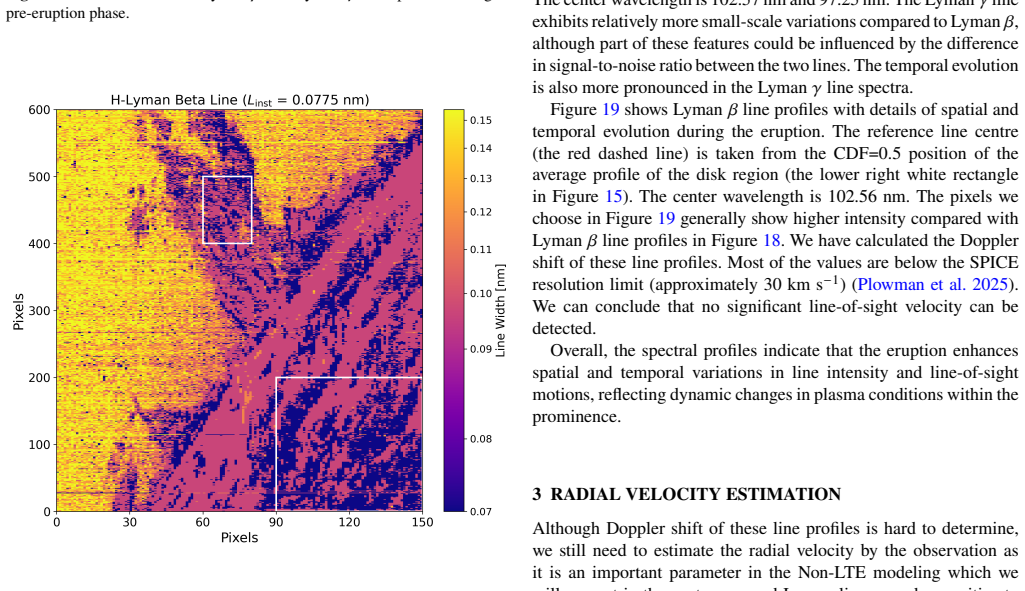
The first dedicated observation of an off-limb prominence by the Spectral Imaging of the Coronal Environment (SPICE) instrument on board Solar Orbiter took place on April 15, 2023. Our aim is to provide an overview of the potentiality of the diagnostics using these data. We show that we can derive the changes in the physical parameters of the pre-eruptive and eruptive prominence using the Lyman lines. We investigate the integrated intensity and line widths of the Lyman $\beta$ and Lyman $\gamma$ lines, finding variations between the prominence, disk, and coronal regions. The results reflect dynamic changes in density, temperature, and optical thickness. We analyze the spatial and temporal evolution of the Lyman $\beta$ and Lyman $\gamma$ line profiles. Using a simple geometric model, we obtain the radial velocity of this prominence at the early phase of its eruption with GONG H$\alpha$ images. This offers a way of calculating the radial velocity of an eruptive filament from a pair of 2D images. The result helps us understand the potential Doppler effect in line profiles. Overall, the spectral profiles indicate that the eruption enhances spatial and temporal variations in line intensity, reflecting dynamic changes in plasma conditions within the prominence. These findings highlight the diagnostic potential of SPICE observations, and future Non-LTE radiative transfer modeling will help to further constrain prominence plasma parameters.
Editorial analysis
A structured set of objections, weighed in public.
Referee Report
Summary. The paper presents the first dedicated SPICE observations of an off-limb prominence on 15 April 2023, analyzing Lyman-β and Lyman-γ line profiles to report variations in integrated intensity and line width between pre-eruptive and eruptive phases. These variations are interpreted as reflecting dynamic changes in density, temperature, and optical thickness. A simple geometric model applied to paired SPICE Lyman and GONG Hα 2D images is used to derive the radial velocity during the early eruption phase, with the result offered as a general method for estimating radial velocities from 2D image pairs.
Significance. If the geometric model and qualitative interpretations hold, the work demonstrates the diagnostic potential of SPICE Lyman-line observations for prominences and provides an accessible approach to radial-velocity estimation from imaging data alone. The reported spatial-temporal evolution of line profiles supplies concrete observational constraints on eruptive plasma dynamics that can guide future modeling.
major comments (2)
- [Abstract and §3] Abstract and §3: The simple geometric model for radial velocity is introduced without a detailed description of its construction, the assumed prominence geometry (e.g., rigid structure, negligible line-of-sight depth, uniform emissivity), or quantitative treatment of projection and line-of-sight effects. Because this model supplies the reported radial-velocity value and is used to interpret Doppler contributions to the line profiles, the lack of error propagation or sensitivity tests makes the velocity claim load-bearing and currently under-supported.
- [Abstract] Abstract: The statement that changes in physical parameters are derived from the Lyman lines rests on qualitative attribution of intensity and width variations to density, temperature, and optical-thickness changes. No non-LTE radiative-transfer calculations or forward-modeling results are presented to demonstrate uniqueness or to convert the observed quantities into parameter values; the manuscript defers such modeling to future work, leaving the derivation claim qualitative rather than quantitative.
Simulated Author's Rebuttal
We thank the referee for their constructive and detailed comments, which have helped us improve the clarity and rigor of the manuscript. We address each major comment point by point below.
read point-by-point responses
-
Referee: [Abstract and §3] Abstract and §3: The simple geometric model for radial velocity is introduced without a detailed description of its construction, the assumed prominence geometry (e.g., rigid structure, negligible line-of-sight depth, uniform emissivity), or quantitative treatment of projection and line-of-sight effects. Because this model supplies the reported radial-velocity value and is used to interpret Doppler contributions to the line profiles, the lack of error propagation or sensitivity tests makes the velocity claim load-bearing and currently under-supported.
Authors: We agree that the geometric model requires a more complete description to support the reported radial velocity. In the revised manuscript we have expanded §3 with a step-by-step account of the model construction, explicit statements of the assumed geometry (rigid structure, negligible line-of-sight depth, uniform emissivity), and a quantitative discussion of projection and line-of-sight effects. We have also added error propagation and sensitivity tests to the velocity estimate. These additions directly address the load-bearing nature of the result and strengthen its use in interpreting the line profiles. revision: yes
-
Referee: [Abstract] Abstract: The statement that changes in physical parameters are derived from the Lyman lines rests on qualitative attribution of intensity and width variations to density, temperature, and optical-thickness changes. No non-LTE radiative-transfer calculations or forward-modeling results are presented to demonstrate uniqueness or to convert the observed quantities into parameter values; the manuscript defers such modeling to future work, leaving the derivation claim qualitative rather than quantitative.
Authors: We concur that the present analysis remains qualitative. The manuscript already notes that non-LTE radiative-transfer calculations are reserved for future work. To prevent any overstatement, we have revised the abstract and the relevant discussion in §3 to state that the observed variations in intensity and line width indicate dynamic changes in density, temperature, and optical thickness, rather than claiming quantitative derivation of specific parameter values. This revision aligns the language with the scope of the current study. revision: yes
Circularity Check
No significant circularity detected
full rationale
The paper analyzes new SPICE Lyman line observations of a prominence and applies a simple geometric model to separate GONG Hα image pairs to estimate radial velocity. Physical parameter changes are inferred qualitatively from integrated intensity and width variations in the Lyman-β and Lyman-γ lines. No derivation step reduces a reported result (velocity or parameter evolution) to a quantity fitted from the same dataset by construction, nor does any load-bearing claim rest on a self-citation chain, imported uniqueness theorem, or ansatz smuggled from prior work. The central claims remain independent of the input data reductions.
Axiom & Free-Parameter Ledger
axioms (1)
- domain assumption Simple geometric model converts apparent 2D motion in paired images to radial velocity without significant line-of-sight confusion
Reference graph
Works this paper leans on
-
[1]
Curdt W., Brekke P., Feldman U., Wilhelm K., Dwivedi B. N., Schühle U., Lemaire P., 2001, A&A, 375, 591 Ebadi H., Vial J.-C., Ajabshirizadeh A., 2009, Solar Physics, 257, 91 Fludra A., et al., 2021, Astronomy & Astrophysics, 656, A38 Gunár S., Heinzel P., Anzer U., Schmieder B., 2008, A&A, 490, 307 Harvey J. W., et al., 1996, Science, 272, 1284 Hasegawa T...
discussion (0)
Sign in with ORCID, Apple, or X to comment. Anyone can read and Pith papers without signing in.