Recognition: unknown
Non-LTE Analysis of Pre-eruptive Prominence Plasma Parameters Effects on the Lyman-beta and Lyman-gamma Lines with Solar Orbiter SPICE Observations
Pith reviewed 2026-05-10 11:50 UTC · model grok-4.3
The pith
Non-LTE models constrained by Solar Orbiter observations identify central pressure, column mass, and temperature gradient as the main controls on Lyman-beta and Lyman-gamma line formation in prominences.
A machine-rendered reading of the paper's core claim, the machinery that carries it, and where it could break.
Core claim
The paper shows that an ensemble of 200 random non-LTE models, bounded by SPICE observations of a pre-eruptive prominence and by incident radiation derived from a November 13, 2023 full-disk mosaic, yields clear inferences about the central pressure, column mass, and temperature gradient that govern the formation of the Lyman beta and Lyman gamma lines.
What carries the argument
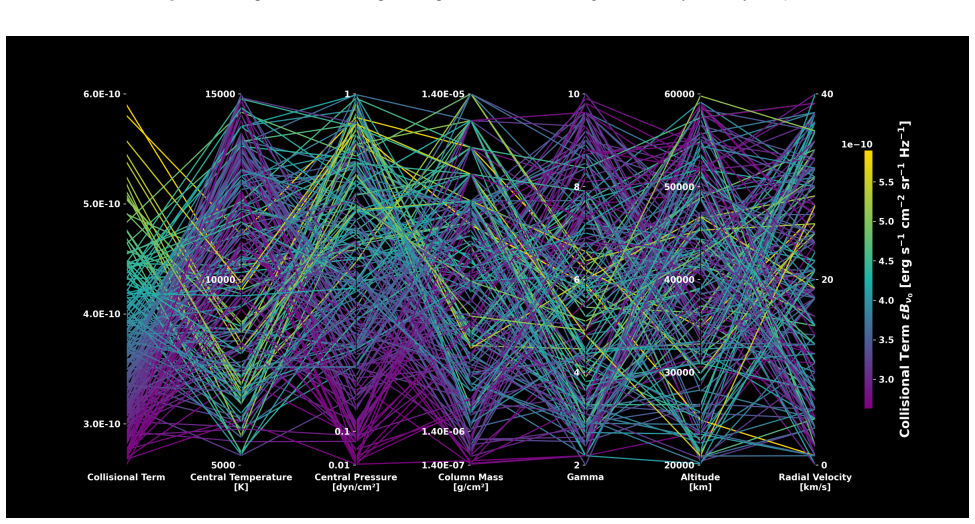
The 200 randomly sampled non-LTE models, each constrained by the SPICE spectral data and the chosen incident-radiation mosaic, used to generate Lyman beta and gamma profiles and to map parameter influence via parallel coordinate plots.
Load-bearing premise
The 200 randomly generated models, limited only by the SPICE observations and one incident-radiation mosaic, are assumed to sample the full range of physically realistic conditions.
What would settle it
A direct comparison between the observed SPICE Lyman-beta and Lyman-gamma profiles and the synthetic profiles produced by the subset of models whose central pressure, column mass, and temperature gradient fall inside the inferred ranges.
Figures




read the original abstract
The first dedicated observation of an off-limb prominence by Solar Orbiter took place on April 15, 2023. Our aim is to determine the range of different physical parameters of this prominence and to examine how these parameters affect the formation of the Lyman $\beta$ and Lyman $\gamma$ lines of hydrogen. We have found a way to refine key physical parameters by observational data. We will test the method by this prominence observation. We generate 200 random non-LTE models using these observational constraints and compute the Lyman $\beta$ line and the Lyman $\gamma$ line profiles. We use the Spectral Imaging of the Coronal Environment (SPICE) full-disk mosaic from November 13, 2023 to constrain the incident radiation. We present the parameters and results of 200 random models using parallel coordinate plots to explore how different parameters affect the results. This allows us to infer the key physical parameters (e.g., central pressure, column mass and temperature gradient) that impact the formation of the Lyman $\beta$ line and the Lyman $\gamma$ line in this observation.
Editorial analysis
A structured set of objections, weighed in public.
Referee Report
Summary. The paper analyzes the first off-limb prominence observation by Solar Orbiter SPICE on 15 April 2023. It generates 200 random non-LTE models constrained by the SPICE data and a November 13 incident-radiation mosaic, computes the resulting Lyman β and Lyman γ line profiles, and employs parallel-coordinate plots to identify which parameters (central pressure, column mass, temperature gradient) most strongly affect the line formation.
Significance. If the sampling and inference procedure were shown to be robust, the work would demonstrate a practical route to constraining prominence plasma parameters from Lyman-line observations with SPICE, adding a new diagnostic tool for solar-atmosphere studies. The approach is novel in its use of an ensemble of random models tied directly to a specific SPICE dataset.
major comments (4)
- [Abstract] Abstract and method description: the central claim that 200 randomly generated models suffice to 'infer the key physical parameters' is not supported by any quantitative goodness-of-fit metric (e.g., χ², residual maps, or intensity ratios) between the computed and observed line profiles, nor by error bars or posterior distributions on the inferred parameters.
- [Abstract] Abstract: the Monte-Carlo sampling of the three-dimensional parameter space (central pressure, column mass, temperature gradient) with only 200 draws is too sparse to guarantee that the regions reproducing the observed Lyman β/γ profiles are uniquely identified; no convergence test or comparison with a larger ensemble is presented.
- [Abstract] Abstract: the incident radiation is taken from a full-disk mosaic acquired on 13 November 2023, seven months after the 15 April prominence observation; no assessment of temporal variability or its effect on the derived line profiles is provided, undermining the reliability of the model-observation comparison.
- [Abstract] Abstract: no forward-modeling test with synthetic observations of known input parameters is reported, leaving open the possibility that the parallel-coordinate analysis recovers spurious 'key' parameters due to the limited sampling and the circular use of the same data for both constraint and inference.
minor comments (2)
- [Abstract] The abstract states that the models are 'constrained by these observational constraints' without specifying the exact observational quantities (e.g., which SPICE spectral windows or spatial pixels) used to set the random-model bounds.
- [Abstract] Parallel-coordinate plots are mentioned but no figure numbers, axis ranges, or selection criteria for 'key' parameters are given in the provided text.
Simulated Author's Rebuttal
We thank the referee for the constructive and detailed report. We address each major comment below, indicating where revisions will be made to improve the manuscript's rigor and clarity.
read point-by-point responses
-
Referee: [Abstract] Abstract and method description: the central claim that 200 randomly generated models suffice to 'infer the key physical parameters' is not supported by any quantitative goodness-of-fit metric (e.g., χ², residual maps, or intensity ratios) between the computed and observed line profiles, nor by error bars or posterior distributions on the inferred parameters.
Authors: We agree that the current analysis relies primarily on parallel-coordinate plots for identifying influential parameters rather than formal statistical fitting. The 200 models were generated subject to the SPICE observational constraints, but quantitative metrics were not computed. In the revised manuscript we will add χ² values, residual maps, and intensity-ratio comparisons for the subset of models that best reproduce the observed Lyman-β and Lyman-γ profiles, together with simple uncertainty estimates derived from the ensemble spread. revision: yes
-
Referee: [Abstract] Abstract: the Monte-Carlo sampling of the three-dimensional parameter space (central pressure, column mass, temperature gradient) with only 200 draws is too sparse to guarantee that the regions reproducing the observed Lyman β/γ profiles are uniquely identified; no convergence test or comparison with a larger ensemble is presented.
Authors: We acknowledge that 200 samples provide only an exploratory view of the three-dimensional parameter space. To demonstrate robustness we will repeat the analysis with a larger ensemble (1000 models) and include a convergence test showing that the ranking of key parameters (central pressure, column mass, temperature gradient) remains stable. This comparison will be added to the methods and results sections. revision: yes
-
Referee: [Abstract] Abstract: the incident radiation is taken from a full-disk mosaic acquired on 13 November 2023, seven months after the 15 April prominence observation; no assessment of temporal variability or its effect on the derived line profiles is provided, undermining the reliability of the model-observation comparison.
Authors: The November 2023 mosaic was the nearest available full-disk dataset suitable for constraining the incident radiation field. We will expand the discussion to note the seven-month separation and to reference typical timescales of solar EUV variability. A quantitative assessment of variability effects would require contemporaneous full-disk observations that are not available for this event; we will therefore treat this as an explicit limitation of the present study. revision: partial
-
Referee: [Abstract] Abstract: no forward-modeling test with synthetic observations of known input parameters is reported, leaving open the possibility that the parallel-coordinate analysis recovers spurious 'key' parameters due to the limited sampling and the circular use of the same data for both constraint and inference.
Authors: We recognize the value of an independent validation step. In the revised manuscript we will add a forward-modeling test: synthetic Lyman-β and Lyman-γ profiles will be generated from a known set of input parameters, then recovered using the same 200-model ensemble and parallel-coordinate procedure. This will demonstrate that the method correctly identifies the injected key parameters and will be presented as a new subsection. revision: yes
Circularity Check
No circularity: forward modeling within observational constraints
full rationale
The paper generates 200 random non-LTE models constrained by SPICE off-limb observations from April 15 2023 and a separate November 13 mosaic for incident radiation, then computes synthetic Lyman β and γ profiles and uses parallel-coordinate plots to examine how parameters such as central pressure, column mass and temperature gradient affect those computed profiles. This is a standard forward-modeling parameter-space exploration; the line profiles are outputs of the radiative-transfer calculation, not inputs that are fitted and then re-labeled as predictions. No self-citations, self-definitional steps, uniqueness theorems, or renamings of known results appear in the provided text, so the derivation chain remains self-contained.
Axiom & Free-Parameter Ledger
free parameters (3)
- central pressure
- column mass
- temperature gradient
axioms (2)
- domain assumption Non-LTE conditions govern the formation of Lyman-beta and Lyman-gamma lines in the prominence plasma.
- domain assumption The November 13 2023 SPICE full-disk mosaic provides a representative incident radiation field for the April 15 prominence.
Reference graph
Works this paper leans on
-
[1]
Anderson M., et al., 2020, A&A, 642, A14 Anzer U., Heinzel P., 1999, A&A, 349, 974 DufresneR.,DelZannaG.,YoungP.,DereK.,DeliporanidouE.,BarnesW., Landi E., 2024, The Astrophysical Journal, 974, 71 Edsall R. M., 2003, Computational Statistics & Data Analysis, 43, 605 GeY.,LiS.,LakhanV.C.,LucieerA.,2009,InternationalJournalofApplied Earth Observation and Ge...
discussion (0)
Sign in with ORCID, Apple, or X to comment. Anyone can read and Pith papers without signing in.