Noncrossing Partitions From Cones and Semicircles
Pith reviewed 2026-05-10 12:17 UTC · model grok-4.3
The pith
Point configurations with locations on convex polygon sides yield three lattices of noncrossing partitions defined by cones and semicircles.
A machine-rendered reading of the paper's core claim, the machinery that carries it, and where it could break.
Core claim
For each finite configuration of distinct points in the plane, there is an associated lattice of noncrossing partitions. When points may lie on the sides of their convex hull, three variations arise from distinct geometric definitions of crossing (via cones or semicircles), and each variation produces a lattice.
What carries the argument
The lattice of noncrossing partitions for a point configuration in the plane, with noncrossing defined geometrically by cones and semicircles rather than chord intersections.
If this is right
- Each of the three variations forms a lattice.
- All three variations coincide with the classical noncrossing partition lattice when no points lie strictly on sides.
- The lattices admit geometric visualizations of partitions that avoid cone or semicircle crossings.
- The structures remain ranked or possess other order-theoretic features inherited from the vertex-only case.
Where Pith is reading between the lines
- Enumeration of the three lattices for small polygons may produce new integer sequences that generalize Catalan numbers.
- These lattices could embed into larger families of partition lattices arising from other geometric constraints.
- Algebraic representations (such as via noncrossing diagrams or generating functions) might transfer directly from the classical setting.
Load-bearing premise
That the three variations defined by placing points on polygon sides actually form lattices (i.e., every pair of elements has a well-defined meet and join) and that the noncrossing condition extends in a natural way without additional ad-hoc rules.
What would settle it
For a concrete four-vertex convex polygon with one interior point on a side, compute the poset of candidate partitions under the three geometric noncrossing rules and check whether every pair possesses a unique meet and join.
Figures
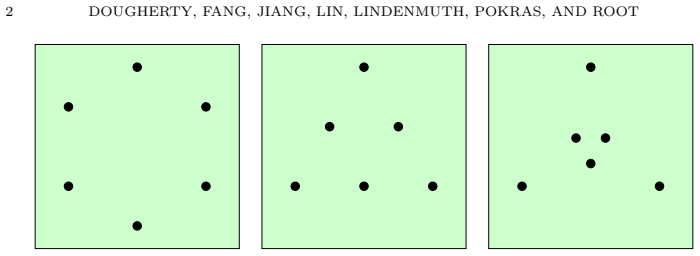
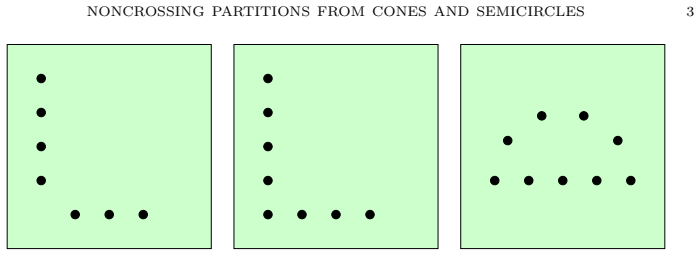
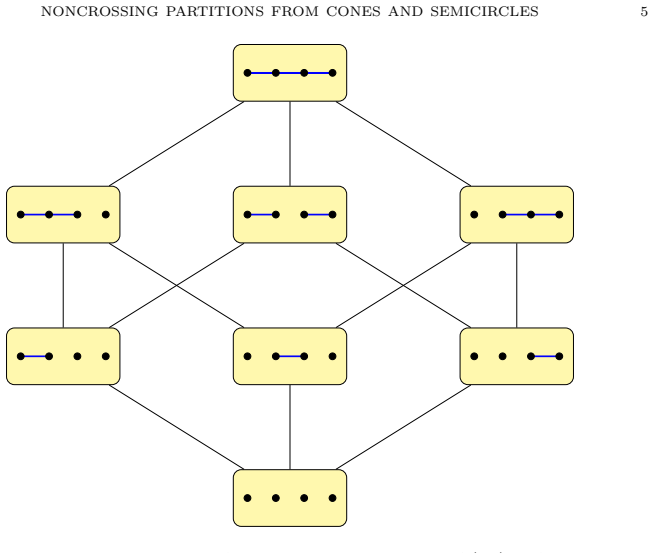
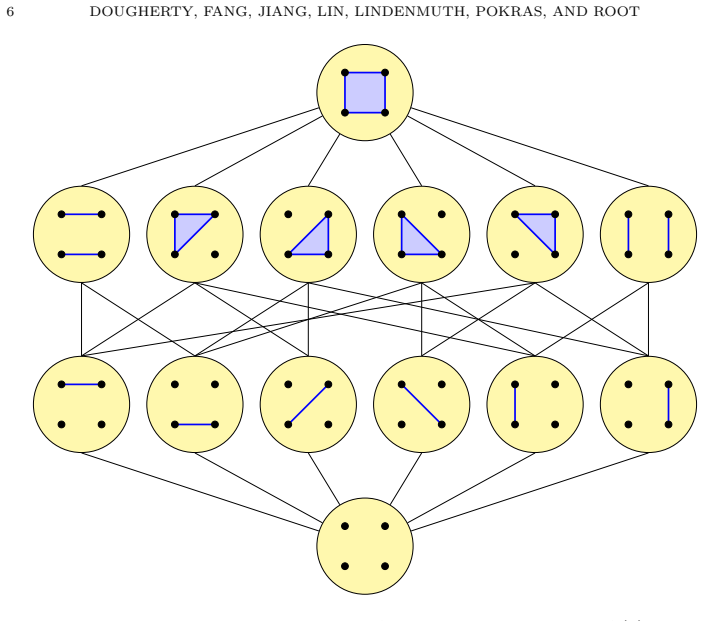
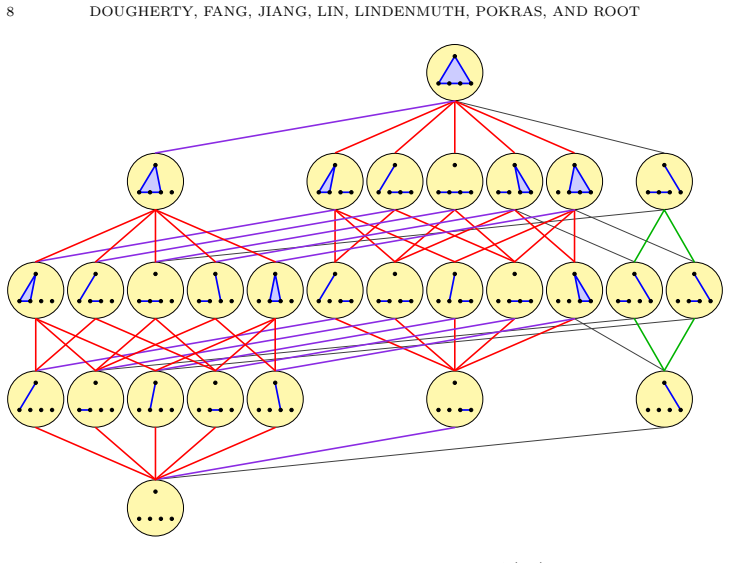
read the original abstract
For each finite configuration of distinct points in the plane, there is an associated lattice of noncrossing partitions. When these points form the vertices of a convex polygon, the result is the classical noncrossing partition lattice, which is enumerated by the Catalan numbers and satisfies many other useful properties. In this article, we examine three variations of this lattice which arise when the starting configuration is allowed to have points on the sides of a convex polygon rather than just the vertex set.
Editorial analysis
A structured set of objections, weighed in public.
Referee Report
Summary. The paper claims that for every finite set of distinct points in the plane there exists an associated lattice of noncrossing partitions. When the points are the vertices of a convex polygon this recovers the classical noncrossing partition lattice (enumerated by the Catalan numbers). The manuscript then defines and studies three variations obtained by placing additional points on the sides of the convex polygon, using geometric constructions based on cones and semicircles to characterize the noncrossing condition.
Significance. A correct geometric generalization of the noncrossing partition lattice to configurations with boundary points would extend a well-studied Catalan object and could yield new enumerative or structural results in combinatorial lattice theory. The classical case has many applications; if the three side-point variants are indeed lattices and admit similar properties, the work would be a useful contribution.
major comments (2)
- [§3] §3 (Definitions of the three variations): the noncrossing condition is defined via cones and semicircles for points lying on polygon sides, but no argument is supplied that the resulting collection is closed under the meet (coarsest common refinement) and join (finest common coarsening) of the ambient partition lattice. Without this closure the structures are not sublattices and the central claim fails.
- [Theorem 5.2] Theorem 5.2 (or the statement asserting the three objects are lattices): the proof sketch relies on the geometric noncrossing condition automatically preventing crossings in meets and joins, yet no explicit verification or counter-example exclusion is given for the case of multiple points on a single side; this step is load-bearing for the lattice assertion.
minor comments (2)
- [Abstract / Introduction] The abstract refers to 'three variations' without naming them; the introduction should list the three constructions explicitly (e.g., 'one point per side', 'multiple points per side', 'semicircle variant').
- [§2] Notation for the geometric noncrossing relation (cones versus semicircles) is introduced without a summary table comparing the three variants; a small comparison table would improve readability.
Simulated Author's Rebuttal
We thank the referee for their careful reading of the manuscript and for identifying the need for stronger justification of the lattice properties. We address the two major comments below and will revise the paper accordingly to include the missing arguments.
read point-by-point responses
-
Referee: [§3] §3 (Definitions of the three variations): the noncrossing condition is defined via cones and semicircles for points lying on polygon sides, but no argument is supplied that the resulting collection is closed under the meet (coarsest common refinement) and join (finest common coarsening) of the ambient partition lattice. Without this closure the structures are not sublattices and the central claim fails.
Authors: We acknowledge that the manuscript defines the three variations geometrically in §3 but does not supply an explicit argument showing closure under meet and join. This is a substantive gap for establishing that the collections are sublattices of the partition lattice. In the revised version we will insert a new lemma immediately after the definitions that proves preservation of the noncrossing condition under both operations. The argument will proceed by cases on the relative positions of blocks, using the convexity of the underlying polygon together with the cone and semicircle characterizations to show that any potential crossing introduced by the meet or join would already contradict the noncrossing assumption on the input partitions. revision: yes
-
Referee: [Theorem 5.2] Theorem 5.2 (or the statement asserting the three objects are lattices): the proof sketch relies on the geometric noncrossing condition automatically preventing crossings in meets and joins, yet no explicit verification or counter-example exclusion is given for the case of multiple points on a single side; this step is load-bearing for the lattice assertion.
Authors: We agree that the current proof sketch of Theorem 5.2 is insufficient on this point. When several points lie on the same side, the semicircle (or cone) condition can interact with the partition operations in ways that are not immediately obvious from the single-point-per-side case. We will expand the proof to contain a dedicated case analysis for multiple points per side. The revision will either derive a direct geometric contradiction for any crossing that might arise or exhibit a short verification that no such crossing is possible, thereby making the load-bearing step fully explicit. revision: yes
Circularity Check
No circularity: definitions and lattice claims are independent
full rationale
The paper introduces three variations of noncrossing partition lattices by allowing additional points on the sides of a convex polygon. These are presented as new combinatorial objects whose lattice structure (closure under meet/join in the refinement order) is a property to be established, not presupposed by the definitions themselves. No equations, fitted parameters, self-citations as load-bearing uniqueness theorems, or renamings of known results appear in the provided abstract or description. The noncrossing condition is extended naturally from the classical case without reducing to a tautology or self-referential fit. The derivation chain consists of explicit constructions followed by verification steps that remain open to independent checking.
Axiom & Free-Parameter Ledger
Reference graph
Works this paper leans on
-
[1]
[BBG+19] B. Baumeister, K.-U. Bux, F. G¨ otze, D. Kielak, and H. Krause,Non-crossing parti- tions, Spectral structures and topological methods in mathematics, EMS Ser. Congr. Rep., EMS Publ. House, Z¨ urich, 2019, pp. 235–274. [Bes03] David Bessis,The dual braid monoid, Annales Scientifiques de l’ ´Ecole Normale Sup´ erieure36(2003), no. 5, 647–683. [BW02...
work page 2019
discussion (0)
Sign in with ORCID, Apple, or X to comment. Anyone can read and Pith papers without signing in.