Bound-state Compton scattering of linearly polarized photons
Pith reviewed 2026-05-10 08:50 UTC · model grok-4.3
The pith
S-matrix calculations for bound-state Compton scattering of linearly polarized photons reveal kinematic regimes where the impulse approximation matches the full relativistic results reasonably well for Ne9+ and Pb81+ ions.
A machine-rendered reading of the paper's core claim, the machinery that carries it, and where it could break.
Core claim
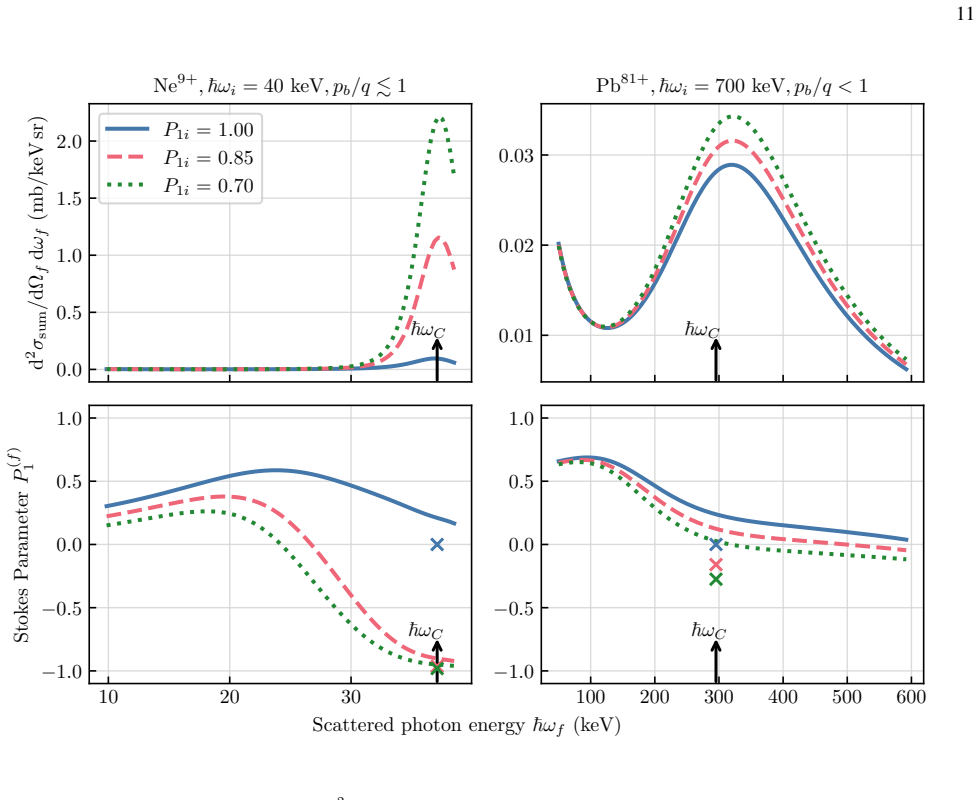
The calculations reveal kinematic regimes in which the impulse approximation agrees reasonably well with the S-matrix results. We also explore the polarization of scattered photons for slightly depolarized incident radiation, including the highly sensitive case of scattering at 90°.
Load-bearing premise
The S-matrix approach based on relativistic Green's functions fully captures the binding effects for K-shell electrons without needing higher-order QED corrections or more complex many-body effects.
Figures


read the original abstract
We present a theoretical study of Compton scattering of X- and $\gamma$-rays by a $K$-shell electron. Special attention is paid to the double-differential cross section and polarization of the scattered photons for linearly polarized incident photons. To investigate these observables, we employ the scattering matrix (S-matrix) approach based on relativistic Green's functions. The S-matrix results are moreover compared with predictions of the free-electron and impulse approximations, allowing us to assess the role of electron binding effects. Detailed calculations are carried out for hydrogen-like Ne$^{9+}$ and Pb$^{81+}$ targets over a wide range of incident photon energies and scattering angles. The calculations reveal kinematic regimes in which the impulse approximation agrees reasonably well with the S-matrix results. We also explore the polarization of scattered photons for slightly depolarized incident radiation, including the highly sensitive case of scattering at $90^\circ$.
Editorial analysis
A structured set of objections, weighed in public.
Circularity Check
No significant circularity detected in derivation chain
full rationale
The paper performs direct numerical evaluation of the S-matrix for bound-state Compton scattering using relativistic Green's functions on hydrogen-like ions, with explicit comparisons to the impulse and free-electron approximations. These are independent calculations under standard relativistic quantum mechanics; no parameters are fitted to the target observables, no predictions reduce to input definitions by construction, and no load-bearing uniqueness or ansatz is imported via self-citation. The reported kinematic regimes of agreement and polarization results follow from the stated equations without circular reduction.
Axiom & Free-Parameter Ledger
axioms (1)
- domain assumption Relativistic quantum mechanics and the S-matrix formalism with Green's functions accurately describe photon scattering from bound K-shell electrons.
Reference graph
Works this paper leans on
-
[2]
A. H. Compton, Physical Review22, 409 (1923), URL https://link.aps.org/doi/10.1103/PhysRev. 22.409
-
[3]
S. J. Norton, Journal of Applied Physics76, 2007 (1994), ISSN 0021-8979, https://pubs.aip.org/aip/jap/article- pdf/76/4/2007/18669300/2007 1 online.pdf, URLhttps:// doi.org/10.1063/1.357668
-
[4]
M. J. Cooper, Radiation Physics and Chemistry50, 63 (1997), ISSN 0969-806X, inelastic Scattering of X-Rays and Gamma Rays, URLhttps://www.sciencedirect. com/science/article/pii/S0969806X97000248
work page 1997
-
[5]
J. C. Aguiar, D. Mitnik, and H. O. Di Rocco, Journal of Physics and Chemistry of Solids83, 64 (2015), ISSN 0022-3697, URLhttps://www.sciencedirect.com/science/ article/pii/S0022369715000785
work page 2015
-
[6]
U. Spillmann, H. Br ¨auning, S. Hess, H. Beyer, Th. St ¨ohlker, J.-Cl. Dousse, D. Protic and T. Krings, Review of Scientific Instruments79, 083101 (2008), URLhttps://doi.org/ 10.1063/1.2963046
-
[7]
M. V ockert, G. Weber, U. Spillmann, T. Krings, M. Herdrich and Th. St¨ohlker, Nuclear Instruments and Methods in Physics Research B408, 313 (2017), URLhttps://doi.org/10. 1016/j.nimb.2017.05.035
work page 2017
-
[8]
G. Weber, K.-H. Blumenhagen, H. Br ¨auning, H. Ding, S. Fritzsche, S. Hess, R. M ¨artin, U. Spillmann, A. Surzhykov, S. Trotsenko, et al., Journal of Physics: Conference Series 583, 012041 (2015), URLhttps://doi.org/10.1088/ 1742-6596/583/1/012041
work page 2015
-
[9]
D. Bernard, T. Chattopadhyay, F. Kislat, and N. Pro- duit,Gamma-Ray Polarimetry(Springer Nature Sin- gapore, Singapore, 2022), pp. 1–42, ISBN 978-981- 16-4544-0, URLhttps://doi.org/10.1007/ 978-981-16-4544-0_52-1
work page 2022
-
[10]
O. Klein and Y . Nishina, Zeitschrift f¨ur Physik52, 853 (1929), URLhttps://link.springer.com/article/10. 1007/BF01366453
work page 1929
-
[12]
J. W. M. Du Mond, Phys. Rev.33, 643 (1929), URLhttps: //link.aps.org/doi/10.1103/PhysRev.33.643
-
[14]
Impurity spectra of graphene unde r electric and magnetic fields
R. Ribberfors, Physical Review B12, 3136 (1975), URL https://link.aps.org/doi/10.1103/PhysRevB. 12.3136
-
[15]
P. Bergstrom and R. Pratt, Radiation Physics and Chemistry50, 3 (1997), ISSN 0969-806X, inelastic Scattering of X-Rays and Gamma Rays, URLhttps://www.sciencedirect. com/science/article/pii/S0969806X97000224
work page 1997
-
[16]
C.-K. Qiao, H.-C. Chi, L. Zhang, P. Gu, C.-P. Liu, C.-J. Tang, S.-T. Lin, and K.-N. Huang, Journal of Physics B: Atomic, Molecular and Optical Physics53, 075002 (2020), URLhttps://dx.doi.org/10.1088/ 1361-6455/ab69a7
work page 2020
-
[17]
C.-K. Qiao, J.-W. Wei, and L. Chen, Crystals11(2021), ISSN 2073-4352, URLhttps://www.mdpi.com/ 2073-4352/11/5/525
work page 2021
-
[18]
W. Middents, A. Gumberidze, T. Krings, T. Over-Winter, P. Pf¨afflein, N. Schell, U. Spillmann, M. V ockert, G. Weber, and T. St¨ohlker, New Journal of Physics27, 073204 (2025), URL https://doi.org/10.1088/1367-2630/adf140
-
[19]
R. Pratt, L. LaJohn, V . Florescu, T. Suri ´c, B. Chatter- jee, and S. Roy, Radiation Physics and Chemistry79, 124 (2010), ISSN 0969-806X, special Issue on Future Directions in Atomic and Condensed Matter Research and Applications, URLhttps://www.sciencedirect.com/science/ article/pii/S0969806X09003491
work page 2010
-
[20]
P. M. Bergstrom, T. Suri´c, K. Pisk, and R. H. Pratt, Physical Re- view A48, 1134 (1993), URLhttps://link.aps.org/ doi/10.1103/PhysRevA.48.1134
-
[21]
A. Surzhykov, V . A. Yerokhin, T. Jahrsetz, P. Amaro, T. St¨ohlker, and S. Fritzsche, Physical Review A88, 062515 (2013), URLhttps://link.aps.org/doi/10.1103/ PhysRevA.88.062515
work page 2013
-
[22]
K.-H. Blumenhagen, S. Fritzsche, T. Gassner, A. Gum- beridze, R. M ¨artin, N. Schell, D. Seipt, U. Spillmann, A. Surzhykov, S. Trotsenko, et al., New Journal of Physics18, 103034 (2016), URLhttps://dx.doi.org/10.1088/ 1367-2630/18/10/103034
work page 2016
-
[23]
J. Eichler and T. St ¨ohlker, Physics Reports439, 1 (2007), ISSN 0370-1573, URLhttps://www.sciencedirect.com/ science/article/pii/S037015730600442X
work page 2007
-
[24]
T. Jahrsetz, S. Fritzsche, and A. Surzhykov, Physical Review A 89, 042501 (2014), URLhttps://link.aps.org/doi/ 10.1103/PhysRevA.89.042501
-
[25]
V . G. Serbo, A. Surzhykov, and A. V olotka, Annalen der Physik534, 2100199 (2022), https://onlinelibrary.wiley.com/doi/pdf/10.1002/andp.202100199, URLhttps://onlinelibrary.wiley.com/doi/ abs/10.1002/andp.202100199
-
[26]
J. Eichler and W. Meyerhof,Relativistic Atomic Collisions (Academic Press, 1995), ISBN 9780122336751, URLhttps: //books.google.de/books?id=RNTvAAAAMAAJ
work page 1995
-
[27]
J. Eichler,Lectures on Ion-Atom Collisions, North-Holland Personal Library (Elsevier Science, Amsterdam, 2005), URLhttps://www.sciencedirect.com/science/ article/pii/B9780444520470500000
work page 2005
-
[28]
P. Koval and S. Fritzsche, Computer Physics Com- munications172, 187 (2005), ISSN 0010-4655, URL https://www.sciencedirect.com/science/ article/pii/S0010465505004200
work page 2005
-
[29]
A. Surzhykov, P. Koval, and S. Fritzsche, Physical Review A 71, 022509 (2005), URLhttps://link.aps.org/doi/ 10.1103/PhysRevA.71.022509
-
[30]
J. Sommerfeldt, V . A. Yerokhin, and A. Surzhykov, Annalen der Physik536, 2300364 (2024), https://onlinelibrary.wiley.com/doi/pdf/10.1002/andp.202300364, URLhttps://onlinelibrary.wiley.com/doi/ 14 abs/10.1002/andp.202300364
-
[31]
D. J. Hylton, Journal of Mathematical Physics25, 1125 (1984), ISSN 0022-2488, https://pubs.aip.org/aip/jmp/article- pdf/25/4/1125/19119426/1125 1 online.pdf, URLhttps:// doi.org/10.1063/1.526255
-
[32]
P. J. Mohr, G. Plunien, and G. Soff, Physics Reports 293, 227 (1998), ISSN 0370-1573, URLhttps: //www.sciencedirect.com/science/article/ pii/S037015739700046X
work page 1998
-
[33]
J. Sommerfeldt, V . A. Yerokhin, R. A. M ¨uller, V . A. Za- ytsev, A. V . V olotka, and A. Surzhykov, Physical Review A105, 022804 (2022), URLhttps://link.aps.org/ doi/10.1103/PhysRevA.105.022804
-
[34]
J. Sommerfeldt, V . A. Yerokhin, T. St ¨ohlker, and A. Surzhykov, Phys. Rev. Lett.131, 061601 (2023), URLhttps://link.aps.org/doi/10.1103/ PhysRevLett.131.061601
work page 2023
-
[35]
W. Middents, A. Gumberidze, T. Krings, A. Kononov, P. Pf¨afflein, N. Schell, U. Spillmann, S. Strnat, A. Surzhykov, M. V ockert, et al., Physical Review A113, 013525 (2026), URLhttps://link.aps.org/doi/10.1103/ sfnd-hv3k
work page 2026
-
[36]
D. Budker, J. R. Crespo L ´opez-Urrutia, A. Dere- vianko, V . V . Flambaum, M. W. Krasny, A. Pe- trenko, S. Pustelny, A. Surzhykov, V . A. Yerokhin, and M. Zolotorev, Annalen der Physik532, 2000204 (2020), https://onlinelibrary.wiley.com/doi/pdf/10.1002/andp.202000204, URLhttps://onlinelibrary.wiley.com/doi/ abs/10.1002/andp.202000204
discussion (0)
Sign in with ORCID, Apple, or X to comment. Anyone can read and Pith papers without signing in.