Degenerations of generalized Kummer varieties
Pith reviewed 2026-05-10 09:39 UTC · model grok-4.3
The pith
Closing the relative generalized Kummer variety inside a compactified Hilbert scheme produces explicit degenerations of these varieties.
A machine-rendered reading of the paper's core claim, the machinery that carries it, and where it could break.
Core claim
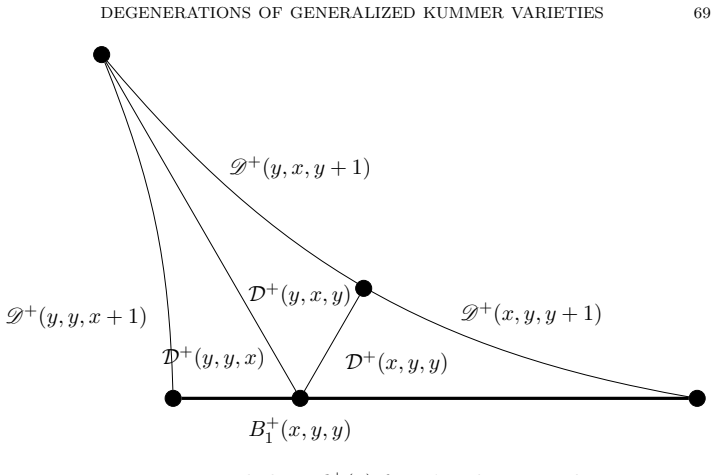
We embed the relative generalized Kummer variety K^{n-1}_o as a closed subscheme of the relative Hilbert scheme and take its closure K^{n-1}_{Y/C} inside the compactification I^n_{Y/C} previously constructed for the Hilbert scheme. This closure supplies a canonical degeneration of the generalized Kummer family over the base curve C. When n equals 2 the model is a projective Kulikov degeneration of Kummer surfaces and the dual complex of its special fiber is PL-homeomorphic to the standard 2-simplex.
What carries the argument
The closure K^{n-1}_{Y/C} of the relative generalized Kummer variety inside the compactification I^n_{Y/C} of the relative Hilbert scheme.
If this is right
- For n=2 the construction yields a projective Kulikov model of Kummer surfaces.
- The dual complex of this model for n=2 is PL-homeomorphic to the standard 2-simplex.
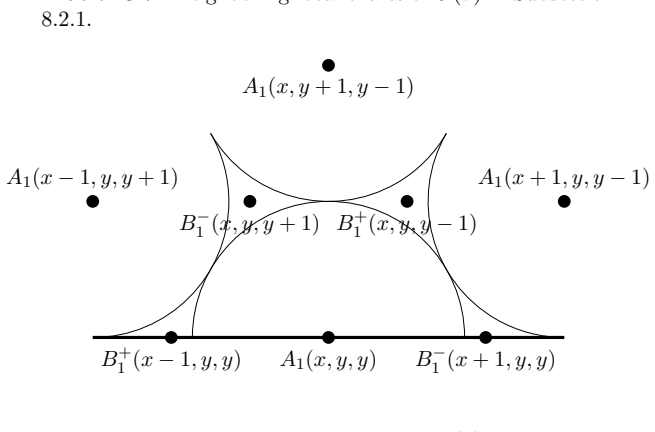
- The scheme K^{n-1}_{Y/C} carries a natural stratification whose geometry can be studied directly from the construction.
- Already for n=3 the special fiber exhibits geometric features absent in the surface case.
Where Pith is reading between the lines
- The same closure technique could be tested on other moduli spaces that embed into Hilbert schemes of abelian varieties.
- The PL-homeomorphism of the dual complex suggests that certain topological invariants of the degeneration are completely determined by the base curve.
- Comparing the resulting special fibers with those obtained from other known degeneration methods might identify which properties are canonical.
Load-bearing premise
The existing compactification of the relative Hilbert scheme contains the relative generalized Kummer variety as a closed subscheme so that its closure remains flat over the base curve.
What would settle it
An explicit computation showing that the closure K^{n-1}_{Y/C} fails to be flat over C or that its generic fiber is not isomorphic to the generalized Kummer variety would falsify the construction.
Figures






read the original abstract
We present a method to construct explicit degenerations of higher-dimensional generalized Kummer varieties. We start with a simple degeneration $f: \mathcal Y \to C$ of abelian surfaces. Then $ \mathcal{Y} \setminus \mathcal{Y}_0$ is an abelian scheme over $C \setminus 0$ and we can form the relative generalized Kummer variety $K^{n-1}_{\circ} = \mathrm{Kum}^{n-1}(\mathcal{Y} \setminus \mathcal{Y}_0) \to C \setminus 0$. This is naturally a closed subscheme of the relative Hilbert scheme $\mathrm{Hilb}^{n}(\mathcal{Y} \setminus \mathcal{Y}_0) \to C \setminus 0$. In previous work (joint with Gulbrandsen) we had constructed a compactification $I^n_{\mathcal{Y}/C}$ over $C$ of the latter scheme. The closure $K^{n-1}_{\mathcal{Y}/C}$ of $K^{n-1}_{\circ}$ inside $I^n_{\mathcal{Y}/C}$ yields a canonical way to degenerate the family of generalized Kummer varieties, and is the degeneration we propose. This paper contains a detailed study of the geometry of the scheme $K^{n-1}_{\mathcal{Y}/C}$ and its natural stratification. For $n=2$ we obtain a projective Kulikov model of Kummer surfaces, whereas already for $n=3$ new phenomena occur. We study in detail the dual complex of $K^{2}_{\mathcal{Y}/C}$ and show that this is PL-homeomorphic to the standard $2$-simplex.
Editorial analysis
A structured set of objections, weighed in public.
Referee Report
Summary. The manuscript presents a construction for degenerations of generalized Kummer varieties associated to a degeneration of abelian surfaces. Starting from a degeneration f: Y -> C of abelian surfaces, it forms the relative generalized Kummer variety K^{n-1}_o over C minus 0, embeds it into the relative Hilbert scheme, and takes its closure K^{n-1}_{Y/C} inside the compactification I^n_{Y/C} from previous joint work with Gulbrandsen. The paper studies the geometry and stratification of this closure. For n=2, it yields a projective Kulikov model of Kummer surfaces, and the dual complex of K^2_{Y/C} is shown to be PL-homeomorphic to the standard 2-simplex. For n=3, new phenomena are noted.
Significance. If the proposed closure is indeed flat and the stratification is preserved as claimed, this work provides an explicit and canonical degeneration of generalized Kummer varieties, which are important in the study of hyperkähler manifolds and their moduli spaces. The result on the dual complex for n=2 gives a precise description of the degeneration, potentially facilitating calculations of Hodge numbers or other invariants in the limit. The detailed study of the stratification for higher n could lead to new insights into the geometry of these degenerations.
major comments (2)
- [Abstract and construction (prior to §3)] Abstract and construction (prior to §3): The definition of K^{n-1}_{Y/C} as the scheme-theoretic closure of K^{n-1}_o inside I^n_{Y/C} is load-bearing for all subsequent claims. The manuscript does not provide an explicit argument that this closure is flat over C or has the expected dimension, which is required to ensure it defines a proper degeneration family and that the induced stratification has no extraneous components or collapsed strata.
- [Dual complex computation (n=2 case)] Dual complex computation (n=2 case): The claim that the dual complex of K^2_{Y/C} is PL-homeomorphic to the standard 2-simplex relies on the stratification being exactly the one induced by the relative Kummer condition in the limit. No concrete verification (e.g., via local equations or a specific example) is given to rule out obstructions from the summation map failing to extend compatibly to the boundary of I^n_{Y/C}.
minor comments (2)
- [Abstract] The abstract mentions 'new phenomena' for n=3 but provides no indication of what they are; adding one sentence would improve readability without lengthening the abstract.
- [Introduction] The notation I^n_{Y/C} and the precise reference to the prior joint work with Gulbrandsen should be introduced with a full citation on first use in the introduction.
Simulated Author's Rebuttal
We thank the referee for their careful reading of the manuscript and for the positive assessment of its significance. We address each major comment below and will revise the manuscript to incorporate the suggested clarifications and verifications.
read point-by-point responses
-
Referee: Abstract and construction (prior to §3): The definition of K^{n-1}_{Y/C} as the scheme-theoretic closure of K^{n-1}_o inside I^n_{Y/C} is load-bearing for all subsequent claims. The manuscript does not provide an explicit argument that this closure is flat over C or has the expected dimension, which is required to ensure it defines a proper degeneration family and that the induced stratification has no extraneous components or collapsed strata.
Authors: We agree that an explicit argument establishing flatness of K^{n-1}_{Y/C} over C and the expected dimension is necessary to support the subsequent claims about the degeneration and its stratification. Although the ambient space I^n_{Y/C} is known to be flat from our prior joint work, the current text does not detail how the scheme-theoretic closure inherits these properties. In the revised manuscript we will add a dedicated lemma (placed immediately after the definition of K^{n-1}_{Y/C}) that proves flatness and dimension by showing that the ideal sheaf of the relative Kummer condition extends without introducing extraneous components or dimension drop, using the universal properties of the Hilbert scheme compactification. revision: yes
-
Referee: Dual complex computation (n=2 case): The claim that the dual complex of K^2_{Y/C} is PL-homeomorphic to the standard 2-simplex relies on the stratification being exactly the one induced by the relative Kummer condition in the limit. No concrete verification (e.g., via local equations or a specific example) is given to rule out obstructions from the summation map failing to extend compatibly to the boundary of I^n_{Y/C}.
Authors: We acknowledge that the existing argument for the PL-homeomorphism, while based on the stratification induced by the extended summation map, would benefit from a concrete check ruling out possible obstructions at the boundary. In the revised version we will include an explicit local computation (in the section on the dual complex for n=2) that provides local equations around the relevant boundary strata and verifies that the summation map extends compatibly, thereby confirming that no extraneous strata arise and that the dual complex is indeed PL-homeomorphic to the 2-simplex. revision: yes
Circularity Check
No significant circularity; degeneration defined explicitly and geometric claims derived independently
full rationale
The paper explicitly defines K^{n-1}_{Y/C} as the scheme-theoretic closure of the relative generalized Kummer K^{n-1}_o inside the ambient compactification I^n_{Y/C} constructed in prior joint work. This is a direct construction, not a derivation that reduces to its inputs by definition. The central results—the detailed geometry and stratification of K^{n-1}_{Y/C}, the projective Kulikov model for n=2, and the PL-homeomorphism of the dual complex of K^2_{Y/C} to the standard 2-simplex—are established through analysis internal to this paper. No load-bearing step equates a claimed prediction or theorem to a fitted parameter, self-citation chain, or ansatz from the same authors; the prior compactification supplies only the ambient space, while the new properties are proven separately without circular reduction.
Axiom & Free-Parameter Ledger
axioms (1)
- domain assumption The compactification I^n_{Y/C} of the relative Hilbert scheme exists and is suitable for taking closures of the relative generalized Kummer subscheme.
Reference graph
Works this paper leans on
-
[1]
F. Bogomolov, L. H. Halle, F. Pazuki, and S. Tanimoto. Abelian Calabi-Yau threefolds: N\'eron models and rational points, Math. Res. Lett. 25, no. 2, 367--392 (2018)
work page 2018
- [2]
-
[3]
S. Bosch. Lectures on formal and rigid geometry, Lecture Notes in Mathematics 2105. Cham: Springer, viii+254 pp. (2014)
work page 2014
-
[4]
M.V. Brown and E. Mazzon. The essential skeleton of a product of degenerations , Compos. Math. 155, no. 7, 1259--1300 (2019)
work page 2019
-
[5]
B. Chiarellotto and C. Lazda. Combinatorial degenerations of surfaces and Calabi-Yau threefolds , Algebra Number Theory, 10, no. 10, 2235 -- 2266 (2016)
work page 2016
-
[6]
P. Deligne and D. Mumford, The irreducibility of the space of curves of given genus , Inst. Hautes Etudes Sci. Publ. Math., 36, 75--109 (1969)
work page 1969
-
[7]
T. de Fernex, J. Koll\' a r and C. Xu. The dual complex of singularities , Higher dimensional algebraic geometry---in honour of P rofessor Y ujiro K awamata's sixtieth birthday , Adv. Stud. Pure Math., Math. Soc. Japan, Tokyo , 74, pp. 103--129 (2017)
work page 2017
-
[8]
G. Faltings and C.-L. Chai. Degeneration of Abelian varieties. Ergeb. Math. Grenzgeb., Springer-Verlag (3), xii + 316 pp. (1990)
work page 1990
-
[9]
Feller, W. An Introduction to Probability Theory and Its Applications , Wiley, New York, 1, 3rd ed., xviii+509 pp. (1968)
work page 1968
-
[10]
J. Fogarty. Algebraic families on an algebraic surface Amer. J. Math , 90, 511--521 (1968)
work page 1968
-
[11]
M. G. Gulbrandsen, L. H. Halle, and K. Hulek. A GIT construction of degenerations of Hilbert schemes of points . Doc. Math. , 24, 421--472 (2019)
work page 2019
-
[12]
M. G. Gulbrandsen, L. H. Halle, K. Hulek and Z. Zhang. The geometry of degenerations of Hilbert schemes of points. J. Algebraic Geom. 30, 1--56 (2021)
work page 2021
-
[13]
L. H. Halle and J. Nicaise. The N\'eron component series of an abelian variety. Math. Ann. , 348, no. 3, 749--778 (2010)
work page 2010
-
[14]
L. H. Halle and J. Nicaise. Motivic zeta functions of degenerating Calabi-Yau varieties. Math. Ann., 370, no. 3-4, 1277--1320 (2018)
work page 2018
-
[15]
R. Hartshorne. Algebraic Geometry. Graduate Texts in Mathematics, 52, Springer Verlag, New York -- Heidelberg, xvi+496 pp. (1977)
work page 1977
-
[16]
M. Hochster and J.L. Roberts. Rings of invariants of reductive groups acting on regular rings are Cohen-Macaulay . Advances in Mathematics , 13 (2), 115--175 (1974)
work page 1974
-
[17]
J. Koll \'a r, R. Laza, G. Sacc \`a , and C. Voisin. Remarks on degenerations of hyper-K\"ahler manifolds , Ann. Inst. Fourier (Grenoble), 68, no. 7, 2837--2882 (2018)
work page 2018
-
[18]
K. K\"unnemann. Projective regular models for abelian varieties, semistable reduction, and the height pairing . Duke Math. J. , 95, 161--212 (1998)
work page 1998
-
[19]
V. S. Kulikov Degenerations of \(K_3\) surfaces and Enriques surfaces . Math. USSR, Izv. , 11, 957--989 (1977)
work page 1977
- [20]
-
[21]
Q. Liu. Algebraic geometry and arithmetic curves. Oxford Graduate Texts in Mathematics, Volume 6 , Oxford University Press , xv + 577 pp. (2006)
work page 2006
-
[22]
J. Li. Stable morphisms to singular schemes and relative stable morphisms. J. Differential Geom. , 57, no. 3, 509--578 (2001)
work page 2001
-
[23]
J. Li. Good degenerations of moduli spaces. Handbook of moduli. V ol. II , Adv. Lect. Math. (ALM) 25, 299--351 (2013)
work page 2013
-
[24]
D. Mumford, J. Fogarty, F. Kirwan. Geometric invariant theory. Third edition. Ergebnisse der Mathematik und ihrer Grenzgebiete (2) [Results in Mathematics and Related Areas (2)], 34, Springer-Verlag, Berlin , xiv+292 pp. (1994)
work page 1994
-
[25]
Y. Nagai. On monodromies of a degeneration of irreducible symplectic K \"a hler manifolds . Math. Z. , 258, no. 2, 407--426 (2008)
work page 2008
-
[26]
Y. Nagai. Symmetric products of a semistable degeneration of surfaces . Math. Z. , 289, no. 3-4, 1143--1168 (2018)
work page 2018
-
[27]
Y. Nagai. Gulbrandsen–Halle–Hulek degeneration and Hilbert-Chow morphism . Pure Appl. Math. Q. , 17, no. 1, 401--422 (2022)
work page 2022
- [28]
-
[29]
U. Persson, H. Pinkham. Degeneration of surfaces with trivial canonical bundle . Ann. Math. (2) ,113, 45--66 (1981)
work page 1981
-
[30]
Q. Shafi, C. Tschanz. From logarithmic Hilbert schemes to degenerations of hyperkähler varieties . arXiv:2512.21190
-
[31]
The Stacks Project Authors. Stacks Project . https://stacks.math.columbia.edu (2024)
work page 2024
- [32]
-
[33]
C. Tschanz. Expansions for Hilbert schemes of points on semistable degenerations . Forum of Mathematics, Sigma , 14, e53 (2026)
work page 2026
-
[34]
G. M. Ziegler. Lectures on polytopes . Graduate Texts in Mathematics, 152, Springer Verlag, New York, x+370 pp. (1995)
work page 1995
discussion (0)
Sign in with ORCID, Apple, or X to comment. Anyone can read and Pith papers without signing in.