On nonlinear saturation of toroidal Alfv\'en eigenmode due to thermal plasma nonlinearities
Pith reviewed 2026-05-10 09:23 UTC · model grok-4.3
The pith
Thermal plasma nonlinearities govern toroidal Alfvén eigenmode saturation with stiffness above a 0.47 percent drive threshold.
A machine-rendered reading of the paper's core claim, the machinery that carries it, and where it could break.
Core claim
In single toroidal mode number simulations with zonal fields filtered out, the saturation level of TAE is governed by thermal plasma nonlinearities for gamma_L/omega_n > 0.47%, exhibiting weak dependence on the linear drive gamma_L. The TAE frequency decreases with increasing amplitude due to phase-space zonal structures of thermal plasmas, and saturation is reached when the mode merges into the continuum. Zonal fields counteract the PSZS effects, enhancing the saturation level by a factor of about two.
What carries the argument
Phase-space zonal structures (PSZS) formed by thermal particles, which induce a nonlinear frequency downshift in the TAE until it merges with the Alfvén continuum.
If this is right
- The saturation amplitude shows little variation with changes in linear drive strength once above the threshold.
- The TAE frequency downshifts progressively with growing amplitude.
- At saturation, the mode transitions by merging into the continuum, accompanied by separation of poloidal harmonics.
- Simulations including zonal fields yield approximately twice the saturation level compared to filtered cases.
Where Pith is reading between the lines
- In full multi-mode simulations without filtering, the effective saturation might balance thermal nonlinearities against zonal field effects differently.
- This stiffness could allow simpler estimates of TAE amplitudes in varying plasma conditions without detailed drive calculations.
Load-bearing premise
Filtering out zonal fields in single-toroidal-mode-number simulations isolates the thermal-plasma nonlinearity without altering the saturation physics or phase-space structures.
What would settle it
A simulation or experiment showing strong dependence of saturation level on linear drive even above 0.47% threshold, or no frequency downshift correlating with amplitude.
Figures





read the original abstract
The nonlinear saturation of toroidal Alfven eigenmode (TAE) due to thermal plasma nonlinearities is investigated using gyrokinetic particle-in-cell simulations and theoretical analysis. In the single toroidal mode number simulations with zonal fields filtered out, we find that the saturation level of TAE is governed by thermal plasma nonlinearities for gamma_L/omega_n > 0.47%, which has weak dependence on the linear drive gamma_L, i.e., "stiffness" in saturation level. We find that the frequency of TAE decreases as the amplitude of it increases, which is induced by the phase-space zonal structure (PSZS) of thermal plasmas universally existed in particle-in-cell simulations. The saturation of TAE can be finally reached when the mode merges into the continuum. Following this process, the separation of neighboring poloidal harmonics and mode transition to energetic particle modes can be observed. In simulations with zonal fields, zonal fields can essentially counteract the effects of PSZS of thermal plasmas, leading to roughly a factor of 2 enhancement of the TAE saturation level compared to the single toroidal mode number simulation, implying the necessity of including zonal modes in evaluating the saturation level of TAE.
Editorial analysis
A structured set of objections, weighed in public.
Referee Report
Summary. The manuscript investigates the nonlinear saturation of toroidal Alfvén eigenmodes (TAEs) due to thermal plasma nonlinearities via gyrokinetic particle-in-cell simulations and theoretical analysis. In single-toroidal-mode-number runs with zonal fields filtered out, saturation is reported to be governed by thermal nonlinearities for gamma_L/omega_n > 0.47%, exhibiting stiffness (weak dependence on linear drive gamma_L). The frequency downshift is attributed to phase-space zonal structures (PSZS) of thermal ions, leading to continuum merging, poloidal harmonic separation, and transition to energetic-particle modes. Restoring zonal fields counteracts PSZS effects and increases saturation amplitude by a factor of approximately 2, implying the importance of zonal modes for accurate saturation estimates.
Significance. If the central claims hold, the work would advance understanding of TAE saturation in fusion-relevant plasmas by isolating thermal-plasma nonlinearities and PSZS as key mechanisms, with the stiffness result potentially simplifying amplitude predictions above threshold. The explicit contrast between filtered and unfiltered simulations usefully illustrates competing nonlinear channels. The combination of PIC evidence with interpretive analysis of frequency shifts and mode transitions is a strength, though the absence of analytic derivations or multi-mode benchmarks limits immediate generality.
major comments (3)
- [Abstract and simulation results] Abstract and simulation results: The claim that saturation is governed by thermal plasma nonlinearities with stiffness for gamma_L/omega_n > 0.47% rests exclusively on single-n simulations in which zonal fields are filtered. The manuscript states that restoring zonal fields counteracts PSZS and raises saturation amplitude by a factor of ~2; this indicates that the filtered setup omits a dominant saturation channel (possibly via E×B shearing or modified continuum damping), so the reported threshold and stiffness may be artifacts of the numerical isolation rather than intrinsic to thermal nonlinearities. Self-consistent multi-mode benchmarks are needed to confirm the result survives when zonal dynamics are retained.
- [Numerical setup and results sections] Numerical setup and results sections: The specific 0.47% threshold and stiffness are extracted from simulation time series without reported convergence tests (particle number, spatial resolution, time step), error bars on saturation levels, or systematic scans in gamma_L. This makes the quantitative claims provisional; small numerical variations could shift the apparent threshold or eliminate the weak gamma_L dependence.
- [Discussion of PSZS and frequency shift] Discussion of PSZS and frequency shift: The frequency decrease with amplitude and saturation via continuum merging are presented as induced by PSZS, but the link is observational from time series rather than derived from an equation relating PSZS amplitude to the observed shift or merging criterion. A quantitative model would be required to elevate this from correlation to causal mechanism supporting the saturation picture.
minor comments (3)
- Ensure the normalized drive strength gamma_L/omega_n is defined at first use in the main text, and clarify whether omega_n refers to a local or global frequency.
- Figure captions and text should explicitly state which runs include zonal-field filtering to avoid ambiguity when comparing saturation levels.
- Add references to prior gyrokinetic literature on phase-space zonal structures to place the PSZS observations in context.
Simulated Author's Rebuttal
We thank the referee for the constructive comments, which help clarify the scope of our findings. We address each major comment point by point below. Revisions have been made to add caveats, numerical details, and expanded discussion, while acknowledging limitations in the current study.
read point-by-point responses
-
Referee: The claim that saturation is governed by thermal plasma nonlinearities with stiffness for gamma_L/omega_n > 0.47% rests exclusively on single-n simulations in which zonal fields are filtered. ... this indicates that the filtered setup omits a dominant saturation channel ... Self-consistent multi-mode benchmarks are needed to confirm the result survives when zonal dynamics are retained.
Authors: We agree that the filtered single-n setup isolates thermal nonlinearities and that zonal fields provide an important additional saturation channel, as demonstrated by the factor-of-two enhancement in our simulations. The stiffness and 0.47% threshold are explicitly reported for the filtered case to highlight the role of thermal plasma effects without zonal-mode interference. We do not claim these quantitative values apply unchanged to full multi-mode scenarios. In the revised manuscript we have added a dedicated paragraph in the discussion clarifying this scope and noting that self-consistent multi-mode runs would be valuable for assessing combined effects. revision: partial
-
Referee: The specific 0.47% threshold and stiffness are extracted from simulation time series without reported convergence tests (particle number, spatial resolution, time step), error bars on saturation levels, or systematic scans in gamma_L. This makes the quantitative claims provisional.
Authors: We acknowledge that a full set of convergence tests, error bars, and exhaustive gamma_L scans were not reported in the original submission. The presented runs used standard PIC resolutions for this class of problem, and the weak gamma_L dependence was observed consistently across the available drive values. The revised manuscript now includes additional details on the numerical parameters employed and a note on observed sensitivity to resolution. A complete systematic convergence study with error bars would require a new series of simulations. revision: partial
-
Referee: The frequency decrease with amplitude and saturation via continuum merging are presented as induced by PSZS, but the link is observational from time series rather than derived from an equation relating PSZS amplitude to the observed shift or merging criterion. A quantitative model would be required.
Authors: The frequency evolution and continuum-merging saturation are interpreted using the theoretical analysis already present in the manuscript, which connects PSZS-induced modifications of the effective potential to the observed downshift and the standard continuum-damping criterion for merging. While a closed-form analytic expression for the exact frequency shift magnitude is not derived, the simulations exhibit a consistent causal sequence. We have expanded the relevant section with a step-by-step interpretive model linking PSZS amplitude to the frequency trajectory and mode transition. revision: yes
- Self-consistent multi-mode benchmarks with zonal dynamics retained
Circularity Check
No significant circularity; results are direct simulation observations
full rationale
The paper reports saturation levels, frequency shifts, and stiffness directly from gyrokinetic PIC simulation time series in single-n runs with zonal fields filtered. No analytic derivation chain is presented that reduces the saturation amplitude or the gamma_L/omega_n threshold to a fitted parameter, self-cited uniqueness theorem, or self-referential definition. The PSZS explanation and continuum-merging description are interpretive accounts of observed phase-space structures rather than equations that loop back to the inputs. Zonal-field effects are explicitly contrasted in separate runs, and the filtering choice is stated as a deliberate isolation step without being smuggled in via prior self-citation as an unverified ansatz. The central claim therefore remains self-contained against external benchmarks.
Axiom & Free-Parameter Ledger
axioms (1)
- domain assumption Gyrokinetic ordering remains valid for the thermal and energetic particle distributions studied
invented entities (1)
-
phase-space zonal structure (PSZS)
no independent evidence
Reference graph
Works this paper leans on
-
[1]
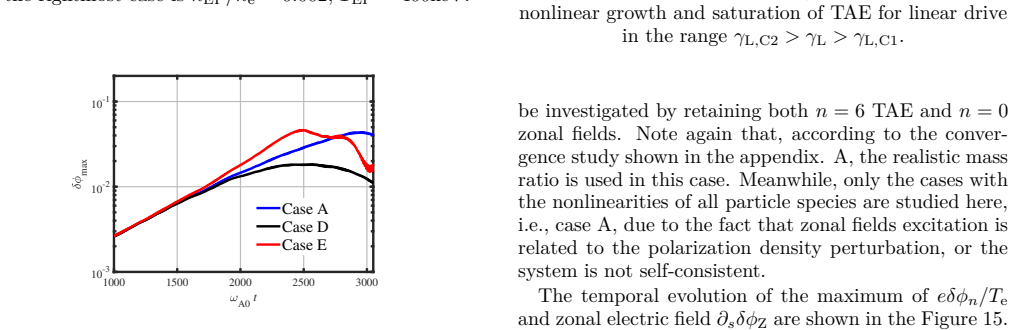
The saturation level of TAE shows two regimes. For the linear drive below γL/ωn ≃ 0.47%, the nonlin- ear saturation is dominated by EP nonlinearity. Oth- erwise, the saturation of TAE is dominated by thermal plasma nonlinearity, i.e., PSZS of thermal species, which is eδϕn/Te ∼ 0.1 and almost independent of linear drive, showing feature of “stiffness” . He...
-
[2]
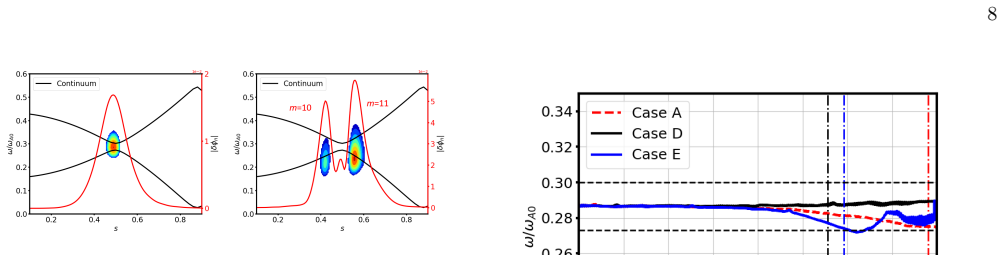
The saturation of TAE can happen when the mode amplitude reaches eδϕn/Te ∼ 0.1 even if EPs evolve lin- early, which implies a threshold on the amplitude of TAE imposed by thermal plasma nonlinearity. Upon mode saturation, the decrease of mode frequency and the sep- aration of m = 10 and m = 11 poloidal harmonics can be observed
-
[3]
The decrease of mode frequency results from the modification of the potential well of TAE by PSZS of thermal species, as indicated by gyrokinetic theory devel- oped herein. As the mode merges to the continuum, the mode saturation and separation of neighboring poloidal harmonics can be identified. Meanwhile, the saturation level can be quantitatively derived...
-
[4]
For reasonable linear drive γL/ωn > 1%, the satu- ration of TAE is also dominated by thermal plasma non- linearities. However, in this case, the effect of PSZS on TAE is significantly counteracted, leading to enhance- ment of the saturation level of TAE from eδϕn/Te ∼ 0.1 to eδϕn/Te ∼ 0.2
-
[5]
For both cases with/without zonal fields, the satu- ration level of TAE is found to be proportionate to the square root of inverse aspect ratio, which is predicted by the theory. This implies a stronger TAE activity in devices with a larger inverse aspect ratio. The results given above imply that for future toka- maks with much stronger EP drive, the satur...
-
[6]
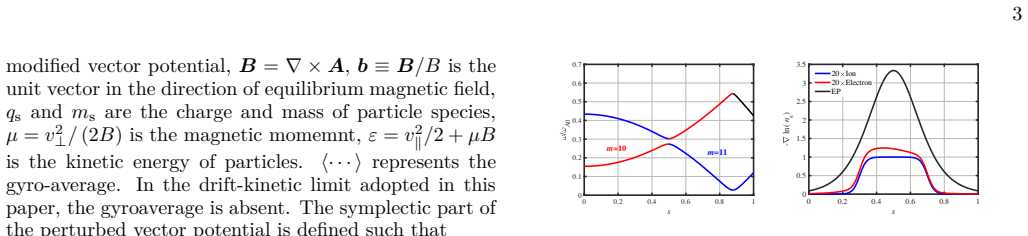
It is found that both the growth rate and frequency of TAE increase with increasing EP concentration. The mode structures of poloidal harmonics of TAE are shown in Figure 4. It is found that for both scalar and vector potentials, the m = 10 and m = 11 poloidal harmonics are dominant, which is a typical characteristic of TAE. Besides, we can also find that ...
-
[7]
The temporal evolution of eδϕn/Te of n = 6 TAE is shown in Figure 5
Nonlinear saturation due to EP nonlinearity Before investigating the nonlinear saturation of TAE with thermal plasma nonlinearities, we need to identify the saturation due to EP nonlinearity [26], i.e., case D in Table I. The temporal evolution of eδϕn/Te of n = 6 TAE is shown in Figure 5. Here, we can observe a lin- ear growth before ωA0t ∼ 400. After th...
-
[8]
Nonlinear saturation with thermal plasma nonlinearity With the nonlinear saturation of TAE due to EP nonlinearity investigated above, the nonlinear saturation 2 4 6 8 10 20 L (103s-1) 10-3 10-2 10-1 100 sat Asat ALL Asat EP Asat T L,C2 L,C1 sat L 2 sat L Figure 6: The scaling law of the saturation of TAE versus the linear growth rate γL in single- n = 6 s...
work page 2000
- [9]
- [10]
- [11]
- [12]
-
[13]
G. Y. Fu and J. W. Van Dam, Physics of Fluids B 1, 1949 (1989)
work page 1949
-
[14]
H. L. Berk and B. N. Breizman, Physics of Fluids B 2, 2226 (1990)
work page 1990
-
[15]
H. L. Berk and B. N. Breizman, Physics of Fluids B 2, 2235 (1990)
work page 1990
-
[16]
T. Barberis, V. N. Duarte, E. J. Hartigan-OConnor, and N. N. Gorelenkov, Nuclear Fusion 65, 112005 (2025)
work page 2025
- [17]
-
[18]
L. Chen, F. Zonca, R. Santoro, and G. Hu, Plasma physics and controlled fusion 40, 1823 (1998)
work page 1998
-
[19]
Z. Qiu, L. Chen, and F. Zonca, Reviews of Modern Plasma Physics 7 (2023)
work page 2023
- [20]
- [21]
-
[22]
L. Chen, P. Liu, R. Ma, Z. Lin, Z. Qiu, W. Wang, and F. Zonca, Nuclear Fusion 65, 016018 (2024)
work page 2024
-
[23]
Q. Fang, G. Wei, N. Chen, L. Chen, F. Zonca, and Z. Qiu, Nuclear Fusion 65, 066004 (2025)
work page 2025
- [24]
-
[25]
S. Wang, Z. Wang, and T. Wu, Phys. Rev. Lett. 132, 065106 (2024)
work page 2024
-
[26]
L. Chen, Z. Qiu, and F. Zonca, Physics of Plasmas 29, 050701 (2022)
work page 2022
- [27]
- [28]
- [29]
- [30]
-
[31]
A. Mishchenko, A. Kies, R. Kleiber, and M. Cole, Physics of Plasmas 21, 092110 (2014)
work page 2014
-
[32]
A. Mishchenko, A. Bottino, A. Biancalani, R. Hatzky, T. Hayward-Schneider, N. Ohana, E. Lanti, S. Brunner, L. Villard, M. Borchardt, et al., Computer Physics Com- munications 238, 194 (2019)
work page 2019
- [33]
-
[34]
A. Biancalani, A. Bottino, M. Cole, C. D. Troia, P. Lauber, A. Mishchenko, B. Scott, and F. Zonca, Plasma Physics and Controlled Fusion 59, 054004 (2017)
work page 2017
-
[35]
Y. Todo, H. Berk, and B. Breizman, Nuclear Fusion 50, 084016 (2010)
work page 2010
-
[36]
Z. Qiu, L. Chen, and F. Zonca, Nuclear Fusion 57, 056017 (2017)
work page 2017
-
[37]
E. A. Frieman and L. Chen, Physics of Fluids 25, 502 (1982)
work page 1982
discussion (0)
Sign in with ORCID, Apple, or X to comment. Anyone can read and Pith papers without signing in.