Enhancing time-frequency resolution with optimal transport and barycentric fusion of multiple spectrogram
Pith reviewed 2026-05-10 10:23 UTC · model grok-4.3
The pith
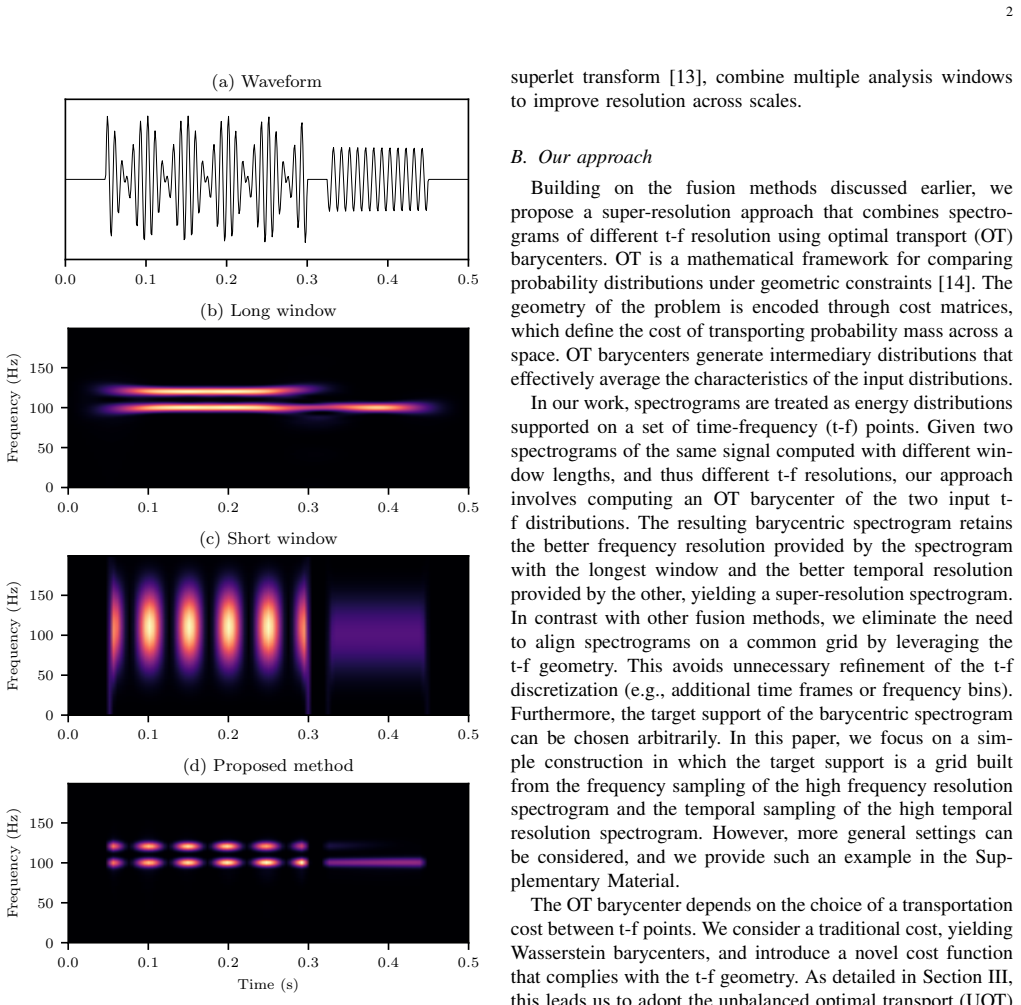
Fusing spectrograms with different resolutions via optimal transport barycenters produces a super-resolution time-frequency map that combines their sharpest localizations.
A machine-rendered reading of the paper's core claim, the machinery that carries it, and where it could break.
Core claim
The super-resolution spectrogram is defined as the barycenter of the input spectrograms under optimal transport divergences; this construction merges the localization advantages of the inputs without forcing them onto a common grid and is realized efficiently by a new transportation cost together with an unbalanced OT block majorization-minimization algorithm.
What carries the argument
The unbalanced optimal transport barycenter of spectrograms, equipped with a novel transportation cost that preserves time-frequency geometry while lowering complexity.
If this is right
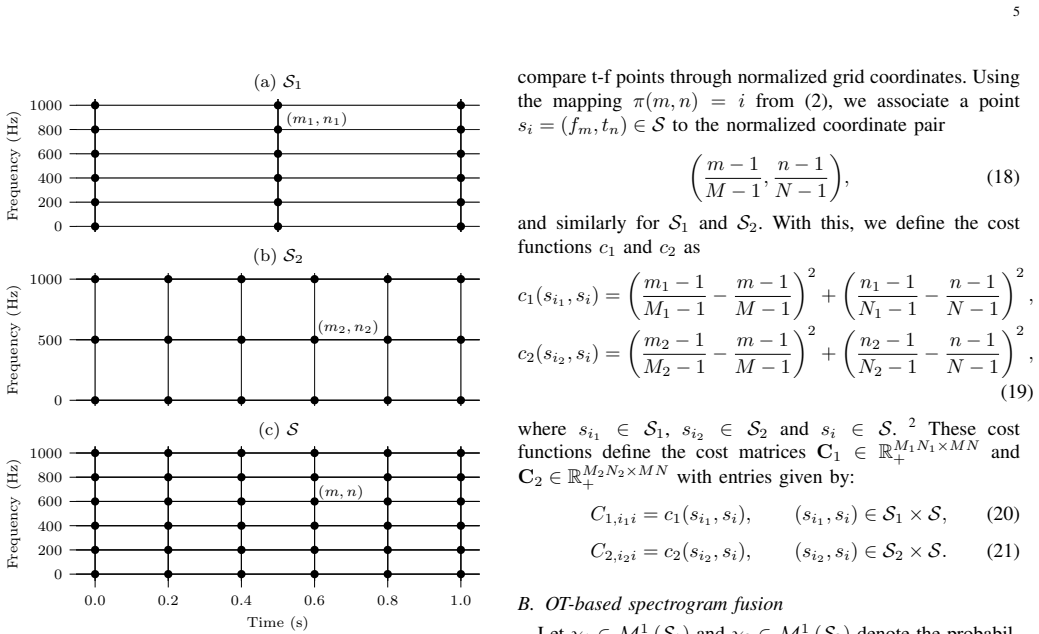
- Any set of STFT parameters can be used for the input spectrograms; the output is defined on an arbitrary user-chosen grid.
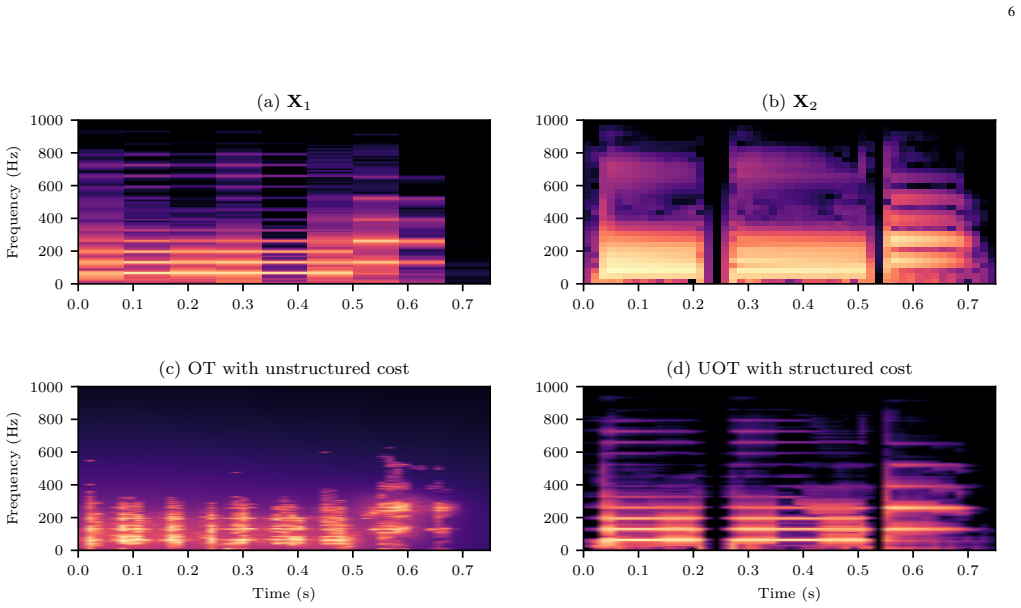
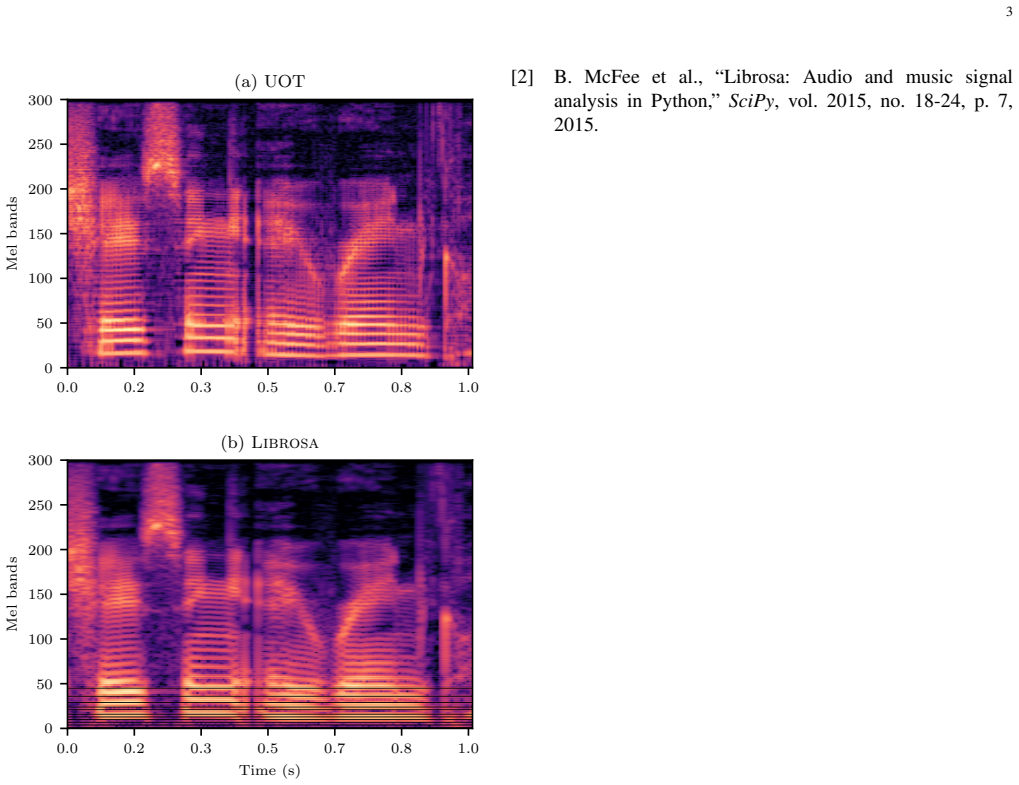
- The method outperforms an unsupervised state-of-the-art fusion technique on both quantitative metrics and qualitative listening tests for synthetic signals and recorded speech.
- Several optimal transport divergences can be substituted by changing the transportation cost, with the proposed cost offering a practical trade-off between geometric fidelity and speed.
- Unbalanced optimal transport allows mass creation and destruction, which accommodates spectrograms whose total energy may differ.
Where Pith is reading between the lines
- The same barycentric construction could be applied to other time-frequency representations such as wavelet scalograms or reassigned spectrograms whose grids also differ.
- Because the output grid is free, the method could be inserted into iterative pipelines where a coarse map is first computed and then refined on a finer grid without recomputing the original transforms.
- The framework naturally extends to fusing data from heterogeneous sensors whose sampling rates or analysis windows are mismatched.
Load-bearing premise
That the optimal transport average of spectrograms computed at different resolutions will consistently sharpen both time and frequency features without introducing new distortions that cancel the localization gains.
What would settle it
On a synthetic signal whose true time-frequency support is known exactly, the fused spectrogram either fails to show narrower peaks than the best single input or exhibits spurious energy concentrations not present in any input.
Figures
read the original abstract
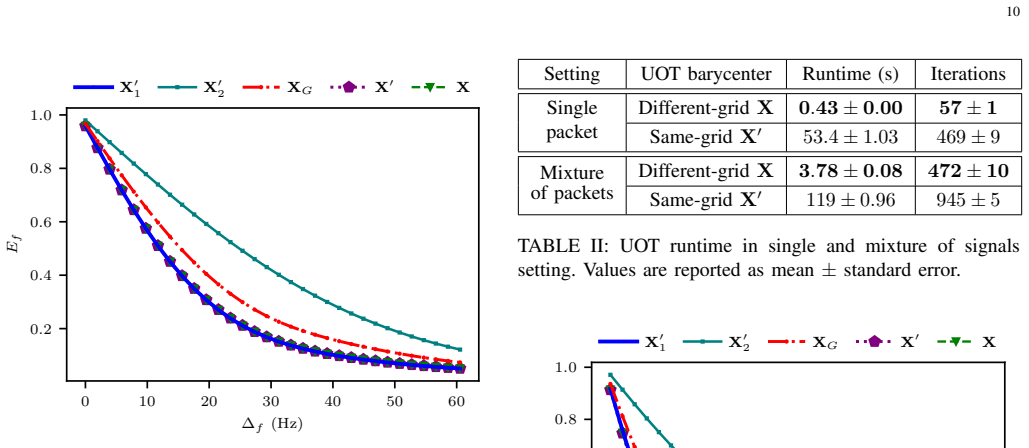
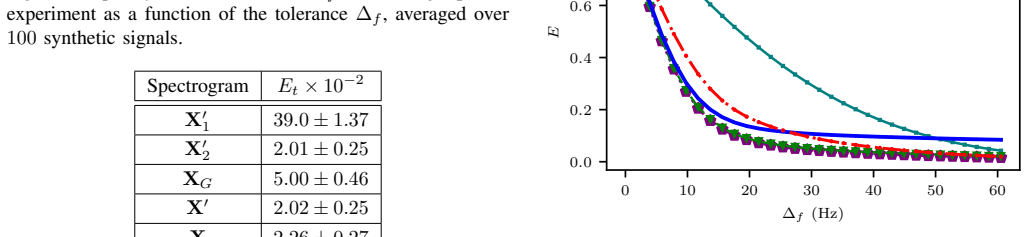
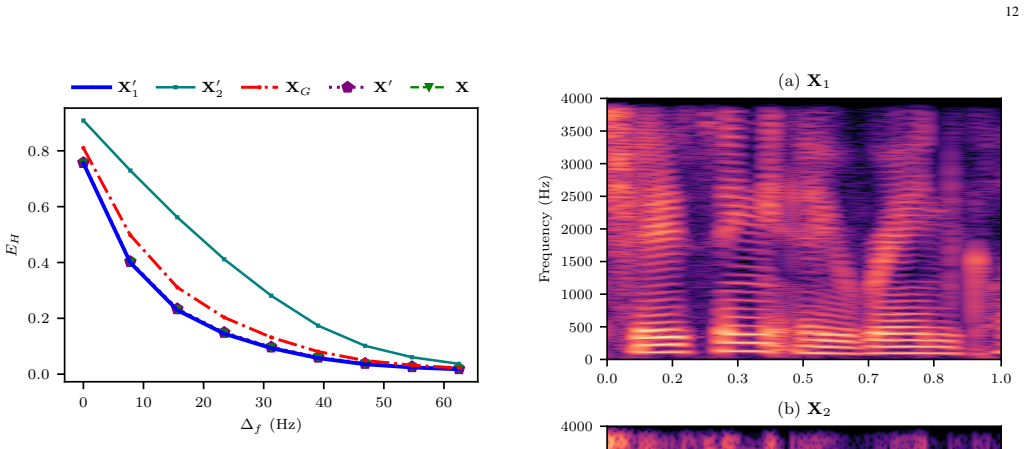
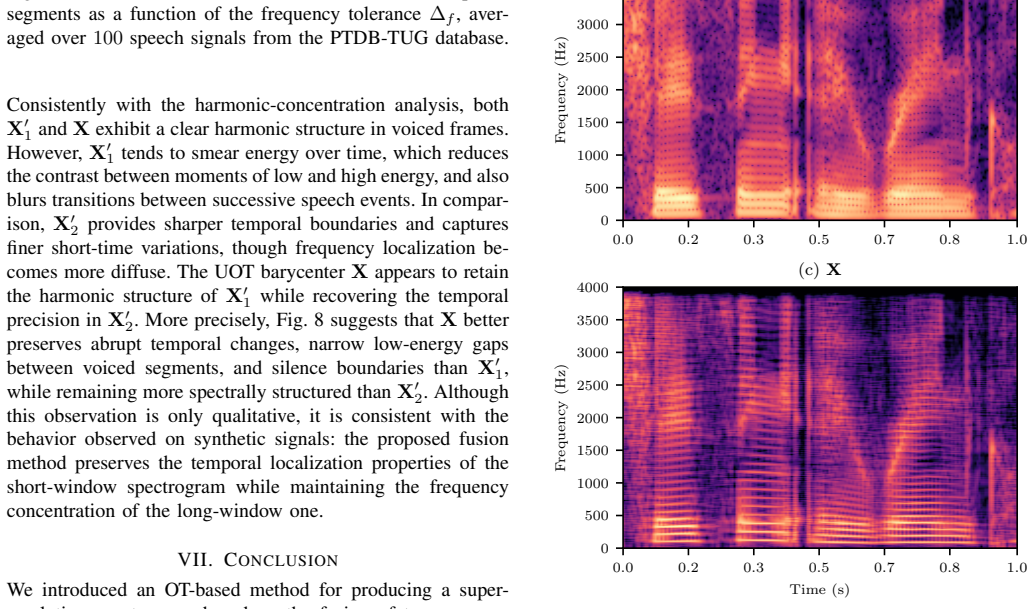
Time-frequency representations, such as the short-time Fourier transform (STFT), are fundamental tools for analyzing non-stationary signals. However, their ability to achieve sharp localization in both time and frequency is inherently limited by the Gabor-Heisenberg uncertainty principle. In this paper, we address this limitation by introducing a method to generate super-resolution spectrograms through the fusion of two or more spectrograms with varying resolutions. Specifically, we compute the super-resolution spectrogram as the barycenter of input spectrograms using optimal transport (OT) divergences. Unlike existing fusion approaches, our method does not require the input spectrograms to share the same time-frequency grid. Instead, the input spectrograms can be computed using any STFT parameters, and the resulting super-resolution spectrogram can be defined on an arbitrary user-specified grid. We explore various OT divergences based on different transportation costs. Notably, we introduce a novel transportation cost that preserves time-frequency geometry while significantly reducing computational complexity compared to standard Wasserstein barycenters. We adopt the unbalanced OT framework and derive a new block majorization-minimization algorithm for efficient barycenter computation. We validate the proposed method on controlled synthetic signals and recorded speech using both quantitative and qualitative evaluations. The results show that our approach combines the best localization properties of the input spectrograms and outperforms an unsupervised state-of-the-art fusion method.
Editorial analysis
A structured set of objections, weighed in public.
Referee Report
Summary. The manuscript claims to overcome the Gabor-Heisenberg uncertainty limit in time-frequency analysis by fusing two or more spectrograms of differing resolutions into a super-resolution spectrogram defined as their barycenter under unbalanced optimal transport (OT) divergences. Inputs need not share a common grid; the output can be placed on any user-specified grid. A novel transportation cost is introduced that preserves time-frequency geometry at lower complexity than standard Wasserstein distances, an unbalanced OT framework is adopted, and a block majorization-minimization algorithm is derived for efficient computation. Validation is performed on controlled synthetic signals and recorded speech via quantitative metrics and qualitative inspection, with reported outperformance relative to an unsupervised state-of-the-art fusion baseline.
Significance. If the central claim is substantiated, the work offers a principled, grid-flexible alternative to existing spectrogram fusion techniques and could find use in applications requiring high joint time-frequency localization (e.g., audio source separation, radar, or biomedical signal analysis). Credit is due for the algorithmic contribution (block MM solver) and for the empirical demonstration on both synthetic and real data. The approach also avoids the need for explicit grid alignment, which is a practical advantage. Significance is tempered by the absence of a theoretical guarantee that the fused representation improves localization without net fidelity loss or new artifacts.
major comments (2)
- [§3] §3 (novel transportation cost and unbalanced OT formulation): the manuscript asserts that the barycenter combines the best localization properties of the inputs, yet no inequality or bound is derived showing that the effective time-frequency spread of the OT barycenter is strictly smaller than that of the best single input. Because the unbalanced formulation permits mass creation/destruction controlled by a free regularization parameter, it is possible for the fusion to trade localization gains for new distortions; this load-bearing point for the super-resolution claim therefore requires either a supporting analysis or an explicit statement that no such guarantee is claimed.
- [§5] §5 (quantitative validation): the reported outperformance on synthetic signals is presented without error bars, without details on how data points were excluded or how the unbalanced OT regularization parameter was selected for each trial, and without statistical significance tests against the baseline. These omissions make it impossible to determine whether the observed gains are robust or sensitive to the specific experimental controls, directly affecting confidence in the central empirical claim.
minor comments (2)
- [Abstract] Abstract and §1: the phrase 'combines the best localization properties' is used without a preceding definition of the localization metric (e.g., time or frequency spread, or a specific divergence). Adding a short clarifying sentence would improve readability.
- [§5] Figure captions (throughout §5): the STFT window lengths, hop sizes, and the exact unbalanced OT regularization value used for each panel should be stated explicitly so that readers can reproduce the visual comparisons.
Simulated Author's Rebuttal
We thank the referee for the constructive comments. We address each major point below and indicate the planned revisions.
read point-by-point responses
-
Referee: the manuscript asserts that the barycenter combines the best localization properties of the inputs, yet no inequality or bound is derived showing that the effective time-frequency spread of the OT barycenter is strictly smaller than that of the best single input. Because the unbalanced formulation permits mass creation/destruction controlled by a free regularization parameter, it is possible for the fusion to trade localization gains for new distortions; this load-bearing point for the super-resolution claim therefore requires either a supporting analysis or an explicit statement that no such guarantee is claimed.
Authors: We agree that no theoretical inequality or bound is derived to prove the OT barycenter has strictly smaller time-frequency spread than the best single input. The claim that the barycenter combines the best localization properties rests on the empirical results shown in Section 5. In the revised manuscript we will add an explicit statement in Section 3 clarifying that no theoretical guarantee of strict improvement is claimed and that the observed super-resolution effect is empirical. We will also discuss the role of the unbalanced regularization parameter and the possibility of fidelity-localization trade-offs. revision: yes
-
Referee: the reported outperformance on synthetic signals is presented without error bars, without details on how data points were excluded or how the unbalanced OT regularization parameter was selected for each trial, and without statistical significance tests against the baseline. These omissions make it impossible to determine whether the observed gains are robust or sensitive to the specific experimental controls, directly affecting confidence in the central empirical claim.
Authors: We acknowledge these omissions in the current presentation. In the revised manuscript we will add error bars to all quantitative plots in Section 5, state that no data points were excluded, describe the regularization-parameter selection procedure (a fixed value chosen via preliminary tuning for consistency across trials), and include statistical significance tests (paired t-tests) against the baseline where appropriate. revision: yes
Circularity Check
No significant circularity; OT barycenter construction is independent of target resolution claim
full rationale
The paper defines the super-resolution spectrogram explicitly as the unbalanced OT barycenter of input spectrograms (with a new geometry-preserving cost and block MM solver). This is a direct application of established OT theory rather than a self-referential loop. No equation reduces a 'prediction' of enhanced localization to a fitted parameter or prior self-citation by construction. The novel cost is introduced as a computational device, not smuggled via self-citation. Experiments on synthetic and speech data supply independent empirical checks. At most a minor self-citation load (score 2) if prior OT work by the authors is referenced, but it is not load-bearing for the core fusion claim.
Axiom & Free-Parameter Ledger
free parameters (1)
- unbalanced OT regularization parameter
axioms (1)
- standard math Optimal transport divergences define valid barycenters that minimize aggregate transport costs to input measures
invented entities (1)
-
novel transportation cost preserving time-frequency geometry
no independent evidence
Reference graph
Works this paper leans on
-
[1]
Speech communication, human and machine addison wesley,
D. O’Shaughnessy, “Speech communication, human and machine addison wesley,”Reading MA, vol. 40, p. 150, 1987
work page 1987
-
[2]
Librosa: Audio and music signal analysis in Python,
B. McFee et al., “Librosa: Audio and music signal analysis in Python,”SciPy, vol. 2015, no. 18-24, p. 7, 2015
work page 2015
discussion (0)
Sign in with ORCID, Apple, or X to comment. Anyone can read and Pith papers without signing in.