pith. machine review for the scientific record. sign in

arxiv: 2604.15085 · v1 · submitted 2026-04-16 · ⚛️ physics.optics

Recognition: unknown

Roadmap on Attosecond Science

Rocio Borrego Varillas , Pierre Agostini , Fernando Ardana-Lamas , Cord L. Arnold , David Ayuso , Maurizio Reduzzi , Jakub Benda , Jens Biegert
show 103 more authors
Charles Bourassin-Bouchet Thomas Brabec Christian Brahms Andrew C. Brown David Busto J\'er\'emie Caillat Francesca Calegari Carlo Callegari Stefanos Carlstr\"om Zenghu Chang Ming-Chang Chen Anna G. Ciriolo Paul Corkum Gabriele Crippa Rafael de Q. Garcia Louis DiMauro Nirit Dudovich Per Eng-Johnsson Davide Faccial\`a Philip Flores Titouan Gadeyne Gianluca Aldo Geloni Chase Geirger Shima Gholam-Mirzaei Jimena D. Gorfinkiel Eleftherios Goulielmakis Mohammed Hassan Carlos Hern\'andez-Garc\'ia Phay Ho Dandan Hui Lynda R. Hutcheson Misha Ivanov Subhendu Kahaly Henry Kapteyn Nicholas Karpowicz Franz X. K\"artner Matthias Kling Omer Kneller Dong Hyuk Ko Peter M. Kraus Maximilian Kubullek Stephen R. Leone Franck L\'epine Anne L'Huillier Chen-Ting Liao Thomas Linker Alexander Gabriel Lohr Matteo Lucchini Lars Bojer Madsen Roland E. Mainz Bal\'azs Major Jon P. Marangos David Marco Hugo Marroux Sean Marshallsay Rebeca Mart\'inez V\'azquez Rodrigo Mart\'in-Hern\'andez Zden\v{e}k Ma\v{s}\'in Michael Meyer Felipe Morales Moreno Margaret Murnane Daniel M. Neumark Mauro Nisoli Marcus Ossiander Sreelakshmi Palakka Serguei Patchkovskii Zekun Pi Luis Plaja Julita Poborska Miguel A. Porras Kevin C. Prince David N. Purschke Nicolette G. Puskar Giulio Maria Rossi J\'er\'emy R. Rouxel Thierry Ruchon Patrick Rupprecht Pascal Sali\`eres Giuseppe Sansone Fabian Scheiba Martin Schultze Bernd Sch\"utte Svitozar Serkez Miguel A. Silva-Toledo Olga Smirnova Salvatore Stagira Andrea Trabattoni John C. Travers Igor Tyulnev Morgane Vacher Giulio Vampa Hugo W. van der Hart Katalin Varj\'u Anne-Lise Viotti Vartika Vishnoi Marc Vrakking Vincent Wanie Stefan Witte Fei Xu Vladislav S. Yakovlev Linda Young Diling Zhu Caterina Vozzi
Authors on Pith no claims yet

Pith reviewed 2026-05-10 10:08 UTC · model grok-4.3

classification ⚛️ physics.optics
keywords attosecond pulseshigh-order harmonic generationelectron dynamicsultrafast spectroscopyfree-electron laserspump-probe techniquesquantum optics
0
0 comments X

The pith

Attosecond pulses have evolved into a method for probing and steering electron dynamics in atoms, molecules, and solids.

A machine-rendered reading of the paper's core claim, the machinery that carries it, and where it could break.

The paper surveys twenty-five years of attosecond science, from the first experimental pulses to current capabilities for resolving electron motion in real time. It compiles advances in pulse generation through lasers and free-electron facilities, along with measurement approaches such as pump-probe spectroscopy and interferometry. The roadmap also examines applications to electron dynamics in molecules and condensed matter, plus emerging links to quantum optics. A sympathetic reader would care because these tools grant direct access to the fastest processes that govern chemistry and materials behavior.

Core claim

Twenty-five years after the first experimental demonstration of attosecond pulses, the field has evolved into a powerful approach for probing and steering electronic dynamics in atoms, molecules, and solids. The work reviews progress in light sources including novel lasers, waveform synthesizers, high-order harmonic generation schemes, free-electron laser sources, and structured light. It also covers measurement methods such as all-attosecond pump-probe spectroscopy, four-wave mixing, microscopy, light-transient spectroscopy, and interferometry, together with theoretical and experimental studies of electron dynamics in molecules and solids, and new directions at the quantum optics interface.

What carries the argument

Attosecond pulses, produced by high-order harmonic generation or free-electron lasers, serve as the central tool for time-resolved pump-probe experiments that capture electron motion on its natural timescale.

If this is right

  • Electron dynamics in molecules can be revealed directly through attosecond spectroscopy from both theoretical and experimental viewpoints.
  • New schemes enable attosecond pulse generation at free-electron lasers and with structured light.
  • Techniques such as attosecond four-wave mixing and interferometry extend measurement capabilities beyond traditional limits.
  • Interfaces with quantum optics open routes to study entanglement on attosecond timescales.

Where Pith is reading between the lines

These are editorial extensions of the paper, not claims the author makes directly.

  • Wider adoption could allow real-time tracking of charge migration during chemical reactions, guiding the design of faster molecular electronics.
  • The surveyed methods may connect to quantum information tasks by providing temporal control over entangled electron states.
  • Maturation of attosecond microscopy could enable spatially resolved maps of electron flow inside operating devices.

Load-bearing premise

The premise that the assembled expert contributions form a complete and unbiased map of the field's current state and future directions without major gaps.

What would settle it

Experimental results showing that attosecond techniques cannot achieve the claimed resolution or control over electron dynamics in condensed-matter systems would undermine the roadmap's assessment of progress and applications.

Figures

Figures reproduced from arXiv: 2604.15085 by Alexander Gabriel Lohr, Andrea Trabattoni, Andrew C. Brown, Anna G. Ciriolo, Anne L'Huillier, Anne-Lise Viotti, Bal\'azs Major, Bernd Sch\"utte, Carlo Callegari, Carlos Hern\'andez-Garc\'ia, Caterina Vozzi, Charles Bourassin-Bouchet, Chase Geirger, Chen-Ting Liao, Christian Brahms, Cord L. Arnold, Dandan Hui, Daniel M. Neumark, David Ayuso, David Busto, Davide Faccial\`a, David Marco, David N. Purschke, Diling Zhu, Dong Hyuk Ko, Eleftherios Goulielmakis, Fabian Scheiba, Fei Xu, Felipe Morales Moreno, Fernando Ardana-Lamas, Francesca Calegari, Franck L\'epine, Franz X. K\"artner, Gabriele Crippa, Gianluca Aldo Geloni, Giulio Maria Rossi, Giulio Vampa, Giuseppe Sansone, Henry Kapteyn, Hugo Marroux, Hugo W. van der Hart, Igor Tyulnev, Jakub Benda, Jens Biegert, J\'er\'emie Caillat, J\'er\'emy R. Rouxel, Jimena D. Gorfinkiel, John C. Travers, Jon P. Marangos, Julita Poborska, Katalin Varj\'u, Kevin C. Prince, Lars Bojer Madsen, Linda Young, Louis DiMauro, Luis Plaja, Lynda R. Hutcheson, Marcus Ossiander, Marc Vrakking, Margaret Murnane, Martin Schultze, Matteo Lucchini, Matthias Kling, Maurizio Reduzzi, Mauro Nisoli, Maximilian Kubullek, Michael Meyer, Miguel A. Porras, Miguel A. Silva-Toledo, Ming-Chang Chen, Misha Ivanov, Mohammed Hassan, Morgane Vacher, Nicholas Karpowicz, Nicolette G. Puskar, Nirit Dudovich, Olga Smirnova, Omer Kneller, Pascal Sali\`eres, Patrick Rupprecht, Paul Corkum, Per Eng-Johnsson, Peter M. Kraus, Phay Ho, Philip Flores, Pierre Agostini, Rafael de Q. Garcia, Rebeca Mart\'inez V\'azquez, Rocio Borrego Varillas, Rodrigo Mart\'in-Hern\'andez, Roland E. Mainz, Salvatore Stagira, Sean Marshallsay, Serguei Patchkovskii, Shima Gholam-Mirzaei, Sreelakshmi Palakka, Stefanos Carlstr\"om, Stefan Witte, Stephen R. Leone, Subhendu Kahaly, Svitozar Serkez, Thierry Ruchon, Thomas Brabec, Thomas Linker, Titouan Gadeyne, Vartika Vishnoi, Vincent Wanie, Vladislav S. Yakovlev, Zden\v{e}k Ma\v{s}\'in, Zekun Pi, Zenghu Chang.

Figure 1
Figure 1. Figure 1: Overview of the technological advances that are pushing attosecond sc [PITH_FULL_IMAGE:figures/full_fig_p007_1.png] view at source ↗
Figure 1
Figure 1. Figure 1: (a) and (c): Electron trajectories calculated from the semiclassical three-step model. (b) and (d): Electron return energy, in unit of the ponderomotive energy U_p, as a function of return time, in unit of the period of the fundamental optical cycle. (a) and (b) correspond to the single-colour case and (c) and (d) to the two-colour (fundamental and second harmonic) case. We assume a 1 µm driving wavelength… view at source ↗
Figure 1
Figure 1. Figure 1: Comparison of HHG source efficiencies reported in the literature. The performance of the microfluidic source in He and Ar is highlighted. Figure from ref. [14], see ref [14] for detailed references [PITH_FULL_IMAGE:figures/full_fig_p016_1.png] view at source ↗
Figure 2
Figure 2. Figure 2: Key benefits of the microfluidic approach, including (a) efficient generation in extended gas media [14], (b) precise control of gas delivery and distribution within the active region [14], and (c) driving and XUV beam manipulation through modal properties [16] [PITH_FULL_IMAGE:figures/full_fig_p017_2.png] view at source ↗
Figure 1
Figure 1. Figure 1: Fig.1 [PITH_FULL_IMAGE:figures/full_fig_p021_1.png] view at source ↗
Figure 1
Figure 1. Figure 1: (a) A multi-octave supercontinuum from Ne-filled HCF capillary post-compressor, seeded by 22 fs pulse with central wavelength of 790 nm and an energy of ~ 1 mJ. (b) Photograph of an attosecond light field synthesizer. The pulse in (a) is divided into four nearly equal-width spectral bands by dichroic beam splitters. The pulse in each spectral band is compressed to a duration of several femtoseconds, as sho… view at source ↗
Figure 1
Figure 1. Figure 1: Three tailoring schemes focusing on cutoff (a) and efficiency (b,c) enhancement are depicted above. The horizontal axis is normalized based on the period of the main pulse (grey dashed line) used in the synthesis, with each tailoring method having different limits of wavelength scalability depending on the propagation effects. LWIR = Long wave infrared, MWIR= Mid wave infrared [PITH_FULL_IMAGE:figures/ful… view at source ↗
Figure 1
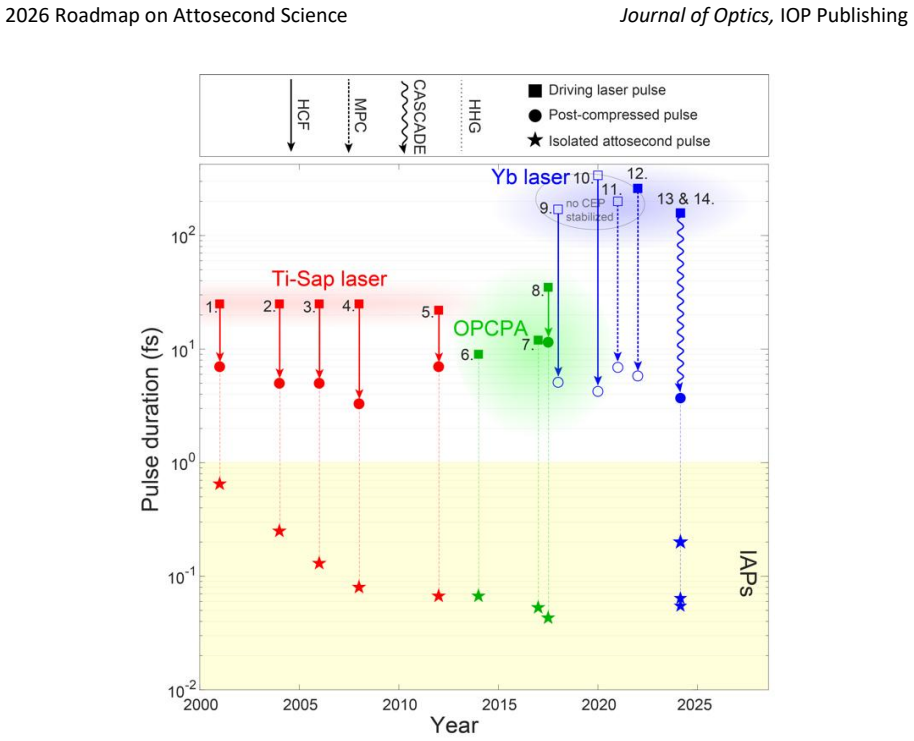
Figure 1. Figure 1: Laser sources and post-compression techniques demonstrated for IAP generation include three types of drivers: (1) CEP-stabilized Ti:Sapphire lasers (red), (2) CEP-stabilized OPA/OPCPA driven by Ti:Sapphire or Yb lasers (green), and (3) direct CEP-stabilized Yb lasers (blue). Hollow-core fibers (HCF) have been the primary post-compression method for Ti:Sapphire and OPA/OPCPA, while multi-pass cells (MPC) an… view at source ↗
Figure 2
Figure 2. Figure 2: Attosecond pulse generation in argon driven by a post-compressed Yb laser. (a) Streaking spectrogram, (b) retrieved EUV spectrum and spectral phase, and (c) temporal profile of an isolated attosecond pulse in Ar, with a retrieved duration of about 200 as. The pulse is slightly positively chirped. Figure adapted from [14] [PITH_FULL_IMAGE:figures/full_fig_p038_2.png] view at source ↗
Figure 1
Figure 1. Figure 1: Volumes enclosing positive electric field values for two ultrashort vortex structures. (a) attosecond light spring resulting from the interference of five harmonics with increasing topological charges (see inset). (b) Train of attosecond vortex pulses from the interference of harmonics with the same charge (see inset). Adapted from [2] [PITH_FULL_IMAGE:figures/full_fig_p041_1.png] view at source ↗
Figure 2
Figure 2. Figure 2: (a) Iso-intensity contour of an electron wavepacket ionized by an attosecond light spring, reconstructed from experimental intensity profiles and spectral phases, assuming an ideal qℓ vortex phase for each harmonic order. Reproduced from [5]. (b) Experimental intensity and phase front of the 25th harmonic of a ℓ =-1 driving laser, measured with a Hartmann wavefront sensor. The bar graph shows its decomposi… view at source ↗
Figure 1
Figure 1. Figure 1: Attosecond structured pulses. a) High harmonic STOVs with scaling topological charge resulting from HHG driven by STOV pulses [23] (Credit, Steve Burrows and KM group, JILA). b) Attosecond STOV pulses, obtained from the coherent superposition of SSOV-driven harmonics [7]. d) Attosecond skyrmion pulses, obtained from the superposition of harmonic polarization textures that cover one Poincaré sphere, ie, wit… view at source ↗
Figure 1
Figure 1. Figure 1: Example of materials dynamics for which hard X-ray attosecond pulses can help observe. (a) Simulation of attosecond electron dynamics in photoexcited ferroelectric PbTiO3 resulting in O to Ti charge transfer. The plots are based on simulations described in ref. [16]. Core level X-ray spectroscopy combined with diffraction has potential to directly image such charge transfer dynamics. (b) DFT simulation ill… view at source ↗
Figure 2
Figure 2. Figure 2: Two-dimensional map of the spectral and temporal distribution of a sub￾femtosecond soft X-ray pulse with nominal photon energy of 984 eV reconstructed from the analysis of the electron angular streaking measurements of the Ne 1s photoelectron using an array of 16 time-of-flight electron spectrometers [9] [PITH_FULL_IMAGE:figures/full_fig_p065_2.png] view at source ↗
Figure 1
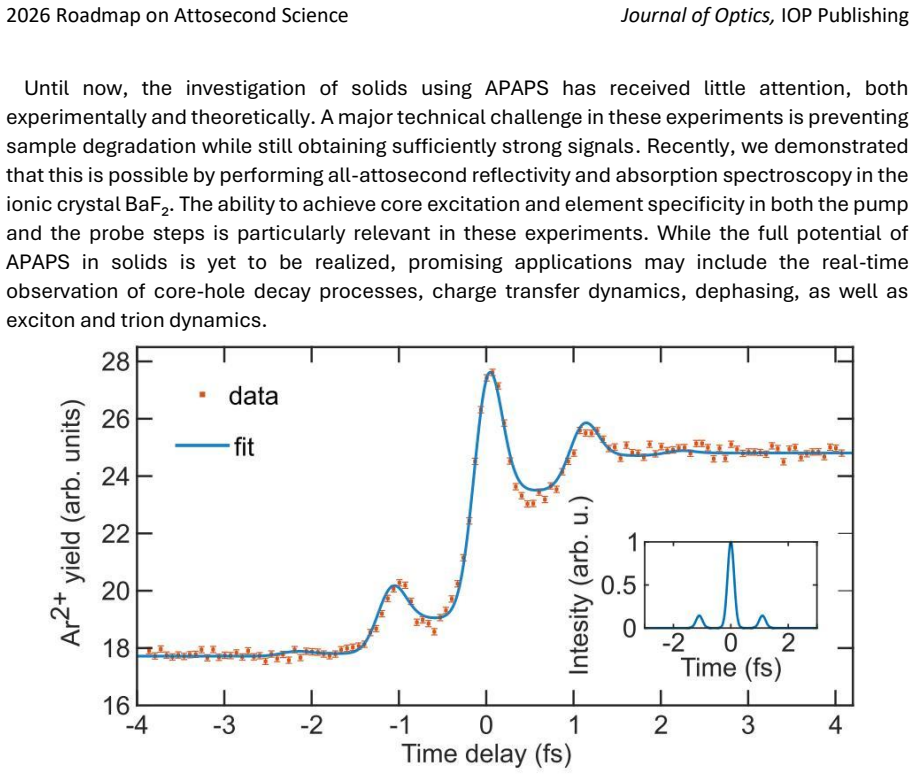
Figure 1. Figure 1: Two-color APAPS performed in Ar. The pump pulse, dominated by contributions below the second ionization potential (27.6 eV), ionizes Ar. When the probe pulse, centered at 31 eV, arrives after the pump pulse (positive time delays), it can further ionize Ar+, leading to an increased Ar2+ signal. Additional maxima appear when the individual attosecond bursts overlap in time. The blue solid line shows a fit ba… view at source ↗
Figure 1
Figure 1. Figure 1: Since the electric fields are observable in the context [PITH_FULL_IMAGE:figures/full_fig_p081_1.png] view at source ↗
Figure 1
Figure 1. Figure 1: In field-resolved attosecond science, there are four physical quantities that are coupled during the interaction with a material: the incident, reflected, and transmitted fields, and the current density. Field measurement techniques have made these observable quantities: the fields are directly observable, and the relationship between them determines the current [PITH_FULL_IMAGE:figures/full_fig_p082_1.png] view at source ↗
Figure 1
Figure 1. Figure 1: The advancement of terawatt attosecond x-rays, attosecond pump-probe tec [PITH_FULL_IMAGE:figures/full_fig_p086_1.png] view at source ↗
Figure 1
Figure 1. Figure 1: a) Concept of HHG-based scatterometry and imaging. Coherent diffraction using broadband or monochromatized harmonics enables characterization of substrate-based nanostructures: b) either through full image reconstruction using phase retrieval methods, or model-based inference of key parameters such as line thickness (LT), height (H), critical dimension (CD) and edge-placement error (EPE). c-f) RCWA simulat… view at source ↗
Figure 2
Figure 2. Figure 2: (a) Schematic representation of an HHG source and refocusing (lens shown for simplicity). Different focus positions are caused by both chromatic aberrations and long/short-trajectory contributions. (b1,b2) Experimentally reconstructed virtual source positions for harmonics 15 (53 nm), 800 nm driver) and 25 (23 nm) via ptychography, showing strong chromatic aberrations. (c) Focus smearing due to long and sh… view at source ↗
Figure 1
Figure 1. Figure 1: Attosecond delays obtained using R-matrix methods. a) One-photon ionization delays for ground state of CO2+ calculated in UKRmol+. b) Relative RABBITT delays for ionization into the first two excited states of CO2+. c) RABBITT (sideband) delays and “higher￾order RABBITT” (mainband and outer sideband) delays in argon in two-harmonic field configurations around four selected central sidebands calculated usin… view at source ↗
Figure 1
Figure 1. Figure 1: Roadmap of attosecond chemistry. Important milestones along the path toward attosecond chemistry - including attosecond technology developments and advances in tracing charge dynamics in molecules - are reported together with a vision of the future challenges [PITH_FULL_IMAGE:figures/full_fig_p132_1.png] view at source ↗
Figure 1
Figure 1. Figure 1: Harmonic yield in reflection for TiN irradiated with a few cycles of 800 nm light [5] [PITH_FULL_IMAGE:figures/full_fig_p148_1.png] view at source ↗
Figure 1
Figure 1. Figure 1: (a) The UEM temporal resolution enhancement over the last 25 years. (b) Attomciroscopy setup for imaging the electron motion based on the optical and polarization gating approaches [PITH_FULL_IMAGE:figures/full_fig_p155_1.png] view at source ↗
Figure 2
Figure 2. Figure 2: (a) Schematic of attosecond Scanning tunnelling electron microscope (Q-attomicroscope). (b) the structure and the potential applications at the attomicroscopy quantum imaging center [PITH_FULL_IMAGE:figures/full_fig_p157_2.png] view at source ↗
Figure 1
Figure 1. Figure 1: Entangled photoemission dynamics from the photoelectron (PE) perspective. Left panels: Final PE RDMs measured with: (a) the KRAKEN [12] protocol in experimental narrowband ionization of Ar overlapping the 1/2 and 3/2 spin-orbit channels; and (b) the mixed-FROG [11] protocol in broadband ionization of Ne. The inset in (b) is a close-up of the RDM’s central structure (45.0- 45.8 eV) evidencing instrumental d… view at source ↗
Figure 1
Figure 1. Figure 1: Comparison between the strong field ionization process and the quantum trajectory selector approach [PITH_FULL_IMAGE:figures/full_fig_p173_1.png] view at source ↗
Figure 2
Figure 2. Figure 2: QTS Spectrogram from measurements in argon. In (a) the subcyle character of the argon double ion signal is clearly observed. (b) illustrates the NIR vector potential and (c) shows the calibrations of the time origin determined through the analysis of the photoelectron spectrum. (Reproduced from Piper et al., Phys. Rev. Lett. 134, 073201) [PITH_FULL_IMAGE:figures/full_fig_p173_2.png] view at source ↗
read the original abstract

Twenty-five years have passed since the first experimental demonstration of attosecond pulses, marking the advent of our ability to resolve and control electron motion in real time. What began as a technological breakthrough - generating the shortest flashes ever produced - has evolved into a powerful approach for probing and steering electronic dynamics in atoms, molecules, and solids. This roadmap, authored by leading experts in the field, surveys the recent rapid progress in the generation and characterization of attosecond pulses, emerging attosecond measurement and control techniques, and their expanding range of applications. It reviews current and future developments in attosecond light sources, including novel laser technologies, waveform synthesizers, new schemes for high-order harmonic generation, attosecond pulse generation at free-electron lasers, and structured light. Advances in attosecond measurement methodologies are also discussed, encompassing all-attosecond pump-probe spectroscopy, attosecond four-wave mixing, attosecond microscopy, spectroscopy with light transients, and attosecond interferometry. Furthermore, the roadmap addresses applications of attosecond spectroscopy to reveal electron dynamics in molecules and condensed matter systems from both theoretical and experimental perspectives, and highlights emerging directions at the interface with quantum optics and quantum entanglement. Overall, this work aims to serve as a comprehensive resource for navigating the evolving landscape of attosecond science.

Editorial analysis

A structured set of objections, weighed in public.

Desk editor's note, referee report, simulated authors' rebuttal, and a circularity audit. Tearing a paper down is the easy half of reading it; the pith above is the substance, this is the friction.

Referee Report

0 major / 2 minor

Summary. The manuscript is a roadmap on attosecond science authored by a large group of leading experts. It surveys 25 years of progress since the first experimental attosecond pulses, covering advances in light sources (novel lasers, waveform synthesizers, HHG schemes, FEL-based generation, structured light), measurement and control methods (all-attosecond pump-probe, four-wave mixing, microscopy, light transients, interferometry), applications to electron dynamics in atoms/molecules/solids from theory and experiment, and emerging interfaces with quantum optics and entanglement. The central purpose is to serve as a comprehensive community resource.

Significance. If the expert syntheses are accurate, the roadmap will be a high-value reference that consolidates the field's evolution from pulse generation to real-time control of electronic dynamics. Its strengths include the breadth of coverage across sources, methods, and applications plus the collective expert input that provides forward-looking perspectives without reliance on new derivations or single experiments.

minor comments (2)
  1. [Abstract] The abstract and introduction would benefit from explicit section headings or a brief outline of the roadmap structure to help readers navigate the broad coverage of sources, methods, and applications.
  2. [Applications and Emerging Directions] Ensure consistent citation style and completeness across all sub-sections; for example, the discussion of attosecond microscopy and quantum-optics interfaces should reference the most recent experimental benchmarks to maintain the roadmap's utility.

Simulated Author's Rebuttal

0 responses · 0 unresolved

We thank the referee for their positive summary and significance assessment of the roadmap on attosecond science. The recommendation for minor revision is noted, and we will make appropriate minor adjustments to enhance clarity and completeness in the revised manuscript. No specific major comments were provided in the report.

Circularity Check

0 steps flagged

No significant circularity in this expert roadmap overview

full rationale

This is a descriptive literature survey and forward-looking roadmap on attosecond science with no derivations, equations, fitted parameters, or hypothesis-testing models present. The central claim is a historical and technical synthesis of the field's evolution, supported by expert-authored sections drawing on prior published work. No load-bearing step reduces by construction to its own inputs, self-citations, or ansatzes; the argument rests on collective expert compilation of existing results rather than any internal derivation chain. This is the expected outcome for a non-technical roadmap paper.

Axiom & Free-Parameter Ledger

0 free parameters · 0 axioms · 0 invented entities

This is a survey paper with no new derivations, so it introduces no free parameters, axioms, or invented entities.

pith-pipeline@v0.9.0 · 6116 in / 993 out tokens · 41764 ms · 2026-05-10T10:08:07.265351+00:00 · methodology

discussion (0)

Sign in with ORCID, Apple, or X to comment. Anyone can read and Pith papers without signing in.

Reference graph

Works this paper leans on

14 extracted references

  1. [1]

    P. M. Paul et al. 2001 Observation of a Train of Attosecond Pulses from High Harmonic Generation, Science 292 1289

  2. [2]

    Hentschel, R

    M. Hentschel, R. Kienberger et al. 2001 Attosecond metrology Nature 414: 509-513

  3. [3]

    Mauritsson et al

    J. Mauritsson et al. 2008 Coherent Electron Scattering Captured by an Attosecond Quantum Stroboscope Phys. Rev. Lett. 100 073003

  4. [4]

    K. J. Schafer, M. B. Gaarde, A. Heinrich, J. Biegert, and U. Keller 2004 Strong field quantum path control using attosecond pulse trains, Phys. Rev. Lett. 92, 023003

  5. [5]

    Biegert, A

    J. Biegert, A. Heinrich, C. P. Hauri, W. Kornelis, P. Schlup, M. P. Anscombe, M. B. Gaarde, K. J. Schafer, and U. Keller 2006 Control of high-order harmonic emission using attosecond pulse trains J. Mod. Opt. 53, 87

  6. [6]

    M. B. Gaarde, K. J. Schafer, A. Heinrich, J. Biegert, and U. Keller 2005 Large enhancement of macroscopic yield in attosecond pulse train-assisted harmonic generation Phys. Rev. A 72 013411

  7. [7]

    Gademann, F

    G. Gademann, F. Kelkensberg, W. K. Siu, P. Johnsson, M. B. Gaarde, K. J. Schafer, and M. J. Vrakking 2011 Attosecond control of electron-ion recollision in high harmonic generation New J. Phys. 13, 033002

  8. [8]

    Azoury, M

    D. Azoury, M. Krüger, G. Orenstein, H. R. Larsson, S. Bauch, B. D. Bruner, and N. Dudovich 2017 Self-probing spectroscopy of XUV photo-ionization dynamics in atoms subjected to a strong-field environment Nat. Commun. 8, 1453

  9. [9]

    Heldt, J

    T. Heldt, J. Dubois, P. Birk, G. D. Borisova, G. M. Lando, C. Ott, and T. Pfeifer 2023 Attosecond real-time observation of recolliding electron trajectories in helium at low laser intensities Phys. Rev. Lett. 130 183201

  10. [10]

    2025 Attosecond Clocking and Control of Strong Field Quantum Trajectories Phys

    A J Piper et al. 2025 Attosecond Clocking and Control of Strong Field Quantum Trajectories Phys. Rev Lett. 134 073201

  11. [11]

    Corkum 1993 Plasma perspective on strong field multiphoton ionization, Phys

    P. Corkum 1993 Plasma perspective on strong field multiphoton ionization, Phys. Rev. Lett. 71, 1994

  12. [12]

    K. J. Schafer, et al. 1993 Above threshold ionization beyond the high harmonic cutoff Phys. Rev. Lett. 70, 1599

  13. [13]

    Walker et al

    B. Walker et al. 1996 Elastic Rescattering in the Strong Field Tunneling Limit Phys. Rev. Lett. 77, 5031

  14. [14]

    Gruson, V. et al. 2016 Attosecond dynamics through a Fano resonance: monitoring the birth of a photoelectron Science 354, 734–738