Complexity of Fungal Automaton Prediction
Pith reviewed 2026-05-10 09:49 UTC · model grok-4.3
The pith
Predicting fungal automaton evolution under the freezing majority rule at radius 1.5 is P-complete.
A machine-rendered reading of the paper's core claim, the machinery that carries it, and where it could break.
Core claim
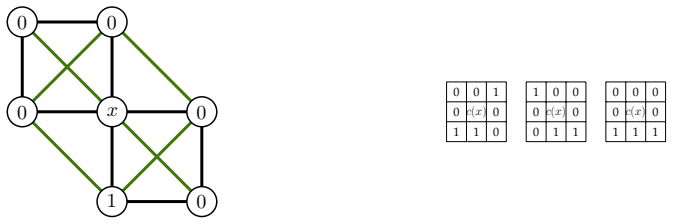
While most fungal freezing totalistic one-dimensional rules of radius 1 admit non-deterministic logspace prediction algorithms, the freezing majority rule at radius 1.5 makes the prediction task P-complete under the alternating vertical-horizontal application.
What carries the argument
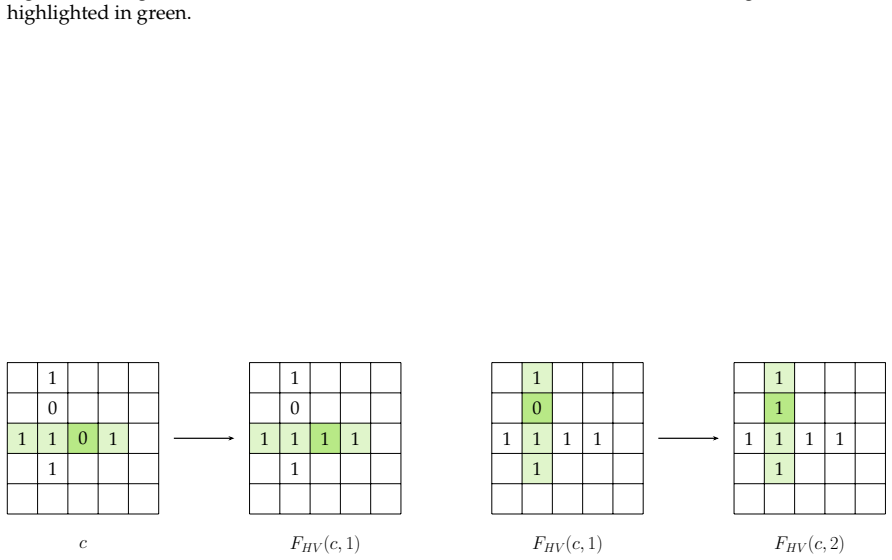
Alternating vertical and horizontal application of a single freezing totalistic rule on a one-dimensional lattice, with the majority rule serving as the example that reaches P-completeness when the radius is extended to 1.5.
Load-bearing premise
The model relies on the alternating vertical-horizontal application of the rules together with the exact definition of freezing totalistic rules at the stated radii.
What would settle it
An explicit logspace reduction from a known P-complete problem such as the circuit value problem to the prediction task for the radius-1.5 freezing majority rule, or conversely a non-deterministic logspace algorithm that correctly forecasts all configurations of that rule.
Figures




read the original abstract
Fungal automata are a nature-inspired computational model, where a rule is alternatively applied verticaly and horizontaly. In this work we study the computational complexity of predicting the dynamics of all fungal freezing totalistic one-dimentional rules of radius $1$, exhibiting various behaviors. Despite efficiently predictable in most cases (with non-deterministic logspace algorithms), a non-linear rule is left open to characterize. We further explore the freezing majority rule (which is totalistic), and prove that at radius $1.5$ it becomes $\mathbf{P}$-complete to predict.
Editorial analysis
A structured set of objections, weighed in public.
Referee Report
Summary. The manuscript examines the computational complexity of predicting the evolution of fungal automata, defined as one-dimensional cellular automata where rules are applied alternately in vertical and horizontal directions. It classifies all freezing totalistic rules of radius 1, showing that most admit non-deterministic logspace (NL) prediction algorithms, leaving one non-linear rule open. Additionally, it proves that the freezing majority rule at radius 1.5 is P-complete to predict.
Significance. If the proofs hold, this provides a fine-grained complexity map for a biologically inspired variant of cellular automata, highlighting how the alternating application and radius affect predictability. The distinction between NL and P-completeness for similar rules is a useful contribution to the study of prediction problems in automata.
major comments (2)
- [Abstract] Abstract: the NL membership claims for radius-1 freezing totalistic rules and the P-completeness claim for the radius-1.5 freezing majority rule cannot be verified, as the specific algorithms, reductions (e.g., from CVP), and proof details are absent from the abstract; this is load-bearing for the central classification results.
- [Abstract] Abstract: the alternating vertical-horizontal application mechanism is taken as given without explicit definition or justification of how it interacts with the totalistic freezing constraint at radius 1 vs. 1.5; this needs clarification to confirm the reduction preserves the model.
minor comments (2)
- [Abstract] Abstract: typos include 'alternatively' (should be 'alternately'), 'verticaly' (should be 'vertically'), and 'one-dimentional' (should be 'one-dimensional').
- [Abstract] Abstract: the open non-linear rule at radius 1 should be identified by its explicit rule definition or number to allow readers to assess the gap.
Simulated Author's Rebuttal
We thank the referee for their careful reading and constructive comments. We address each major comment below. The detailed proofs are present in the body of the manuscript, but we agree the abstract can be strengthened for clarity and will revise it accordingly.
read point-by-point responses
-
Referee: [Abstract] Abstract: the NL membership claims for radius-1 freezing totalistic rules and the P-completeness claim for the radius-1.5 freezing majority rule cannot be verified, as the specific algorithms, reductions (e.g., from CVP), and proof details are absent from the abstract; this is load-bearing for the central classification results.
Authors: The abstract is intentionally concise and does not contain full algorithmic or reduction details, which are instead provided in Sections 3 and 4. The NL membership for most radius-1 rules follows from a non-deterministic logspace procedure that guesses the order of vertical-then-horizontal updates and verifies local totalistic sums while respecting the freezing constraint (no 1-to-0 transitions). The P-completeness for the radius-1.5 majority rule is established by a direct reduction from the Circuit Value Problem, in which gate evaluations are simulated by majority votes over the alternating neighborhoods. We will revise the abstract to briefly reference these techniques (e.g., “via NL simulation of alternating updates” and “by reduction from CVP”) while remaining within length limits. revision: yes
-
Referee: [Abstract] Abstract: the alternating vertical-horizontal application mechanism is taken as given without explicit definition or justification of how it interacts with the totalistic freezing constraint at radius 1 vs. 1.5; this needs clarification to confirm the reduction preserves the model.
Authors: Section 2 defines the model explicitly: the one-dimensional lattice is embedded in a two-dimensional grid; the totalistic rule is first applied to vertical neighbors and then to horizontal neighbors. Radius 1 uses the four orthogonal neighbors; radius 1.5 additionally incorporates the four diagonal half-steps. Because the rule is totalistic (depends only on the neighbor sum) and freezing (a cell may change from 0 to 1 but never from 1 to 0), both the vertical and horizontal phases preserve these invariants. The CVP reduction is constructed so that every simulated gate respects the same freezing majority vote. We will insert a single clarifying sentence into the abstract and expand the model definition paragraph in the introduction to make the interaction explicit. revision: yes
Circularity Check
No significant circularity; derivation relies on standard reductions
full rationale
The paper defines fungal automata as an alternating vertical-horizontal application of totalistic rules on a 1D grid and then classifies prediction complexity for freezing variants at radius 1 (mostly NL, one open) and proves P-completeness for the freezing majority rule at radius 1.5 via reduction from a known P-complete problem. These steps use external complexity-theoretic machinery (standard logspace reductions, circuit-value hardness) rather than any self-definition, fitted parameter renamed as prediction, or load-bearing self-citation. The model assumptions are stated upfront as the object of study, not derived from the complexity results themselves.
Axiom & Free-Parameter Ledger
axioms (2)
- standard math Standard definitions and closure properties of NL and P complexity classes
- domain assumption The fungal automaton is defined by alternating vertical and horizontal rule applications on a 1D grid
Reference graph
Works this paper leans on
-
[1]
Modanese,A.,Worsch,T.: EmbeddingarbitraryBooleancircuitsintofungalautomata.Algorithmica, 1–23 (2024)
2024
-
[2]
Oxford University Press (1995)
Greenlaw, R., Hoover, H.J., Ruzzo, W.L.: Limits to Parallel Computation: P-Completeness Theory. Oxford University Press (1995)
1995
-
[3]
In: Adamatzky, A
Adamatzky, A., Goles, E., Martínez, G.J., Tsompanas, M.-A., Tegelaar, M., Wösten, H.A.B.: Fungal automata. In: Adamatzky, A. (ed.)Fungal Machines: Sensing and Computing with Fungi, pp. 323–339. Springer, Berlin (2023)
2023
-
[4]
In: Adamatzky, A
Sepúlveda, C.S., Goles, E., Ríos-Wilson, M., Adamatzky, A.: Exploring dynamics of fungal cellular automata. In: Adamatzky, A. (ed.)Fungal Machines: Sensing and Computing with Fungi, pp. 341–370. Springer, Berlin (2023)
2023
-
[5]
Physics Letters A384(22), 126541 (2020)
Goles, E., Tsompanas, M.-A., Adamatzky, A., Tegelaar, M., Wösten, H.A.B., Martínez, G.J.: Computational universality of fungal sandpile automata. Physics Letters A384(22), 126541 (2020)
2020
-
[6]
Fundamenta Informaticae171(1–4), 189–219 (2020)
Formenti, E., Perrot, K.: How hard is it to predict sandpiles on lattices? A survey. Fundamenta Informaticae171(1–4), 189–219 (2020)
2020
-
[7]
Miltersen,P.B.: Thecomputationalcomplexityofone-dimensionalsandpiles.TheoryofComputing Systems41(1), 119–125 (2007)
2007
-
[8]
SIGACT News9(2), 25–29 (1977)
Goldschlager, L.M.: The monotone and planar circuit value problems are log-space complete for P. SIGACT News9(2), 25–29 (1977)
1977
-
[9]
Journal of Statistical Physics 96(1), 205–224 (1999)
Moore, C., Nilsson, M.: The computational complexity of sandpiles. Journal of Statistical Physics 96(1), 205–224 (1999)
1999
-
[10]
Physical Review Letters59(4), 381–384 (1987)
Bak, P., Tang, C., Wiesenfeld, K.: Self-organized criticality: An explanation of the1/f noise. Physical Review Letters59(4), 381–384 (1987)
1987
-
[11]
Theoretical Computer Science997, 114511 (2024)
Ríos-Wilson, M., Theyssier, G.: Intrinsic universality in automata networks I: Families and simulations. Theoretical Computer Science997, 114511 (2024)
2024
-
[12]
Goles, E., Montealegre, P., Ríos-Wilson, M., Theyssier, G.: On the complexity of freezing automata networks of bounded pathwidth. arXiv:2511.09297 (2025)
-
[13]
Journal of Computer and System Sciences22(3), 365–383 (1981)
Ruzzo, W.L.: On uniform circuit complexity. Journal of Computer and System Sciences22(3), 365–383 (1981)
1981
-
[14]
Theoretical Computer Science1016, 114779 (2024)
Ríos-Wilson,M.,Theyssier,G.: IntrinsicuniversalityinautomatanetworksII:Glueingandgadgets. Theoretical Computer Science1016, 114779 (2024)
2024
-
[15]
Theoretical Computer Science1022, 114890 (2024)
Ríos-Wilson, M., Theyssier, G.: Intrinsic universality in automata networks III: On symmetry versus asynchrony. Theoretical Computer Science1022, 114890 (2024)
2024
-
[16]
Information and Computation274, 104537 (2020)
Goles,E.,Montealegre,P.: Thecomplexityoftheasynchronouspredictionofthemajorityautomata. Information and Computation274, 104537 (2020)
2020
-
[17]
Advances in Applied Mathematics125, 102161 (2021) 20
Goles, E., Montealegre, P., Perrot, K.: Freezing sandpiles and Boolean threshold networks: Equivalence and complexity. Advances in Applied Mathematics125, 102161 (2021) 20
2021
-
[18]
Ríos-Wilson, M
Goles, E., Montealegre, P. Ríos-Wilson, M. Theyssier, G.: On the parameterized complexity of freezing dynamics, Advances in Applied Mathematics157, 102706 (2024)
2024
-
[19]
Theoretical Computer Science609, 118–128 (2016)
Goles, E., Montealegre, P., Salo, V., Törmä, I.: PSPACE-completeness of majority automata networks. Theoretical Computer Science609, 118–128 (2016)
2016
-
[20]
Information and Computation281, 104764 (2021)
Goles, E., Maldonado, D., Montealegre, P., Ríos-Wilson, M.: On the complexity of asynchronous freezing cellular automata. Information and Computation281, 104764 (2021)
2021
-
[21]
Natural Computing24(1), 29–66 (2025)
Concha-Vega, P., Goles, E., Montealegre, P., Perrot, K.: Sandpiles prediction and crossover onZ2 within Moore neighborhood. Natural Computing24(1), 29–66 (2025)
2025
-
[22]
Discrete Mathematics & Theoretical Computer Science24(1) (2022)
Ollinger, N., Theyssier, G.: Freezing, bounded-change and convergent cellular automata. Discrete Mathematics & Theoretical Computer Science24(1) (2022)
2022
-
[23]
Nakar,Y.,Ron,D.: Characterizingandtestingconfigurationstabilityintwo-dimensionalthreshold cellular automata. arXiv:2507.14569 (2025) 21 10101010101010101101 10 0101010101011 10 01 1 10 0 010101011 1 10 0 01 1 1 11 0 0 0 10010101010101010101011 0 0 0 10 1 1 11 1 1 0 0 00101000101 1 1 11 11 0 0 00 1001 1 1 11 1 0 0 01 0 0 1 1 1010101010101010101010101010101...
discussion (0)
Sign in with ORCID, Apple, or X to comment. Anyone can read and Pith papers without signing in.