NEFFY 2.0: A Breathing Companion Robot: User-Centered Design and Findings from a Study with Ukrainian Refugees
Pith reviewed 2026-05-15 15:53 UTC · model grok-4.3
The pith
A breathing companion robot reduces perceived stress more than audio guidance alone in a study with Ukrainian refugees.
A machine-rendered reading of the paper's core claim, the machinery that carries it, and where it could break.
Core claim
NEFFY 2.0, built as an embodied haptic breathing companion through iterative user-centered design, yields a substantially larger significant drop in perceived stress than audio-only guidance when tested with 14 Ukrainian refugees; qualitative data confirm users experience the robot as intuitive, calming and supportive, physiological measures display mixed results with large inter-personal variability, and k-means clustering identifies three patterns of breathing practice.
What carries the argument
Embodied multi-sensory interaction that guides slow-paced breathing, directly compared against an audio-only baseline.
If this is right
- Embodied robots can deliver accessible breathing support for people facing prolonged anxiety.
- Direct robot-versus-audio comparisons provide evidence that physical presence adds value beyond voice instructions.
- Clustering breathing patterns with the robot can reveal distinct user styles that may guide personalization.
- Such tools offer a low-threshold option for stress relief in vulnerable groups like refugees.
Where Pith is reading between the lines
- If the benefit stems from embodiment rather than novelty, the same robot might help other stressed populations without requiring cultural adaptation.
- Controlling for attention effects in future trials would clarify whether the robot's physical form is the active ingredient.
- Linking the identified breathing clusters to long-term stress outcomes could turn the robot into a more adaptive coach.
Load-bearing premise
The robot's physical presence and multi-sensory features, rather than novelty or extra attention from the experiment, are what produce the greater stress reduction.
What would settle it
A larger follow-up study that equalizes attention and expectation across conditions and still finds no reliable difference in stress reduction between robot and audio would falsify the central claim.
Figures
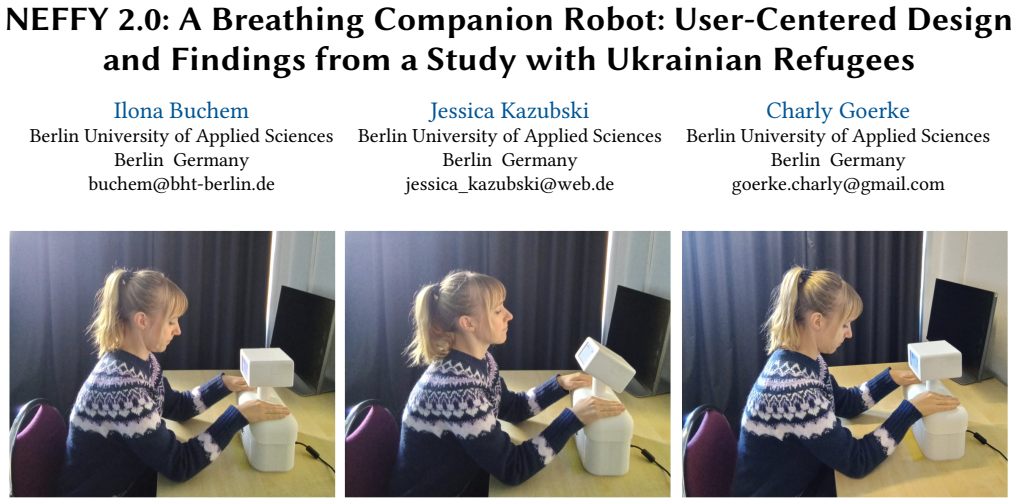
read the original abstract
This paper presents the design of NEFFY 2.0, a social robot designed as a haptic slow-paced breathing companion for stress reduction, and reports findings from a mixed-methods user study with 14 refugees from Ukraine. Developed through a user-centered design process, NEFFY 2.0 builds on NEFFY 1.0 and integrates embodiment and multi-sensory interaction to provide low-threshold, accessible guidance of slow-paced breathing for stress relief, which may be particularly valuable for individuals experiencing prolonged periods of anxiety. To evaluate effectiveness, an experimental comparison of a robot-assisted breathing intervention versus an audio-only condition was conducted. Measures included subjective ratings and physiological indicators, such as heart rate (HR), heart rate variability (HRV) using RMSSD parameter, respiratory rate (RR), and galvanic skin response (GSR), alongside qualitative data from interviews exploring user experience and perceived support. Qualitative findings showed that NEFFY 2.0 was perceived as intuitive, calming and supportive. Survey results showed a substantially larger effect in significant reduction of perceived stress in the NEFFY 2.0 condition compared to audio-only. Physiological data reveled mixed results combined with large inter-personal variability. Three patterns of breathing practice with NEFFY 2.0 were identified using k-means clustering. Despite the small sample size, this study makes a novel contribution by providing empirical evidence of stress reduction in a vulnerable population through a direct comparison of robot-assisted and non-robot conditions. The findings position NEFFY 2.0 as a promising low-threshold tool that supports stress relief and contributes to the vision of HRI empowering society.
Editorial analysis
A structured set of objections, weighed in public.
Referee Report
Summary. The manuscript describes the iterative user-centered design of NEFFY 2.0, a social robot for guiding slow-paced breathing with haptic feedback, and presents findings from a mixed-methods experiment with 14 Ukrainian refugees. The study compares the robot condition to an audio-only breathing guidance condition, reporting a substantially larger reduction in perceived stress for the robot arm, mixed outcomes on physiological measures (HR, HRV, RR, GSR) with high inter-individual variability, positive qualitative perceptions of the robot as calming and supportive, and three distinct breathing practice patterns identified via k-means clustering on the robot data.
Significance. If the subjective stress reduction difference holds after addressing confounds and statistical reporting, the work would supply a direct empirical comparison of robot versus non-robot breathing guidance in a vulnerable population, offering concrete data on user experience and practice patterns that could inform accessible HRI interventions for anxiety.
major comments (3)
- [Results] Results section: the claim of a 'substantially larger effect in significant reduction of perceived stress' in the NEFFY 2.0 condition is presented without statistical details such as the test used, p-value, effect size, confidence intervals, or power analysis for the n=14 sample. This is load-bearing for the central empirical claim, especially given the noted large inter-personal variability.
- [Methods] Methods section: the robot versus audio-only comparison lacks controls for novelty, attention, or demand characteristics (no sham-embodiment arm, no blinding, no placebo measures). This undermines attribution of the effect specifically to embodiment and multi-sensory features rather than non-specific factors.
- [Results] Results (physiological measures): the mixed HR, HRV (RMSSD), RR, and GSR outcomes with large variability are noted but without reported analysis details, pre-registered hypotheses, or explicit linkage to the subjective findings, weakening the overall support for intervention effectiveness.
minor comments (2)
- [Abstract] Abstract: 'reveled' is a typo and should read 'revealed'.
- [Abstract] Abstract: the statement that the study 'makes a novel contribution' despite small n could be qualified more precisely regarding the scope of novelty (direct comparison in this population).
Simulated Author's Rebuttal
We thank the referee for the detailed and constructive feedback on our manuscript. We address each major comment point by point below, agreeing where revisions are needed to improve statistical transparency and discussion of limitations. We plan to submit a revised version incorporating these changes.
read point-by-point responses
-
Referee: [Results] Results section: the claim of a 'substantially larger effect in significant reduction of perceived stress' in the NEFFY 2.0 condition is presented without statistical details such as the test used, p-value, effect size, confidence intervals, or power analysis for the n=14 sample. This is load-bearing for the central empirical claim, especially given the noted large inter-personal variability.
Authors: We agree that the statistical details were insufficiently reported. In the revised manuscript, we will add the specific test performed (paired t-test on stress score differences), exact p-value, effect size (Cohen's d), 95% confidence intervals, and a post-hoc power analysis for n=14. This will be presented alongside the existing note on inter-individual variability to provide a balanced and rigorous account of the central finding. revision: yes
-
Referee: [Methods] Methods section: the robot versus audio-only comparison lacks controls for novelty, attention, or demand characteristics (no sham-embodiment arm, no blinding, no placebo measures). This undermines attribution of the effect specifically to embodiment and multi-sensory features rather than non-specific factors.
Authors: We acknowledge this as a genuine limitation of the current design. The study was conducted with a vulnerable population under time and resource constraints that precluded additional control arms or blinding. In revision, we will expand the Methods and Discussion sections to explicitly describe these design choices, discuss their potential impact on causal attribution, and outline them as priorities for future controlled trials. revision: partial
-
Referee: [Results] Results (physiological measures): the mixed HR, HRV (RMSSD), RR, and GSR outcomes with large variability are noted but without reported analysis details, pre-registered hypotheses, or explicit linkage to the subjective findings, weakening the overall support for intervention effectiveness.
Authors: We will revise the Results section to include full details of the statistical tests applied to each physiological measure, descriptive statistics on variability, and any exploratory nature of the analyses (the study was not pre-registered). We will also add explicit cross-references in the Discussion linking the mixed physiological patterns to the subjective stress reduction results, framing the overall evidence more cautiously. revision: yes
Circularity Check
Empirical user study reports direct comparisons and clustering with no derivations or self-referential loops
full rationale
The paper contains no equations, fitted parameters, or mathematical derivations. Claims rest on observed survey differences, mixed physiological measures, qualitative interviews, and standard k-means clustering applied to collected breathing data. No self-citations are invoked to justify uniqueness theorems or load-bearing premises, and the design does not rename known results or smuggle ansatzes. The analysis is self-contained as a report of empirical outcomes from a small-sample comparison, with no reduction of predictions to inputs by construction.
Axiom & Free-Parameter Ledger
axioms (2)
- domain assumption Subjective stress ratings and physiological signals (HR, HRV via RMSSD, RR, GSR) validly measure stress reduction from breathing guidance.
- domain assumption The user-centered design process produces an intuitive and calming interaction for the target population.
Lean theorems connected to this paper
-
IndisputableMonolith/Foundation/RealityFromDistinction.leanreality_from_one_distinction unclear?
unclearRelation between the paper passage and the cited Recognition theorem.
NEFFY 2.0 guides users through a sequence of five phases: Startup, Greeting, Settings, Breathing, Ending. By harmonizing haptic motion, expressive visuals, and auditory cues...
What do these tags mean?
- matches
- The paper's claim is directly supported by a theorem in the formal canon.
- supports
- The theorem supports part of the paper's argument, but the paper may add assumptions or extra steps.
- extends
- The paper goes beyond the formal theorem; the theorem is a base layer rather than the whole result.
- uses
- The paper appears to rely on the theorem as machinery.
- contradicts
- The paper's claim conflicts with a theorem or certificate in the canon.
- unclear
- Pith found a possible connection, but the passage is too broad, indirect, or ambiguous to say the theorem truly supports the claim.
Reference graph
Works this paper leans on
-
[1]
Bethany Nichol, Jemma Mccready, Goran Erfani, Dania Comparcini, Valentina Simonetti, Giancarlo Cicolini, Kristina Mikkonen, Miyae Yamakawa, and Marco Tomietto. 2024. Exploring the impact of socially assistive robots on health and wellbeing across the lifespan: An umbrella review and meta- analysis. International Journal of Nursing Studies 153, (May 2024),...
-
[2]
Imane Guemghar, Marie-Pascale Pomey, Amal Abdel-Baki, Jesseca Paquette, Paula Pires De Oliveira Padilha, and Didier Jutras-Aswad. 2021. Social Robot In terventions in Mental Health Care and Their Outcomes, Barriers, and Facilitators: Scoping Review. doi: 10.2196/preprints.36094
-
[3]
Arielle Aj Scoglio, Erin D Reilly, Jay A Gorman, and Charles E Drebing. 2019. Use of Social Robots in Mental Health and Well-Being Research: Systematic Review. Journal of Medical Internet Research 21, 7 (July 2019), e13322. doi: 10.2196/13322
-
[4]
Susan M. Rabbitt, Alan E. Kazdin, and Brian Scassellati. 2015. Integrating socially assistive robotics into mental healthcare interventions: Applications and recom mendations for future research. Clinical Psychology: Science and Practice 35, 4 (2015), 35-46. doi: 10.1016/j.cpr.2014.07.001
-
[5]
Sedighadeli, Rajiv Khosla, and Mei-Tai Chu
Rebekah Kachouie, Moeen T. Sedighadeli, Rajiv Khosla, and Mei-Tai Chu. 2014. Socially assistive robots in elderly care: A mixed-method systematic literature re view. International Journal of Human–Computer Interaction 30, 5 (2014), 369–393. doi:10.1080/10447318.2013.873278
-
[6]
Zachary Witkower, Laura Cang, Paul Bucci, Karon Maclean, and Jessica L Tracy
-
[7]
Human psychophysiology is influenced by physical touch with a “breathing” robot. Emotion (Washington, D.C.) (November 2025). doi: 10.1037/emo0001601
-
[8]
Steve Yohanan and Karon E Maclean. 2011. Design and assessment of the haptic creature’s affect display. association for computing machinery, 473–480. doi: 10.1145/1957656.1957820
-
[9]
Kayla Matheus, Marynel Vázquez, and Brian Scassellati. 2025. Ommie: The Design and Development of a Social Robot for Anxiety Reduction. J. Hum.-Robot Interact. 14, 2, Article 31 (June 2025), 34 pages. https://doi.org/10.1145/3706122
-
[10]
Emily Jean Thomas, Kerim Dincel, and Ilona Buchem. 2025. NEFFY - A Social Robot for Multimodal Support of Slow-Paced Breathing Exercises. In Proceedings of the 2025 ACM/IEEE International Conference on Human-Robot Interaction (HRI ’25). IEEE Press, 1800–1802. doi: hri61500.2025.10974160
-
[11]
Awwad Alenezy, Basem Salama, Naglaa A. Bayomy, Safya E. Esmaeel, Eslam K. Fahmy, Yasir Mehmood, Omaima A. Hamid, and Syed Sajid Hussain Shah. 2025. Health consequences of refugee displacement: A comprehensive review of risks, barriers and systemic challenges. Journal of Pioneering Medical Sciences 14, 8 (2025), 124–134
work page 2025
-
[12]
Othelia Eunkyoung Lee, Kwi Ok Nah, Eun Mi Kim, Namkee G Choi, and Do- Hyung Park. 2024. Exploring the Use of Socially Assistive Robots Among Socially Isolated Korean American Older Adults. Journal of applied gerontology, 43, 9 (February 2024), 1295–1304. doi: 10.1177/07334648241236081
-
[13]
Turankar, Arvind V., Jain, Shilpa, Patel, S. B., Sinha, S. R., Joshi, A. D., Vallish, B. N., Mane, P. R., and Turankar, S. A. 2013. Effects of slow breathing exercise on cardiovascular functions, pulmonary functions and galvanic skin resistance in healthy human volunteers – a pilot study. Indian Journal of Medical Research 137, 5 (May 2013), 916–921
work page 2013
-
[14]
Andrea Zaccaro, Andrea Piarulli, Marco Laurino, Erika Garbella, Danilo Menicucci, Bruno Neri, and Angelo Gemignani. 2018. How Breath-Control Can Change Your Life: A Systematic Review on Psycho-Physiological Correlates of Slow Breathing. Frontiers in Human Neuroscience 12 (2018), Article 353. doi: 10.3389/fnhum.2018.00353
-
[15]
Shen-Mou Hsu, Chih-Hsin Tseng, Chao-Hsien Hsieh, and Chang-Wei Hsieh
-
[16]
Journal of Neurophysiology 123, 1 (January 2020), 289–299
Slow-paced inspiration regularizes alpha phase dynamics in the hu man brain. Journal of Neurophysiology 123, 1 (January 2020), 289–299. https://doi.org/10.1152/jn.00624.2019
-
[17]
Guy William Fincham, Clara Strauss, Jesus Montero-Marin, and Kate Cavanagh
-
[18]
Scientific Reports 13, 1 (January 2023), 432
Effect of breathwork on stress and mental health: A meta-analysis of randomised-controlled trials. Scientific Reports 13, 1 (January 2023), 432. doi: 10.1038/s41598-022-27247-y
-
[19]
Valentina Perciavalle, Marta Blandini, Paola Fecarotta, Andrea Buscemi, Donatella Di Corrado, Luana Bertolo, Fulvia Fichera, and Marinella Coco. 2017. The role of deep breathing on stress. Neurological Sciences 38, 3 (March 2017), 451–458. doi: 10.1007/s10072-016-2790-8
-
[20]
Adriana Chammas, Manuela Quaresma, and Cláudia Mont'Alvão. 2015. A closer look on the user centred design. Procedia Manufacturing 3 (2015), 5397–5404. doi:10.1016/j.promfg.2015.07.656
-
[21]
Tate, Cathy Maxwell, Emily Latshaw, Paul Newhouse, Douglas W
Ritam Ghosh, Nibraas Khan, Miroslava Migovich, Judith A. Tate, Cathy Maxwell, Emily Latshaw, Paul Newhouse, Douglas W. Scharre, Alai Tan, Kelley Colopietro, Lorraine C. Mion, and Nilanjan Sarkar. 2024. User-Centered Design of Socially Assistive Robotic Combined with Non-Immersive Virtual Reality-based Dyadic Activities for Older Adults Residing in Long Te...
-
[22]
Christian Bergner, Robert Schmidt-Vollus, and Klaus Bengler. 2024. User- Centered Human-Robot Coworking: A Novel Approach Transforming Man ual Tasks. In Proceedings of the 2024 IEEE 20th International Conference on Automation Science and Engineering (CASE ’24). IEEE, 3799–3804. doi: 10.1109/CASE59546.2024.10711664
-
[23]
Sebastian Pimminger, Werner Kurschl, Johannes Schönböck, and Gerald Adam Zwettler. 2025. Appearance Matters: Insights from Co-Design and Evaluation of Social Assistive Robots. In Proceedings of the 18th ACM International Con ference on Pervasive Technologies Related to Assistive Environments (PETRA ’25). Association for Computing Machinery, New York, NY,...
-
[24]
Joanne Peng, Chao-Ying, and Mary B. Ziskin. 2008. Control group. In Encyclope dia of Survey Research Methods, Paul J. Lavrakas (Ed.). Sage Publications, Inc., Thousand Oaks, CA, 147. doi: 10.4135/9781412963947.n102
-
[25]
Elena F. Corriero. 2017. Counterbalancing. In The SAGE Encyclopedia of Com munication Research Methods, Mike Allen (Ed.), Vol. 4. SAGE Publications, Inc., Thousand Oaks, CA, 278–281. doi: 10.4135/9781483381411.n103
-
[26]
Ann Shivers-McNair, Laura Gonzales, and Tetyana Zhyvotovska. 2019. An in tersectional technofeminist framework for community-driven technology in novation. Computers and Composition 51 (2019), 43–54. doi: 10.1016/j.comp com.2018.11.005
-
[27]
Shimmer Sensing. 2021. Shimmer User Manual (Revision 3). Online manual. Retrieved December 04, 2025 from https://shimmersensing.com/wp-content/ docs/support/documentation/Shimmer_User_Manual_rev3p.pdf
work page 2021
-
[28]
Vernier Software and Technology. 2024. Go Direct Respiration Belt User Manual (GDX-RB). Vernier Software and Technology. Retrieved December 4, 2025 from https://www.vernier.com/files/manuals/gdx-rb/gdx-rb.pdf
work page 2024
-
[29]
Stefan Sammito, Beatrice Thielmann, Andre Klussmann, Andreas Deußen, Klaus- Michael Braumann, and Irina Böckelmann. 2024. Guideline for the Application of Heart Rate and Heart Rate Variability in Occupational Medicine and Occupational Health Science. Journal of Occupational Medicine and Toxicology 19, 15 (May 2024). doi:10.1186/s12995-024-00414-9
-
[30]
Fred Shaffer and J. P. Ginsberg. 2017. An Overview of Heart Rate Variability Metrics and Norms. Frontiers in Public Health 5, Article 258 (September 2017). doi: 10.3389/fpubh.2017.00258
-
[31]
Shan He, Zixiong Han, Cristóvão Iglesias, Varun Mehta, and Miodrag Bolic. 2022. A Real-Time Respiration Monitoring and Classification System Using a Depth Camera and Radars. Frontiers in Physiology 13 (March 2022), Article 799621. doi: 10.3389/fphys.2022.799621
-
[32]
Alina S. Nechyporenko, Marcus Frohme, Yaroslav Strelchuk, Vladyslav Omelchenko, Vitaliy Gargin, Liudmyla Ishchenko, and Victoriia Alekseeva. 2024. Galvanic skin response and photoplethysmography for stress recognition using machine learning and wearable sensors. Applied Sciences 14, 24 (2024), Article 11997. doi: 10.3390/app142411997
-
[33]
Anita Dorsey, Elissa Scherer, Randy Eckhoff, and Robert D. Furberg. 2022. Mea surement of Human Stress: A Multidimensional Approach. RTI Press, Research Triangle Park, NC. doi: 10.3768/rtipress.2022.op.0073.2206
-
[34]
Theresa M Marteau and Hilary Bekker. 1992. The development of a six-item short-form of the state scale of the Spielberger State-Trait Anxiety Inventory (STAI). British Journal of Clinical Psychology 31, 3 (September 1992), 301–306. doi: 10.1111/j.2044-8260.1992.tb00997.x
-
[35]
Daniel Ullman and Bertram F. Malle. 2023. MDMT: Multi-Dimensional Measure of Trust v2 – Full Scale. Brown University. Retrieved from https://research.clps. brown.edu/SocCogSci/Measures/MDMT_v2_(2023)_Full_scale.pdf
work page 2023
-
[36]
Sandra G. Hart. 2006. NASA-Task Load Index (NASA-TLX); 20 years later. Pro ceedings of the Human Factors and Ergonomics Society Annual Meeting 50 (2006), 904–908. doi: 10.1177/154193120605000909
-
[37]
Arvind, Deepak K., Daniel Fischer, Alan Bates, and Sanjay Kinra. 2019. Char acterisation of breathing and physical activity patterns in the general popula tion using the wearable Respeck monitor. In Proceedings of BODYNETS 2019 – 14th EAI International Conference on Body Area Networks (BODYNETS ’19). Lecture Notes of the Institute for Computer Sciences,...
-
[38]
Udo Kuckartz (2018). Qualitative Inhaltsanalyse. Methoden, Praxis, Com puterunterstützung, 4. Auflage, Weinheim, Basel: Beltz Juventa. doi: 10.21240/merz/2013.1.23
-
[39]
Rossana Castaldo, Paolo Melillo, Umberto Bracale, Marco Caserta, Maria Tri assi, and Leandro Pecchia. 2015. Acute mental stress assessment via short term HRV analysis in healthy adults: A systematic review with meta-analysis. Biomedical Signal Processing and Control 18, (April 2015), 370–377. doi: 10.1016/j.bspc.2015.02.012 Received 2025-12-08; accepted ...
discussion (0)
Sign in with ORCID, Apple, or X to comment. Anyone can read and Pith papers without signing in.