Distances to molecular clouds in the Galactic longitude l=10-20 deg from the MWISP 12CO 1-0 survey
Pith reviewed 2026-05-10 09:16 UTC · model grok-4.3
The pith
Distances measured for 56 molecular clouds in the 10-20° galactic longitude strip range from 275 to 2118 parsecs
A machine-rendered reading of the paper's core claim, the machinery that carries it, and where it could break.
Core claim
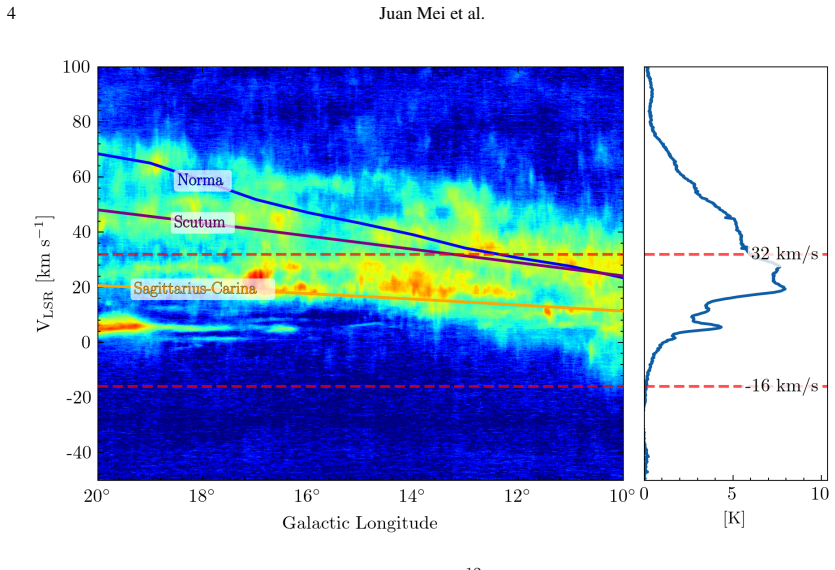
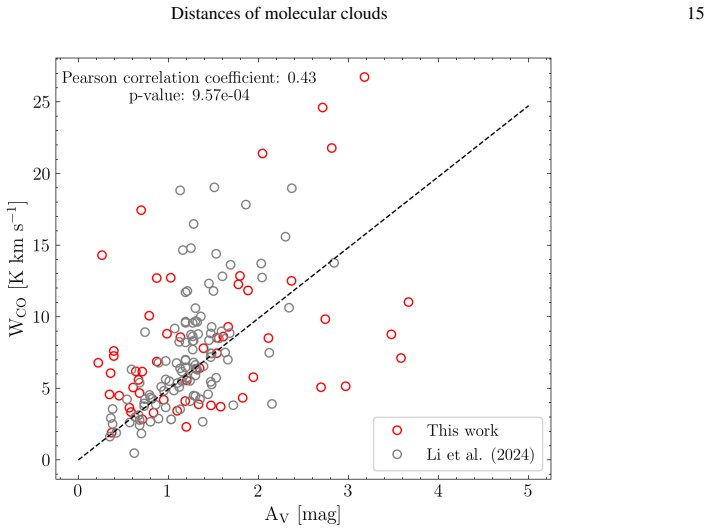
We present distances to 56 molecular clouds within 10° ≤ l ≤ 20° and |b| ≤ 5.25° from the Milky Way Imaging Scroll Painting (MWISP) 12CO survey, 47 of which are first-time determinations. The molecular clouds were identified using the DBSCAN algorithm, and their distances were measured with the model-calibrated color-distance method using J-Ks colors and the distances provided by 2MASS and Gaia EDR3. The distances range from ∼275 pc to ∼2118 pc. We also derived the physical properties of molecular clouds and found a moderate correlation between the dust extinction and the 12CO integrated intensity.
What carries the argument
The model-calibrated color-distance method, which links regions of high J-Ks color excess (from 2MASS) to Gaia EDR3 distances to assign a distance to each cloud identified by DBSCAN clustering of the 12CO emission.
If this is right
- The distances convert observed CO intensities and angular sizes into physical masses, radii, and densities for each cloud.
- The moderate correlation between dust extinction and 12CO intensity provides an empirical relation that can be applied to estimate properties in other survey fields.
- The catalog supplies three-dimensional positions that can be combined with velocity data to trace the spatial arrangement of molecular gas along this galactic line of sight.
- These measurements supply a reference set for comparing cloud properties across different galactic environments and for modeling the inner Milky Way disk.
Where Pith is reading between the lines
- The spread of distances implies clouds lying at different galactocentric radii, which could be used to test whether specific clouds align with predicted locations of spiral arms.
- Extending the same calibrated method to the remaining MWISP coverage would produce a uniform distance catalog covering a much larger fraction of the galactic plane.
- The physical properties derived here could be cross-checked against star-formation tracers to examine how distance uncertainties propagate into efficiency estimates.
Load-bearing premise
The color-distance method correctly ties the measured extinction features to the specific molecular clouds without major line-of-sight confusion or region-specific calibration offsets.
What would settle it
Independent distance measurements, such as Gaia parallaxes to young stellar objects or VLBI maser parallaxes embedded in the same clouds, that fall systematically outside the reported ranges for a substantial fraction of the 56 clouds would falsify the distance assignments.
Figures



read the original abstract
We present distances to 56 molecular clouds within $10\degr \leq l \leq 20\degr$ and $|b| \leq 5.25\degr$ from the Milky Way Imaging Scroll Painting (MWISP) $^{12}$CO survey, 47 of which are first-time determinations. The molecular clouds were identified using the DBSCAN algorithm, and their distances were measured with the model-calibrated color-distance method using $J-K{_s}$ colors and the distances provided by 2MASS and \textit{Gaia} EDR3. The distances range from $\sim$275 pc to $\sim$2118 pc. We also derived the physical properties of molecular clouds and found a moderate correlation between the dust extinction and the $^{12}$CO integrated intensity.
Editorial analysis
A structured set of objections, weighed in public.
Referee Report
Summary. The manuscript reports distances to 56 molecular clouds in the Galactic region 10° ≤ l ≤ 20° and |b| ≤ 5.25° identified via DBSCAN clustering on the MWISP 12CO 1-0 survey. Distances are obtained with a model-calibrated color-distance technique that uses J-Ks colors from 2MASS stars and Gaia EDR3 parallaxes, yielding values from ∼275 pc to ∼2118 pc (47 new). Physical properties are derived and a moderate correlation is reported between dust extinction and 12CO integrated intensity.
Significance. If the distance assignments prove robust, the work supplies a substantial addition to the catalog of molecular-cloud distances in the inner Galaxy, where such measurements help constrain spiral-arm structure and star-formation rates. Strengths include the objective DBSCAN identification and the use of external Gaia/2MASS data rather than kinematic assumptions. The reported correlation, while moderate, may offer a useful empirical link between gas and dust tracers once quantified more precisely.
major comments (1)
- [Distance determination section] The central distance claims rest on the color-distance method correctly assigning each DBSCAN cloud to a single distance via a J-Ks jump. In the l=10–20° strip, multiple CO components and diffuse extinction layers are common along the same sightline; the manuscript does not describe explicit tests (e.g., star-by-star background verification, comparison to kinematic distances or maser parallaxes, or checks against known clouds in the field) that would confirm the selected 2MASS/Gaia stars are uncontaminated by foreground or background layers. This issue is load-bearing for the headline result.
minor comments (2)
- [Abstract] The abstract states a 'moderate correlation' between dust extinction and 12CO integrated intensity but gives neither the numerical coefficient nor the precise quantities (e.g., A_V vs. W_CO). Adding the coefficient, its uncertainty, and a supporting figure would improve clarity.
- [Results] Individual cloud distances, uncertainties, and physical parameters are summarized in ranges; a table listing each cloud (with DBSCAN ID, distance, size, mass, etc.) would make the results more usable and allow readers to assess the correlation directly.
Simulated Author's Rebuttal
We thank the referee for the careful and constructive review. The major comment raises an important point about validating the distance assignments in a region with complex line-of-sight structure. We address it directly below and will incorporate the suggested improvements.
read point-by-point responses
-
Referee: [Distance determination section] The central distance claims rest on the color-distance method correctly assigning each DBSCAN cloud to a single distance via a J-Ks jump. In the l=10–20° strip, multiple CO components and diffuse extinction layers are common along the same sightline; the manuscript does not describe explicit tests (e.g., star-by-star background verification, comparison to kinematic distances or maser parallaxes, or checks against known clouds in the field) that would confirm the selected 2MASS/Gaia stars are uncontaminated by foreground or background layers. This issue is load-bearing for the headline result.
Authors: We agree that explicit validation is essential for the reliability of the distances in this inner-Galaxy field. The manuscript presents the model-calibrated J-Ks method and the resulting distances but does not include a dedicated validation subsection. In the revised version we will add such a subsection that (i) compares our distances to kinematic distances computed from the observed CO velocities using a standard Galactic rotation curve, (ii) cross-matches a subset of the clouds against previously published distances (including any available maser parallaxes or other independent determinations in the l=10–20° range), and (iii) describes the Gaia-based star-selection cuts used to reduce foreground contamination. These additions will be presented without changing the reported distance values or the overall conclusions. revision: yes
Circularity Check
No circularity: distances assigned via external Gaia/2MASS catalogs and pre-existing calibrated method
full rationale
The derivation chain consists of (1) DBSCAN clustering on the MWISP 12CO data to identify clouds and (2) application of an already-published model-calibrated color-distance technique that takes J-Ks photometry from 2MASS and parallax distances from Gaia EDR3 as direct inputs. Neither step fits parameters to the target clouds nor invokes a self-citation whose result is the distance assignment itself. The method is described as pre-calibrated on independent data, and the paper reports no re-derivation or tuning of the color-distance relation from the present sample. Consequently the reported distances are not equivalent to the input CO maps by construction.
Axiom & Free-Parameter Ledger
Reference graph
Works this paper leans on
-
[1]
Bailer-Jones, C. A. L., Rybizki, J., Fouesneau, M., Demleitner, M., & Andrae, R. 2021, AJ, 161, 147 3
2021
-
[2]
2013, ApJ, 768, 132 8, 9 16 Juan Mei et al
Bauermeister, A., Blitz, L., Bolatto, A., et al. 2013, ApJ, 768, 132 8, 9 16 Juan Mei et al
2013
-
[3]
Q., Huang, Y ., Hou, L
Chen, B. Q., Huang, Y ., Hou, L. G., et al. 2019, MNRAS, 487, 1400 2
2019
-
[4]
Q., Li, G
Chen, B. Q., Li, G. X., Yuan, H. B., et al. 2020, MNRAS, 493, 351 2, 11, 12
2020
-
[5]
2021, ApJ, 922, 90 4
Chen, Z., Sun, W., Chini, R., et al. 2021, ApJ, 922, 90 4
2021
-
[6]
M., Skrutskie, M
Cutri, R. M., Skrutskie, M. F., van Dyk, S., et al. 2003, VizieR Online Data Catalog, II/246 3
2003
-
[7]
M., Hartmann, D., & Thaddeus, P
Dame, T. M., Hartmann, D., & Thaddeus, P. 2001, ApJ, 547, 792 1
2001
-
[8]
1996, in Second International Conference on Knowledge Discovery and Data Mining (KDD’96)
Ester, M., Kriegel, H.-P., Sander, J., & Xu, X. 1996, in Second International Conference on Knowledge Discovery and Data Mining (KDD’96). Proceedings of a conference held August 2-4, 226 3 Gaia Collaboration, Brown, A. G. A., Vallenari, A., et al. 2021, A&A, 649, A1 3
1996
-
[9]
M., Schlafly, E., Zucker, C., Speagle, J
Green, G. M., Schlafly, E., Zucker, C., Speagle, J. S., & Finkbeiner, D. 2019, ApJ, 887, 93 2
2019
-
[10]
L., Chen, B
Guo, H. L., Chen, B. Q., & Liu, X. W. 2022, MNRAS, 511, 2302 2
2022
-
[11]
L., Chen, B
Guo, H. L., Chen, B. Q., Yuan, H. B., et al. 2021, ApJ, 906, 47 2
2021
-
[12]
Heyer, M., & Dame, T. M. 2015, ARA&A, 53, 583 1
2015
-
[13]
2012, A&A, 542, A114 4
Hill, T., Motte, F., Didelon, P., et al. 2012, A&A, 542, A114 4
2012
-
[14]
L., & Reffert, S
Hunt, E. L., & Reffert, S. 2023, A&A, 673, A114 6, 9, 11
2023
-
[15]
C., & Evans, N
Kennicutt, R. C., & Evans, N. J. 2012, ARA&A, 50, 531 1
2012
-
[16]
L., et al
Lallement, R., Babusiaux, C., Vergely, J. L., et al. 2019, A&A, 625, A135 2
2019
-
[17]
2024, AJ, 168, 223 14, 15
Li, R.-Z., Chen, B.-Q., Li, G.-X., et al. 2024, AJ, 168, 223 14, 15
2024
-
[18]
1985, ApJ, 295, 402 2
Magnani, L., Blitz, L., & Mundy, L. 1985, ApJ, 295, 402 2
1985
-
[19]
F., & Ostriker, E
McKee, C. F., & Ostriker, E. C. 2007, ARA&A, 45, 565 1
2007
-
[20]
2024, A&A, 685, A39 2, 3, 6, 7 Planck Collaboration, Aghanim, N., Akrami, Y ., et al
Mei, J., Chen, Z., Jiang, Z., Zheng, S., & Feng, H. 2024, A&A, 685, A39 2, 3, 6, 7 Planck Collaboration, Aghanim, N., Akrami, Y ., et al. 2020, A&A, 641, A1 2
2024
-
[21]
J., Menten, K
Reid, M. J., Menten, K. M., Brunthaler, A., et al. 2014, ApJ, 783, 130 8, 9, 12
2014
-
[22]
J., Menten, K
Reid, M. J., Menten, K. M., Brunthaler, A., et al. 2019, ApJ, 885, 131 3, 4, 8, 9, 11, 12, 14
2019
-
[23]
F., Cutri, R
Skrutskie, M. F., Cutri, R. M., Stiening, R., et al. 2006, AJ, 131, 1163 3
2006
-
[24]
W., & Mattox, J
Strong, A. W., & Mattox, J. R. 1996, A&A, 308, L21 15
1996
-
[25]
2019, ApJS, 240, 9 3
Su, Y ., Yang, J., Zhang, S., et al. 2019, ApJS, 240, 9 3
2019
-
[26]
2024, AJ, 168, 203 2
Sun, M., Jiang, B., Guo, H., & Cui, W. 2024, AJ, 168, 203 2
2024
-
[27]
L., Lallement, R., & Cox, N
Vergely, J. L., Lallement, R., & Cox, N. L. J. 2022, A&A, 664, A174 2, 13, 14
2022
-
[28]
2019, ApJ, 877, 116 13
Wang, S., & Chen, X. 2019, ApJ, 877, 116 13
2019
-
[29]
2024, ApJ, 975, 39 2
Xie, Y .-H., Li, G.-X., & Chen, B.-Q. 2024, ApJ, 975, 39 2
2024
-
[30]
J., Liu, D
Xu, Y ., Hao, C. J., Liu, D. J., et al. 2023, ApJ, 947, 54 14
2023
-
[31]
2018, Research in Astronomy and Astrophysics, 18, 146 1
Xu, Y ., Hou, L.-G., & Wu, Y .-W. 2018, Research in Astronomy and Astrophysics, 18, 146 1
2018
-
[32]
2020, ApJ, 898, 80 4
Yan, Q.-Z., Yang, J., Su, Y ., Sun, Y ., & Wang, C. 2020, ApJ, 898, 80 4
2020
-
[33]
2021, ApJ, 922, 8 2, 13, 14
Yan, Q.-Z., Yang, J., Su, Y ., et al. 2021, ApJ, 922, 8 2, 13, 14
2021
-
[34]
2019, ApJ, 885, 19 2 Distances of molecular clouds 17
Yan, Q.-Z., Yang, J., Sun, Y ., Su, Y ., & Xu, Y . 2019, ApJ, 885, 19 2 Distances of molecular clouds 17
2019
-
[35]
2025, arXiv e-prints, arXiv:2512.08260 3
Yang, J., Yan, Q.-Z., Su, Y ., et al. 2025, arXiv e-prints, arXiv:2512.08260 3
-
[36]
2022, Research in Astronomy and Astrophysics, 22, 035021 4
Yin, J., Chen, Z., Yao, Y ., et al. 2022, Research in Astronomy and Astrophysics, 22, 035021 4
2022
-
[37]
2023, arXiv e-prints, arXiv:2303.01053 11
Zhang, M. 2023, arXiv e-prints, arXiv:2303.01053 11
-
[38]
2024, AJ, 167, 220 5
Zhang, S., Su, Y ., Chen, X., et al. 2024, AJ, 167, 220 5
2024
-
[39]
S., Schlafly, E
Zucker, C., Speagle, J. S., Schlafly, E. F., et al. 2019, ApJ, 879, 125 2
2019
-
[40]
S., Schlafly, E
Zucker, C., Speagle, J. S., Schlafly, E. F., et al. 2020, A&A, 633, A51 2, 9, 11 18 Juan Mei et al. APPENDIX 5 THE COLOR-DISTANCE DIAGRAM FOR CLOUD-FREE AREAS Fig. 9: The center-left panel displays the eight selected cloud-free areas (red boxes) overlaid on the in- tegrated intensity map of 12CO emission. The remaining panels present theJ−K s color vs. di...
2020
discussion (0)
Sign in with ORCID, Apple, or X to comment. Anyone can read and Pith papers without signing in.